Reduction in Turnaround Times for STAT Exams in
- Slides: 21
Reduction in Turnaround Times for STAT Exams in Body Imaging Logan Boatman, MD, Eduardo Matta, MD, Kathy Masters, MS, RD
Overview § The Department of Diagnostic and Interventional Imaging at Memorial Hermann-TMC provides 24 hour coverage by staff and residents. § Overnight efforts are concentrated on Emergency Department patients, but preliminary reports may be posted on any exam as soon as it becomes available on PACS. § Transcribed reports, i. e. those that have been reviewed or dictated by the attending radiologists, may be available subsequently. § Similar to other institutions, the current standard for STAT radiology exams is the availability of a finalized report within four hours of the order.
Problem Statement § At the time of our project, turnaround times (TAT) significantly exceeded that standard. § Exam report TAT were also highly variable, which added to the perception of exam delays. § Extended wait times for exam results frustrate ordering physicians and prolong decisions regarding treatment plans. § Reasons for delay and variability in finalized report availability include variable coverage during the day, exam interpretation by resident and significant overutilization of the STAT priority (~4050% of exams), among others.
Goals § Decrease the “order to transcribed” TAT of body imaging STAT exams (CR, CT, US) to a median of 4 hrs. and significantly decrease process variation within six months. § Improve customer satisfaction • Primary customer: Ordering provider • Secondary customer: Patient § Use effort as model and expand scope from body imaging CR, CT and US TAT to TAT across the entire Department. § Institute of Medicine Aims: Timely and Efficient
Project Alignment § Institutional goal: providing better care for the community. • Operational Excellence o Provide extended coverage o Prioritize STAT exams • Customer Safety o Rapid report time improves patient care § Business goals • Decrease TAT to provide for more expedient, efficient and efficacious treatment, improving patient flow. • Decrease indiscriminate STAT orders to decrease overutilization and waste.
Team Members § Eduardo Matta, MD § Logan Boatman, MD § Bill Shepherd, MS § Kathy Masters, MS, RD – Six Sigma Black Belt § Staff and Residents in Body Imaging at Memorial Hermann-TMC
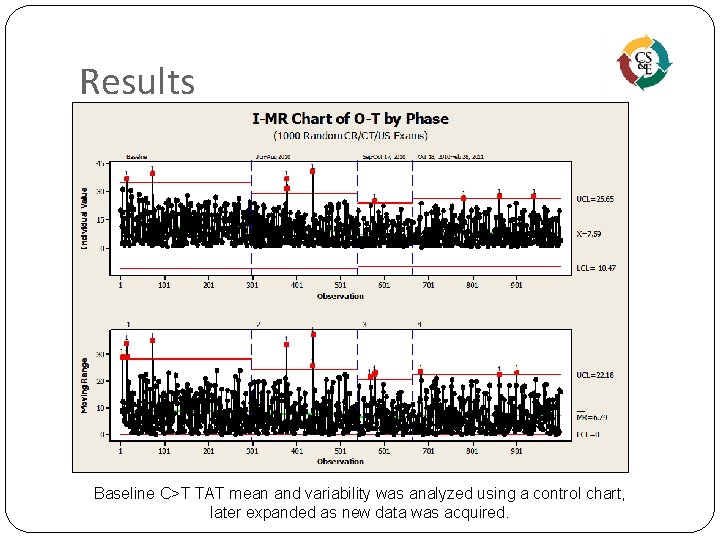
Measurements § Baseline data was acquired for the 3 -5/2010 period (Phase 1). § Mean, median, and standard deviation of our TAT were calculated. § Observations were plotted on control charts. § After implementation of two interventions (Phases 2 and 3), data was also acquired analyzed with similar metrics. § Statistical analyses were performed to demonstrate a statistically significant improvement. § Data was similarly acquired for a period after the withdrawal of one of the interventions (Phase 4).
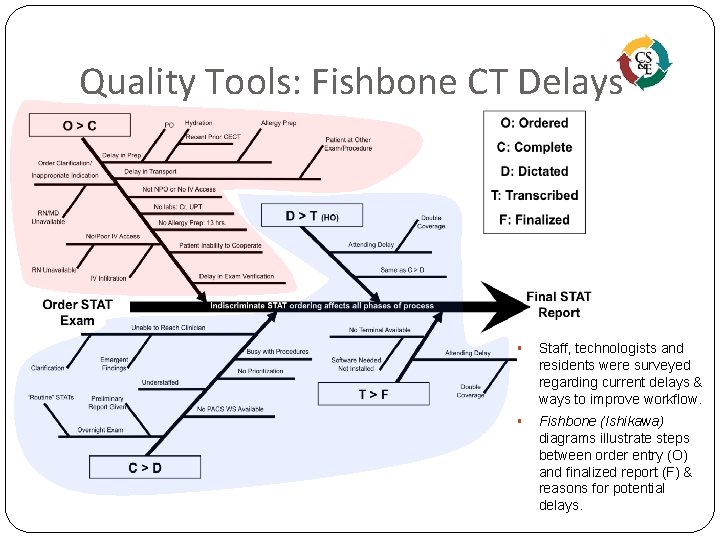
Quality Tools: Fishbone CT Delays § Staff, technologists and residents were surveyed regarding current delays & ways to improve workflow. § Fishbone (Ishikawa) diagrams illustrate steps between order entry (O) and finalized report (F) & reasons for potential delays.
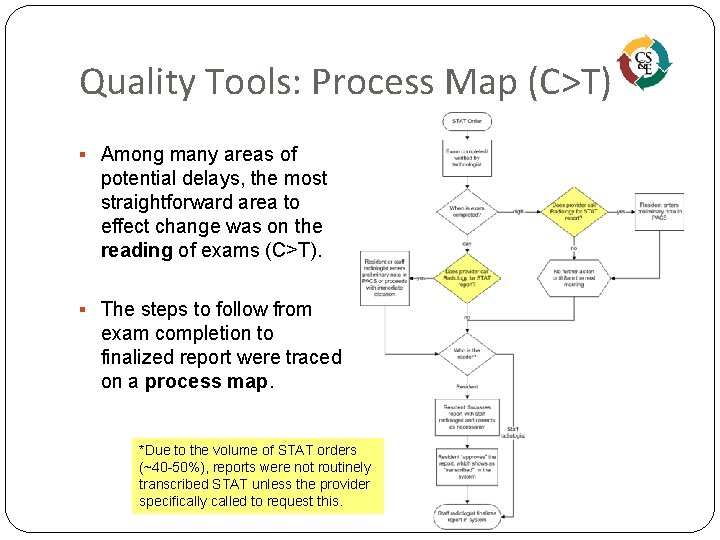
Quality Tools: Process Map (C>T) § Among many areas of potential delays, the most straightforward area to effect change was on the reading of exams (C>T). § The steps to follow from exam completion to finalized report were traced on a process map. *Due to the volume of STAT orders (~40 -50%), reports were not routinely transcribed STAT unless the provider specifically called to request this.
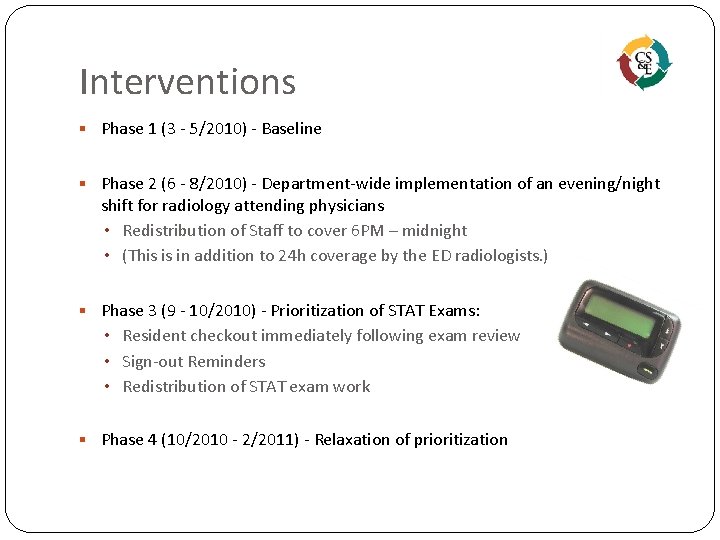
Interventions § Phase 1 (3 - 5/2010) - Baseline § Phase 2 (6 - 8/2010) - Department-wide implementation of an evening/night shift for radiology attending physicians • Redistribution of Staff to cover 6 PM – midnight • (This is in addition to 24 h coverage by the ED radiologists. ) § Phase 3 (9 - 10/2010) - Prioritization of STAT Exams: • Resident checkout immediately following exam review • Sign-out Reminders • Redistribution of STAT exam work § Phase 4 (10/2010 - 2/2011) - Relaxation of prioritization
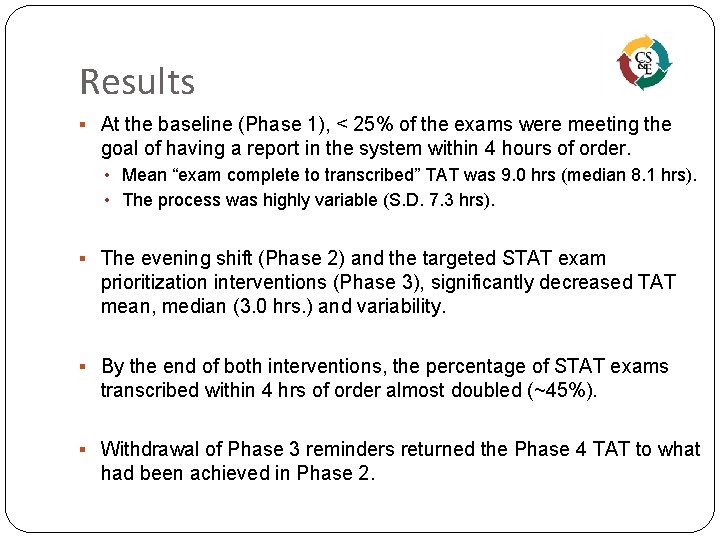
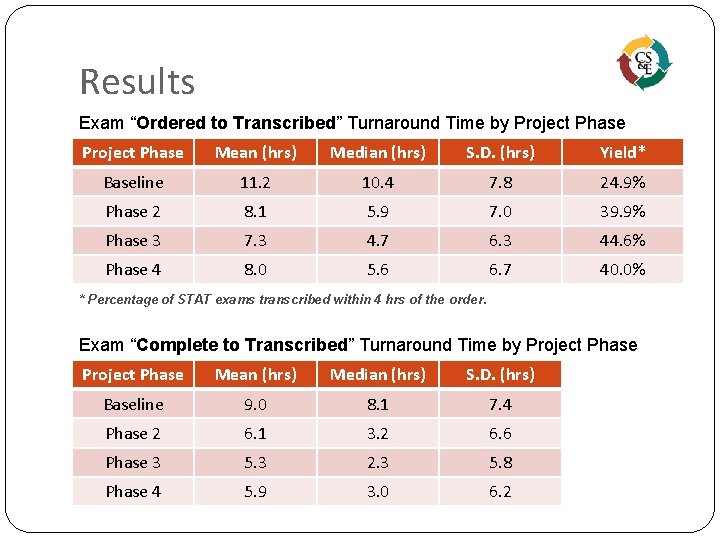
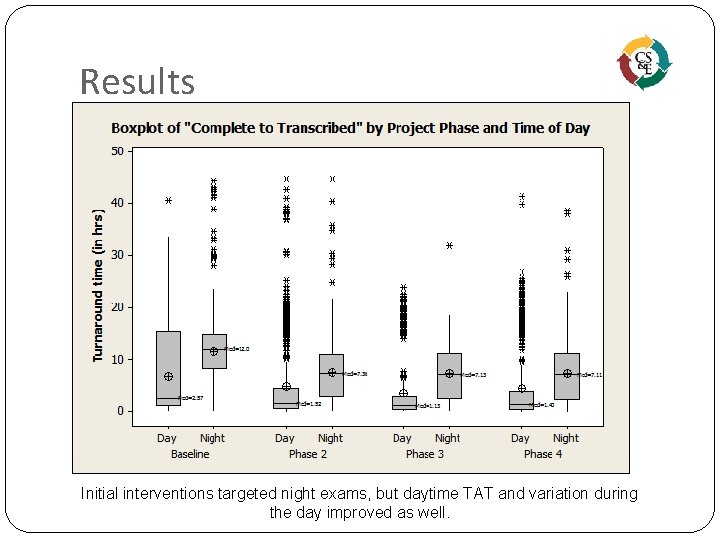
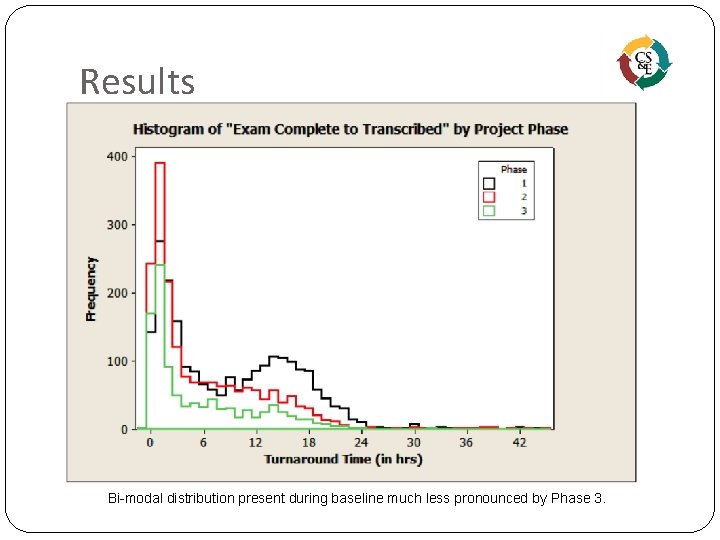
Results § At the baseline (Phase 1), < 25% of the exams were meeting the goal of having a report in the system within 4 hours of order. • Mean “exam complete to transcribed” TAT was 9. 0 hrs (median 8. 1 hrs). • The process was highly variable (S. D. 7. 3 hrs). § The evening shift (Phase 2) and the targeted STAT exam prioritization interventions (Phase 3), significantly decreased TAT mean, median (3. 0 hrs. ) and variability. § By the end of both interventions, the percentage of STAT exams transcribed within 4 hrs of order almost doubled (~45%). § Withdrawal of Phase 3 reminders returned the Phase 4 TAT to what had been achieved in Phase 2.
Results Baseline C>T TAT mean and variability was analyzed using a control chart, later expanded as new data was acquired.
Results Exam “Ordered to Transcribed” Turnaround Time by Project Phase Mean (hrs) Median (hrs) S. D. (hrs) Yield* Baseline 11. 2 10. 4 7. 8 24. 9% Phase 2 8. 1 5. 9 7. 0 39. 9% Phase 3 7. 3 4. 7 6. 3 44. 6% Phase 4 8. 0 5. 6 6. 7 40. 0% * Percentage of STAT exams transcribed within 4 hrs of the order. Exam “Complete to Transcribed” Turnaround Time by Project Phase Mean (hrs) Median (hrs) S. D. (hrs) Baseline 9. 0 8. 1 7. 4 Phase 2 6. 1 3. 2 6. 6 Phase 3 5. 3 2. 3 5. 8 Phase 4 5. 9 3. 0 6. 2
Results Initial interventions targeted night exams, but daytime TAT and variation during the day improved as well.
Results Bi-modal distribution present during baseline much less pronounced by Phase 3.
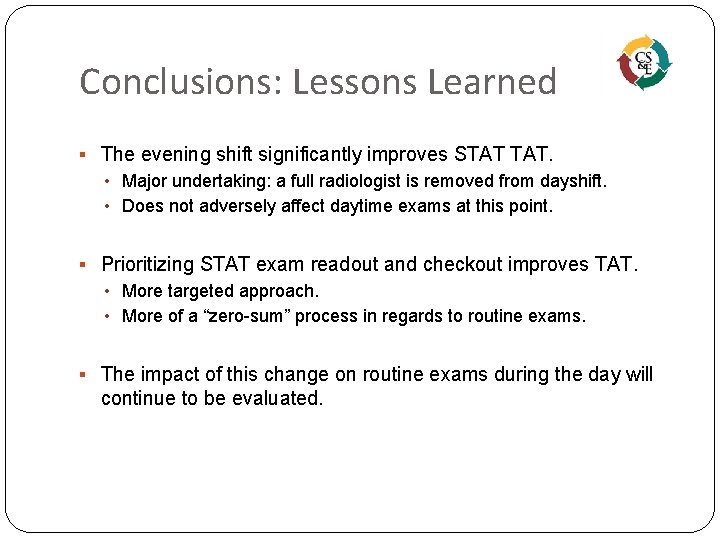
Conclusions: Lessons Learned § The evening shift significantly improves STAT TAT. • Major undertaking: a full radiologist is removed from dayshift. • Does not adversely affect daytime exams at this point. § Prioritizing STAT exam readout and checkout improves TAT. • More targeted approach. • More of a “zero-sum” process in regards to routine exams. § The impact of this change on routine exams during the day will continue to be evaluated.
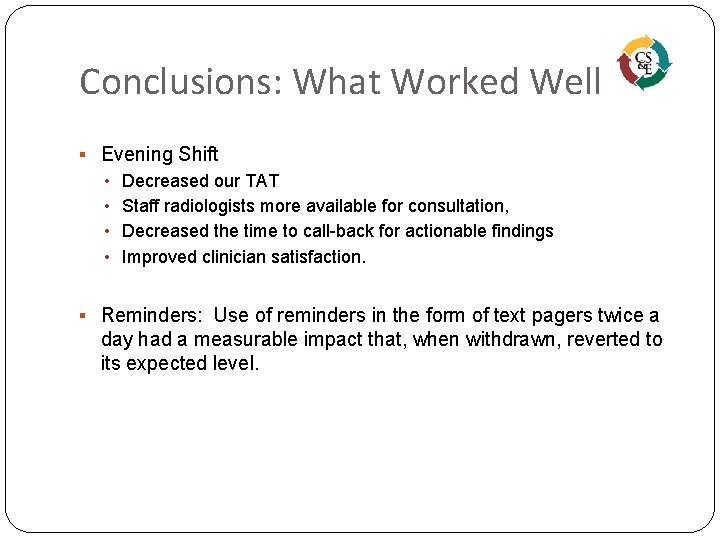
Conclusions: What Worked Well § Evening Shift • Decreased our TAT • Staff radiologists more available for consultation, • Decreased the time to call-back for actionable findings • Improved clinician satisfaction. § Reminders: Use of reminders in the form of text pagers twice a day had a measurable impact that, when withdrawn, reverted to its expected level.
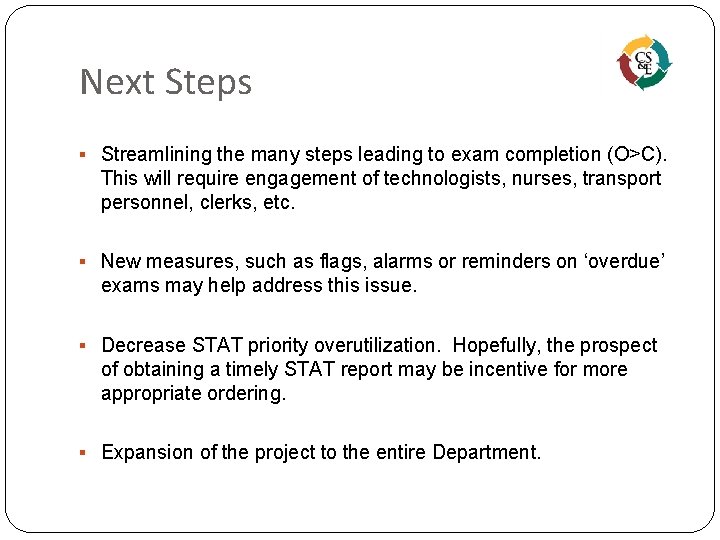
Next Steps § Streamlining the many steps leading to exam completion (O>C). This will require engagement of technologists, nurses, transport personnel, clerks, etc. § New measures, such as flags, alarms or reminders on ‘overdue’ exams may help address this issue. § Decrease STAT priority overutilization. Hopefully, the prospect of obtaining a timely STAT report may be incentive for more appropriate ordering. § Expansion of the project to the entire Department.
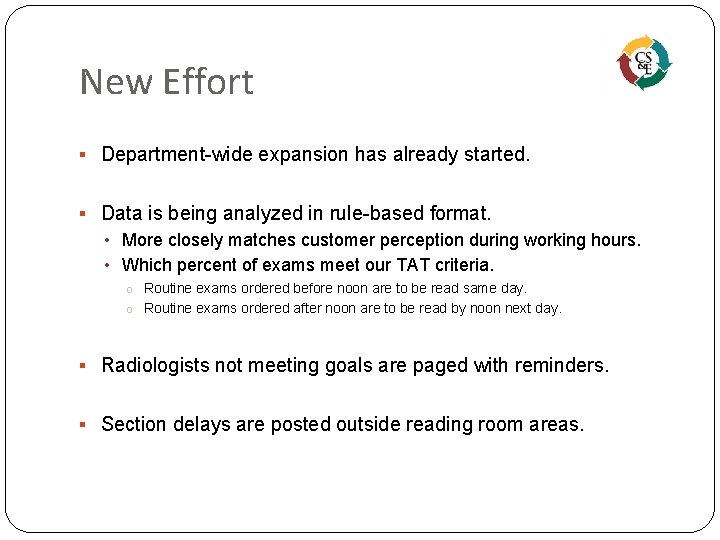
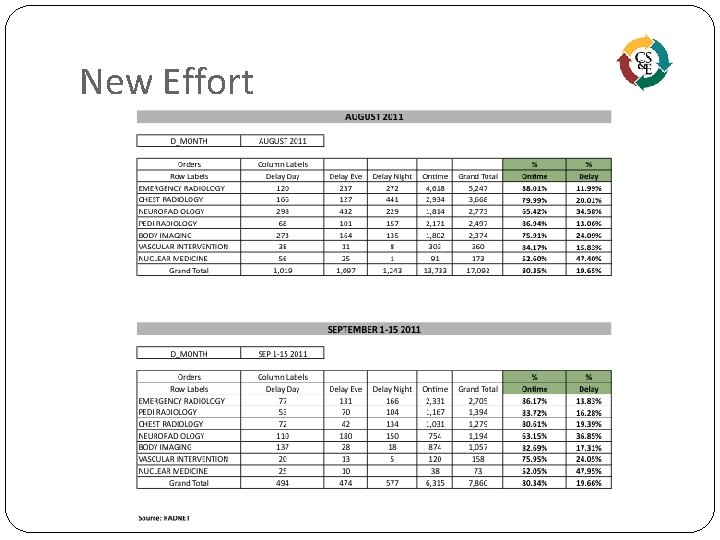
New Effort § Department-wide expansion has already started. § Data is being analyzed in rule-based format. • More closely matches customer perception during working hours. • Which percent of exams meet our TAT criteria. o Routine exams ordered before noon are to be read same day. o Routine exams ordered after noon are to be read by noon next day. § Radiologists not meeting goals are paged with reminders. § Section delays are posted outside reading room areas.
New Effort
Thank you.