Radiosonde Transmitter Standardization in Europe Ilkka Ikonen Vaisala






- Slides: 13
Radiosonde Transmitter Standardization in Europe Ilkka Ikonen Vaisala Oyj Geneva 2006 -03 -20 – WMO Workshop on Frequencies
Legal issues • Directive 1999/5/EC of the European Parliament and of the Council of 9 March 1999 on Radio Equipment and Telecommunications Terminal Equipment and the mutual recognition of their conformity (R&TTE Directive) • Apparatus put into service in the Member States (of EU) shall be submitted into the conformity assessment (of the essential requirements in the Article 3) • Manufacturer has the responsibility to show that apparatus comply with this directive and are properly marked • One method to show the conformity is harmonized standards.
Article 3, Essential requirements R&TTE Directive 1999/5, of the Article 3, point 2 reads: 2. In addition, radio equipment shall be so constructed that it effectively uses the spectrum allocated to terrestrial/space radio communications and orbital resources so to avoid harmful interference This is in accordance with ITU and WMO incentives to improve spectral usage of radiosondes.
Practical Issues • One method to show the conformity with the RTT&E directive is a harmonized standard. • Apparatus meeting the appropriate standards shall bear CE marking. • Only CE marked apparatus are legal in EU. • ETSI gives a public forum to perform the standardization task in Europe – to create an EN (European Norm).
ETSI (European Telecommunications Standard Institute) • ETSI is officially responsible for standardization of Information and Communication Technologies (ICT) in Europe. • ETSI is officially recognized by the European Commission and the EFTA secretariat. • ETSI ensures that harmonised standards are drafted in a way, which allows unambiguous interpretation and can be appropriately updated when needed.
Why one needs specific radiosonde transmitter standard ? • To comply with the R&TTE Directive 1999/5, and to show the conformity of the Article 3 • To avoid the application of the SRD standard EN 300 220 SRD on radiosondes: – SRD standard does not fit to radiosondes – There have been continuos changes to the EN 300 220 • To take into account the radiosonde special features: – High dynamic range in the reception power, – Wide temperature range, – Radiosonde is a disposable product.
Standardization process • All interested parties are welcome to participate task groups (ERM – TG xx) within ETSI to prepare standards (ERM = Electromagnetic compatibility and Radio spectrum Matters) – TG 25 for 1680 MHz – TG 28 for 400 MHz • TGs report to ERM that accept the work done, and sends it to the public inquiry and voting. • After the ETSI process, standards will be issued to the community in the EU official publication (harmonized). • Accredited notified body issues CE marking.
Standardization process - history Standardization of the 400 MHz transmitter – ETSI working group ERM-TG 28 – SRD devices – Work started early 2000 – Accepted by ERM early 2003 – Standard is EN 302 054 Standardization of the 1680 MHz transmitter – ETSI working group ERM-TG 25 - Aviation – Work started early 2004 – Accepted to public inquiry – 2006 -02 -22 – Standard is EN 302 454 – estimated to be harmonized by late 2006
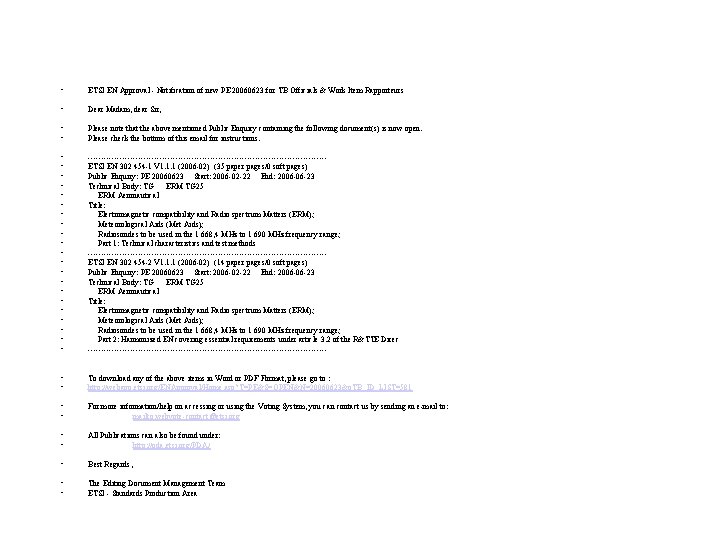
• ETSI EN Approval - Notification of new PE 20060623 for TB Officials & Work Item Rapporteurs • Dear Madam, dear Sir, • • Please note that the above mentioned Public Enquiry containing the following document(s) is now open. Please check the bottom of this email for instructions. • • • • • • ---------------------------------------------ETSI EN 302 454 -1 V 1. 1. 1 (2006 -02) (35 paper pages/0 soft pages) Public Enquiry: PE 20060623 Start: 2006 -02 -22 End: 2006 -06 -23 Technical Body: TG ERM TG 25 ERM Aeronautical Title: Electromagnetic compatibility and Radio spectrum Matters (ERM); Meteorological Aids (Met Aids); Radiosondes to be used in the 1 668, 4 MHz to 1 690 MHz frequency range; Part 1: Technical characteristics and test methods ---------------------------------------------ETSI EN 302 454 -2 V 1. 1. 1 (2006 -02) (14 paper pages/0 soft pages) Public Enquiry: PE 20060623 Start: 2006 -02 -22 End: 2006 -06 -23 Technical Body: TG ERM TG 25 ERM Aeronautical Title: Electromagnetic compatibility and Radio spectrum Matters (ERM); Meteorological Aids (Met Aids); Radiosondes to be used in the 1 668, 4 MHz to 1 690 MHz frequency range; Part 2: Harmonized EN covering essential requirements under article 3. 2 of the R&TTE Direc --------------------------------------------- • • To download any of the above items in Word or PDF Format, please go to : http: //webapp. etsi. org/ENApproval/Home. asp? T=PE&S=OPEN&N=20060623&p. TB_ID_LIST=581 • • For more information/help on accessing or using the Voting System, you can contact us by sending an e-mail to: mailto: webvote-contact@etsi. org • • All Publications can also be found under: http: //pda. etsi. org/PDA/ • Best Regards, • • The Editing Document Management Team ETSI - Standards Production Area
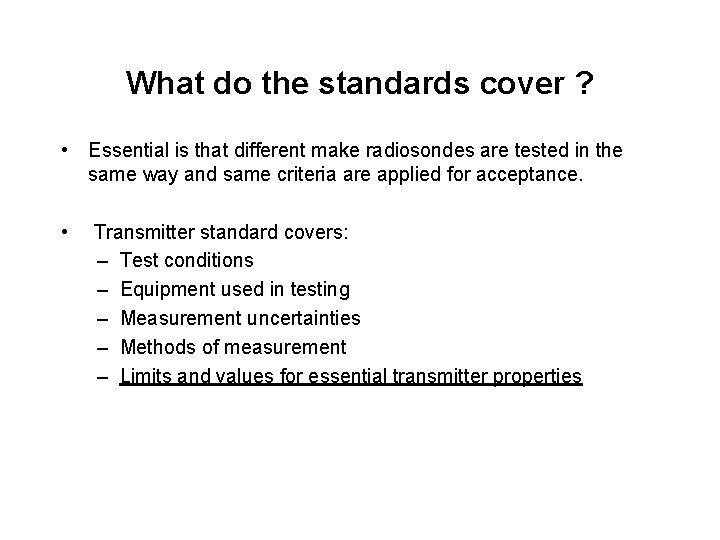
What do the standards cover ? • Essential is that different make radiosondes are tested in the same way and same criteria are applied for acceptance. • Transmitter standard covers: – Test conditions – Equipment used in testing – Measurement uncertainties – Methods of measurement – Limits and values for essential transmitter properties
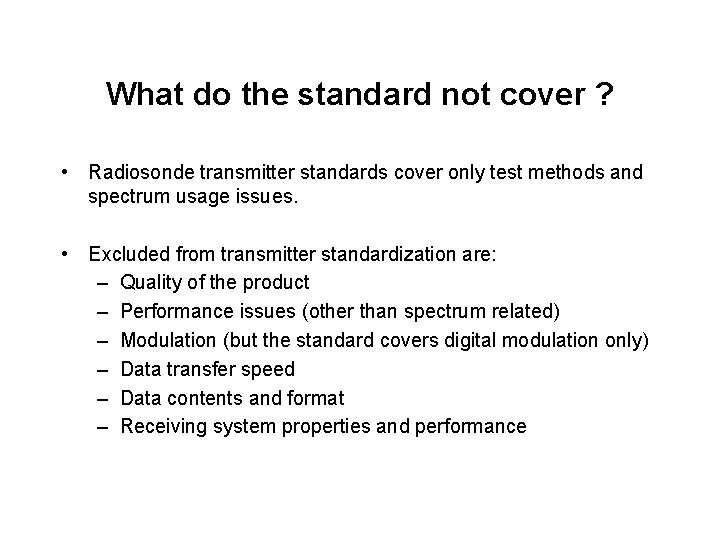
What do the standard not cover ? • Radiosonde transmitter standards cover only test methods and spectrum usage issues. • Excluded from transmitter standardization are: – Quality of the product – Performance issues (other than spectrum related) – Modulation (but the standard covers digital modulation only) – Data transfer speed – Data contents and format – Receiving system properties and performance
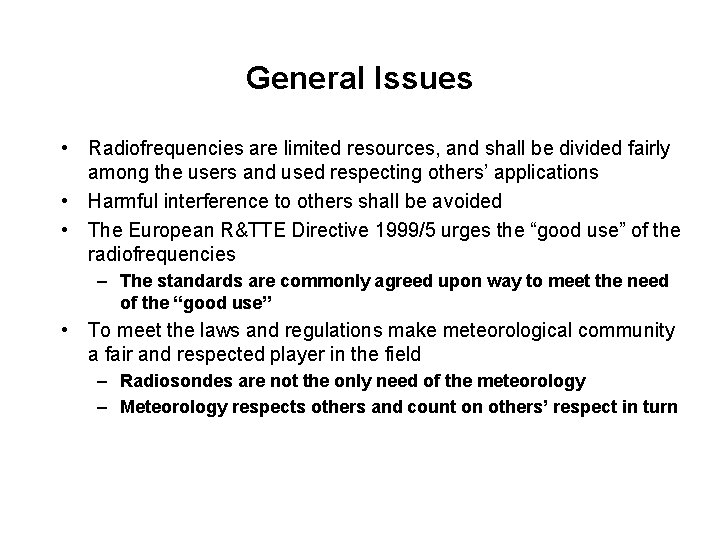
General Issues • Radiofrequencies are limited resources, and shall be divided fairly among the users and used respecting others’ applications • Harmful interference to others shall be avoided • The European R&TTE Directive 1999/5 urges the “good use” of the radiofrequencies – The standards are commonly agreed upon way to meet the need of the “good use” • To meet the laws and regulations make meteorological community a fair and respected player in the field – Radiosondes are not the only need of the meteorology – Meteorology respects others and count on others’ respect in turn
THANK YOU FOR YOUR ATTENTION