Quality Management 1 Ian Sommerville 2004 Software Engineering
- Slides: 24
Quality Management 1 ©Ian Sommerville 2004 Software Engineering, 7 th edition. Chapter 27 Slide 1
Objectives l l To introduce the quality management process and key quality management activities To explain the role of standards in quality management To explain the concept of a software metric, predictor metrics and control metrics To explain how measurement may be used in assessing software quality and the limitations of software measurement ©Ian Sommerville 2004 Software Engineering, 7 th edition. Chapter 27 Slide 2
Software quality management l l l Concerned with ensuring that the required level of quality is achieved in a software product. Involves defining appropriate quality standards and procedures and ensuring that these are followed. Should aim to develop a ‘quality culture’ where quality is seen as everyone’s responsibility. ©Ian Sommerville 2004 Software Engineering, 7 th edition. Chapter 27 Slide 3
What is quality? l l Quality, simplistically, means that a product should meet its specification. This is problematical for software systems • • • There is a tension between customer quality requirements (efficiency, reliability, etc. ) and developer quality requirements (maintainability, reusability, etc. ); Some quality requirements are difficult to specify in an unambiguous way; Software specifications are usually incomplete and often inconsistent. ©Ian Sommerville 2004 Software Engineering, 7 th edition. Chapter 27 Slide 4
Scope of quality management l l Quality management is particularly important for critical systems. The quality documentation is a record of progress and supports continuity of development as the development team changes. Quality management records may be used as evidence that a system is likely to meet dependability requirements set by a regulator. ©Ian Sommerville 2004 Software Engineering, 7 th edition. Chapter 27 Slide 5
Quality management activities l Quality assurance • l Quality planning • l Select applicable procedures and standards for a particular project and modify these as required. Quality control • l Establish organisational procedures and standards for quality. Ensure that procedures and standards are followed by the software development team. Quality management should be separate from project management to ensure independence. ©Ian Sommerville 2004 Software Engineering, 7 th edition. Chapter 27 Slide 6
Quality management and software development ©Ian Sommerville 2004 Software Engineering, 7 th edition. Chapter 27 Slide 7
Process and product quality l l l The quality of a developed product is influenced by the quality of the production process. This is important in software development as some product quality attributes are hard to assess. However, there is a very complex and poorly understood relationship between software processes and product quality. ©Ian Sommerville 2004 Software Engineering, 7 th edition. Chapter 27 Slide 8
Process-based quality l l There is a straightforward link between process and product in manufactured goods. More complex for software because: • • l The application of individual skills and experience is particularly imporant in software development; External factors such as the novelty of an application or the need for an accelerated development schedule may impair product quality. Care must be taken not to impose inappropriate process standards - these could reduce rather than improve the product quality. ©Ian Sommerville 2004 Software Engineering, 7 th edition. Chapter 27 Slide 9
Process-based quality ©Ian Sommerville 2004 Software Engineering, 7 th edition. Chapter 27 Slide 10
Practical process quality l l Define process standards such as how reviews should be conducted, configuration management, etc. Monitor the development process to ensure that standards are being followed. Report on the process to project management and software procurer. Don’t use inappropriate practices simply because standards have been established. ©Ian Sommerville 2004 Software Engineering, 7 th edition. Chapter 27 Slide 11
Quality assurance and standards l l Standards are the key to effective quality management. They may be international, organizational or project standards. Product standards define characteristics that all components should exhibit e. g. a common programming style. Process standards define how the software process should be enacted. ©Ian Sommerville 2004 Software Engineering, 7 th edition. Chapter 27 Slide 12
Importance of standards l l Encapsulation of best practice- avoids repetition of past mistakes. They are a framework for quality assurance processes - they involve checking compliance to standards. They provide continuity - new staff can understand the organisation by understanding the standards that are used. Standards may be mandated for critical systems development ©Ian Sommerville 2004 Software Engineering, 7 th edition. Chapter 27 Slide 13
Product and process standards ©Ian Sommerville 2004 Software Engineering, 7 th edition. Chapter 27 Slide 14
Standards development l l l Involve practitioners in development. Engineers should understand the rationale underlying a standard. Review standards and their usage regularly. Standards can quickly become outdated and this reduces their credibility amongst practitioners. Detailed standards should have associated tool support. Excessive clerical work is the most significant complaint against standards. ©Ian Sommerville 2004 Software Engineering, 7 th edition. Chapter 27 Slide 15
ISO 9000 l l An international set of standards for quality management. Applicable to a range of organisations from manufacturing to service industries. ISO 9001 applicable to organisations which design, develop and maintain products. ISO 9001 is a generic model of the quality process that must be instantiated for each organisation using the standard. ©Ian Sommerville 2004 Software Engineering, 7 th edition. Chapter 27 Slide 16
ISO 9001 ©Ian Sommerville 2004 Software Engineering, 7 th edition. Chapter 27 Slide 17
ISO 9000 certification l l l Quality standards and procedures should be documented in an organisational quality manual. An external body may certify that an organisation’s quality manual conforms to ISO 9000 standards. Some customers require suppliers to be ISO 9000 certified although the need for flexibility here is increasingly recognised. ©Ian Sommerville 2004 Software Engineering, 7 th edition. Chapter 27 Slide 18
ISO 9000 and quality management ©Ian Sommerville 2004 Software Engineering, 7 th edition. Chapter 27 Slide 19
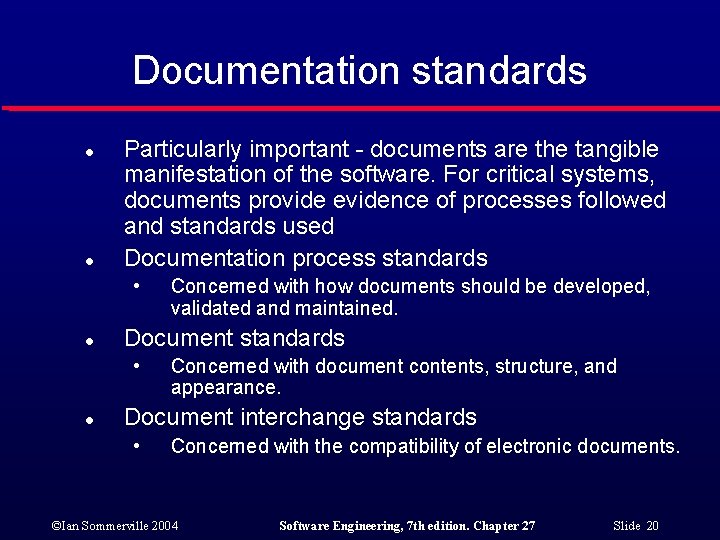
Documentation standards l l Particularly important - documents are the tangible manifestation of the software. For critical systems, documents provide evidence of processes followed and standards used Documentation process standards • l Document standards • l Concerned with how documents should be developed, validated and maintained. Concerned with document contents, structure, and appearance. Document interchange standards • Concerned with the compatibility of electronic documents. ©Ian Sommerville 2004 Software Engineering, 7 th edition. Chapter 27 Slide 20
Documentation process ©Ian Sommerville 2004 Software Engineering, 7 th edition. Chapter 27 Slide 21
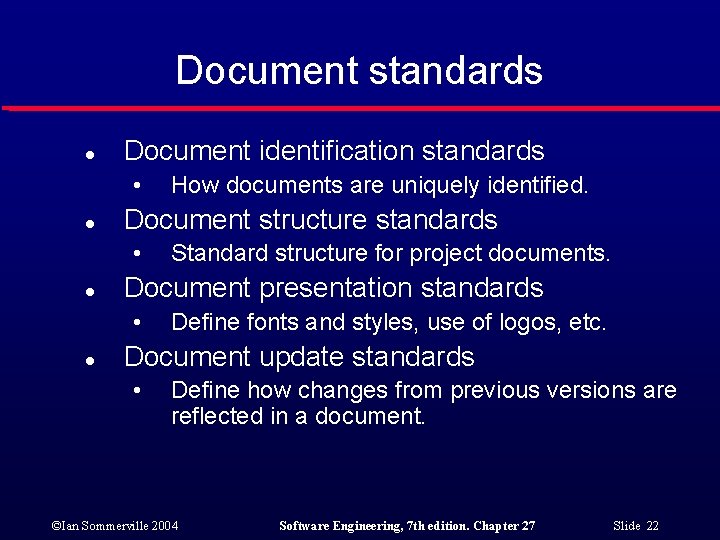
Document standards l Document identification standards • l Document structure standards • l Standard structure for project documents. Document presentation standards • l How documents are uniquely identified. Define fonts and styles, use of logos, etc. Document update standards • Define how changes from previous versions are reflected in a document. ©Ian Sommerville 2004 Software Engineering, 7 th edition. Chapter 27 Slide 22
Document interchange standards l l l Interchange standards allow electronic documents to be exchanged, mailed, etc. Documents are produced using different systems and on different computers. Even when standard tools are used, standards are needed to define conventions for their use e. g. use of style sheets and macros. Need for archiving. The lifetime of word processing systems may be much less than the lifetime of the software being documented. An archiving standard may be defined to ensure that the document can be accessed in future. ©Ian Sommerville 2004 Software Engineering, 7 th edition. Chapter 27 Slide 23
Key points l l l Software quality management is concerned with ensuring that software meets its required standards. Quality assurance procedures should be documented in an organisational quality manual. Software standards are an encapsulation of best practice. ©Ian Sommerville 2004 Software Engineering, 7 th edition. Chapter 27 Slide 24