QEP Secondary Math Options Explained sort of Franca
- Slides: 15
QEP Secondary Math Options Explained… sort of Franca Redivo Secondary Math Consultant Lester B Pearson School Board February 2010
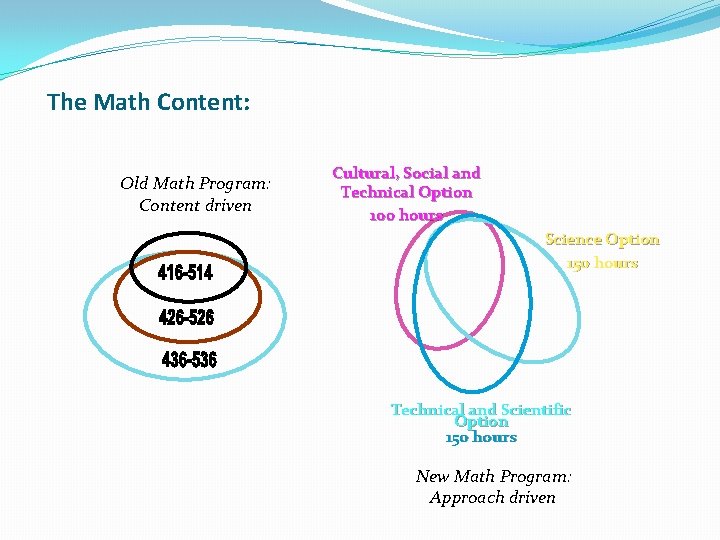
The Math Content: Old Math Program: Content driven Cultural, Social and Technical Option 100 hours Science Option 150 hours Technical and Scientific Option 150 hours New Math Program: Approach driven
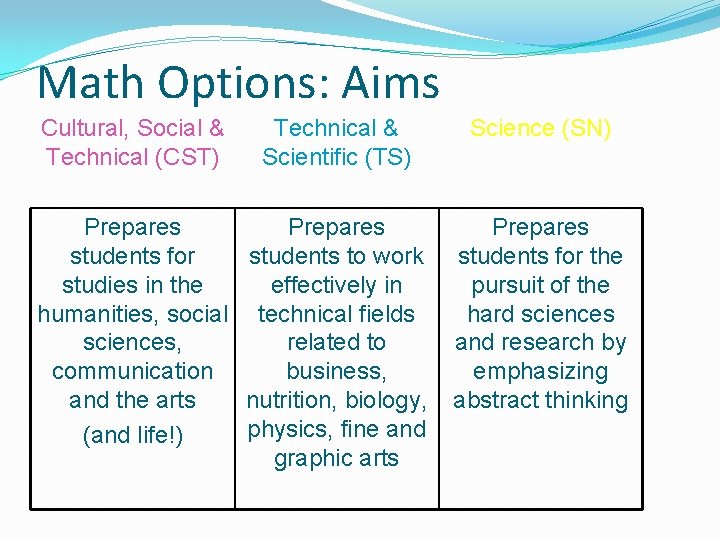
Math Options: Aims Cultural, Social & Technical (CST) Technical & Scientific (TS) Prepares students for students to work studies in the effectively in humanities, social technical fields sciences, related to communication business, and the arts nutrition, biology, physics, fine and (and life!) graphic arts Science (SN) Prepares students for the pursuit of the hard sciences and research by emphasizing abstract thinking
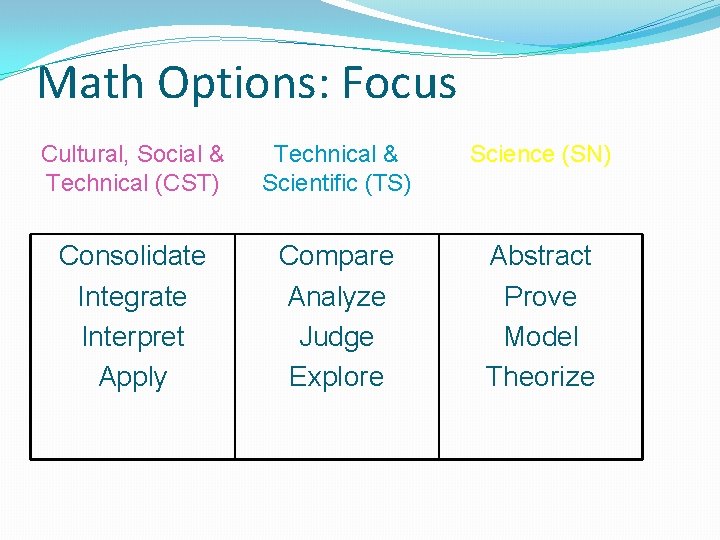
Math Options: Focus Cultural, Social & Technical (CST) Technical & Scientific (TS) Science (SN) Consolidate Integrate Interpret Apply Compare Analyze Judge Explore Abstract Prove Model Theorize
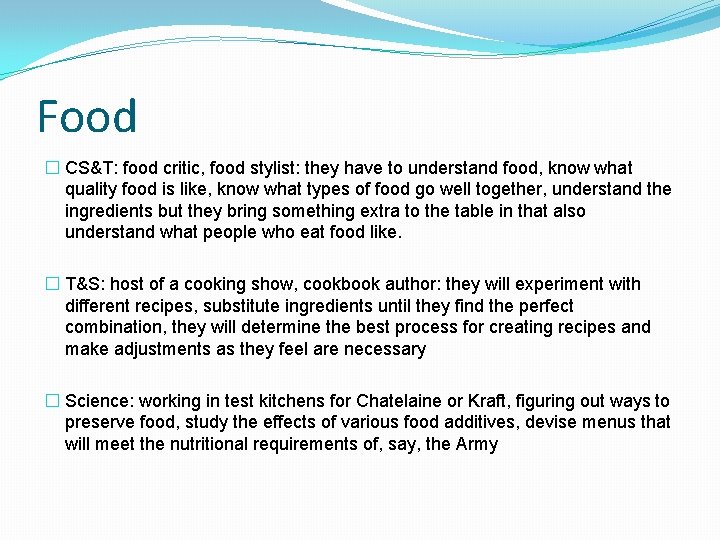
Food � CS&T: food critic, food stylist: they have to understand food, know what quality food is like, know what types of food go well together, understand the ingredients but they bring something extra to the table in that also understand what people who eat food like. � T&S: host of a cooking show, cookbook author: they will experiment with different recipes, substitute ingredients until they find the perfect combination, they will determine the best process for creating recipes and make adjustments as they feel are necessary � Science: working in test kitchens for Chatelaine or Kraft, figuring out ways to preserve food, study the effects of various food additives, devise menus that will meet the nutritional requirements of, say, the Army
Art � CS&T: Art historian, gallery owner – they understand art, they can tell the difference between good and bad art, they have developed an “eye” for quality and perhaps an understanding of what potential clients want and can find art that pleases them � T&S: The artist – they practice, develop techniques and alter them as they see the effects of what they try, they try different materials, they look around for inspiration and try new things – maybe it works for them, maybe not � Science: “supplier of materials” – they develop the paints used by artists, they come up with ways to improve the longevity of the paint (and other materials), they develop ways to make artists’ materials more environmentally friendly, they come up with new ways to authenticate old works of art or detect forgeries, they could come up with regression analysis to try to predict the value of certain works of art.
Business �CS&T: gather and analyze data, be able to read reports and get a story from them, understand the implications of these stories and act on suggestions �T&S: create a business plan, design new reports in order to get new information, figure out what information would be needed in order to improve services, sales, environmental impact, see trends and patterns �Science: determine which data to analyze and how (datamining), operations research (optimization), creating mathematical models for the purpose of projecting (predicting)
That being said, and practically speaking, ØThe students who don’t really like math and don’t think they are good at it, should be encouraged to go into CS&T – because that course has less math in it. ØThe students who love math, do their homework, love the intellectual challenge of it, would enter math contests if they were offered – these are the students who would enjoy the Science math. ØTS math is for the very capable math student who sees math as a tool and wants to know how it works and how to use it. Please remember that TS and Science math open all the same doors at CEGEP
TS vs SN �Given that TS and Science math are treated the same at CEGEP, why are they both offered. �The authors of the QEP knew that people learn differently but can learn the same things so the two courses were designed to approach similar content in different ways. �The following 4 slides will try to illustrate a bit the difference. I hope you will agree that the models are both quite capable in their own ways…
Students: Technical & Scientific Students who choose T&S like using their �Manual skills �Building and using instruments �Constructing models �Intellectual skills �Determining how instruments work �Suggesting changes and improvements �Designing tools, instruments, buildings, etc. �Analyzing economic and financial scenarios
Thomas Edison �Inventions �Cylinder Phonograph �Disc Phonograph �Electricity & the lightbulb �Kinetophone �Kinetoscope �Film Projectors �Motion Pictures � 1, 093 Patents I have not failed. I've just found 10, 000 ways that won't work. Thomas A. Edison
Students: Science Students who choose SN �Want to understand phenomena: �Their origins �How they work �Make decisions about them �Focus on �Finding and developing models within the context of experiments �Formal proofs to confirm truths �Properties of math objects in the abstract
Albert Einstein � theories of special relativity and general relativity � contributions to statistical mechanics - Brownian motion � resolution of the paradox of specific heats � connection of fluctuations and dissipation. � contributions to quantum mechanics and quantum field theory � theoretical studies of the photon The whole of science is nothing more than a refinement of everyday thinking. Albert Einstein
Challenges �Narrowing the gap between where we are and where we want to be �Adapting current resources to activity based learning �Changing the current thinking on how to evaluate �Changing the current thinking on what to evaluate. �Still ensuring the concepts & processes are learned without emphasizing them in evaluation �Not overwhelming the teachers! �Helping parents to understand what is going on with their child’s math education.
Thank you… … for taking the time to go through this presentation.