Psychological therapies for schizophrenia Pages 209 210 of



- Slides: 21
Psychological therapies for schizophrenia Pages 209 -210 of PHG book CBT; Family Therapy and Token Economy Have you used the digital text book?
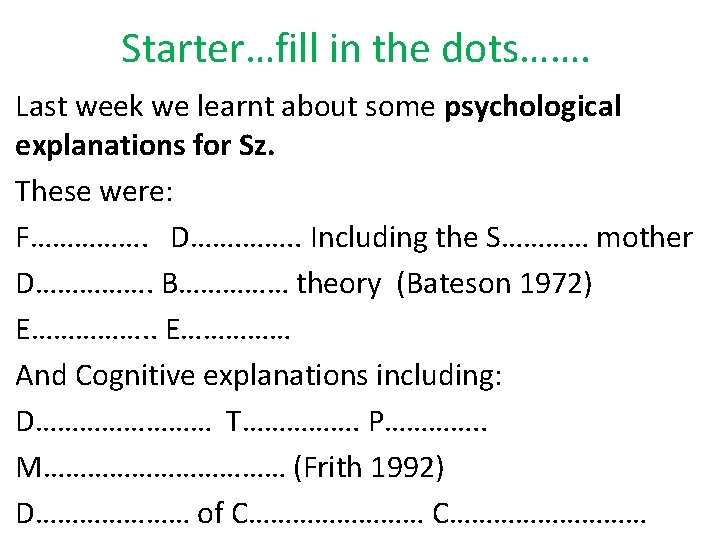
Starter…fill in the dots……. Last week we learnt about some psychological explanations for Sz. These were: F……………. D……. . Including the S………… mother D……………. B…………… theory (Bateson 1972) E……………. . E…………… And Cognitive explanations including: D………… T……………. P…………. . M……………… (Frith 1992) D………………… of C………………………
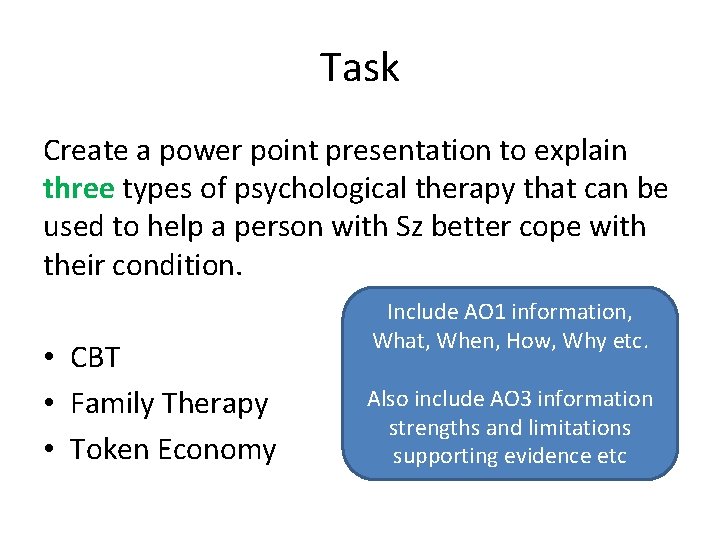
Task Create a power point presentation to explain three types of psychological therapy that can be used to help a person with Sz better cope with their condition. • CBT • Family Therapy • Token Economy Include AO 1 information, What, When, How, Why etc. Also include AO 3 information strengths and limitations supporting evidence etc
Psychological Therapies for Schizophrenia Describe and evaluate CBT as used to treat schizophrenia. Starter: Brainstorm what you already know about cognitive behavioural therapy Write down your ideas ready to feedback.
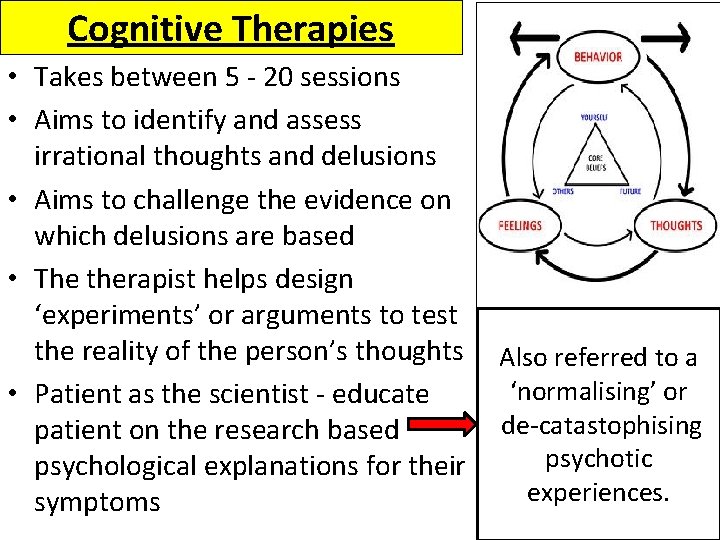
Cognitive Therapies • Takes between 5 - 20 sessions • Aims to identify and assess irrational thoughts and delusions • Aims to challenge the evidence on which delusions are based • The therapist helps design ‘experiments’ or arguments to test the reality of the person’s thoughts • Patient as the scientist - educate patient on the research based psychological explanations for their symptoms Also referred to a ‘normalising’ or de-catastophising psychotic experiences.
1. Coping Strategy Enhancement A form of CBT for Schizophrenia Tarrier (1990) devised a specific form of CBT for schizophrenia known as Coping Strategy Enhancement which builds on the schizophrenics’ existing coping strategies. Tarrier noted that patients were able to identify triggers for schizophrenic episodes and had most has already devised their own coping strategies. Examples of triggers would be things like: • Certain people (e. g. a parent) • Being on their own • Being put under stress
There are two types of coping strategies that are developed in therapy: • Cognitive strategies such as distraction, like concentrating on a specific task; positive self talk • Behavioural strategies such as relaxation techniques (e. g. breathing exercises), social withdrawal/ increasing social contact; loud music to drown out voices, behavioural experiments
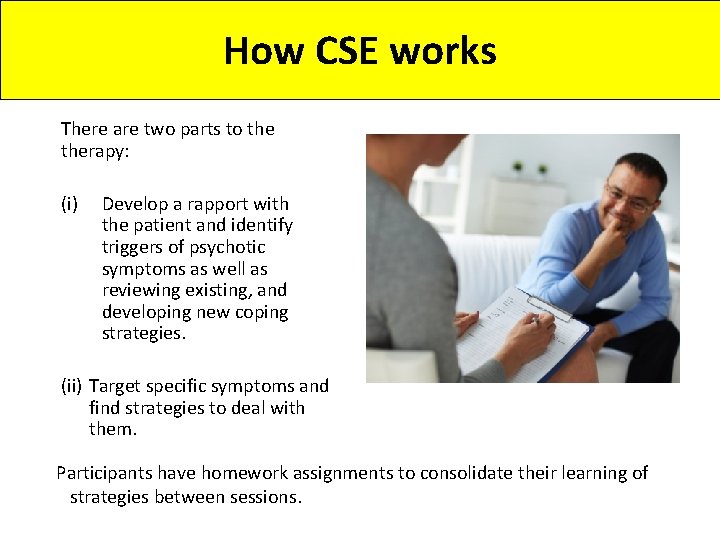
How CSE works There are two parts to therapy: (i) Develop a rapport with the patient and identify triggers of psychotic symptoms as well as reviewing existing, and developing new coping strategies. (ii) Target specific symptoms and find strategies to deal with them. Participants have homework assignments to consolidate their learning of strategies between sessions.
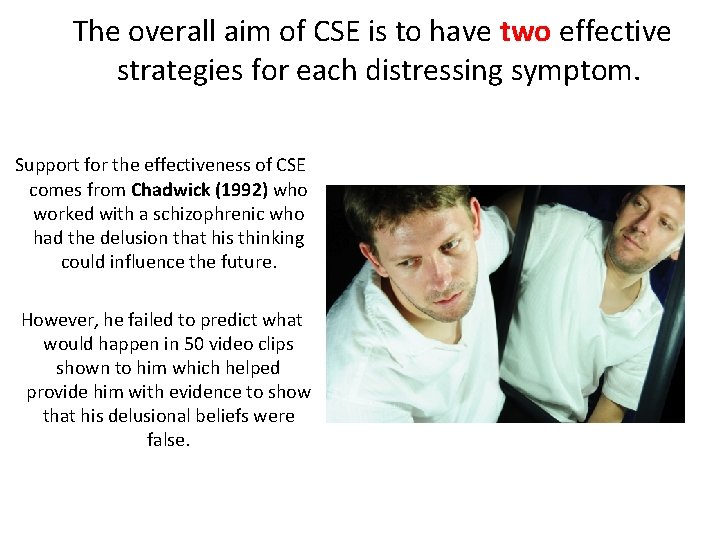
The overall aim of CSE is to have two effective strategies for each distressing symptom. Support for the effectiveness of CSE comes from Chadwick (1992) who worked with a schizophrenic who had the delusion that his thinking could influence the future. However, he failed to predict what would happen in 50 video clips shown to him which helped provide him with evidence to show that his delusional beliefs were false.
Complete worksheet 8. 11
2. Cognitive Behavioural Therapy The focus: Belief Modification In your own words “What is meant by…. ” • Irrational thoughts The • Delusional beliefs problem… • Challenging perceptions • Substituting irrational interpretations with rational The solution… Over to you…. A paranoid schizophrenic believes that the worker in her local supermarket is a secret agent spy who is keeping tabs on her. How might belief modification be used to treat this patient?
Turkington (2004) Turkington cited case studies where Sz patients delusional thoughts were challenged by therapist. Therapist “ you are obviously frightened, there must be a reason for this “ Patient – “I am being spied on in the supermarket” Therapist – “How do you know this? ”…. “Could there be another explanation for why the checkout woman is looking at you? ”
CBT - AO 1 - how it works Normalising strategies where patient is taught to understand the nature of Sz Symptoms § Patients are encouraged to challenge ‘catastrophising’ beliefs about schizophrenia § The patient is helped to feel that their symptoms are understandable and ‘normal’ For each of the dysfunctional thoughts on the next slides. How might a psychologist challenge and modify these thoughts? How might normalising strategies be applied?
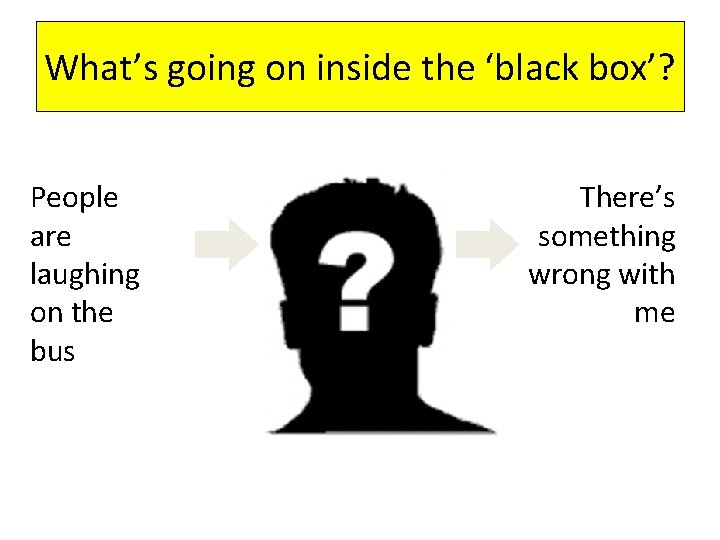
What’s going on inside the ‘black box’? People are laughing on the bus There’s something wrong with me
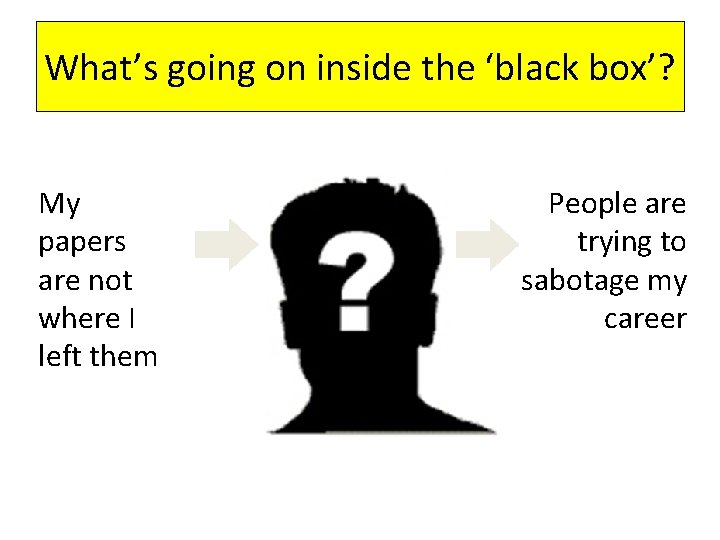
What’s going on inside the ‘black box’? My papers are not where I left them People are trying to sabotage my career
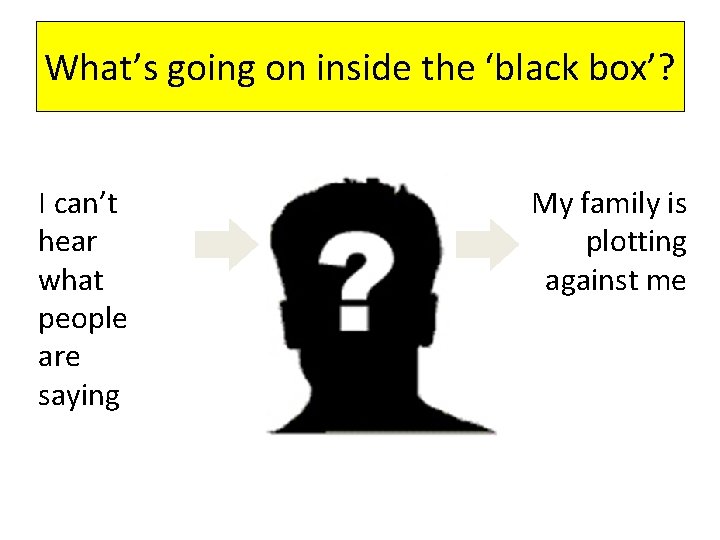
What’s going on inside the ‘black box’? I can’t hear what people are saying My family is plotting against me
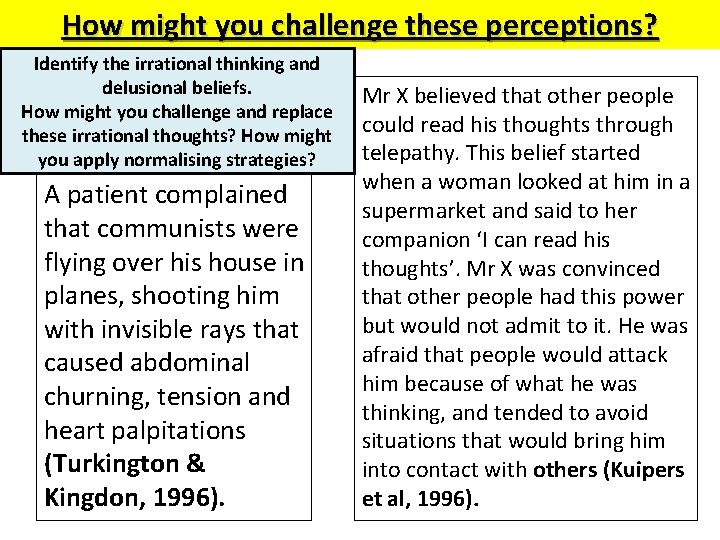
How might you challenge these perceptions? Identify the irrational thinking and delusional beliefs. How might you challenge and replace these irrational thoughts? How might you apply normalising strategies? A patient complained that communists were flying over his house in planes, shooting him with invisible rays that caused abdominal churning, tension and heart palpitations (Turkington & Kingdon, 1996). Mr X believed that other people could read his thoughts through telepathy. This belief started when a woman looked at him in a supermarket and said to her companion ‘I can read his thoughts’. Mr X was convinced that other people had this power but would not admit to it. He was afraid that people would attack him because of what he was thinking, and tended to avoid situations that would bring him into contact with others (Kuipers et al, 1996).
Complete worksheet 8. 12 Using CBT for Schizophrenia
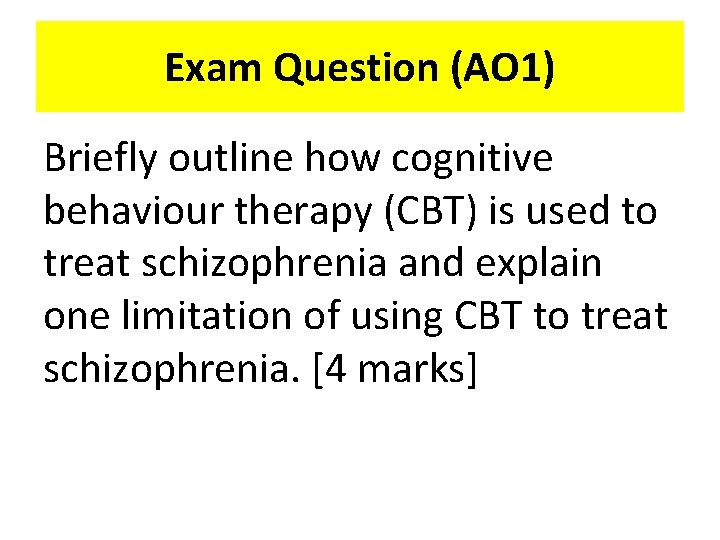
Exam Question (AO 1) Briefly outline how cognitive behaviour therapy (CBT) is used to treat schizophrenia and explain one limitation of using CBT to treat schizophrenia. [4 marks]
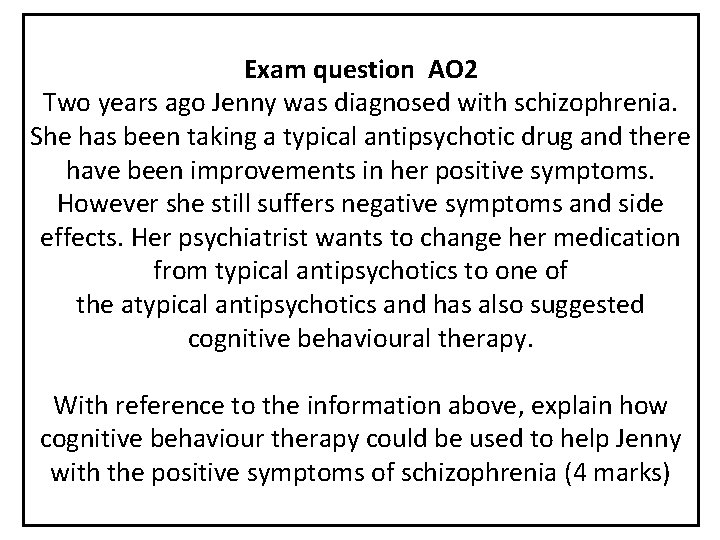
Exam question AO 2 Two years ago Jenny was diagnosed with schizophrenia. She has been taking a typical antipsychotic drug and there have been improvements in her positive symptoms. However she still suffers negative symptoms and side effects. Her psychiatrist wants to change her medication from typical antipsychotics to one of the atypical antipsychotics and has also suggested cognitive behavioural therapy. With reference to the information above, explain how cognitive behaviour therapy could be used to help Jenny with the positive symptoms of schizophrenia (4 marks)
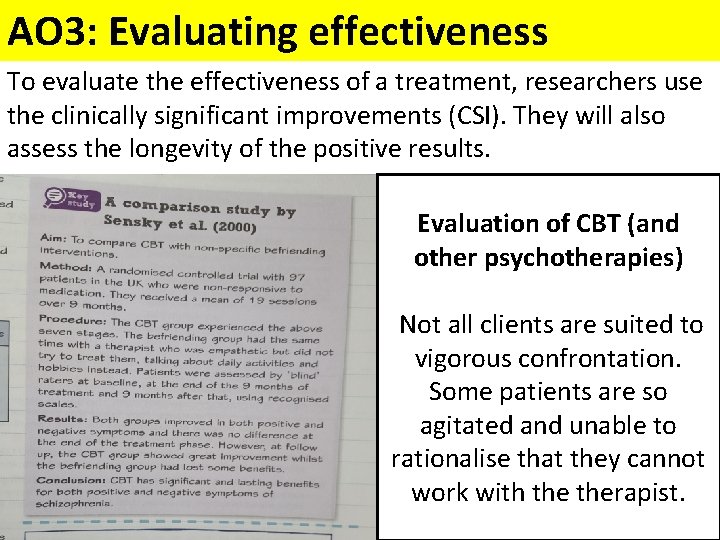
AO 3: Evaluating effectiveness To evaluate the effectiveness of a treatment, researchers use the clinically significant improvements (CSI). They will also assess the longevity of the positive results. Evaluation of CBT (and other psychotherapies) Not all clients are suited to vigorous confrontation. Some patients are so agitated and unable to rationalise that they cannot work with therapist.