Psalms 119 99 I have more understanding than

- Slides: 17
Psalms 119 99 I have more understanding than all my teachers: for thy testimonies are my meditation. 100 I understand more than the ancients, because I keep thy precepts. © 2000 Timothy G. Standish
Decent With Modification Darwin’s Theory Timothy G. Standish, Ph. D. © 2000 Timothy G. Standish
Evolution At least three distinct meanings: Change over time - The fact of evolution Natural selection - The theory of evolution No Creator/God - The belief all organisms descended from a single common ancestor produced by “natural” events © 2000 Timothy G. Standish
The World Before Darwin 427 -347 BC Plato - Believed in two worlds: – An ideal perfect world which was eternal, but not perceived. – An illusory world in which imperfection appears because of our imperfect perception. As the ideal world is perfect and eternal, there could be no evolution, variation from the perfect ideal is only perceived in organisms, not real This belief was incorporated into the church’s theology - God created a perfect world in which everything was perfect and thus any variation was from the ideal God had made. © 2000 Timothy G. Standish
Before Darwin Cont. 384 -322 BC Aristotle - Was ambivalent about Plato’s two worlds philosophy Recognized a scale of complexity in organisms Proposed a “scala naturae” (scale of nature) ranging from simple to complex organisms Aristotle proposed a ladder of life with simple organisms forming the lower rungs and complex organisms the top. Each organism was allotted its rung and could not be moved from it This belief was also incorporated into the church’s theology © 2000 Timothy G. Standish
Before Darwin Cont. Linnaeus 1707 -1778 - Swidish physician and botanist – Sought to classify, or organize nature – The father of taxonomy or systematics – “Deus creavit, Linnaeus disposuit” (God creates, Linnaeus arranges) Lamarck 1744 -1829 - Published his theory of evolution in 1809 – Proposed that organisms responded to “sentiments interieurs” (fealt needs) by evolving Mathus 1766 -1834 - Proposed the utterly dismal theorum: – All populations of organisms grow until resources are completely utilized so that each individual lives at the razor’s edge of existence © 2000 Timothy G. Standish
Before Darwin, Cont. Cuvier 1769 -1832 - Father of Paleontology, the study of fossils – Believed fossils were a record of life over time – Interpreted the fossil record in the context of catastrophism where strata in the rocks represent catastrophic events James Hutton - Scottish geologist who, in 1795, proposed theory of gradualism – Gradualism - Geological strata were laid down over a long period of time – Gradualism is a logical outgrowth of uniformitarianism, the belief that the way things are now is the same as they were in the past. As mountains are eroding slowly now and basins are filling gradually, it follows that if the slow rate occurred in the past, laying down the amount of sedimentary rock we now see must have taken a long time. © 2000 Timothy G. Standish
Erasmus Darwin (1731 -1802) Charles’ grandfather - Physician, radical and free-thinker Influential in publishing Linnaeus's works in English Believed existing life forms evolved gradually from earlier species Published Zoönomia (1794 -1796) ascribed evolutionary development to organism's conscious adaptation (close to Lamarck) Phytologia ("The study of plants") contains the earliest detailed description of photosynthesis and the geological principles of the artesian well Believed that cross-fertilization was a superior form of reproduction to self-fertilization © 2000 Timothy G. Standish
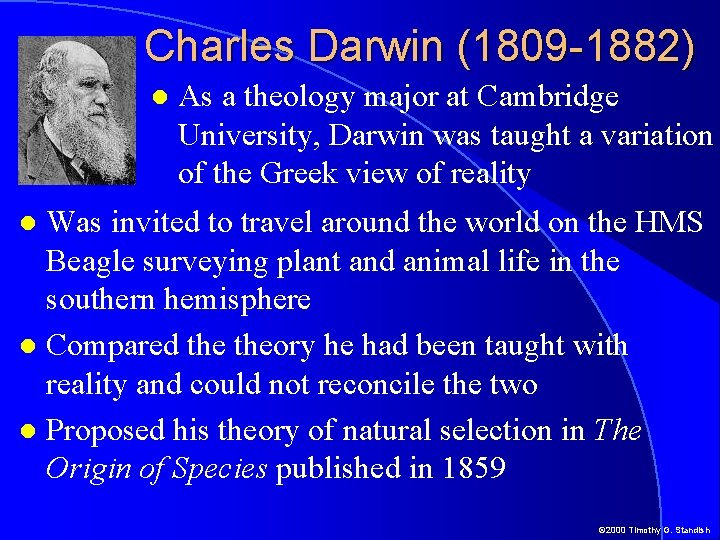
Charles Darwin (1809 -1882) As a theology major at Cambridge University, Darwin was taught a variation of the Greek view of reality Was invited to travel around the world on the HMS Beagle surveying plant and animal life in the southern hemisphere Compared theory he had been taught with reality and could not reconcile the two Proposed his theory of natural selection in The Origin of Species published in 1859 © 2000 Timothy G. Standish
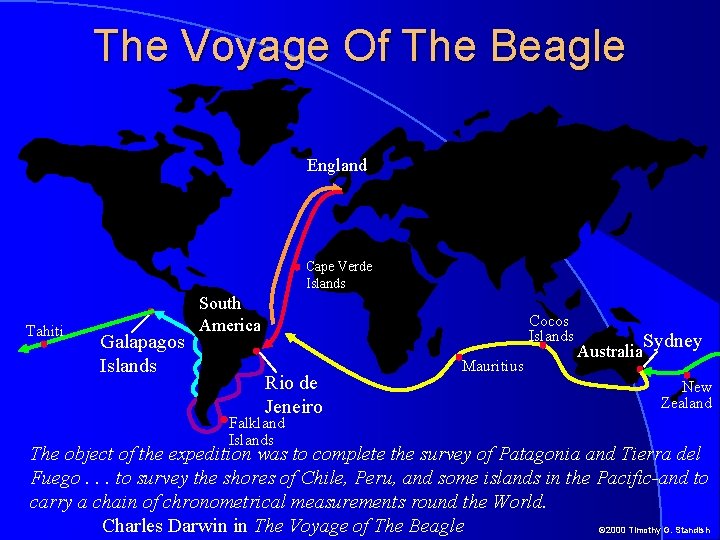
The Voyage Of The Beagle England Cape Verde Islands Tahiti Galapagos Islands South America Cocos Islands Rio de Jeneiro Falkland Islands Mauritius Australia Sydney New Zealand The object of the expedition was to complete the survey of Patagonia and Tierra del Fuego. . . to survey the shores of Chile, Peru, and some islands in the Pacific-and to carry a chain of chronometrical measurements round the World. Charles Darwin in The Voyage of The Beagle © 2000 Timothy G. Standish
The Logic Of Darwin The fossils in South America were different from the animals that lived there now, but some seemed to be related in some way If fossils were a record of the past (Cuvier) then there must have been change (evolution) between the past an now Change is happening slowly thus to get change must have taken a long time (uniformitarianism) The rock strata took a long time to form (Hutton gradualism) thus lots of time is available for evolution Organisms evolved over long periods of time © 2000 Timothy G. Standish
The Mechanism Of Evolution Darwin was not the first to propose evolution, Lamarck and others had done it before him Darwin’s real contribution was a credible mechanism for evolution - Natural Selection Natural selection is based on two points: 1 The reproductive capacity of organisms exceeds the carrying capacity of the environment 2 Variation in organisms makes survival a nonrandom event - Some variants are more likely to survive in a given environment Of the excess products of organisms reproductive capacity the most fit survive - Survival of the fittest © 2000 Timothy G. Standish
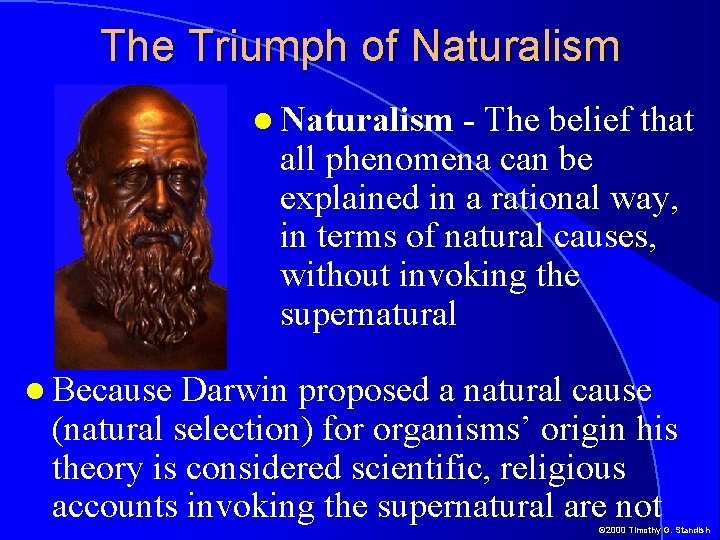
The Triumph of Naturalism - The belief that all phenomena can be explained in a rational way, in terms of natural causes, without invoking the supernatural Because Darwin proposed a natural cause (natural selection) for organisms’ origin his theory is considered scientific, religious accounts invoking the supernatural are not © 2000 Timothy G. Standish
Uniformitarianism - The belief that nature is the same (uniform) today as it has always been Uniformitarianism is true absolutely all the time With absolutely no exceptions. . . Except when it invalidates our theories. © 2000 Timothy G. Standish
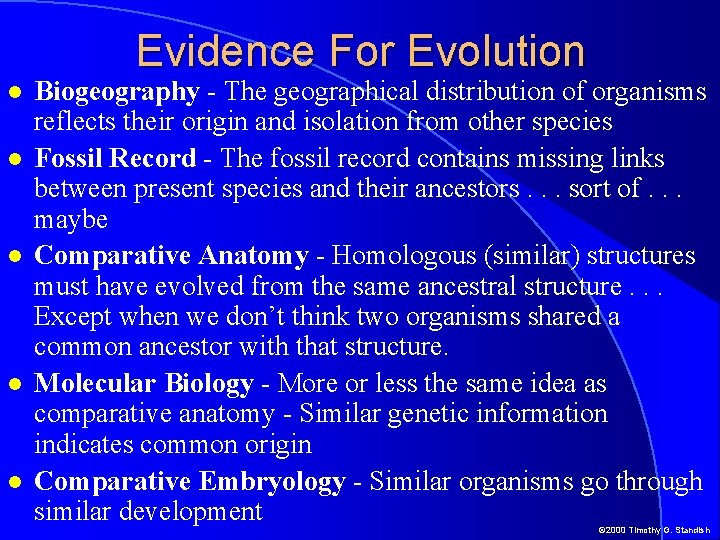
Evidence For Evolution Biogeography - The geographical distribution of organisms reflects their origin and isolation from other species Fossil Record - The fossil record contains missing links between present species and their ancestors. . . sort of. . . maybe Comparative Anatomy - Homologous (similar) structures must have evolved from the same ancestral structure. . . Except when we don’t think two organisms shared a common ancestor with that structure. Molecular Biology - More or less the same idea as comparative anatomy - Similar genetic information indicates common origin Comparative Embryology - Similar organisms go through similar development © 2000 Timothy G. Standish
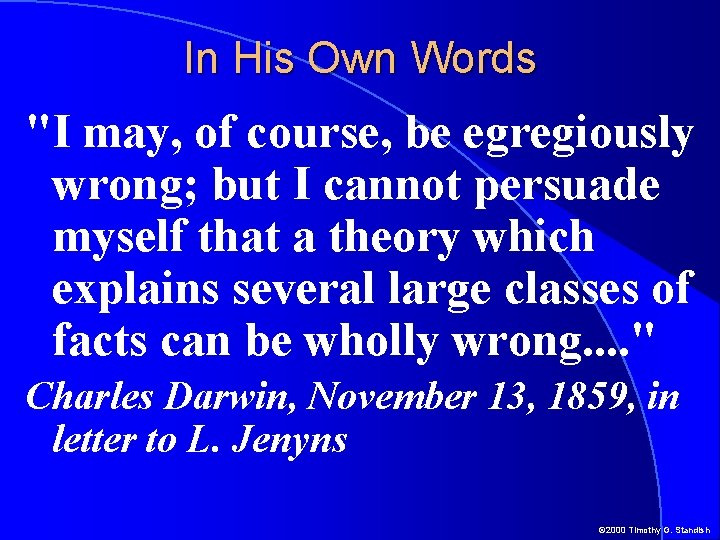
In His Own Words "I may, of course, be egregiously wrong; but I cannot persuade myself that a theory which explains several large classes of facts can be wholly wrong. . " Charles Darwin, November 13, 1859, in letter to L. Jenyns © 2000 Timothy G. Standish
© 2000 Timothy G. Standish