Properties of Logarithms and Common Logarithms Sec 10
- Slides: 16
Properties of Logarithms and Common Logarithms Sec 10. 3 & 10. 4 pg. 541 - 549
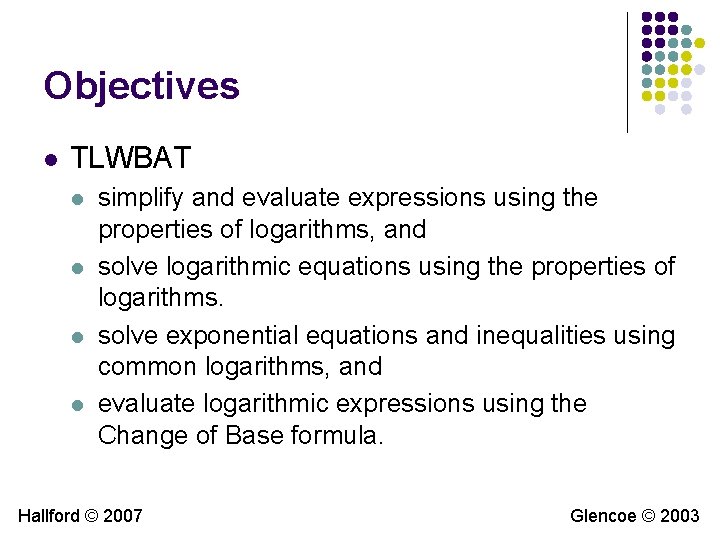
Objectives l TLWBAT l l simplify and evaluate expressions using the properties of logarithms, and solve logarithmic equations using the properties of logarithms. solve exponential equations and inequalities using common logarithms, and evaluate logarithmic expressions using the Change of Base formula. Hallford © 2007 Glencoe © 2003
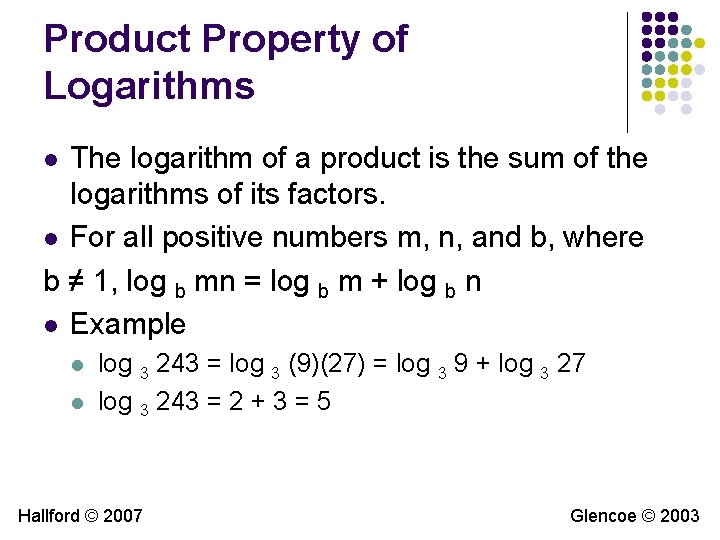
Product Property of Logarithms The logarithm of a product is the sum of the logarithms of its factors. l For all positive numbers m, n, and b, where b ≠ 1, log b mn = log b m + log b n l Example l log 3 243 = log 3 (9)(27) = log 3 9 + log 3 27 log 3 243 = 2 + 3 = 5 Hallford © 2007 Glencoe © 2003
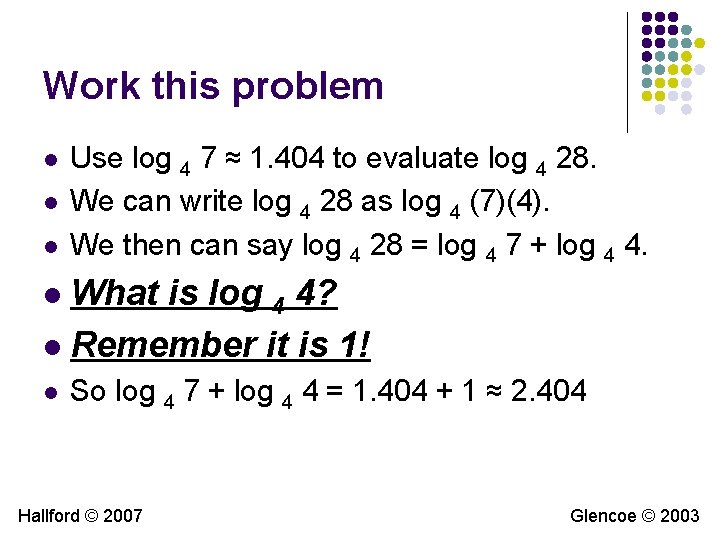
Work this problem l l l Use log 4 7 ≈ 1. 404 to evaluate log 4 28. We can write log 4 28 as log 4 (7)(4). We then can say log 4 28 = log 4 7 + log 4 4. What is log 4 4? l Remember it is 1! l l So log 4 7 + log 4 4 = 1. 404 + 1 ≈ 2. 404 Hallford © 2007 Glencoe © 2003
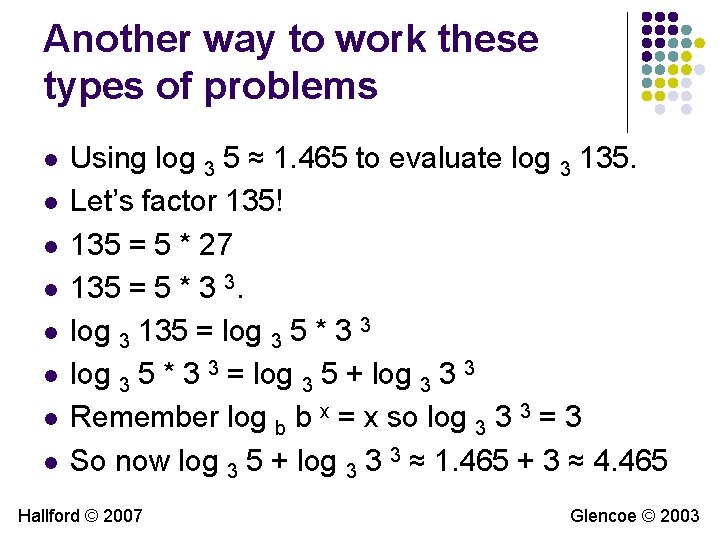
Another way to work these types of problems l l l l Using log 3 5 ≈ 1. 465 to evaluate log 3 135. Let’s factor 135! 135 = 5 * 27 135 = 5 * 3 3. log 3 135 = log 3 5 * 3 3 = log 3 5 + log 3 3 3 Remember log b b x = x so log 3 3 3 = 3 So now log 3 5 + log 3 3 3 ≈ 1. 465 + 3 ≈ 4. 465 Hallford © 2007 Glencoe © 2003
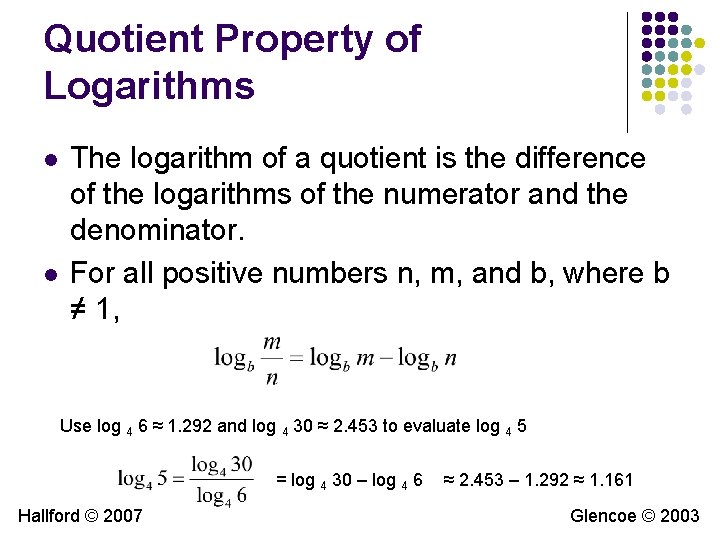
Quotient Property of Logarithms l l The logarithm of a quotient is the difference of the logarithms of the numerator and the denominator. For all positive numbers n, m, and b, where b ≠ 1, Use log 4 6 ≈ 1. 292 and log 4 30 ≈ 2. 453 to evaluate log 4 5 = log 4 30 – log 4 6 Hallford © 2007 ≈ 2. 453 – 1. 292 ≈ 1. 161 Glencoe © 2003
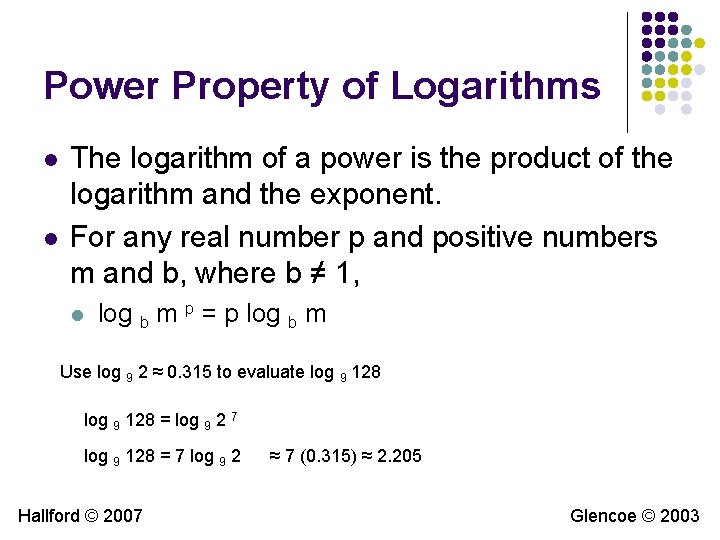
Power Property of Logarithms l l The logarithm of a power is the product of the logarithm and the exponent. For any real number p and positive numbers m and b, where b ≠ 1, l log b m p = p log b m Use log 9 2 ≈ 0. 315 to evaluate log 9 128 = log 9 2 7 log 9 128 = 7 log 9 2 Hallford © 2007 ≈ 7 (0. 315) ≈ 2. 205 Glencoe © 2003
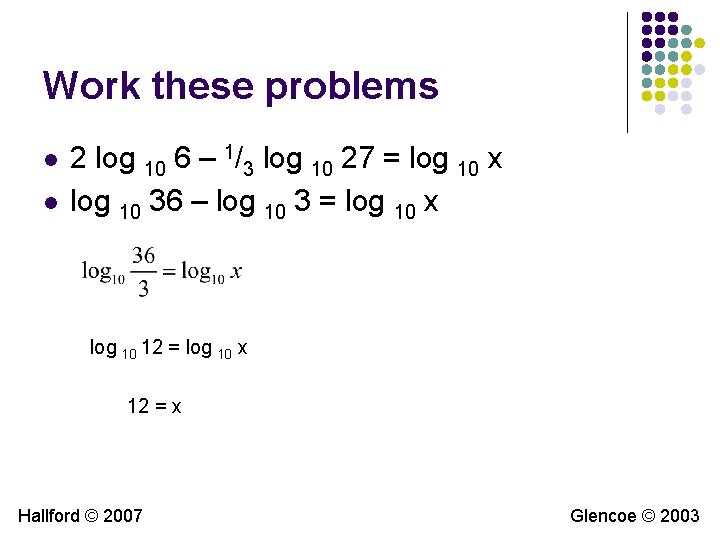
Work these problems l l 2 log 10 6 – 1/3 log 10 27 = log 10 x log 10 36 – log 10 3 = log 10 x log 10 12 = log 10 x 12 = x Hallford © 2007 Glencoe © 2003
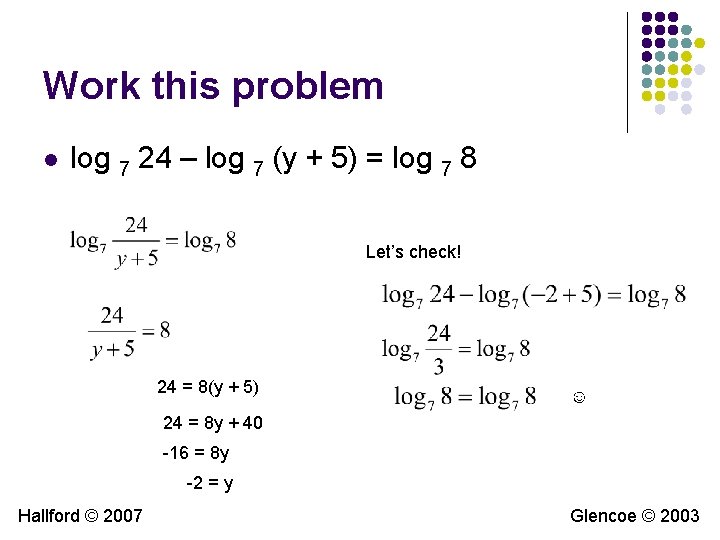
Work this problem l log 7 24 – log 7 (y + 5) = log 7 8 Let’s check! 24 = 8(y + 5) ☺ 24 = 8 y + 40 -16 = 8 y -2 = y Hallford © 2007 Glencoe © 2003
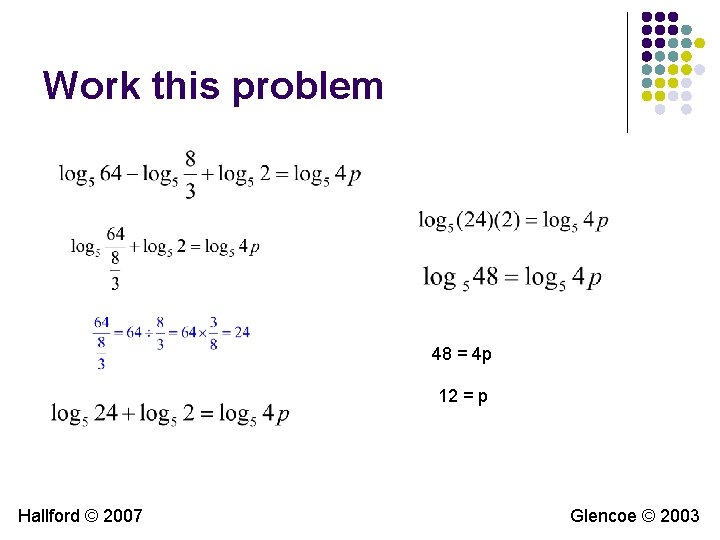
Work this problem 48 = 4 p 12 = p Hallford © 2007 Glencoe © 2003
End of 10. 3 Hallford © 2007 Glencoe © 2003
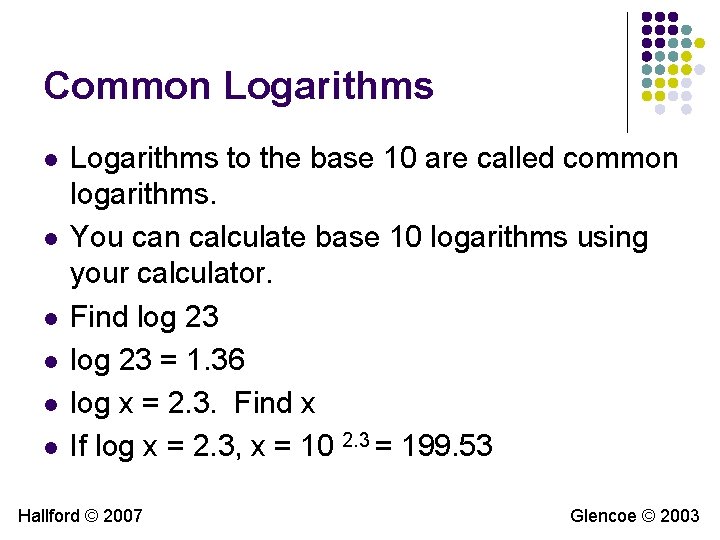
Common Logarithms l l l Logarithms to the base 10 are called common logarithms. You can calculate base 10 logarithms using your calculator. Find log 23 = 1. 36 log x = 2. 3. Find x If log x = 2. 3, x = 10 2. 3 = 199. 53 Hallford © 2007 Glencoe © 2003
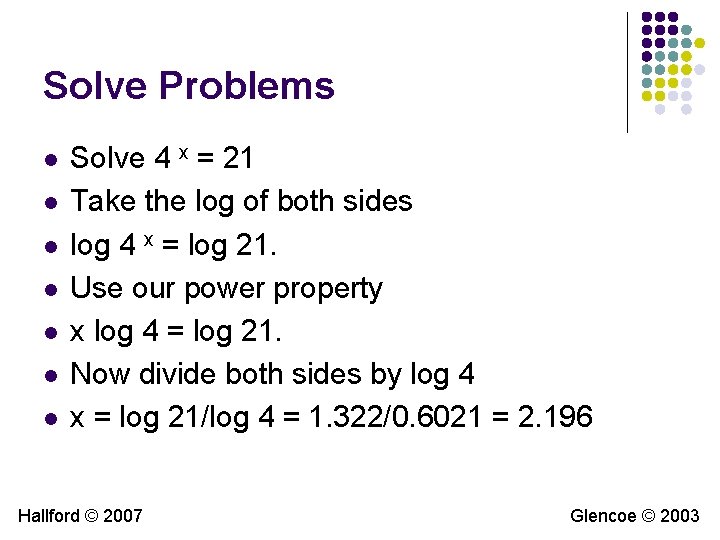
Solve Problems l l l l Solve 4 x = 21 Take the log of both sides log 4 x = log 21. Use our power property x log 4 = log 21. Now divide both sides by log 4 x = log 21/log 4 = 1. 322/0. 6021 = 2. 196 Hallford © 2007 Glencoe © 2003
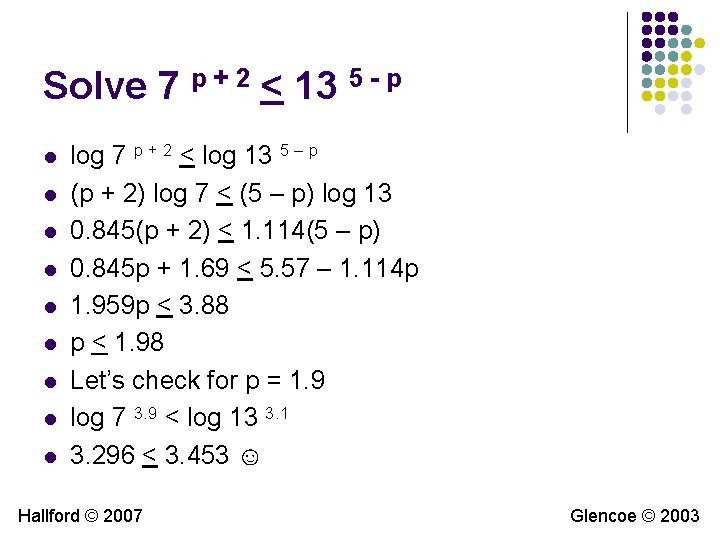
Solve 7 p + 2 < 13 5 - p l l l l log 7 p + 2 < log 13 5 – p (p + 2) log 7 < (5 – p) log 13 0. 845(p + 2) < 1. 114(5 – p) 0. 845 p + 1. 69 < 5. 57 – 1. 114 p 1. 959 p < 3. 88 p < 1. 98 Let’s check for p = 1. 9 log 7 3. 9 < log 13 3. 1 3. 296 < 3. 453 ☺ Hallford © 2007 Glencoe © 2003
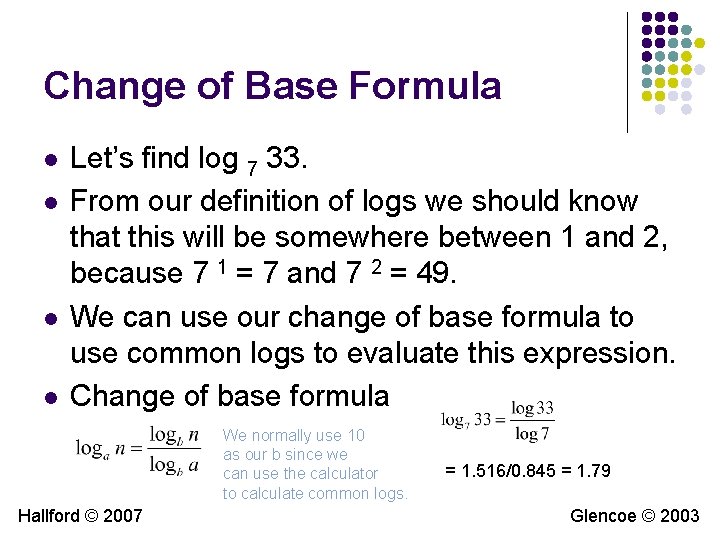
Change of Base Formula l l Let’s find log 7 33. From our definition of logs we should know that this will be somewhere between 1 and 2, because 7 1 = 7 and 7 2 = 49. We can use our change of base formula to use common logs to evaluate this expression. Change of base formula We normally use 10 as our b since we can use the calculator to calculate common logs. Hallford © 2007 = 1. 516/0. 845 = 1. 79 Glencoe © 2003
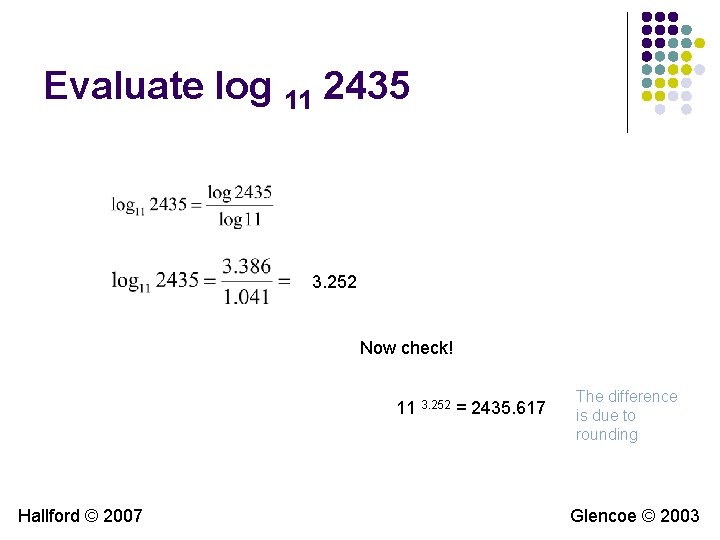
Evaluate log 11 2435 3. 252 Now check! 11 3. 252 = 2435. 617 Hallford © 2007 The difference is due to rounding Glencoe © 2003