
Exponential Functions Intro to Properties of Common Logarithms






- Slides: 51
Exponential Functions Intro. to Properties of Common Logarithms Natural Logarithms 100 100 100 200 200 200 300 300 300 400 400 400 500 500 500
In exponential decay, the value of the base is between these two numbers
What is 0 and 1?
In exponential growth, the value of the base is _____
What is greater than 1?
The simplified form of
What is 15, 625?
The solution of 2 2 x+11 = 128
What is – 2 ?
The solution of 36 5 c = 216 2 c - 8
What is -6 ?
Evaluate log 216
What is 4?
Evaluate log 5 1 125 1
What is -3
The solution of log 9 x = 3
What is 729?
The solution of logb 196 = 2
What is 14?
The solution of 2 log 11 (c – 15) = log 11 (2 c)
What is 5? (-3 is excluded)
The solution of log 5 3 + log 5 x = log 5 99
What is 33?
The solution of log 3 a - log 3 7 = log 3 5
What is 35 ?
The solution of 2 log 7 5 – 1 log 7125 = log 7 x 3
What is 5?
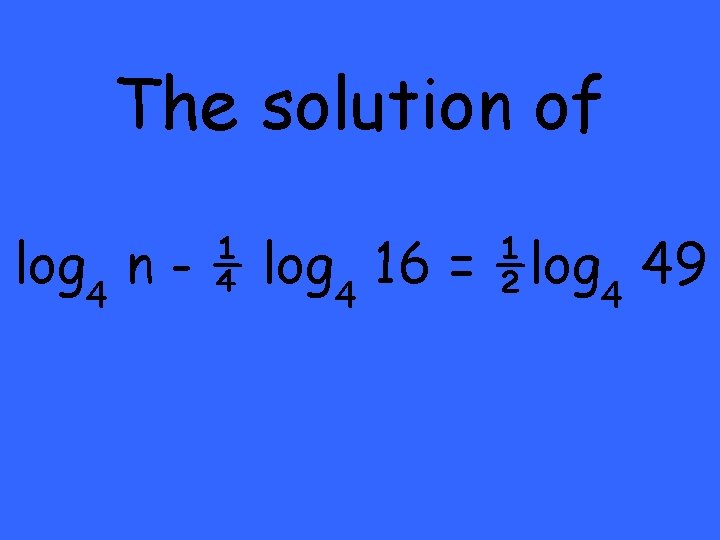
The solution of log 4 n - ¼ log 4 16 = ½log 4 49
What is 14?
The solution of 2 log 6 (c + 2) + log 6 2 = 2
What is 4 and -4?
The base of common logarithms?
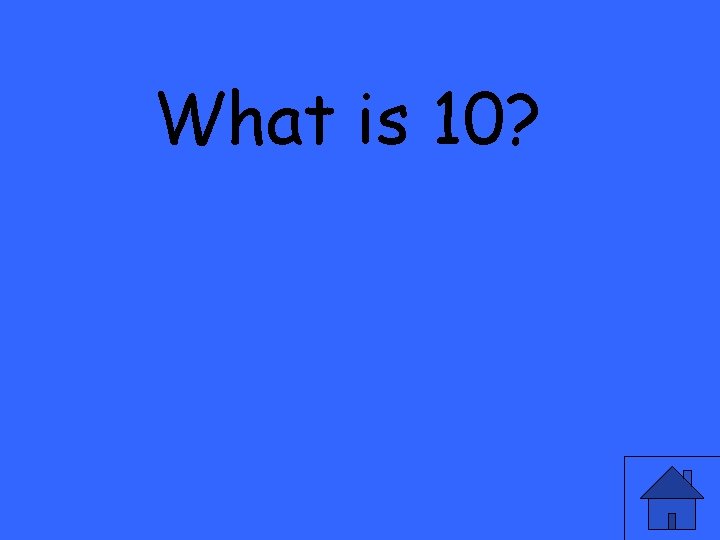
What is 10?
Evaluate to 4 decimal places log 28
What is 1. 4472?
Evaluate using the change of base formula (round to 4 decimal places) log 726
What is 1. 6743?
The solution of x 9 = 73 (rounded to 4 decimal places)
What is ? 1. 9527
The solution of 5 w+3 = 17 (rounded to 4 decimal places)
What is -1. 2396?
The base of natural logarithms
What is e?
The approximate value of e
What is 2. 718?
The abbreviation used for natural logarithms
What is ln?
The solution of x 3 e + 1 = 5 (round to 4 decimal places)
What is 0. 2877?
The solution of ln(x – 7) = 2 (round to 4 decimal places)
What is 14. 3891?