Proof Geometry All quadrilaterals have four sides They

- Slides: 15
Proof Geometry
� All quadrilaterals have four sides. � They also have four angles. � The sum of the four angles totals 360°. � These properties are what make quadrilaterals alike, but what makes them different?
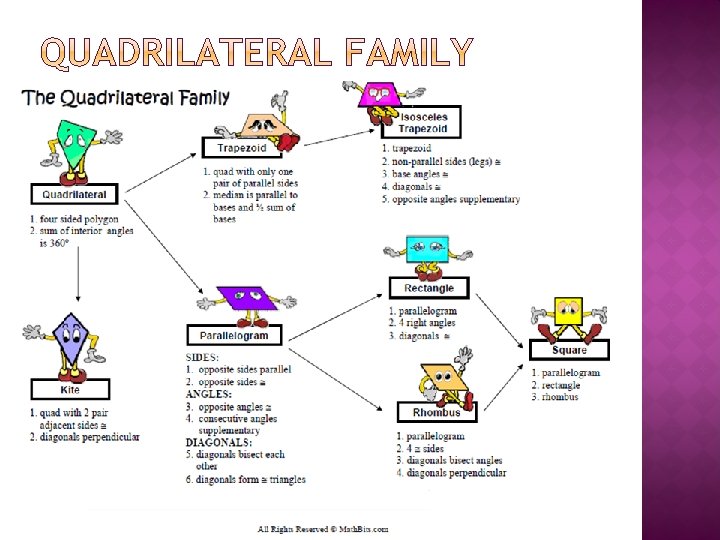
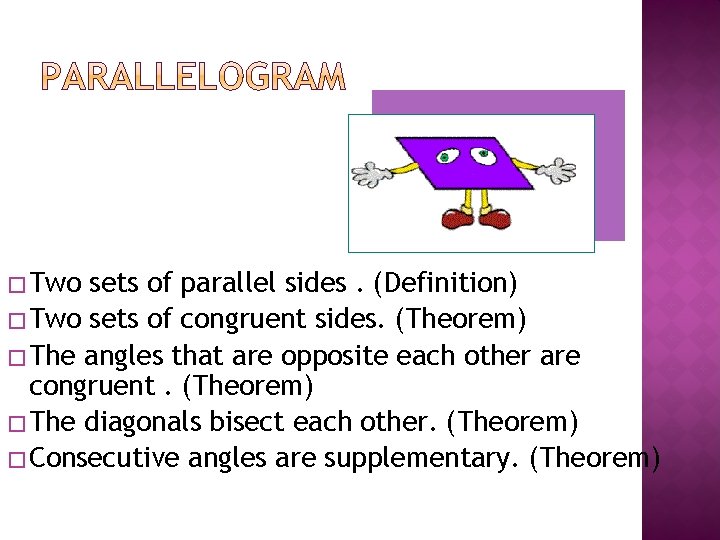
� Two sets of parallel sides. (Definition) � Two sets of congruent sides. (Theorem) � The angles that are opposite each other are congruent. (Theorem) � The diagonals bisect each other. (Theorem) � Consecutive angles are supplementary. (Theorem)
�A rectangle is a parallelogram all of whose angles are right angles. (Def. ) �Has all properties of quadrilateral and parallelogram �A rectangle also has four right angles. (Theorem) �The diagonals are congruent. (Theorem)
� Prove it is a parallelogram with 1 right angle Theorem: If a parallelogram has one right angle then it is a rectangle. � Prove that the diagonals are congruent to each other and bisect each other. Theorem: If the diagonals of a quadrilateral are congruent and bisect each other, then it is a rectangle.
�A rhombus is a parallelogram all of whose sides are congruent. (Definition) �All properties of parallelogram sides are congruent (Theorem) �The diagonals bisect the angles. (Theorem) �The diagonals are perpendicular bisectors of each other (Theorem)
�Prove it is a parallelogram with all 4 sides congruent. �Prove it is a parallelogram with each diagonal bisecting a pair of opposite angles. �Prove it is a quadrilateral with diagonals that bisect each other and are perpendicular to each other.
�A square is a rectangle all of whose sides are congruent. (Definition) �All the properties of a parallelogram apply �All the properties of a rectangle apply �All the properties of a rhombus apply TO PROVE A QUADRILATERAL IS A SQUARE � Prove it is a rectangle and a rhombus
� Trapezoid has one and only one set of parallel sides. TO PROVE A QUADRILATERAL IS A TRAPEZOID � Prove a set of sides is parallel �Technically, we would need to show the other pair of sides are not parallel. We won’t do that.
�An isosceles trapezoid has two equal sides. These equal sides are called the legs of the trapezoid, which are the non-parallel sides of the trapezoid. �Never assume a trapezoid is isosceles unless it is given �Both pair of base angles in an isosceles trapezoid are also congruent. �The diagonals are congruent
�Prove that is a trapezoid with the non parallel set of sides congruent �Prove that it is a trapezoid with congruent diagonals �Prove that it is a trapezoid with base angles congruent.
� Two adjacent sets of consecutive congruent sides (Definition) � Diagonals are perpendicular to each other. (Theorem) � One of the diagonals bisects the other. � The angles included between the sets congruent sides are congruent—i. e. one pair of congruent opp. Angles. (Theorem)
�Prove that it is a quadrilateral with two sets of consecutive congruent sides. �Prove that one diagonal is the perpendicular bisector of the other.
p. 289: #4 -6, 8 -10