PROJECT REPORT ON PROFIT PRIOR TO INCORPORATION MEANING


- Slides: 20
PROJECT REPORT ON PROFIT PRIOR TO INCORPORATION
MEANING • Sometimes a company is formed to take over a running business from a date prior to its incorporation. • In such a case, the amount of profit earned by the company from the date of purchase to date of its incorporation is called as Profit prior to incorporation.
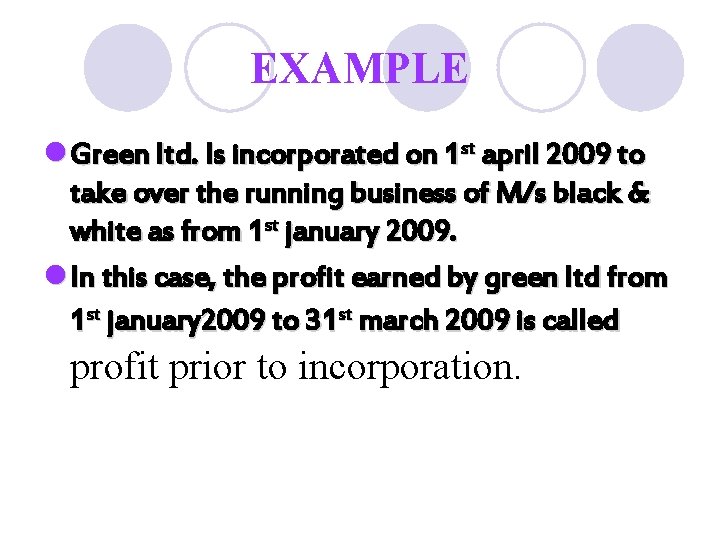
EXAMPLE l Green ltd. Is incorporated on 1 st april 2009 to take over the running business of M/s black & white as from 1 st january 2009. l In this case, the profit earned by green ltd from 1 st january 2009 to 31 st march 2009 is called profit prior to incorporation.
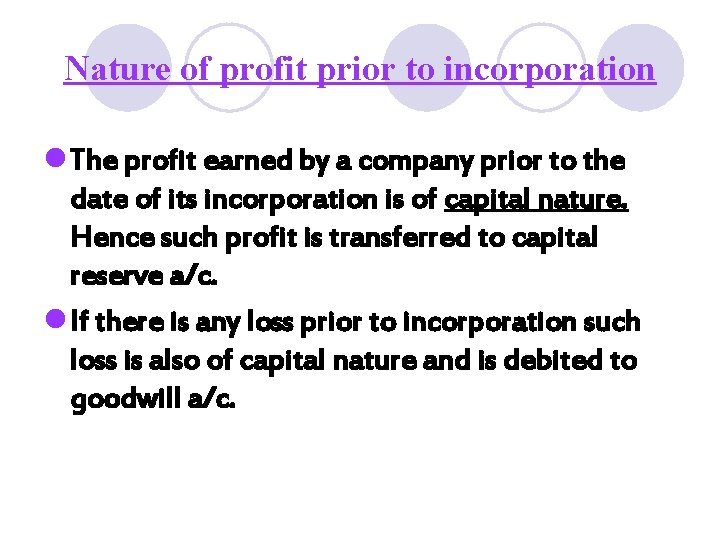
Nature of profit prior to incorporation l The profit earned by a company prior to the date of its incorporation is of capital nature. Hence such profit is transferred to capital reserve a/c. l If there is any loss prior to incorporation such loss is also of capital nature and is debited to goodwill a/c.
ASCERTAINMENT OF PROFIT OR LOSS PRIOR TO INCORPORATION
(1) Prepare Trading a/c l In order to ascertain the amount of gross profit, the trading a/c for the whole period should be prepared. l The whole period means the period starting from the date of purchase of business to the date of closing of accounts.
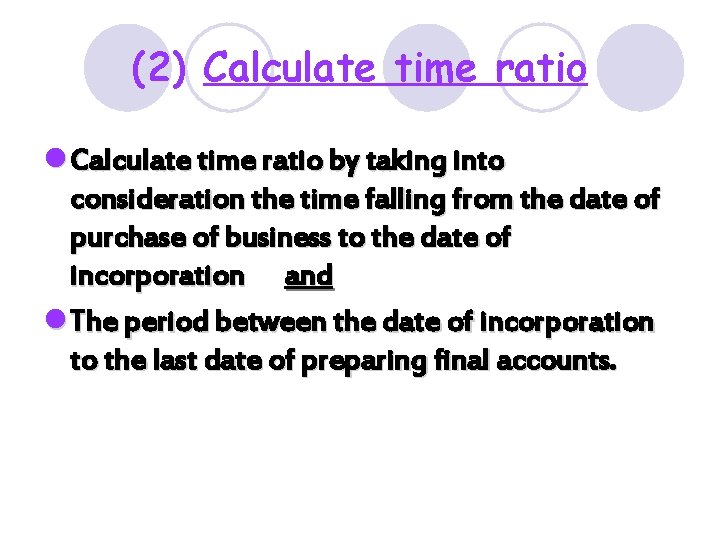
(2) Calculate time ratio l Calculate time ratio by taking into consideration the time falling from the date of purchase of business to the date of incorporation and l The period between the date of incorporation to the last date of preparing final accounts.
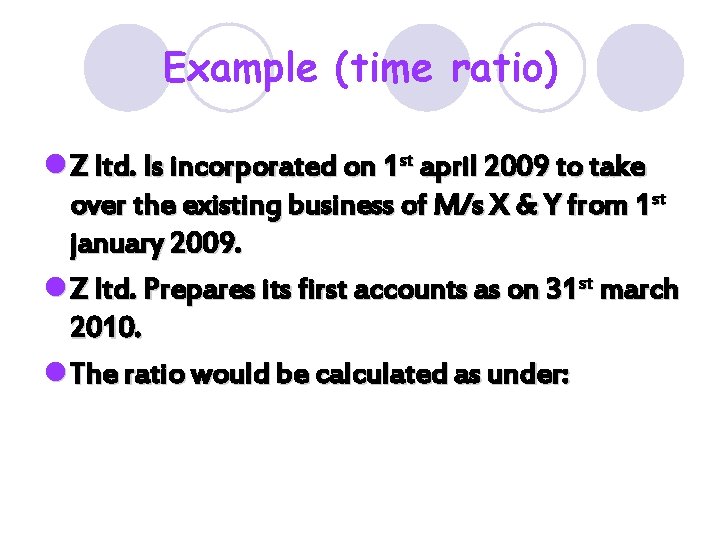
Example (time ratio) l Z ltd. Is incorporated on 1 st april 2009 to take over the existing business of M/s X & Y from 1 st january 2009. l Z ltd. Prepares its first accounts as on 31 st march 2010. l The ratio would be calculated as under:
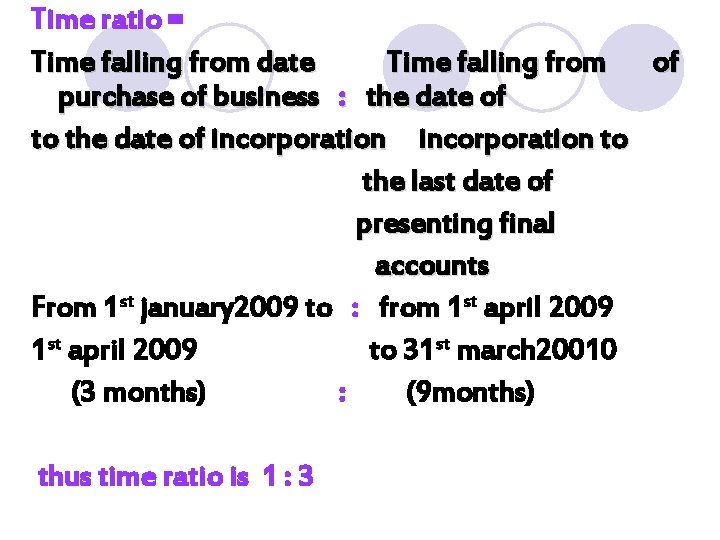
Time ratio = Time falling from date Time falling from of purchase of business : the date of to the date of incorporation to the last date of presenting final accounts From 1 st january 2009 to : from 1 st april 2009 to 31 st march 20010 (3 months) : (9 months) thus time ratio is 1 : 3
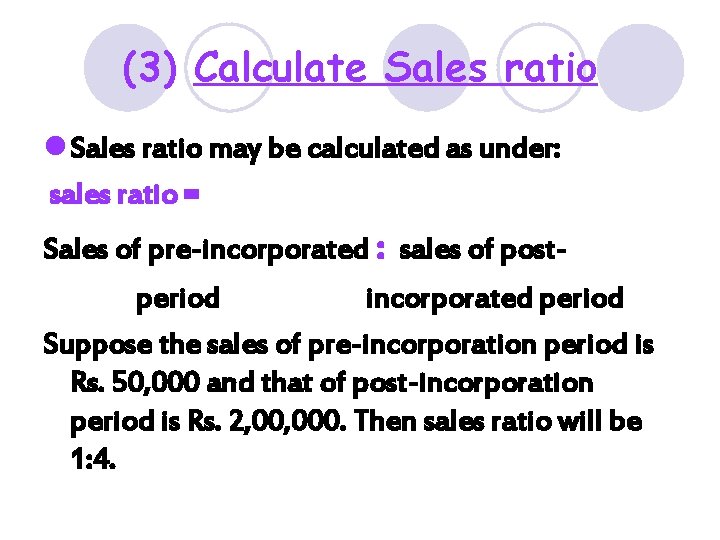
(3) Calculate Sales ratio l Sales ratio may be calculated as under: sales ratio = Sales of pre-incorporated : sales of postperiod incorporated period Suppose the sales of pre-incorporation period is Rs. 50, 000 and that of post-incorporation period is Rs. 2, 000. Then sales ratio will be 1: 4.
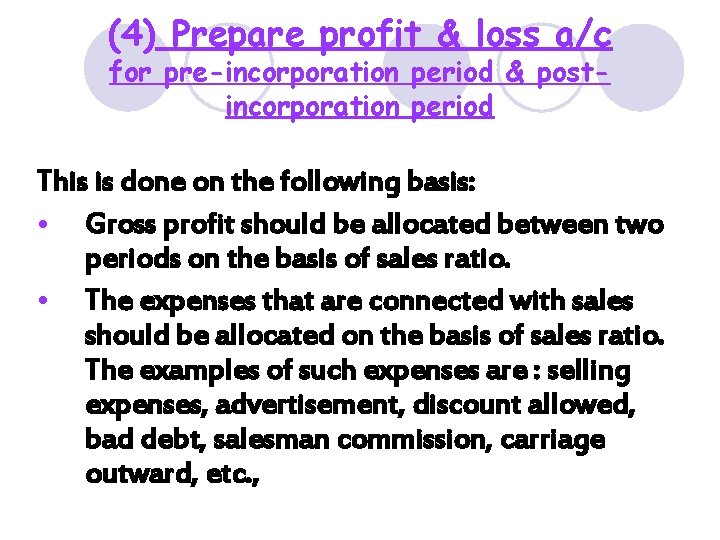
(4) Prepare profit & loss a/c for pre-incorporation period & postincorporation period This is done on the following basis: • Gross profit should be allocated between two periods on the basis of sales ratio. • The expenses that are connected with sales should be allocated on the basis of sales ratio. The examples of such expenses are : selling expenses, advertisement, discount allowed, bad debt, salesman commission, carriage outward, etc. ,
Prepare p&l a/c (contd)…. . l Expenses that are incurred on the basis of time should be allocated on the basis of time ratio. l For example: administration expenses, audit fees, salaries, rent & taxes, misc. expenses, depreciation, insurance, electricity charges, printing & stationary, etc. ,
Prepare p&l a/c (contd)…. l Expenses, which are incurred after the incorporation of the company, should be charged wholly to the post- incorporation period. l The examples of such expenses are: director’ fees, preliminary expenses, debenture interest, etc.
(5)Actual expenses of both the periods l Sometimes actual expenses of both periods are available separately then such expenses are charged to their respective period. l Examples of such expenses are: a) Out of bad debts of Rs. 2000 a sum of Rs. 300 are pertaining to the period prior to incorporation. It means the remaining Rs. 1700 are pertaining to the period after incorporation and these are to be charged as such.
Actual expenses (contd)…. . b) Similarly , if rent paid for the period prior to incorporation is available, the remaining amount of rent pertains to the period after incorporation. c) Interest paid to vendors is to be calculated upto the date of incorporation and charged to the period prior to incorporation & the remaining is charged after incorporation.
Treatment of loss prior to incorporation l Loss prior to incorporation being of capital nature shall be : a) Debited to separate account called ‘loss prior to incorporation account’ & b) Shown under the head miscellaneous expenditure on asset side of the balance sheet to the extent not written off.
l Loss prior to incorporation can be dealt with in any of the following manner : i. Write off against the profits of the company ii. Treated as goodwill and debited to goodwill account iii. Such loss can be treated as deferred revenue expenditure and written off out of profits of the company over a period of years.
Treatment of profit prior to incorporation l Being capital profit in its nature, it cannot be allowed be a part of p&l a/c. l It should not be used for the payment of dividend to shareholders l It is preferable to credit it to ‘capital a/c’ which may be used to write off capital losses & expenses like ‘preliminary expenses’ , ‘underwriting commission’, ‘discount on issue of debentures, etc. ,
Treatment of profit prior to incorporation (contd)…. l Unutilised portion of such capital reserve appears in the liabilities side of the balance sheet under the heading reserves and surplus.
THANK YOU