
Productive Procrastination All hard work brings a profit
Productive Procrastination All hard work brings a profit, but mere talk leads only to poverty ~Proverbs 14: 23
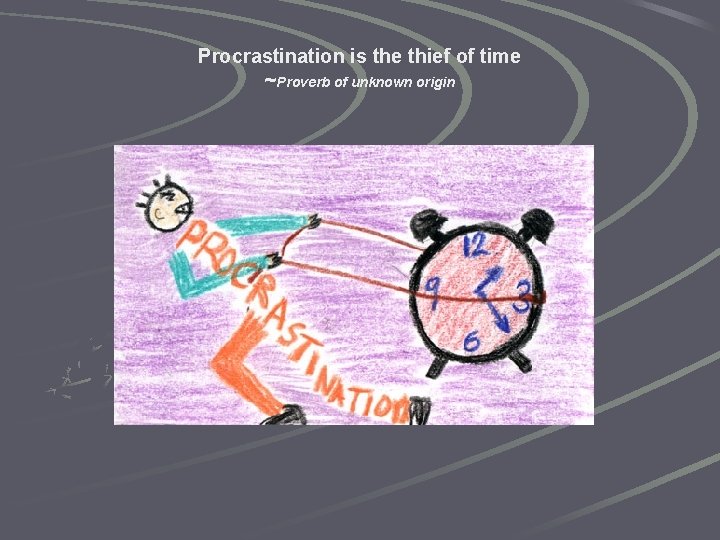
Procrastination is the thief of time ~Proverb of unknown origin
A Waste of Time 25% of students come to the CWT the day of the assignment. 45% of students come to the CWT the day before the assignment.
DOES THIS SOUND FAMILIAR? http: //en. wikipedia. org/wiki/Procrastination_(Sponge. Bo b_Episode)
The Downside of Procrastination may be an addiction. Procrastination may hurt your grades/performance. When you procrastinate, you are more apt to make mistakes. You also leave little time to correct the little things that might go wrong with a project. Procrastination may also cause physical symptoms—such as headache, muscle aches, stomach aches—as well as feelings of guilt, shame, worthlessness, or hopelessness. Research suggests that procrastination can lead to plagiarism.
Okay! Procrastination is bad; but what can we do about it?
Tips fr m Faculty and Staff Just begin! A chocolate chip cookie will eventually be consumed by an ant if he works hard at nibbling—begin an assignment the day you get it and nibble daily until done. (Dr. Isitt) Choose a topic that’s interesting to you, something you’ve always wanted to know more about. (Walter Nata) Use this opportunity to document someone or something meaningful in your life so it can be shared with others. (Joe Robbins) Do what Ernest Hemingway did: stop writing when you know what’s coming next. (Dr. Blake) Make an appt. with the CWT and KEEP IT, even if you haven’t written a word—especially if you need help getting started. (Mrs. Bishop) Set a timer and determine to write for a certain amount of time. Even if it’s a short session, at least you’ve begun, and that can be the toughest part. (Mrs. Blake) Make lists of what you need to do and in what order. Do unpleasant or harder tasks first. Cross things off the list as you do them to give yourself a feeling of accomplishment. As an incentive, reward yourself with something enjoyable after the unpleasant task is complete! (Kurt Mc. Donald) Remember this Spanish adage: “He’s a real man of the future—he puts everything off till tomorrow!” (Dr. Lambeth)
Tips from faculty and staff (continued) • Treat the various parts of the work as separate assignments, each with its own due date. (Walter Nata) • Pray! (Chaplain Dan and Dr. Lambeth) • Romans 12: 11 “Do not be slothful, but zealous, be fervent, serving the Lord. ” • Luke 9: 59 -62 And he said unto another, Follow me. But he said, Lord, suffer me first to go and bury my father. Jesus said unto him, Let the dead bury their dead: but go thou and preach the kingdom of God. And another also said, Lord, I will follow thee; but let me first go bid them farewell, which are at home at my house. And Jesus said unto him, No man, having put his hand to the plough, and looking back, is fit for the kingdom of God. • Proverbs 27: 1 Boast not thyself of to morrow; for thou knowest not what a day may bring forth.
Other Tips Other Tip #1 Try “book-ending”: 1. Post a message (for your roommates or online) committing to do a specific task during a specified period of time. 2. At the end of that period of time, post a message reporting on what you did. This sounds simple-minded, but it's a surprisingly effective tool. It works for several reasons: 1. It makes you accountable. 2. It provides social support. People can cheer you on when you succeed, or encourage you try again when you don't. Plus it ameliorates the sense of loneliness and isolation that people can feel doing certain tasks, making them easier to do.
Other Tip #2 • Avoid “time-bingeing”: doing something (anything - even dreaded tasks) for 3+ hours with no interruption. Do the dreaded writing task for no more than 15 -60 minutes per day, averaging 30 minutes. Most procrastinators think you can't get anything useful done in 15 -30 minutes, but people who worked 15 -30 minutes per day get a lot more writing done than time bingers, as research clearly demonstrates. Other Tip #3 • Visit the Procrastinators Anonymous website (http: //www. procrastinatorsanonymous. org) for articles (such as “The Five Main Types of Procrastination”), postings, advice, etc.
How to approach a writing assignment 1) 2) 3) 4) 5) 6) As soon as you receive the assignment, pick a topic. Approve the topic with the instructor and ask lots of questions. Frame your topic as a question to be answered. Let that question direct your research. Use research to answer the question. When researching, avoid Internet sites ending in. com. Use advanced searches and. edu or. org sites to get more accurate, more credible info. Doing this will save you a lot of time! Also when researching, photocopy any article or page of a book or magazine that you plan to quote in the paper; on the copy, record all of the information you will need later to write a bibliography page, such as the author’s name, the title, the website, the city and date of publication, the publisher’s name, the edition, the website, etc. Highlight
7) Once you’ve discovered the answer to your question, you have a working thesis statement that your research will support. 8) Start using some of the tips from the faculty and staff: • Write a little bit at a time (set a timer); • Try book-ending: commit to making an outline, or writing the intro, or writing the first body paragraph—do it—then record what you got done; • Make an appointment at the CWT anytime during the writing process—and then keep the appointment, no matter what you have finished!
- Slides: 12