PRESENTATION FOR JUDGES AGENDA Trial Structure The Case
- Slides: 41
PRESENTATION FOR JUDGES
AGENDA Trial Structure & The Case Scoring, Presiding, & Commenting Timekeeping & Other Rules
TRIAL STRUCTURE & THE CASE Learning about the mock trial world
What is mock trial? Mock trial is a simulation of a civil jury trial where students portray attorneys and witnesses. The trial happens in the fictional jurisdiction of Midlands, which has its own: Case Law Statutes Rules of Evidence (similar to FRE)
This Year’s Case: MTS v. Kosack On June 29, 2017, animal handler Danny Kosack was scheduled to appear with a chimpanzee named Elias on Midlands After Dark With Alex Grace, a late-night talk show produced by Midlands Television Studios, Inc. During a closed rehearsal for the show that afternoon, Elias attacked and killed Chris Villafana, one of the show's writers. Because of the incident, Midlands After Dark was canceled, and Kosack's animal sanctuary went out of business. MTS sued Kosack for negligence, and Kosack asserted a counterclaim against MTS for negligence as well. The trial has been bifurcated, and each round will deal solely with the issue of liability.
If you’ve heard this case before. . . Witness selection varies from round to round. Do not score on these strategic choices, only on performance of what was actually presented.
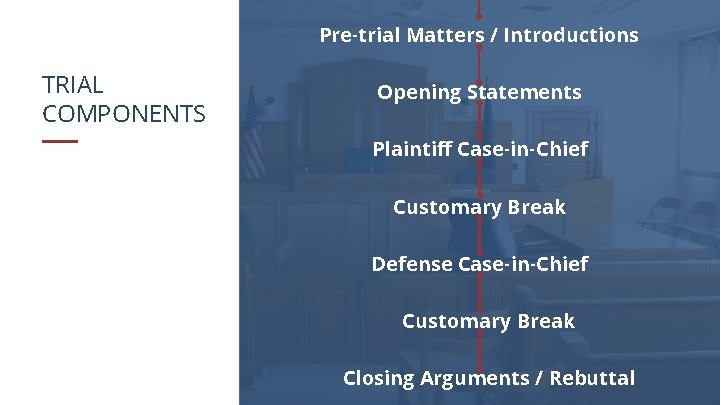
Pre-trial Matters / Introductions TRIAL COMPONENTS Opening Statements Plaintiff Case-in-Chief Customary Break Defense Case-in-Chief Customary Break Closing Arguments / Rebuttal
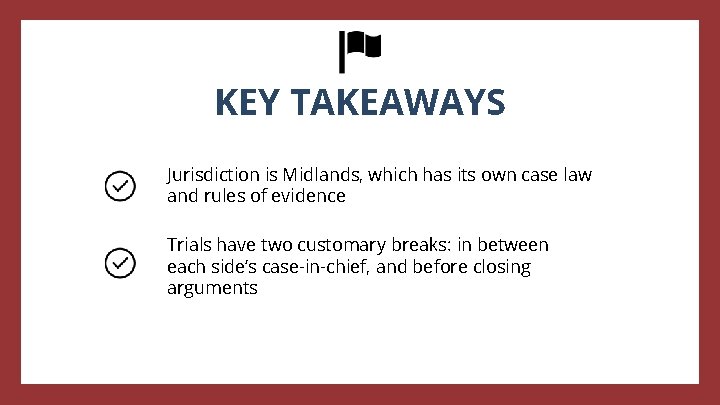
KEY TAKEAWAYS Jurisdiction is Midlands, which has its own case law and rules of evidence Trials have two customary breaks: in between each side’s case-in-chief, and before closing arguments
PRESIDING, SCORING, & COMMENTING How to evaluate the round
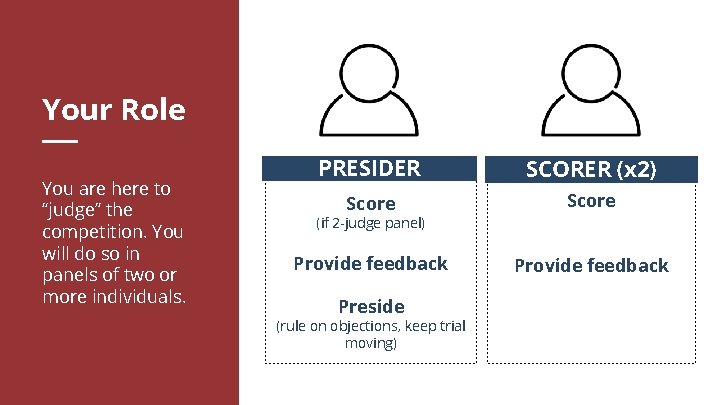
Your Role You are here to “judge” the competition. You will do so in panels of two or more individuals. PRESIDER SCORER (x 2) Score Provide feedback (if 2 -judge panel) Preside (rule on objections, keep trial moving)
! You’re not reaching a verdict.
Notes for Presiders Differences from realworld trials Both teams must. . . • Present opening statements at the start of trial • Call three witnesses • Cross-examine all witnesses called
Notes for Presiders Differences from realworld trials • NO objections to openings or closings • NO motions in limine, for a directed verdict, or mistrial • NO side bars • NO objections or questions from the judges • NO scope limitations on cross-examination (but scope is limited on re-direct and re-cross examination) • NO requirements that expert witnesses be tendered • NO binding federal precedents (e. g. Mc. Donnell Douglas Corp. v Green does not control the burden of proof), though competitors will inform you of Midlands case law if necessary.
SCORING THE TRIAL
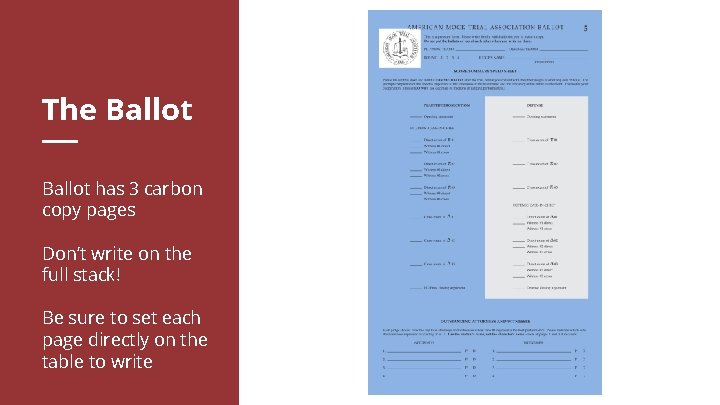
The Ballot has 3 carbon copy pages Don’t write on the full stack! Be sure to set each page directly on the table to write
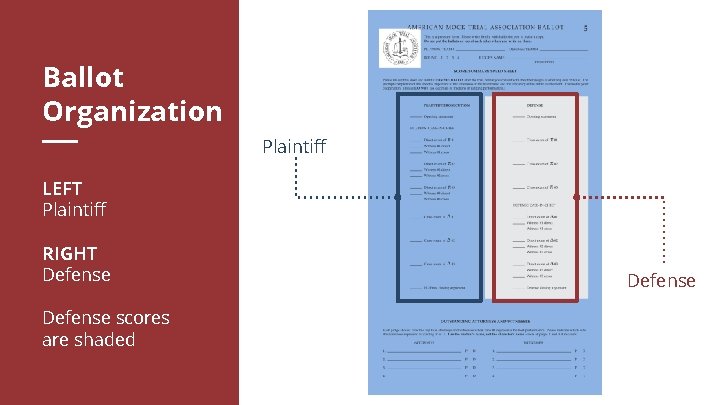
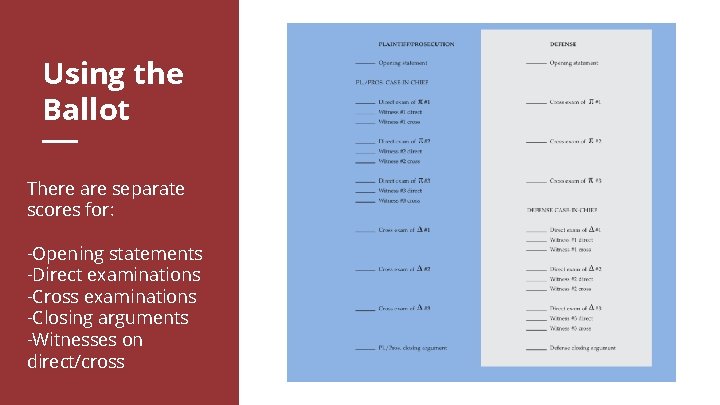
Ballot Organization Plaintiff LEFT Plaintiff RIGHT Defense scores are shaded Defense
Scoring Framework RANGE CALIBRATION Score from 1 -10, with 10 being the highest score Score differences between teams No decimals, only whole numbers No zeros* * Unless the role didn’t occur Scale doesn’t matter, just be internally consistent
! Use whole numbers, no zeros, and write legibly!
Using the Ballot There are separate scores for: -Opening statements -Direct examinations -Cross examinations -Closing arguments -Witnesses on direct/cross
NOTE No separate scores for: ● Pre-trial matters ● Re-direct examinations ● Re-cross examinations ● Rebuttal ● Objections Instead, you can consider these in the corresponding scored portion (for example, the rebuttal may influence your score for closing).
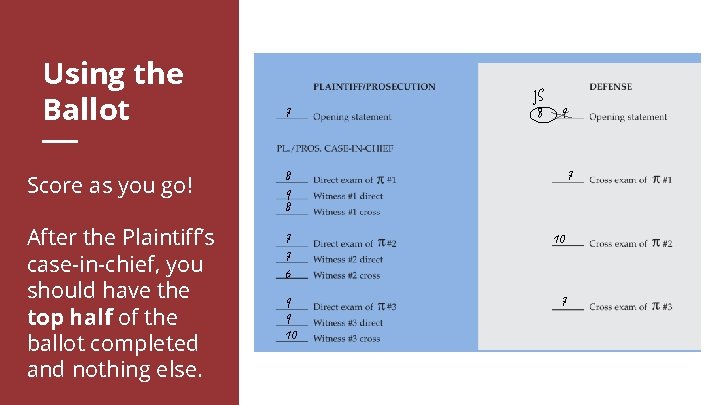
Using the Ballot Score as you go! After the Plaintiff’s case-in-chief, you should have the top half of the ballot completed and nothing else. 7 JS 8 9 8 7 7 6 9 9 10 7
! Score as you go & write scores on the ballot!
NOTE There are several differences from other competitions: ● Witnesses are scored ○ Scored on both direct and cross examination ● Witnesses are allowed to wear costumes, but they’re not required ● Attorneys and witnesses are allowed to use demonstrative aids (subject to objection)
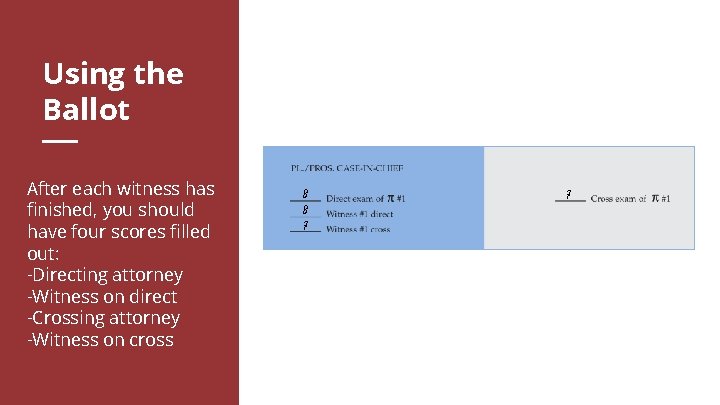
Using the Ballot After each witness has finished, you should have four scores filled out: -Directing attorney -Witness on direct -Crossing attorney -Witness on cross 8 8 7 7
! Score on your own. Don’t confer with your co-judge.
IMPEACHMENTS This competition has NO “invention of fact” objection; instead, the rules allow impeachment for an invention of fact. • Teams may NOT invent a material fact on directexamination—such inventions are subject to impeachment. • If you believe a successful impeachment has occurred, you should reflect that in your score by penalizing the violating team, rewarding the impeaching team, or both.
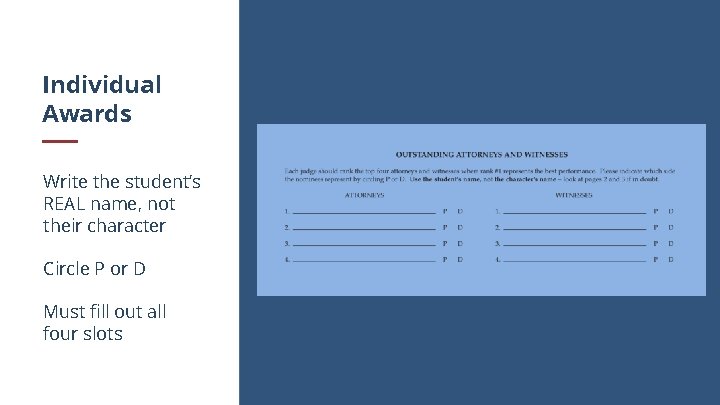
Individual Awards Write the student’s REAL name, not their character Circle P or D Must fill out all four slots
PROVIDING COMMENTS
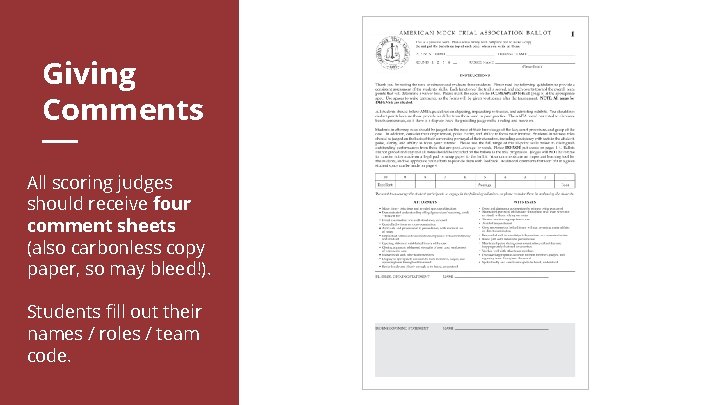
Giving Comments All scoring judges should receive four comment sheets (also carbonless copy paper, so may bleed!). Students fill out their names / roles / team code.
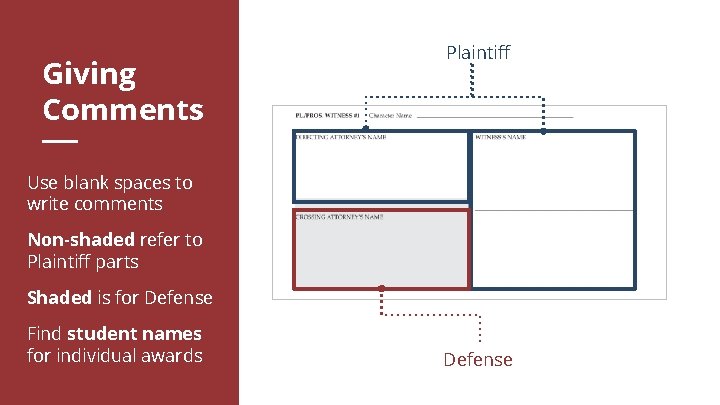
Giving Comments Plaintiff Use blank spaces to write comments Non-shaded refer to Plaintiff parts Shaded is for Defense Find student names for individual awards Defense
Giving Comments Students will receive copies of the written comments after the competition After the trial is complete, please provide a few minutes of verbal feedback
KEY TAKEAWAYS Score as you go & write scores on the ballot! Don’t confer with your co-judge Rank individual awards, and use students’ real names Score on performance, not the merits of the case
TIMEKEEPING & OTHER RULES Keeping by the AMTA book
! All trials must be completed within 3 hours.
Timekeepers Students act as timekeepers The trial has a 3 -hour time limit, and each part of the trial has specific time limits Please enforce time limits when informed of them to avoid exceeding the “all-loss time”
Anonymity & Spectators Students’ school identity should remain anonymous until after the round All trials are public; don’t assume the identity of the teams based on who enters the courtroom
AMTA Representatives Ensure that all rules are followed May enter the courtroom to inform you of time limit issues May enter the courtroom to resolve conflicts students brought to their attention Please follow their instructions!
Conflicts If you have already judged a team at this particular tournament, please DON’T start the trial; inform the AMTA representative If you are affiliated with the team (i. e. your child is on the team), please DON’T start the trial; inform the AMTA representative
KEY TAKEAWAYS All trials must be completed in 3 hours Keep trials moving; let students argue objections, but be aware of time limitations Provide verbal feedback, but try to limit to 10 minutes for the entire panel to keep rounds moving Be aware of potential conflicts
What happens next? Questions & Judging Assignments!
Thanks!