PRAGMATICS SCHEDULE May 14 Yule ch 1 2
- Slides: 22
PRAGMATICS
SCHEDULE May 14: Yule ch. 1, 2 and 3 May 16: Yule ch. 4, 5 and 6 May 21: Yule ch. 7, 8 and 9 May 22: Seminar • EXAM Thursday; May 31, 14 - 18 Language history 40 points, pragmatics 20 points, second lang. acquisition 20 points = 80 points
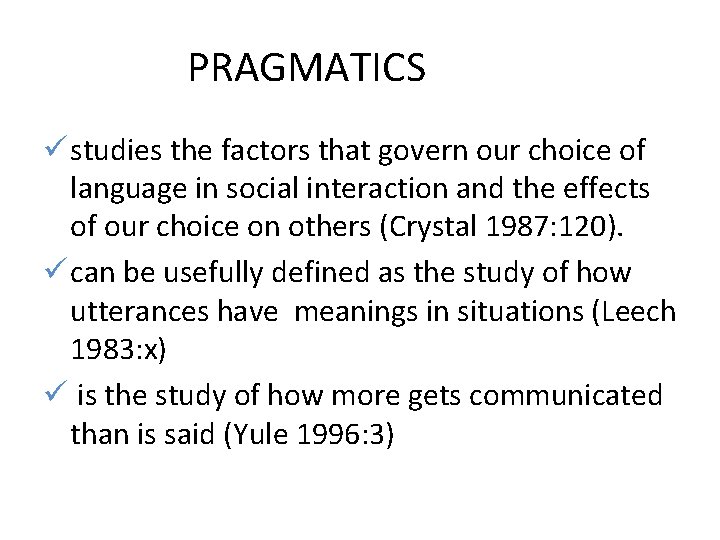
PRAGMATICS ü studies the factors that govern our choice of language in social interaction and the effects of our choice on others (Crystal 1987: 120). ü can be usefully defined as the study of how utterances have meanings in situations (Leech 1983: x) ü is the study of how more gets communicated than is said (Yule 1996: 3)
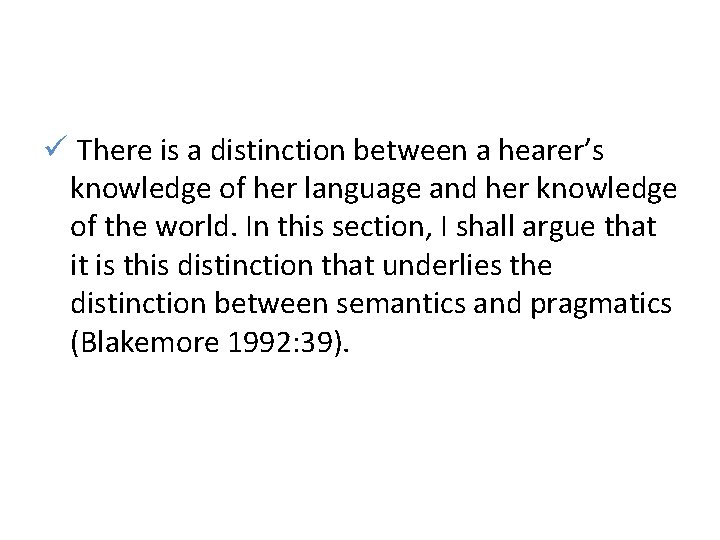
ü There is a distinction between a hearer’s knowledge of her language and her knowledge of the world. In this section, I shall argue that it is this distinction that underlies the distinction between semantics and pragmatics (Blakemore 1992: 39).
PRAGMATICS = the study of üspeaker meaning ücontextual meaning ühow more gets communicated than is said ürelative distance
Speaker meaning It is the speaker’s intention and the listener’s interpretation rather than words and phrases that give the utterance its meaning; That dog looks friendly
Contextual meaning What is said to whom, where, when, under what circumstances; This soup isn’t hot!
How more gets communicated than is said We ’hear’ more than what we are told; - Did you go to the Tower and the British Museum? - We went to the Tower. (= we infer that X did not go to the British Museum)
Relative distance By using different deictic expressions we can signal distance, both mentally and physically; That is your problem! These are my children.
BUT, also: Regularity: pragmatics is the study of regular language use: I bought an ice cream and ate it. *I ate an ice cream and bought it. The sequential nature is a pragmatic principle
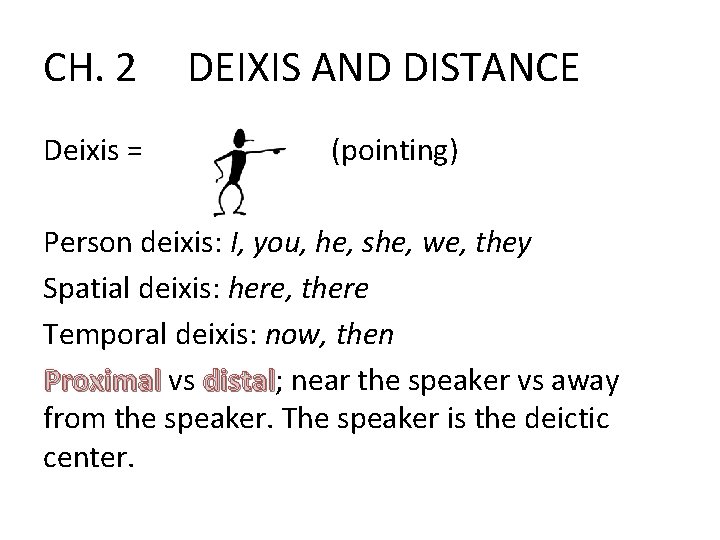
CH. 2 Deixis = DEIXIS AND DISTANCE (pointing) Person deixis: I, you, he, she, we, they Spatial deixis: here, there Temporal deixis: now, then Proximal vs Proximal distal; near the speaker vs away distal from the speaker. The speaker is the deictic center.
PERSON DEIXIS Can show social distance. WE – exclusive: We want a refund (we – not you) WE – inclusive: We’re in luck (we and you) Let’s: Let’s go for a coffee. Let us: Let us bring our bags.
SPATIAL DEIXIS Not necessarily fixed physically, but also mentally = deictic projection, e. g. Answerphone: I’m not here, but leave a message… Psychological distance and physical distance are closely linked.
TEMPORAL DEIXIS Then = both past & present: Then I realised that I had seen him before. OK; we’ll see then how we solve it. Present tense = proximal Past tense = distal + also unlikely events, not close to present reality: If I won a million pounds (cf. if I win a million pounds) distance from current reality or facts.
DEIXIS AND GRAMMAR Direct vs indirect speech. A shift in deixis when direct > indirect to show the distal aspect. Ex. Direct: I think he is quite a nice guy. Indirect (reported): She said she thought he was quite a nice guy. The tense shows the speaker taking one step away from the context.
CH. 3 REFERENCE AND INFERENCE Reference – the act in/with which a speaker or writer uses linguistic forms (= referring expressions) to enable a listener or reader to identify something. Indef > proper noun > pronoun; A child > the child > Daisy > she
REFERENCE Reference has to do with the speaker’s goals and beliefs and is not based on objectively correct naming, but on locally successful choices locally of expression. Successful reference is collaborative, ie speaker and hearer cooperate and agree to agree. Give this to the ham sandwich.
REFERENCE AND ATTRIBUTIVE USE Not all referring expressions have identifiable physical referents, eg. I want to find a job with an enormously high salary and no effort involved. We talk about attributive (ie something that may not exist) as opposed to use (something we know to exist):
The culprit is assumed to have left the country. What would be the difference in interpreting this as either attributive or referential? Expressions themselves don’t have reference; they are ‘loaded’ or ‘invested’ with referential function, in a context, by a speaker and picked up by a listener (if successful).
NAMES AND REFERENTS Names don’t only refer to persons: Can I borrow your Yule? Inference: Name > book/painting/… Pragmatic connection = a conventional association between a person’s name and an object (eg. Yule + his book)
THE ROLE OF CO-TEXT The co-text (= linguistic environment) limits the range of possible interpretations cf. the cheese sandwich But also context (= physical environment) can have a very powerful impact. A broken leg came in at 5 am. CONTEXT A broken leg can be very painful. CO-TEXT
ANAPHORICAL REFERENCE How do we keep track of reference for long texts? We use q. Anaphora q. Antecedent q. Cataphora q. Zero anaphora/Ellipsis