
PART 1 Course Book Syllabus Introduction 1 Course
PART 1 Course Book & Syllabus Introduction

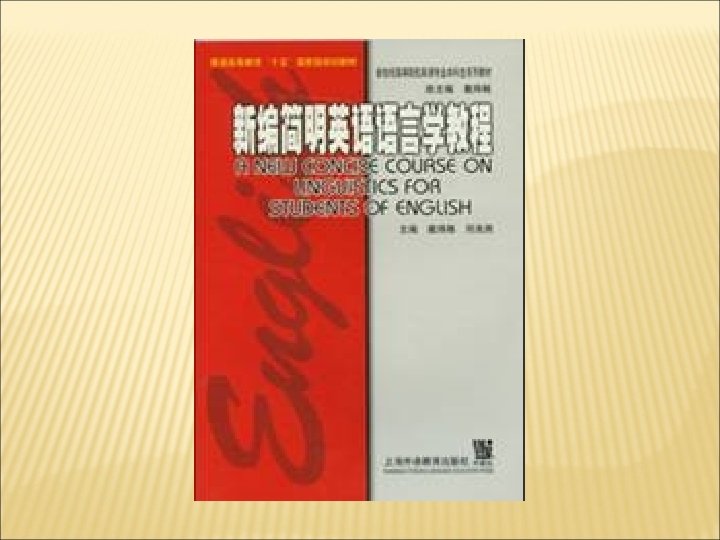
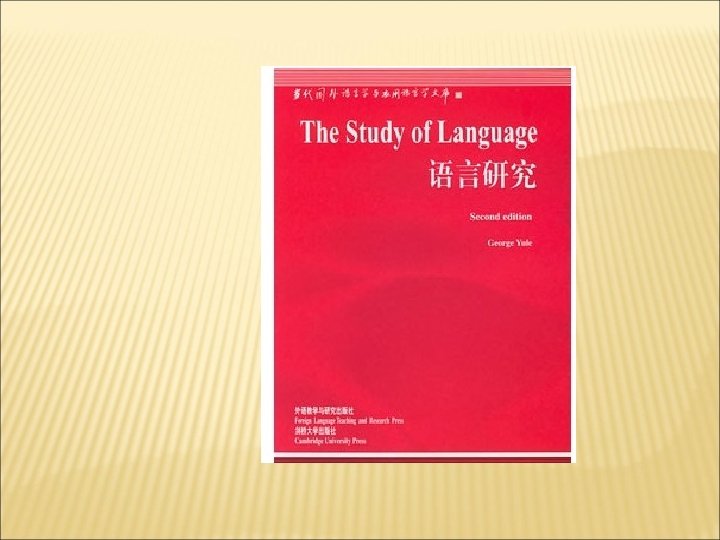
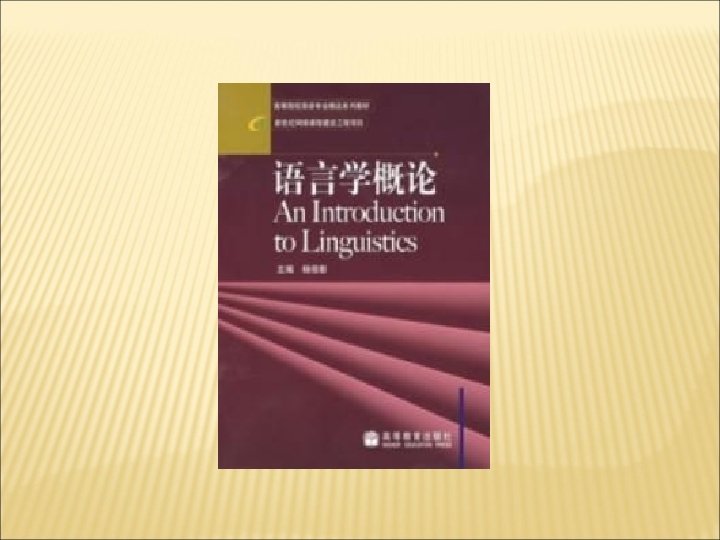
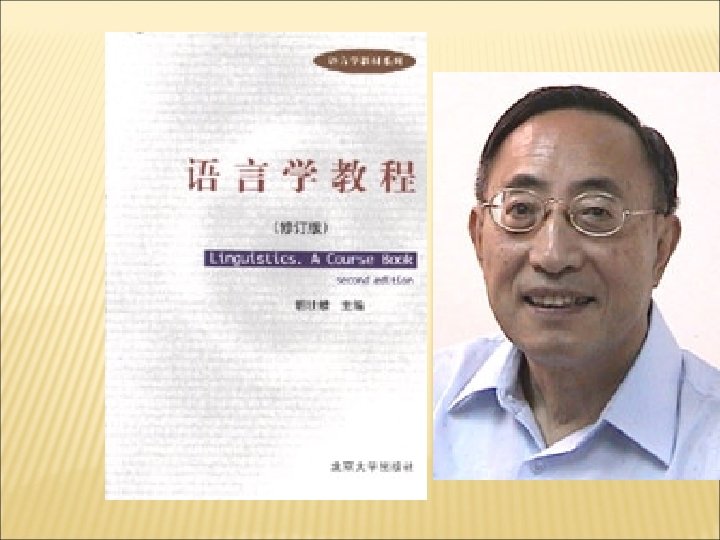
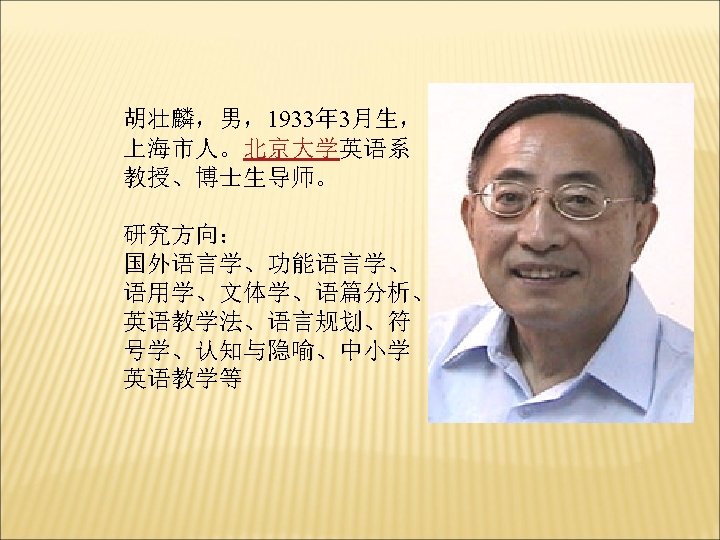
1. Course book
2. SYLLABUS DESIGN FOR AN INTRODUCTION TO ENGLISH LINGUISTICS

� 课程描述(COURSE DESCRIPTION) � This course is an introductory course to the study of language. It deals with topics that an English major or teacher should KNOW about language and the different subfields of LINGUISTICS, such as phonetics, phonology, morphology, syntax, semantics, pragmatics, and text /discourse analysis, as well as the different methods employed in the study, analysis, and understanding of language in each subfield.
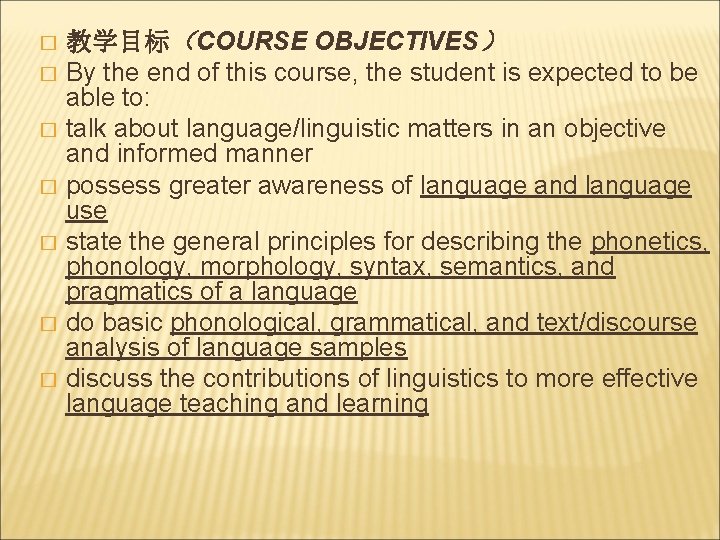
� � � � 教学目标(COURSE OBJECTIVES) By the end of this course, the student is expected to be able to: talk about language/linguistic matters in an objective and informed manner possess greater awareness of language and language use state the general principles for describing the phonetics, phonology, morphology, syntax, semantics, and pragmatics of a language do basic phonological, grammatical, and text/discourse analysis of language samples discuss the contributions of linguistics to more effective language teaching and learning
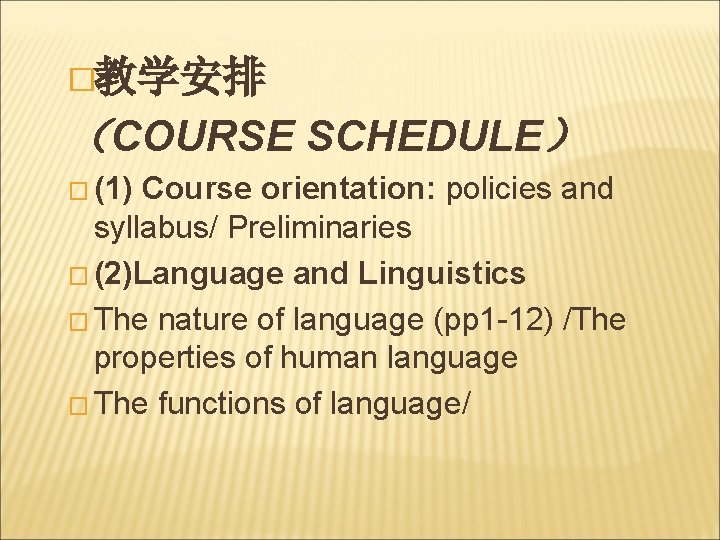
�教学安排 (COURSE SCHEDULE) � (1) Course orientation: policies and syllabus/ Preliminaries � (2)Language and Linguistics � The nature of language (pp 1 -12) /The properties of human language � The functions of language/
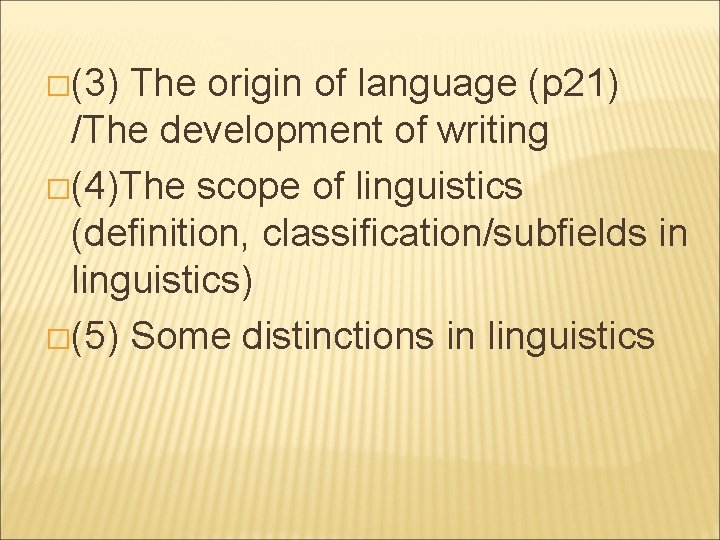
�(3) The origin of language (p 21) /The development of writing �(4)The scope of linguistics (definition, classification/subfields in linguistics) �(5) Some distinctions in linguistics
� (6)Phonetics � Organs of speech/ The sounds of language / Voicing/ Place of articulation/ � Manner of articulation/ Vowels � (7) Phonology � Transcription and Characteristics of Sounds/ Phone, phoneme and allophone/ The sound patterns of language (Minimal Pairs/Complementary distribution) � (8) Sequential rules/ assimilation/elision/ suprasegmental features(syllable, stress, pitch, intonation, tone) Phonetics Quiz
� � � � (9) Morphology Definition of a word/ identification of words/classification of words/ the syntactic category of the word (Group work) (10) Morpheme and its types (allomorph)/ Word formation processes/ Lexicon/ Morphology Quiz (11) Syntax Phrase structure rules/ major or minor lexical categories (12) Sentence structure rules (sentence types/ syntactic function and tategory) (13) Transformation rules (deep vs. surface structure/ syntactic function and category)
� (14) Semantics � Approaches to meaning/ semantic analysis (semantic features/ semantic roles) � (15) Semantic fields/ semantic relations/ lexical relations (synonymy/antonymy/ hyponymy/ prototypes/homophony/homonymy/polysemy /metonymy/collocation) (Group work and individual presentation)
� � � (16) Pragmatics and Text analysis Definition of pragmatics/ invisible meaning and context/cohesion (deixis vs. reference/ sense vs. reference/ presupposition) (17) Austin’s speech act theory/ Searle’s speech act theory and its classification (18) The principles of conversation (The cooperative principle/The politeness principle) (19) Presupposition and the structure of spoken text (presupposition/ exchange vs. adjacency pair)/ due on Essay 3
� (20) Language and Brain � Language and Machines (individual report) � (21) First language acquisition � Second language acquisition and learning (individual presentation)
� (22) Linguistics and language teaching/learning � Approaches to language teaching � Syllabus design � Contrastive analysis/ error analysis � Language testing � (23) Language Varieties � Language and Culture (Sapir-whorf Hypothesis) � Language History and Change
� (24) Language and Society � The scope of sociolinguistics � Speech community and speech variety � Language and gender � Register � Bilingualism vs. diaglossia � (25) Final Review � Independent study
� � 教学方法(METHODOLOGY) Regular class sessions involve lecture, discussion based on reading, assignments, short essays, and tests. The short essays are required to choose 3 topics from the textbook, which you want to discuss or share your opinions with class or your partners; simultaneously the essays are complete by group work. The assignments/short essays should be expected to be typed less than 3 pages long, double-space, 12 -pt Times Roman font, one-inch margin on all sides and printed on A 4 paper.
� 教学要求(COURSE REQUIREMENTS) � Regular class attendance; active participation in class discussion; prompt submission of assignments; quizzes; short essays; final exam
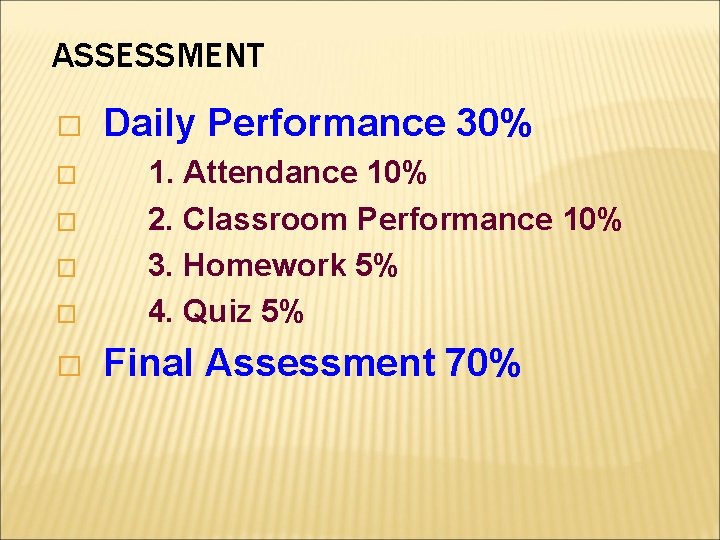
ASSESSMENT � � � Daily Performance 30% 1. Attendance 10% 2. Classroom Performance 10% 3. Homework 5% 4. Quiz 5% Final Assessment 70%
3. GENERAL DESCRIPTION Difficult � 2. Uninteresting � 3. Important � 1.
4. WAYS OUT Preview � 2. Review � 3. Remember � 4. Think � 1.
PART 2 TEACHING CONTENT Chapter One Language and linguistics
� 1. 1 The nature of language � 1. 2 The properties of human language � 1. 3 The functions of language � 1. 4 The origin of language � 1. 5 The development of writing � 1. 6 The scope of linguistics
1. 1 THE NATURE OF LANGUAGE � Definition of Language � Characteristics of Language
DEFINITION OF LANGUAGE Question: What’s language?
WHAT IS LANGUAGE? The definitions that linguist defined differently. For example: � Language is a tool for human communication. � Language is a system. � Language is a set of rules.
WEBSTER' S NEW WORLD DICTIONARY (PP. 759) [ 1 ] � � (a) human speech; (b)the ability to communicate by this means; (c) a system of vocal sounds and combinations of such sounds to which meaning is attributed, used for the expression or communication of thoughts and feelings; (d) the written representation of such a system;
WEBSTER' S NEW WORLD DICTIONARY (PP. 759) [2] 'any means of expressing or communicating, as gestures, signs, or animal sounds; � (b) a special set of symbols; letters, numerals, rules etc. used for the transmission of information, as in a computer; . . . � (a)
A GENERALLY ACCEPTED DEFINITION �Language is a system of arbitrary vocal symbols used for human communication. ——Wardhaugh, 1977
UNDERSTANDING THE DEFINITION � QS: � 1. Why a system? � 2. Why arbitrary? � 3. Why vocal? � 4. Why symbols? � 5. Why human? � 6. Why communication?
CHARACTERISTICS OF LANGUAGE � Language is a system. � Language is arbitrary. � Language is vocal. � Language is a symbol. � Language is human communication.
�Language is a system. �Elements in language arranged according to certain rules, they can not be combined at will. eg. In English, bkli is not a word, he tables a green is not a sentence.
� Language is arbitrary. � Different languages have different words for the same thing. For example, pen is an entity that we use to write with. Actually, the entity and the word pen do not have intrinsic connection. � Japanese: niwa ni kodomo ga sanbong alimas. � English: There are three children in the yard. � Chinese: yuanzi li you sange xiao hai.
� Language is vocal. � The primary medium is sound for all languages, no matter how well developed are their writing systems. � Writing systems are later than spoken forms; the fact is that children acquire spoken language first before they can read. � Language is a symbol. � Words are associated with objects, actions, ideas by convention (惯例,常规,标准).
�Language is human communication. � It is meant to specify that language is human-specific. �It does not equal to other communication systems such as bird songs, bee dancing, animal cries.
Animal and human language � � Animals can interact with human using symbols chosen by humans. Chimp’s performance is not comparable with that of human child’s. There is no objective, no controversial definition of what counts as “using language”. Findings from studies involving animals provide evidence against a language acquisition device (LAD)as proposed by Chomsky.
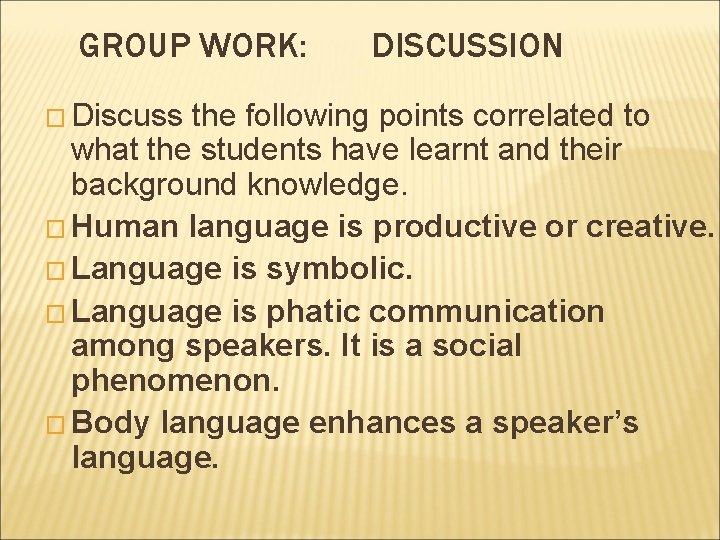
GROUP WORK: � Discuss DISCUSSION the following points correlated to what the students have learnt and their background knowledge. � Human language is productive or creative. � Language is symbolic. � Language is phatic communication among speakers. It is a social phenomenon. � Body language enhances a speaker’s language.
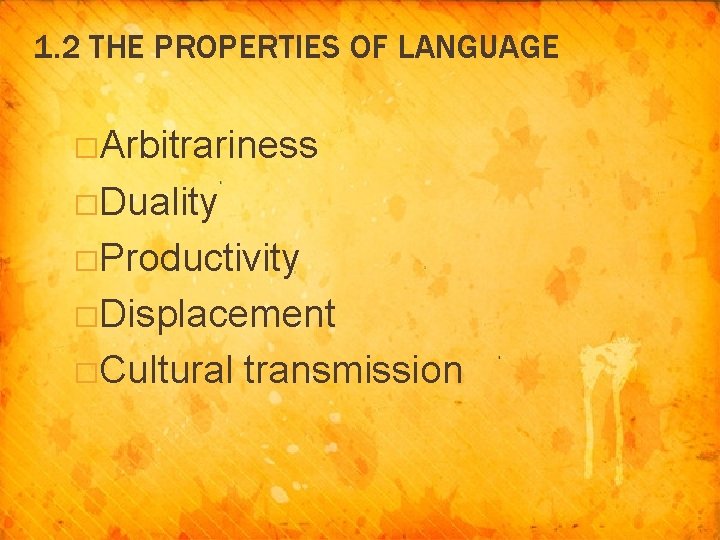
1. 2 THE PROPERTIES OF LANGUAGE �Arbitrariness �Duality �Productivity �Displacement �Cultural transmission
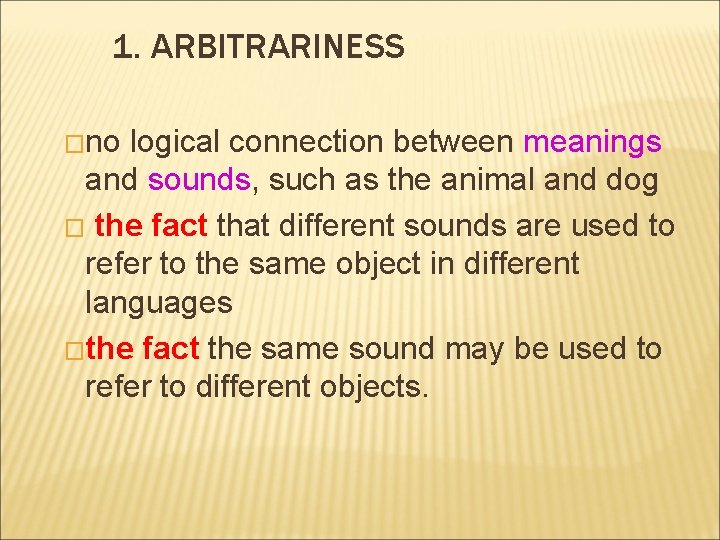
1. ARBITRARINESS �no logical connection between meanings and sounds, such as the animal and dog � the fact that different sounds are used to refer to the same object in different languages �the fact the same sound may be used to refer to different objects.

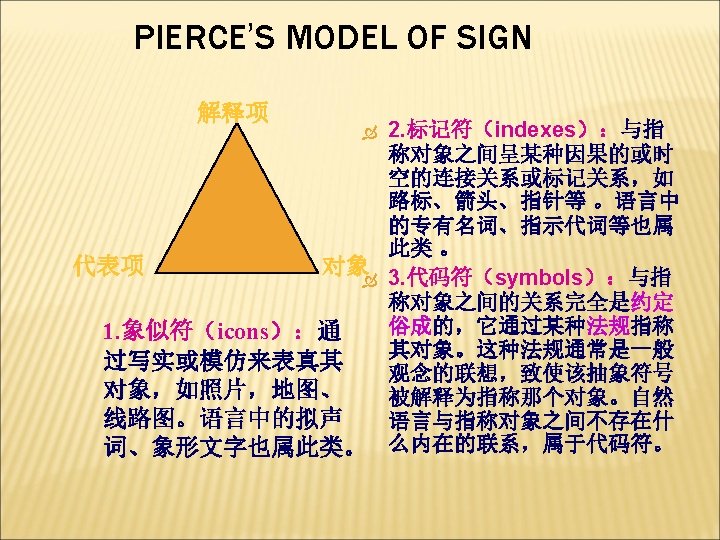
ARBITRARINESS AND SYMBOLIC NATURE OF LANGUAGE Words are just symbols, because they are associated with objects, actions, ideas, etc. by convention.
2. DUALITY(双重性) � By duality is meant the property of having two levels of structures, such that units of the primary level are composed of elements of the secondary level and each of the two levels has its own principles of organization. (Lyons 1982: 20)
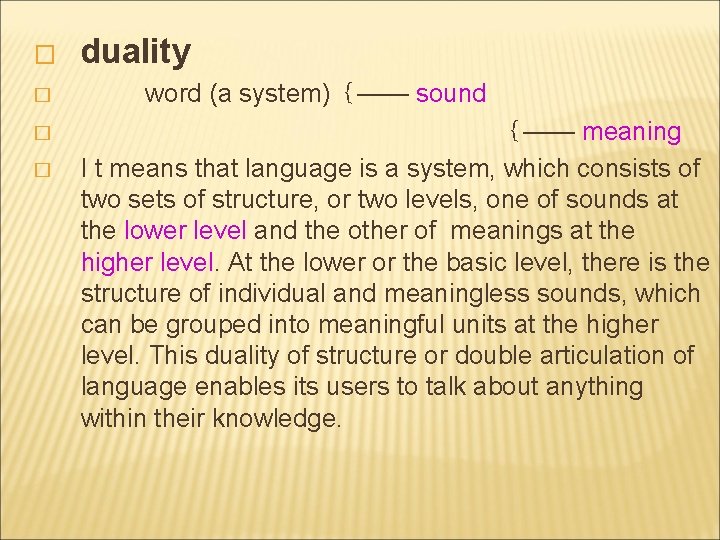
� � duality word (a system){—— sound {—— meaning I t means that language is a system, which consists of two sets of structure, or two levels, one of sounds at the lower level and the other of meanings at the higher level. At the lower or the basic level, there is the structure of individual and meaningless sounds, which can be grouped into meaningful units at the higher level. This duality of structure or double articulation of language enables its users to talk about anything within their knowledge.
DUALITY � We can make dictionaries of a language, but we can not make a dictionary of sentences of that language. � The numbers of words are relatively finite, but the numbers of sentences are absolutely infinite.
SIGNIFICANCE OF DUALITY � Because of duality, the speaker is able to combine the basic linguistic units to form an infinite set of sentences, most of which are never before produced or heard. (胡壮麟 2001: 7 -8) � In other words, language is productive because of its own duality.
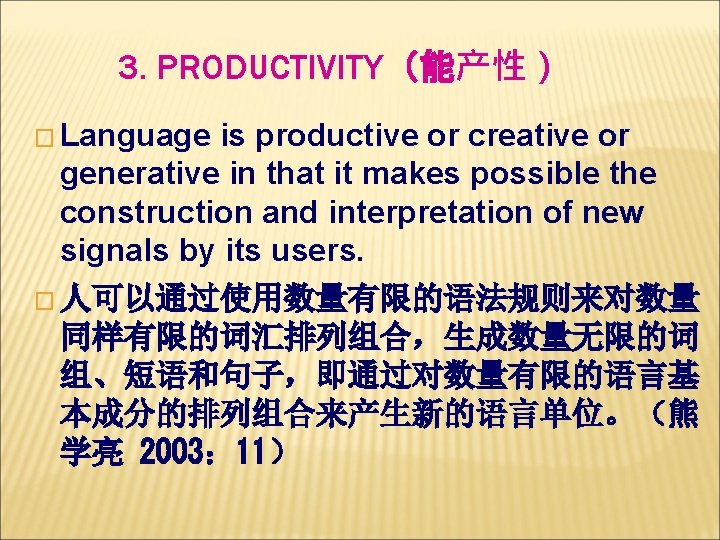
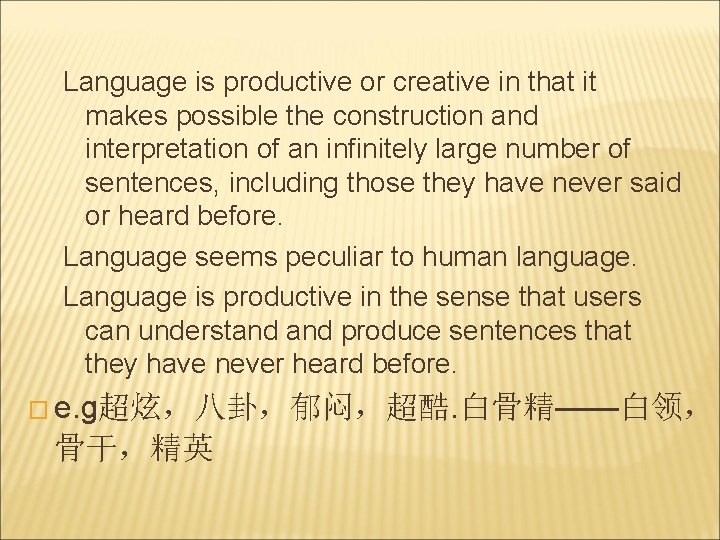
Language is productive or creative in that it makes possible the construction and interpretation of an infinitely large number of sentences, including those they have never said or heard before. Language seems peculiar to human language. Language is productive in the sense that users can understand produce sentences that they have never heard before. � e. g超炫,八卦,郁闷,超酷. 白骨精——白领, 骨干,精英
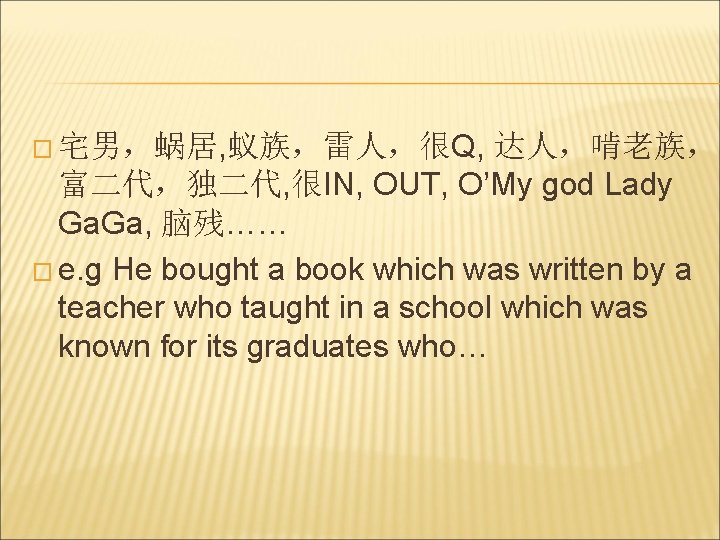
� 宅男,蜗居, 蚁族,雷人,很Q, 达人,啃老族, 富二代,独二代, 很IN, OUT, O’My god Lady Ga. Ga, 脑残…… � e. g He bought a book which was written by a teacher who taught in a school which was known for its graduates who…
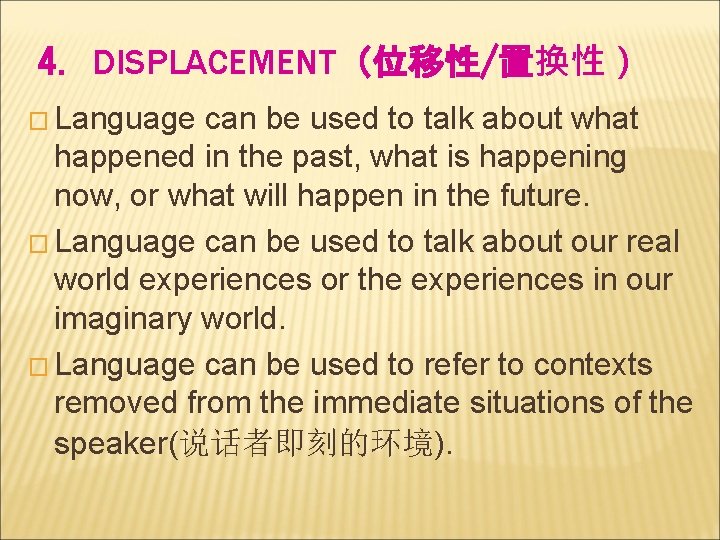
4. DISPLACEMENT(位移性/置换性) � Language can be used to talk about what happened in the past, what is happening now, or what will happen in the future. � Language can be used to talk about our real world experiences or the experiences in our imaginary world. � Language can be used to refer to contexts removed from the immediate situations of the speaker(说话者即刻的环境).
This property of language provides speakers with opportunity to talk about a wide range of things, free from the barriers caused by remoteness in time and place. 移位性指人类语言可以让使用者在交际时用 语言符号代表时间上和空间上并不可及的物 体、时间或观点。
5. CULTURAL TRANSMISSION (文化传递性) � By cultural transmission is meant that the details of any language system are not genetically but culturally transmitted. That is, it is passed on from one generation to the next through teaching and learning, rather than by instinct. � Therefore, it is also called learnability language.
IMPLICATIONS OF CULTURAL TRANSMISSION The importance of language exposition for the acquisition of one’s mother tongue. � 2. The importance of conscious study for the leaning of a foreign language. � 1.
CULTURAL TRANSMISSION � � � While we are born with the ability to acquire language, the details of any language are not genetically transmitted, but instead have to be taught and learned a new. Language is culturally transmitted. Human beings can learn a human language at birth and he has to be exposed to a language in order to acquire it.
1. 3 THE FUNCTIONS OF LANGUAGE Question: What do you think are the functions of language?
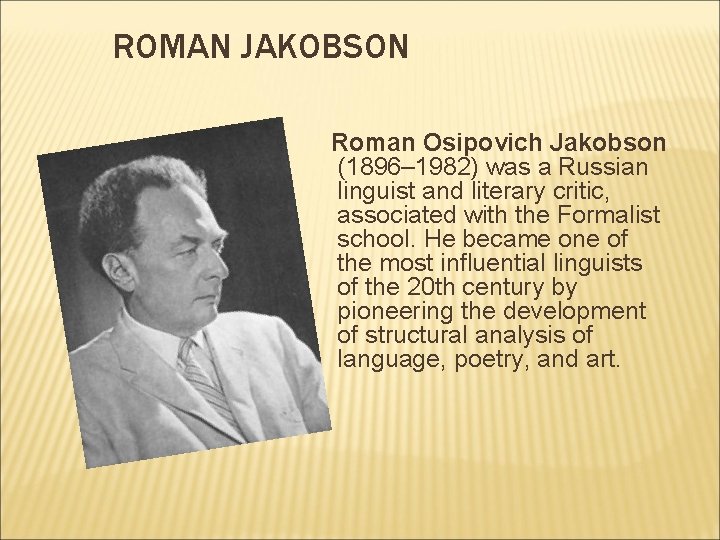
ROMAN JAKOBSON Roman Osipovich Jakobson (1896– 1982) was a Russian linguist and literary critic, associated with the Formalist school. He became one of the most influential linguists of the 20 th century by pioneering the development of structural analysis of language, poetry, and art.
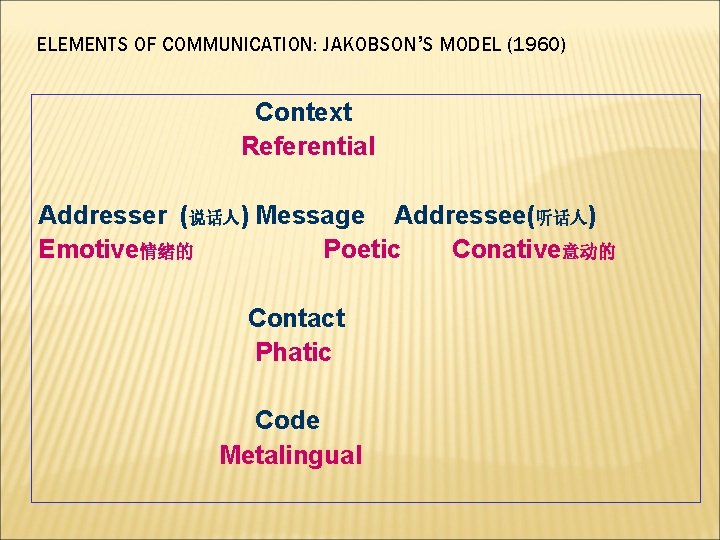
ELEMENTS OF COMMUNICATION: JAKOBSON’S MODEL (1960) Context Referential Addresser (说话人) Message Addressee(听话人) Emotive情绪的 Poetic Conative意动的 Contact Phatic Code Metalingual
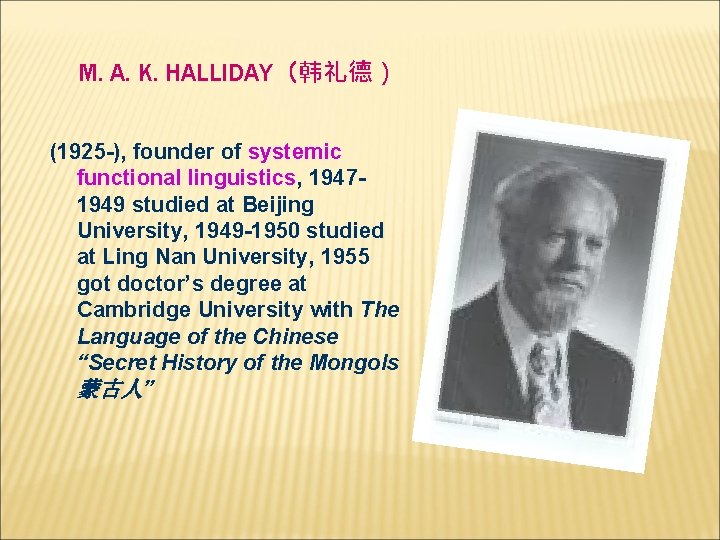
M. A. K. HALLIDAY(韩礼德) (1925 -), founder of systemic functional linguistics, 19471949 studied at Beijing University, 1949 -1950 studied at Ling Nan University, 1955 got doctor’s degree at Cambridge University with The Language of the Chinese “Secret History of the Mongols 蒙古人”

METAFUNCTIONS OF LANGUAGE: HALLIDAY’S MODEL � � � 1. Ideational(概念功能): Constructs a model of experience and constructs logical relations ( through transitive system) (Linguistic Constructionism) 2. Interpersonal(人际功能): enacts social relationships (through mood and modality) 3. Contextual(语篇功能): creates relevance to context (through coherence and cohesion) Systemic Functional Linguistics
SUMMARY OF THE FUNCTIONS OF LANGUAGE (胡壮麟,2002: 8 -11) Informative (信息功能): Language serves an informative function when it is used to tell what the speaker believes, to give information about facts, or to reason things out. � By use of Declarative Sentences � 1.
� Informative——to tell what the speaker believes, to give information about facts, to reason things out. � Water boils at 212 degree Fahrenheit. � Gold melts at 300 degree Fahrenheit.
Interrogative(询问功能): When language is used to get information from others, it serves an interrogative function � 2. � Through � � Questions that expect answers. E. g. How have you been lately? What do you think of it?
Interpersonal(人际功能): Language serves an interpersonal function when it is used to establish and maintain their status in a society. � Five sub-categories of interpersonal function: performative, directive, emotive, expressive, and phatic. � 3.
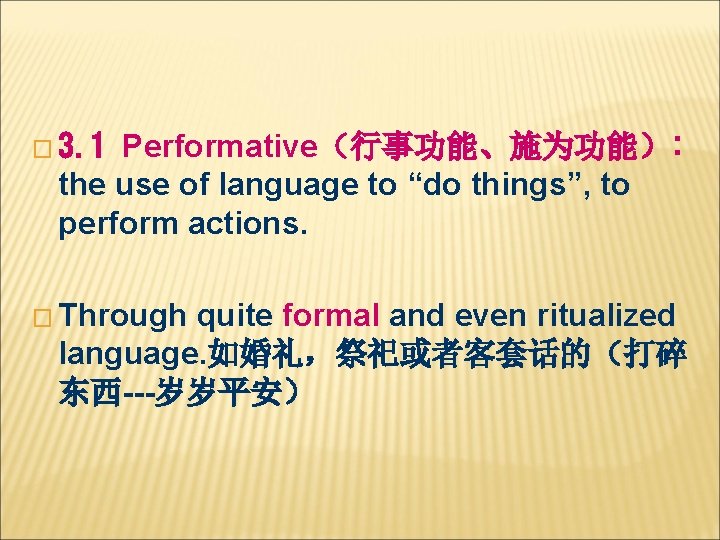
Performative(行事功能、施为功能): the use of language to “do things”, to perform actions. � 3. 1 � Through quite formal and even ritualized language. 如婚礼,祭祀或者客套话的(打碎 东西---岁岁平安)
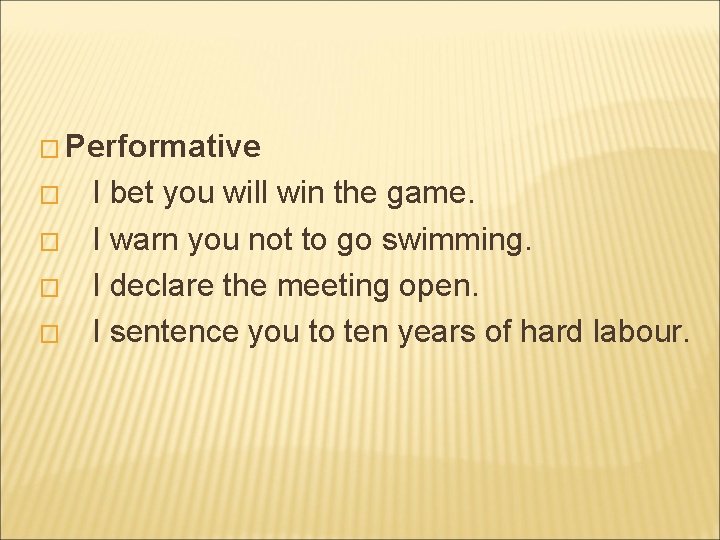
� Performative � � I bet you will win the game. I warn you not to go swimming. I declare the meeting open. I sentence you to ten years of hard labour.
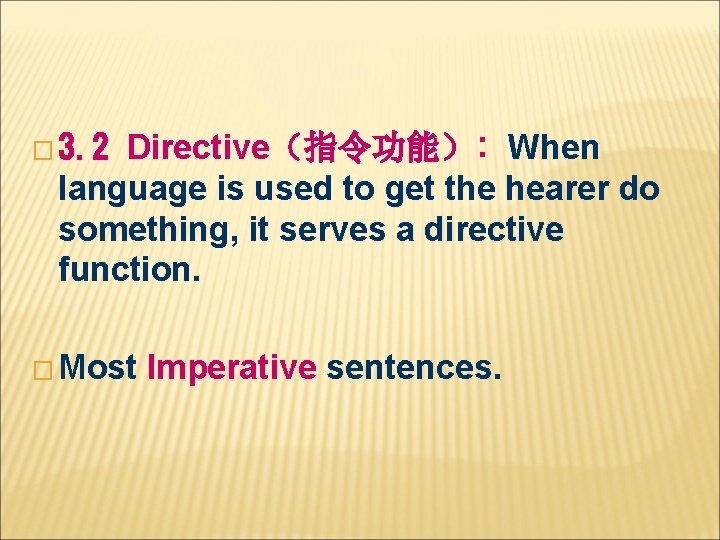
Directive(指令功能): When language is used to get the hearer do something, it serves a directive function. � 3. 2 � Most Imperative sentences.
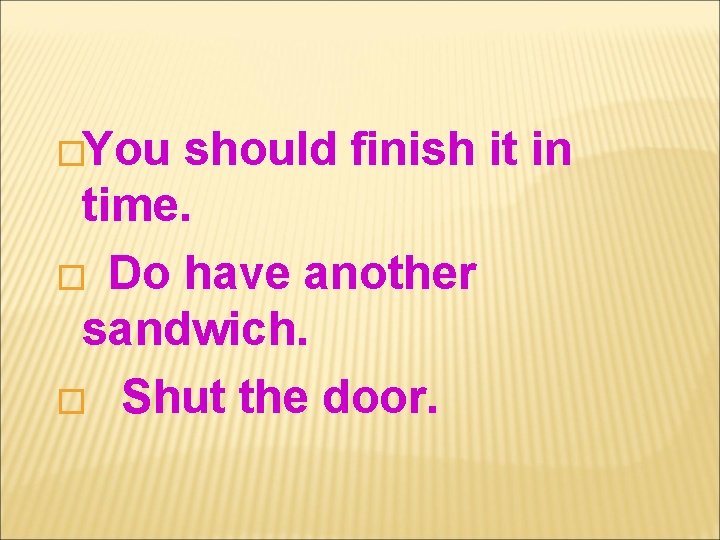
�You should finish it in time. � Do have another sandwich. � Shut the door.
Emotive(感情功能): the use of language to create certain feelings in the hearer. � 3. 3 � Through Jokes, Advertising, Propaganda(宣传), etc.
� 3. 4 Expressive(表达功能): the use of language to reveal something about the feelings and attitudes of the speaker. � Through Exclamations, etc.

Phatic(寒暄功能): the use of language to establish an atmosphere or maintaining social contact. � 3. 5 � E. g. Greetings, Farewells, and Comments on the weather, etc.
Recreational(娱乐功能): the use of language for the sheer joy of using it. � 4. � E. g. baby’s babbling, poetry, 儿歌等
� The enjoyment of sound itself and the melody of certain combination of sounds. � E. g The moumurous haunt of flies on summer eve. (---John Keats) � Syntax level � e. g rearrangement by inversion/ellipsis of normal phrase or clause order
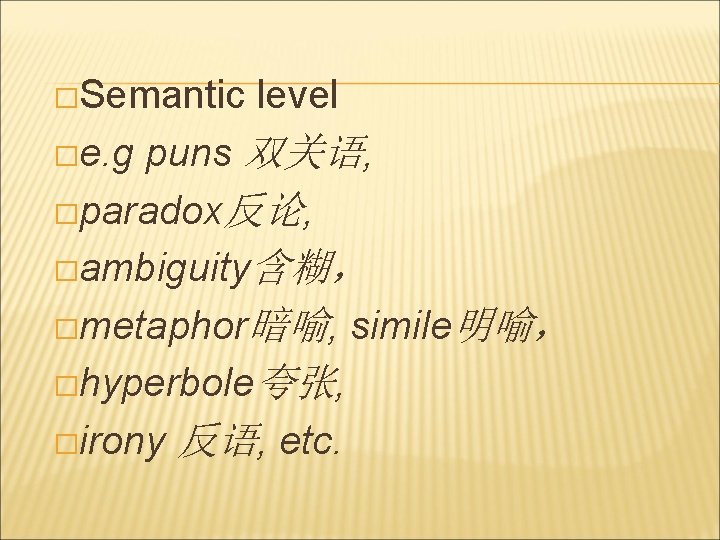
�Semantic level puns 双关语, �paradox反论, �ambiguity含糊, �metaphor暗喻, simile明喻, �hyperbole夸张, �irony 反语, etc. �e. g
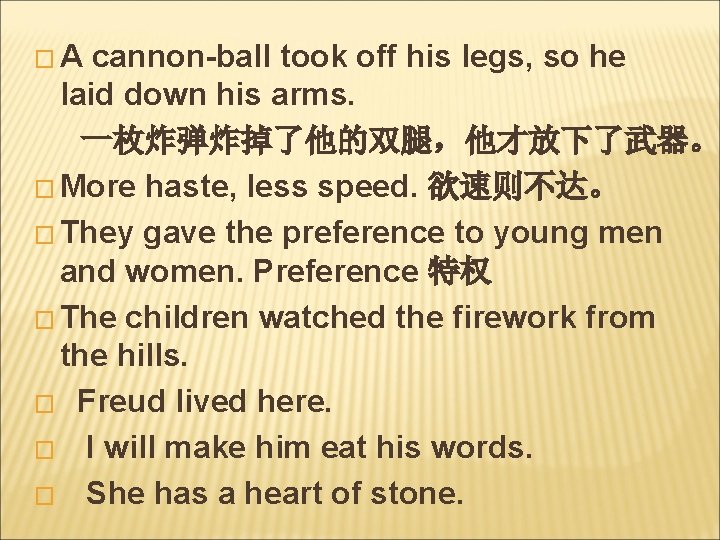
�A cannon-ball took off his legs, so he laid down his arms. 一枚炸弹炸掉了他的双腿,他才放下了武器。 � More haste, less speed. 欲速则不达。 � They gave the preference to young men and women. Preference 特权 � The children watched the firework from the hills. � Freud lived here. � I will make him eat his words. � She has a heart of stone.
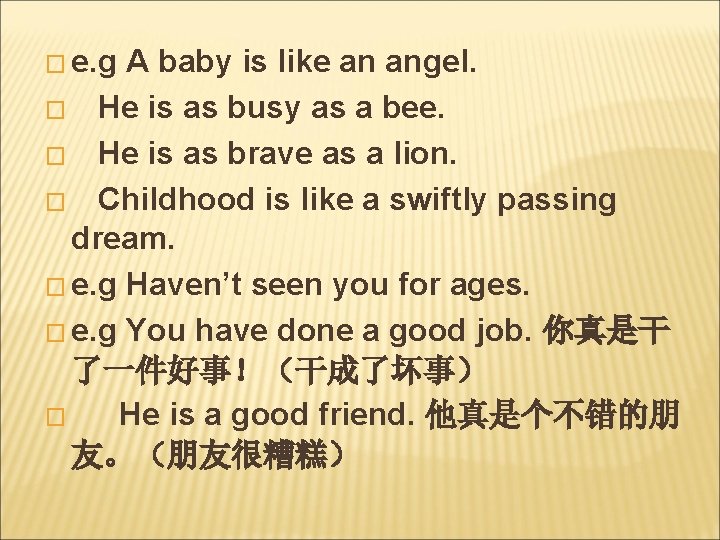
� e. g A baby is like an angel. � He is as busy as a bee. � He is as brave as a lion. � Childhood is like a swiftly passing dream. � e. g Haven’t seen you for ages. � e. g You have done a good job. 你真是干 了一件好事!(干成了坏事) � He is a good friend. 他真是个不错的朋 友。(朋友很糟糕)
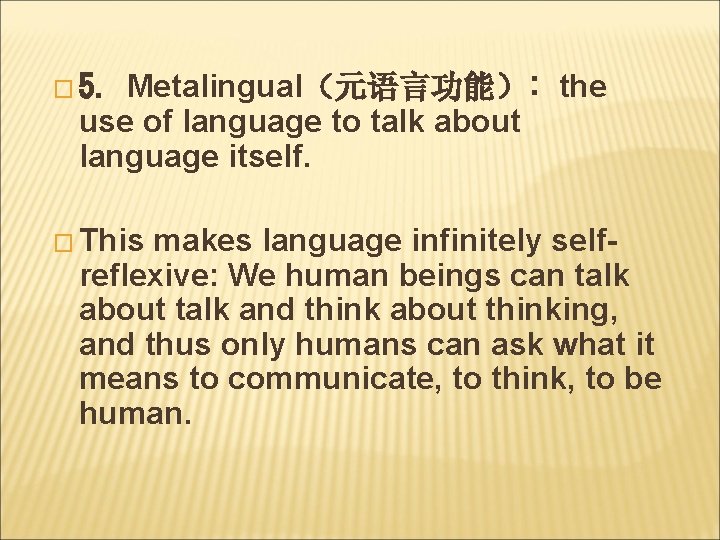
Metalingual(元语言功能): the use of language to talk about language itself. � 5. � This makes language infinitely selfreflexive: We human beings can talk about talk and think about thinking, and thus only humans can ask what it means to communicate, to think, to be human.
OTHER FUNCTIONS OF LANGUAGE �recording �identifying �reasoning
1. 4 THE ORIGIN OF LANGUAGE
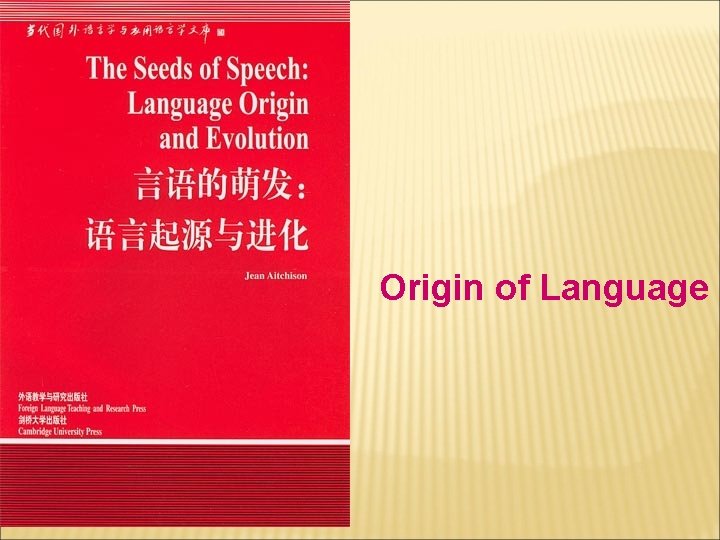
Origin of Language
QUESTION How did language come into being? �
The Divine- Origin Theory 1
ADAM’S NAMING And out of the ground the LORD God formed e ve ry be a st of the field, and every fowl of the a ir; a nd brought them unto Adam to see wha t he woul d ca l l them: and whatsoever Ad a m ca l l e d e ve ry living cre a ture , tha t was the name thereof. 耶 和 华 神 用 土 所 造 成 的 野 地 各 样 走 兽 和 空 中 各 样 飞 鸟 都 带到那人面前, 看 他 叫 什 么 。 那 人 怎 样 叫 各 样 的 活 物 , 那 就 是 它 的 名 字 。
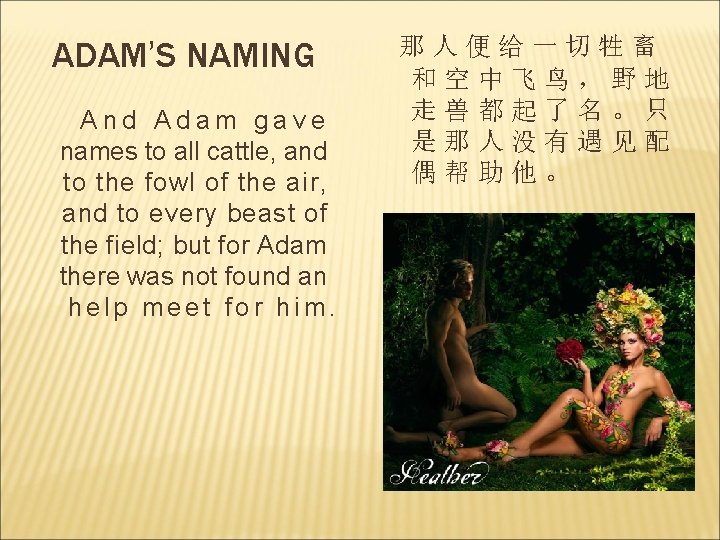
ADAM’S NAMING And Adam gave names to all cattle, and to the fowl of the air, and to every beast of the field; but for Adam there was not found an help meet for him. 那人便给一切牲畜 和空中飞鸟,野地 走兽都起了名。只 是那人没有遇见配 偶帮助他。
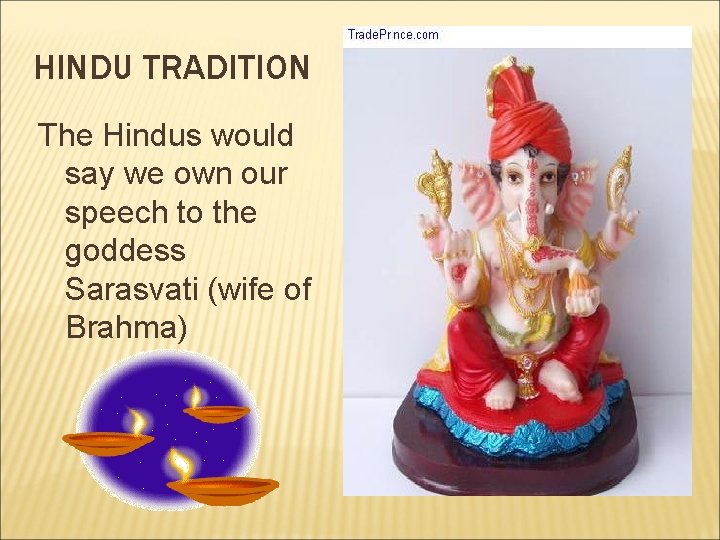
HINDU TRADITION The Hindus would say we own our speech to the goddess Sarasvati (wife of Brahma)
The Invention Theory 2
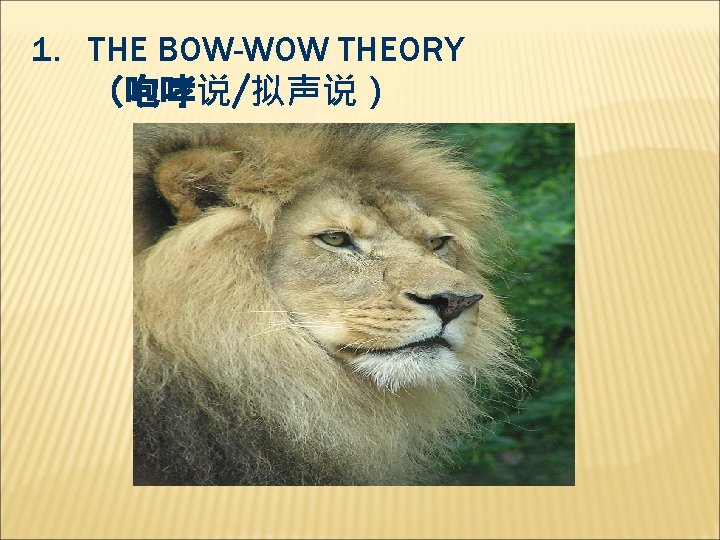
1. THE BOW-WOW THEORY (咆哮说/拟声说)
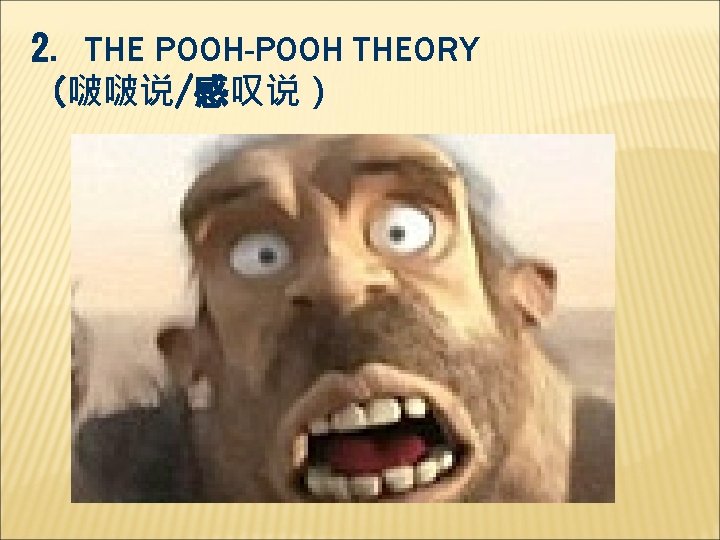
2. THE POOH-POOH THEORY (啵啵说/感叹说)
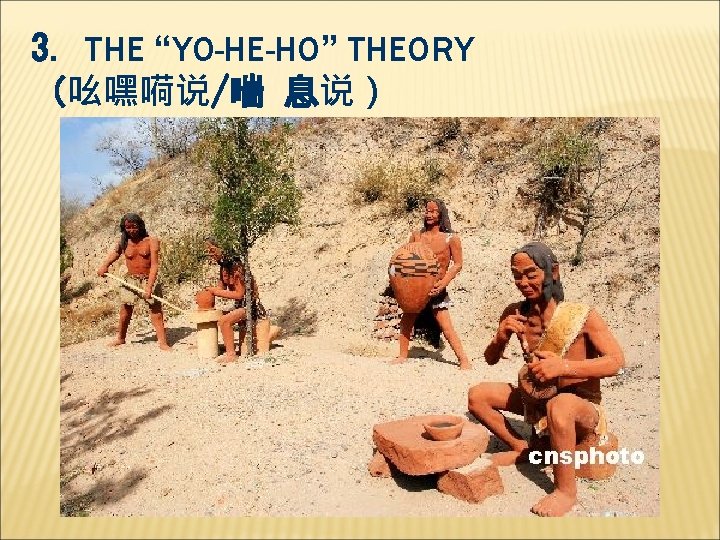
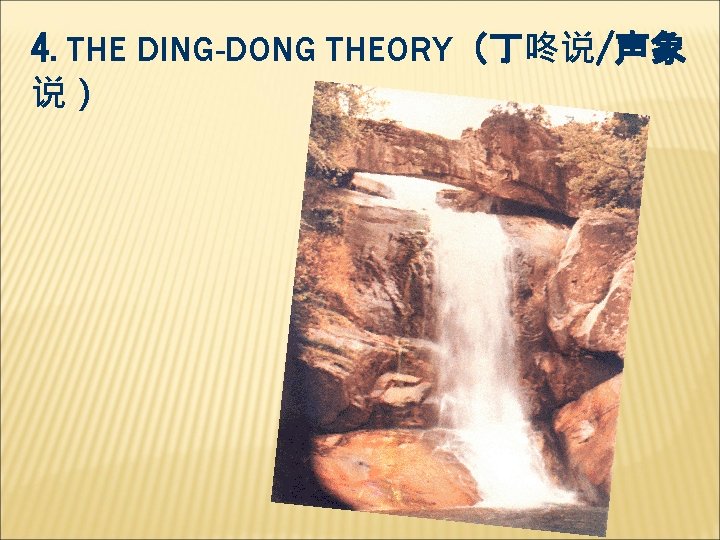
4. THE DING-DONG THEORY(丁咚说/声象 说)
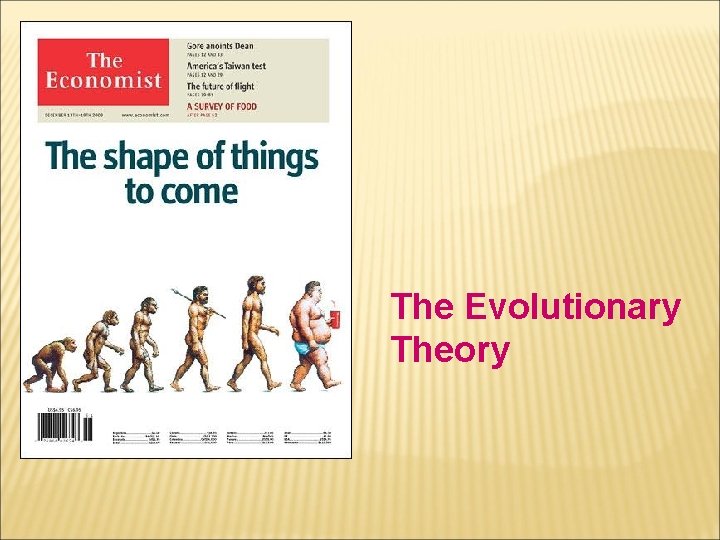
The Evolutionary Theory 3

THERE IS CERTAIN RELATIONSHIP BETWEEN THE DEVELOPMENT OF LANGUAGE AND THE EVOLUTIONARY DEVELOPMENT OF THE HUMAN SPECIES. � 1. Children are born with both thought and language. � 2. The development of the physical apparatus for speech. � 3. It is labor that created the necessity for language.

CERTAIN PHYSICAL FEATURES FOR HUMAN � Human teeth are upright. � Human lips have more intricate muscles � Human tongue is flexible � Human mouth can be opened and closed rapidly � Human larynx(喉)is lower thereby creating the pharynx (resonator咽)
INTERACTION AND TRANSACTION � a). Speech: two main purposes. Interaction – mainly a social function of language. Transaction – mainly a function involving the communication of knowledge and information. � b). There is a need for a more permanent record of information

1. 5 THE DEVELOPMENT OF WRITING
�Pictograms �Ideograms �Logograms �Rebus Writing �Syllabic Writing �Alphabetic Writing
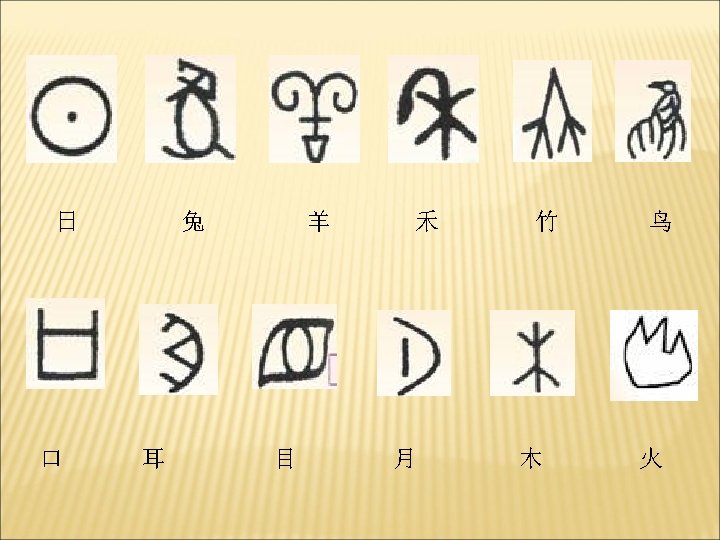
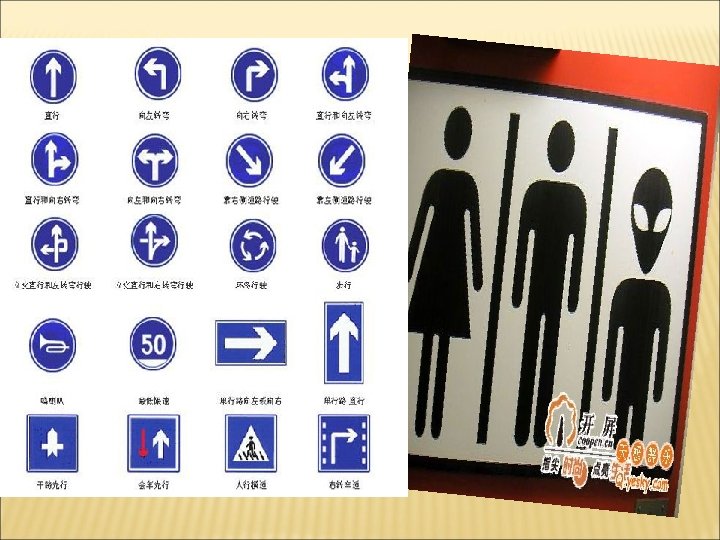
PICTOGRAMS � � use of a representative symbol to convey meaning; a conventional relationship must exist between the symbol and its interpretation 形符,象形图,图画字
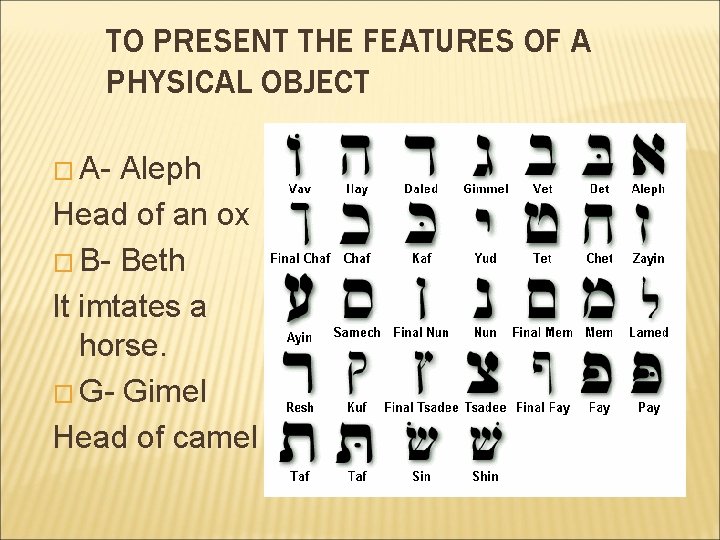
TO PRESENT THE FEATURES OF A PHYSICAL OBJECT � A- Aleph Head of an ox � B- Beth It imtates a horse. � G- Gimel Head of camel
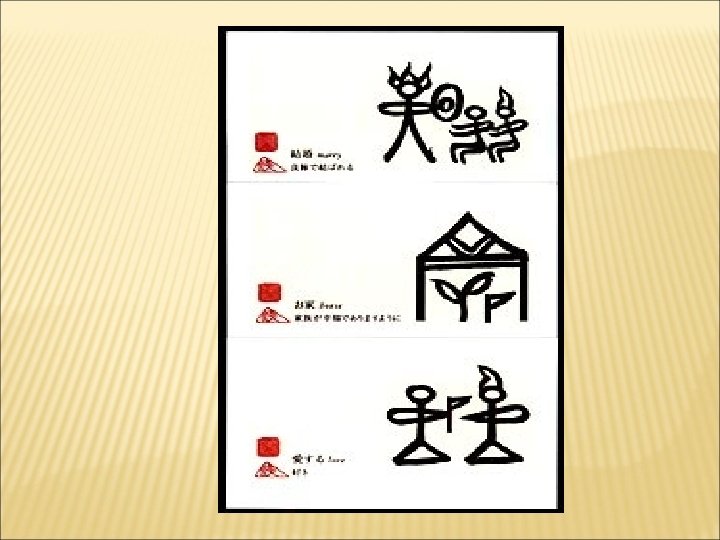
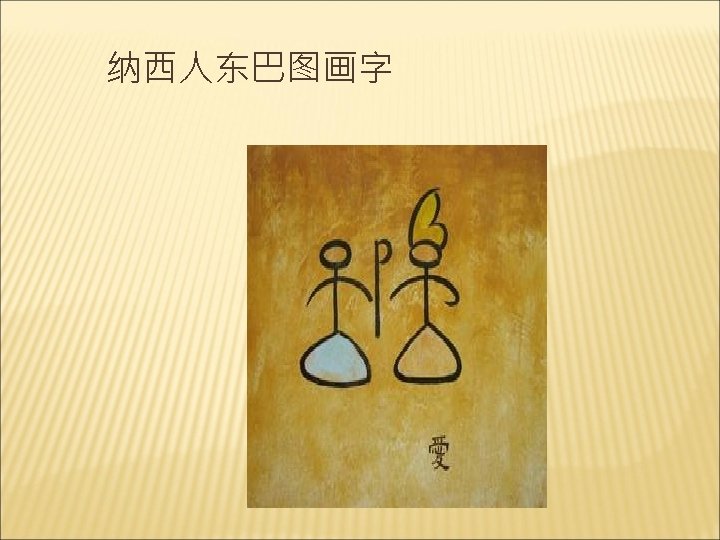
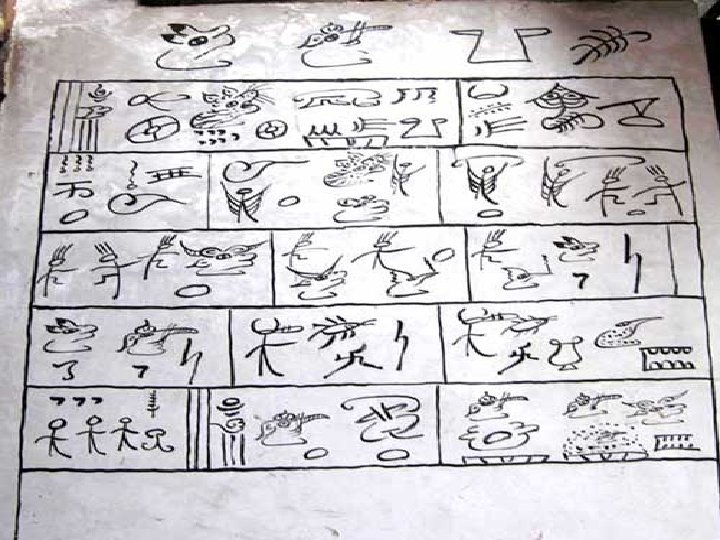
MANY CHINESE CHARACTERS DERIVED FROM PICTOGRAMS
INTERNATIONAL ROAD SIGNS OR SIGNS ON PUBLIC TOILETS USE MODERN PICTOGRAMS
IDEOGRAMS � more abstract relationship between symbol and interpretation � 意符、表意符号、表意字
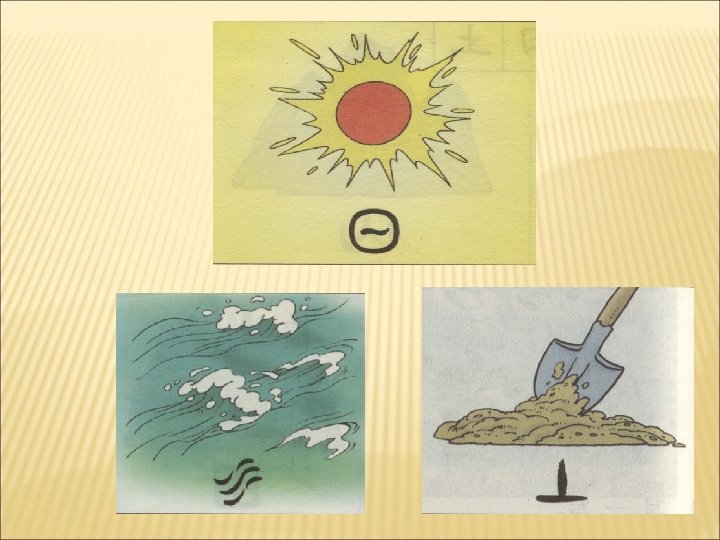
Neither pictograms nor ideograms represent words or sounds of a language; they present concepts or objects.
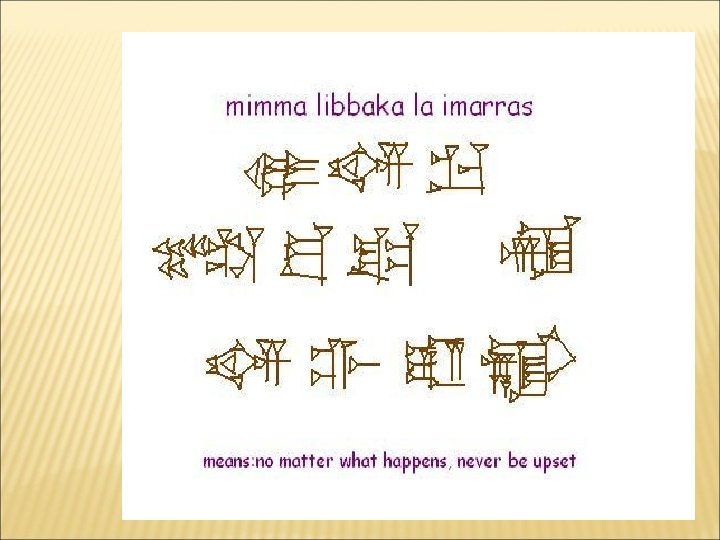
LOGOGRAMS Symbols are used to represent words in a language. (表字符号) 例如:楔形文字和汉字
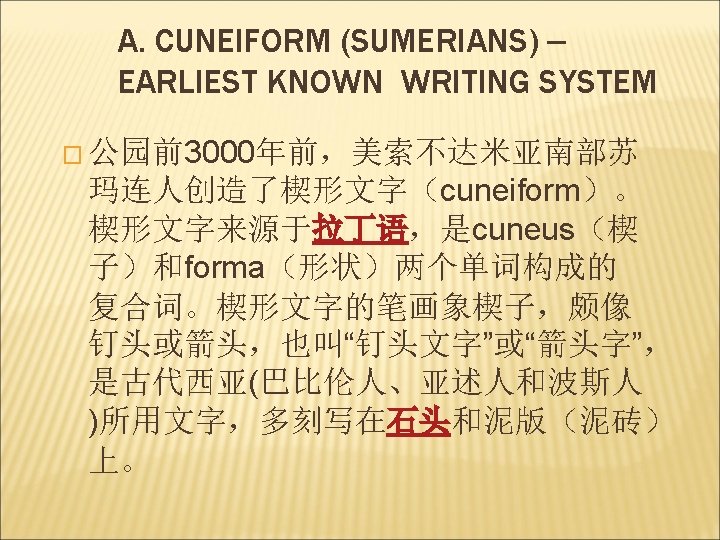
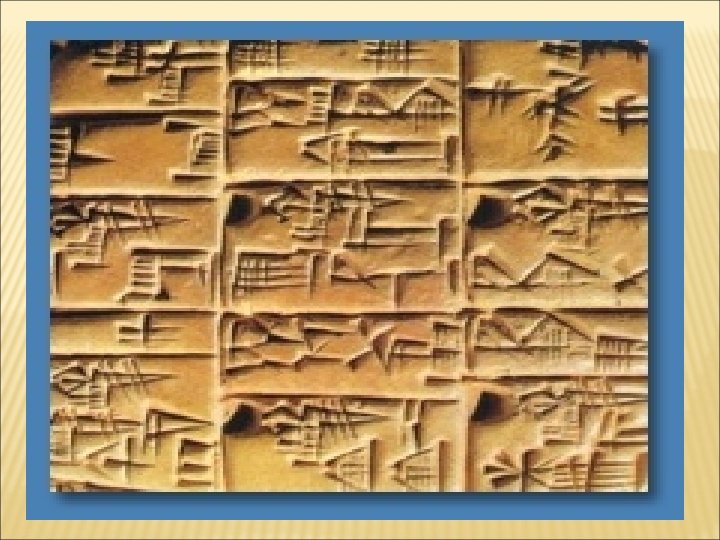
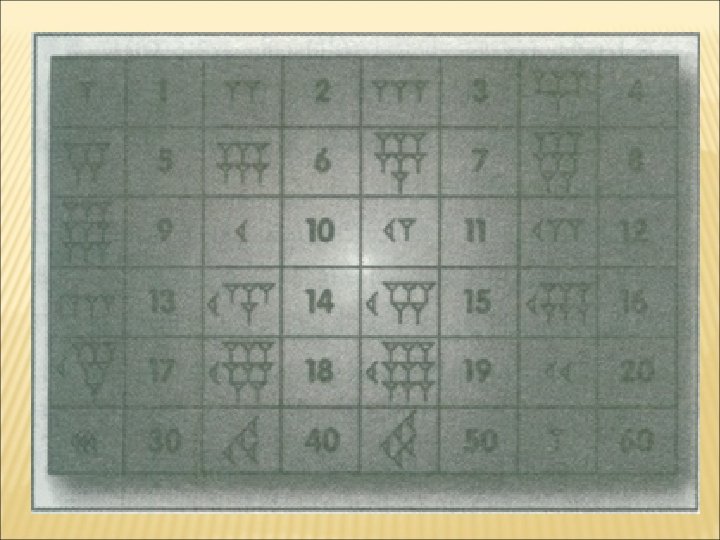
B. CHINESE CHARACTERS—— MODERN USE OF LOGOGRAMS �Many Chinese symbols, or characters, are used as representations of the meaning of words and not of the sounds of the spoken language.
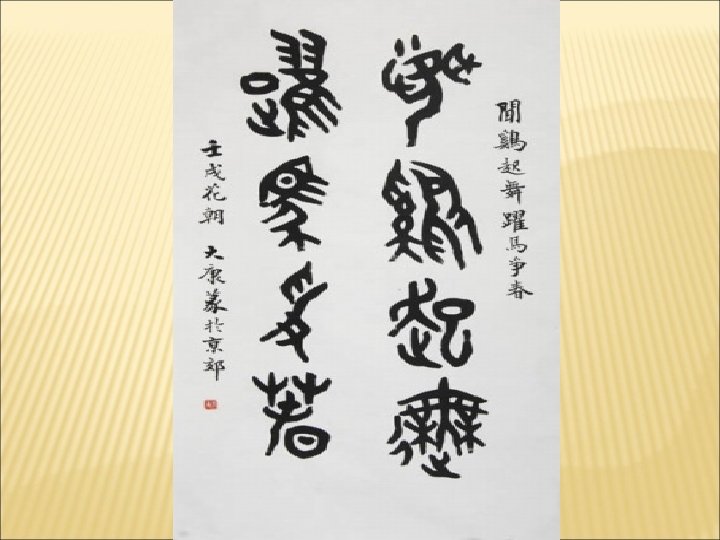
�Advantage: Speakers of two Chinese dialects (languages) can read and understand the same text. �Disadvantage: Speakers have to memorize and recognize many different written symbols.
REBUS WRITING Symbol for an entity is used to represent the sound of the spoken word used to refer to that entity. 图意书写

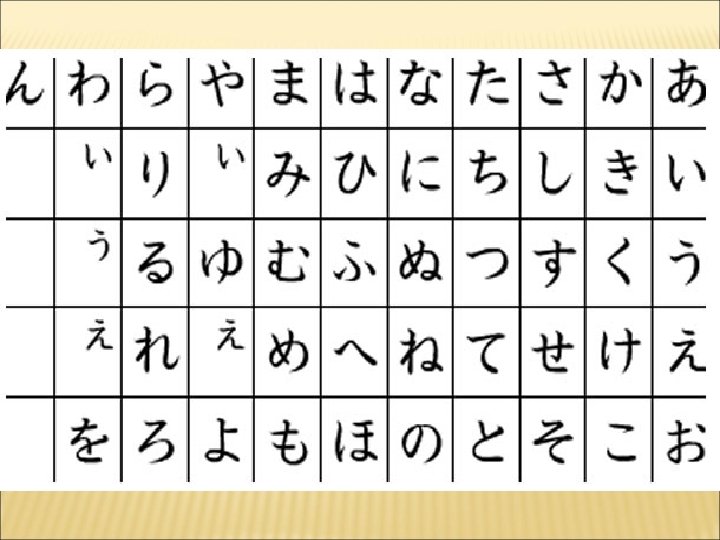
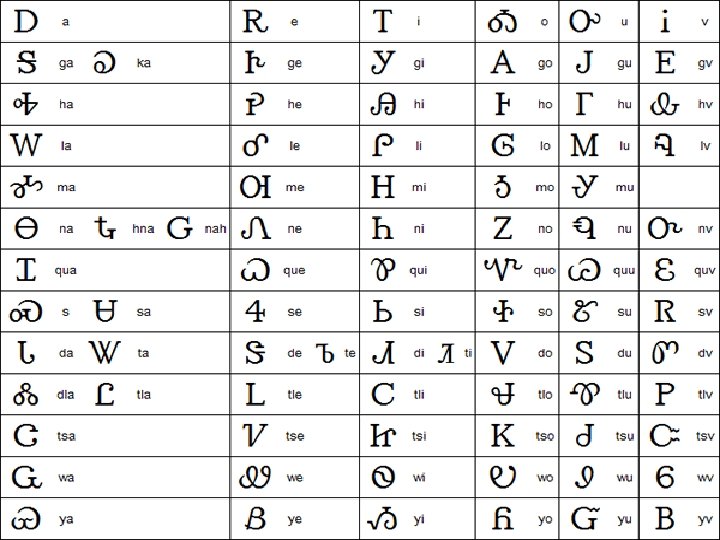
SYLLABIC WRITING A set of symbols is used to represent the pronunciation of syllables in the language. e. g. Japanese, Cherokee
ALPHABETIC WRITING symbols represent single sounds in the language (English, Arabic, Hebrew, Greek, Cyrillic)
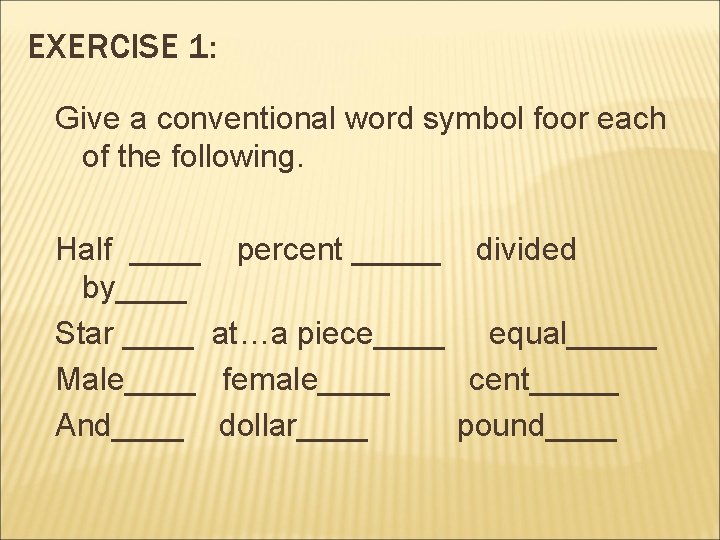
EXERCISE 1: Give a conventional word symbol foor each of the following. Half ____ percent _____ divided by____ Star ____ at…a piece____ equal_____ Male____ female____ cent_____ And____ dollar____ pound____
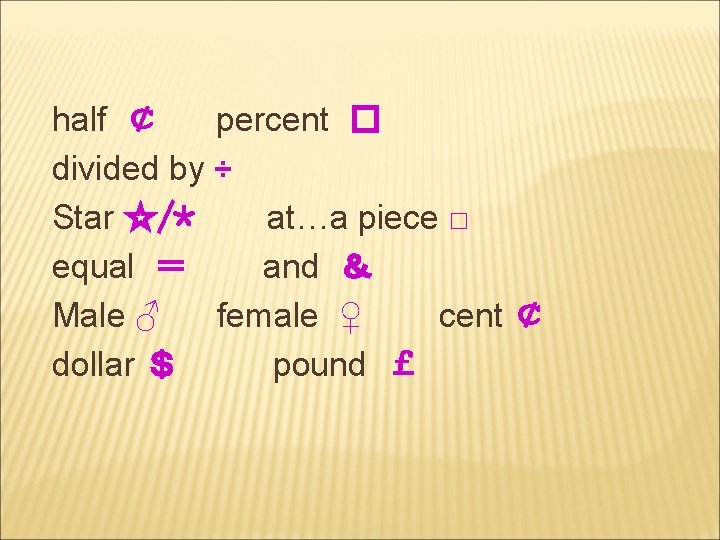
half ¢ percent � divided by ÷ Star ☆/* at…a piece □ equal = and & Male ♂ female ♀ cent ¢ dollar $ pound £
1. 6 THE SCOPE OF LINGUISTICS
1. 6. 1 WHAT IS LINGUISTICS?
1. 6. 1. 1 DEFINITION � Linguistics is the scientific study of language or the science of language � Object: language in general � Method: systematic investigation
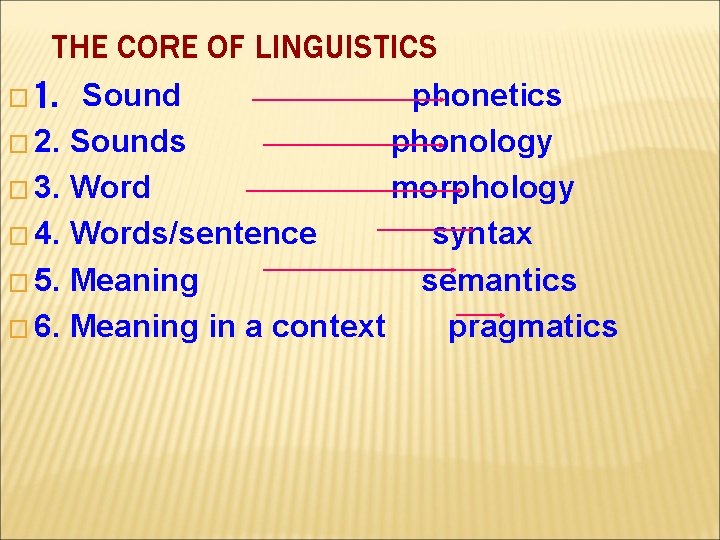
THE CORE OF LINGUISTICS Sound phonetics � 2. Sounds phonology � 3. Word morphology � 4. Words/sentence syntax � 5. Meaning semantics � 6. Meaning in a context pragmatics � 1.
Some important definitions in linguistics 1. 6. 3
1. PRESCRIPTIVE VS. DESCRIPTIVE (规定性和描述性) If a linguistic study aims to describe and analyze the language people actually use, it is said to be descriptive. � 2. If the linguistic study aims to lay down rules for correct and standard behavior in using language, i. e. to tell people what they should say and what they should not say, it sis said to be prescriptive. � 1.
2. SYNCHRONIC VS. DIACHRONIC (共时性和历时性) The description of a language at some point of time in history is a synchronic study. � 2. The description of a language as it changes through time is a diachronic study. � 1.
3. SPEECH VS. WRITING(口语和书面语) � Speech is regarded as the primary medium of human language for the following reasons: � � A. history B. function C. acquisition order 如果说语言符号是人类走出动物界的里 程碑,那么文字的产生,则是人类由野蛮社会进 入文明社会的一个重要标志。(陈宗明 2004: 109)
4. LANGUE VS. PAROLE (语言和言语) � Langue: the abstract linguistic system shared by all members of a speech community. � Parole: the realization of langue in actual use. � A Sociological View
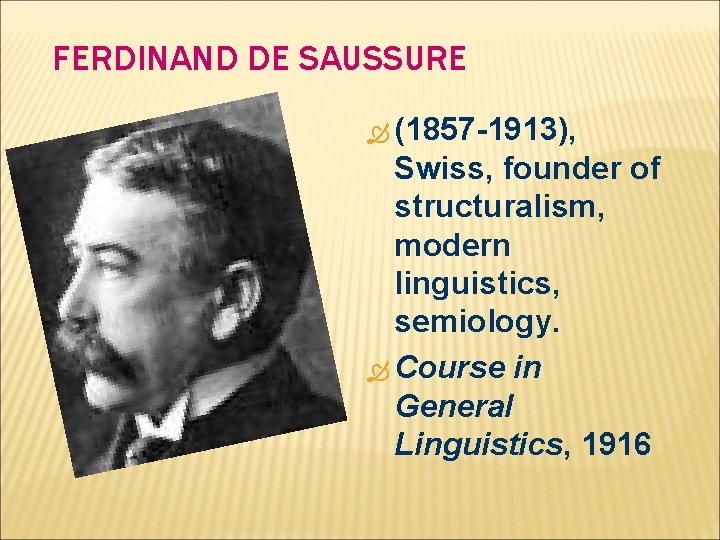
FERDINAND DE SAUSSURE (1857 -1913), Swiss, founder of structuralism, modern linguistics, semiology. Course in General Linguistics, 1916
5. COMPETENCE VS PERFORMANCE (语言能力和语用能力) � Competence: the ideal user’s knowledge of the rules of his language � Performance: the actual realization of this knowledge in linguistic communication � A Psychological View
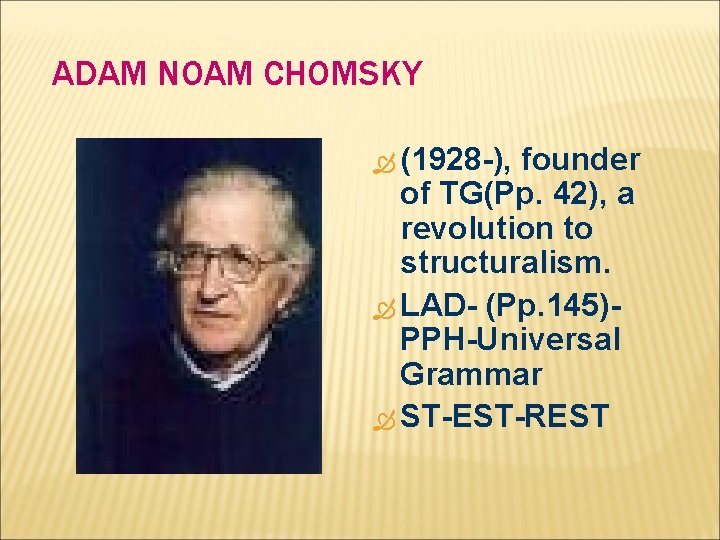
ADAM NOAM CHOMSKY (1928 -), founder of TG(Pp. 42), a revolution to structuralism. LAD- (Pp. 145)PPH-Universal Grammar ST-EST-REST
语言学分支 � Anthropological Linguistics � Psycholinguistics � Sociolinguistics � Neurolinguistics � Applied Linguistics � Computational Linguistics � Corpus Linguistic (语料库) � Discourse Analysis � Cognitive Linguistic � Systemic Functional Grammar
HOMEWORK What’s the difference between langue and parole? � 2. What’s the difference between competence and performance? � 3. What’s the difference between the distinction of langue Vs. parole and that of competence Vs. performance? � 1.

- Slides: 150