Polynomial Rollercoaster Project Mrs Chernowski PreCalculus Chris Murphy
- Slides: 11
Polynomial Rollercoaster Project Mrs. Chernowski Pre-Calculus Chris Murphy
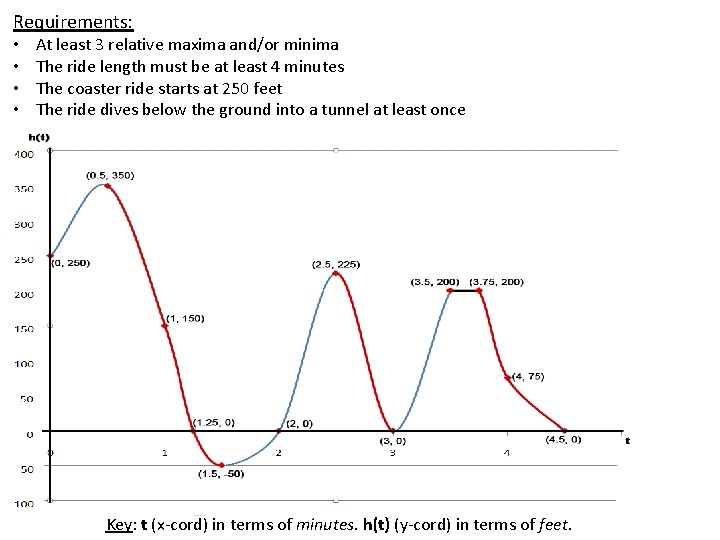
Requirements: • • At least 3 relative maxima and/or minima The ride length must be at least 4 minutes The coaster ride starts at 250 feet The ride dives below the ground into a tunnel at least once Key: t (x-cord) in terms of minutes. h(t) (y-cord) in terms of feet.
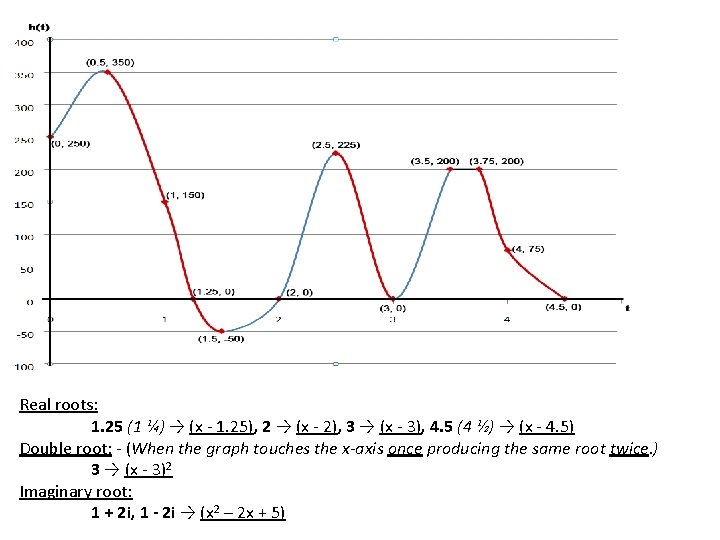
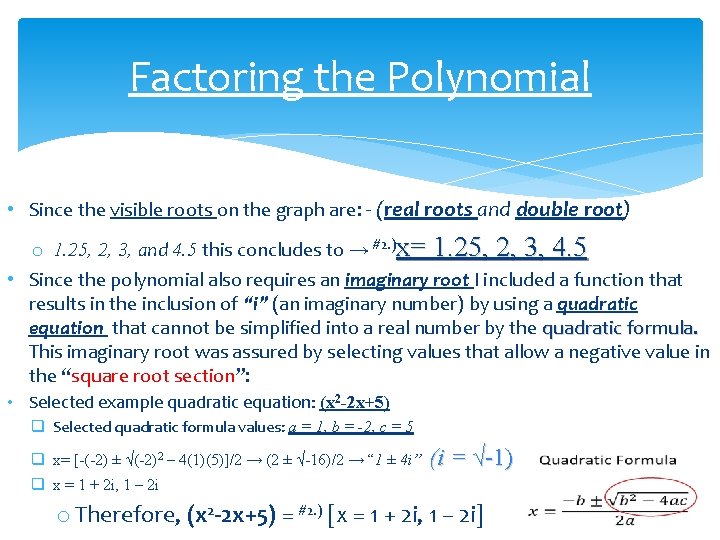
Real roots: 1. 25 (1 ¼) → (x - 1. 25), 2 → (x - 2), 3 → (x - 3), 4. 5 (4 ½) → (x - 4. 5) Double root: - (When the graph touches the x-axis once producing the same root twice. ) 3 → (x - 3)2 Imaginary root: 1 + 2 i, 1 - 2 i → (x 2 – 2 x + 5)
Factoring the Polynomial • Since the visible roots on the graph are: - (real roots and double root) o 1. 25, 2, 3, and 4. 5 this concludes to → #2. )x= 1. 25, 2, 3, 4. 5 • Since the polynomial also requires an imaginary root I included a function that results in the inclusion of “i” (an imaginary number) by using a quadratic equation that cannot be simplified into a real number by the quadratic formula. This imaginary root was assured by selecting values that allow a negative value in the “square root section”: • Selected example quadratic equation: (x 2 -2 x+5) q Selected quadratic formula values: a = 1, b = -2, c = 5 q x= [-(-2) ± √(-2)2 – 4(1)(5)]/2 → (2 ± √-16)/2 → “ 1 ± 4 i” (i = √-1) q x = 1 + 2 i, 1 – 2 i o Therefore, (x 2 -2 x+5) = #2. ) [x = 1 + 2 i, 1 – 2 i]
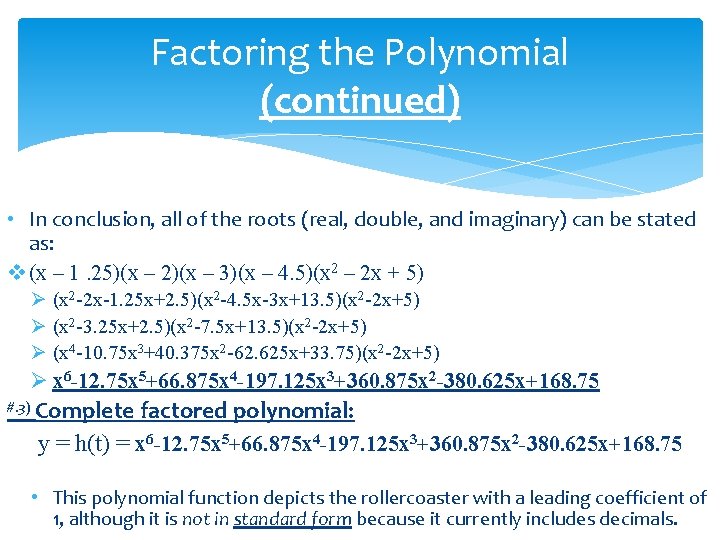
Factoring the Polynomial (continued) • In conclusion, all of the roots (real, double, and imaginary) can be stated as: v (x – 1. 25)(x – 2)(x – 3)(x – 4. 5)(x 2 – 2 x + 5) Ø (x 2 -2 x-1. 25 x+2. 5)(x 2 -4. 5 x-3 x+13. 5)(x 2 -2 x+5) Ø (x 2 -3. 25 x+2. 5)(x 2 -7. 5 x+13. 5)(x 2 -2 x+5) Ø (x 4 -10. 75 x 3+40. 375 x 2 -62. 625 x+33. 75)(x 2 -2 x+5) Ø x 6 -12. 75 x 5+66. 875 x 4 -197. 125 x 3+360. 875 x 2 -380. 625 x+168. 75 #. 3) Complete factored polynomial: y = h(t) = x 6 -12. 75 x 5+66. 875 x 4 -197. 125 x 3+360. 875 x 2 -380. 625 x+168. 75 • This polynomial function depicts the rollercoaster with a leading coefficient of 1, although it is not in standard form because it currently includes decimals.
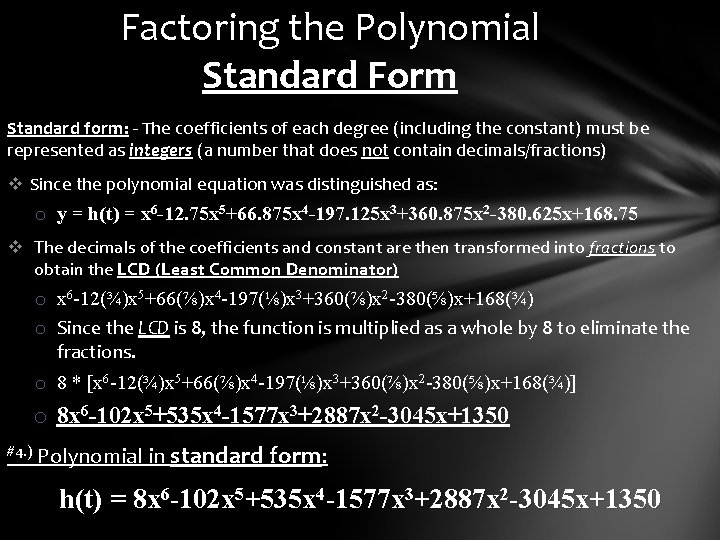
Factoring the Polynomial Standard Form Standard form: - The coefficients of each degree (including the constant) must be represented as integers (a number that does not contain decimals/fractions) v Since the polynomial equation was distinguished as: o y = h(t) = x 6 -12. 75 x 5+66. 875 x 4 -197. 125 x 3+360. 875 x 2 -380. 625 x+168. 75 v The decimals of the coefficients and constant are then transformed into fractions to obtain the LCD (Least Common Denominator) o x 6 -12(¾)x 5+66(⅞)x 4 -197(⅛)x 3+360(⅞)x 2 -380(⅝)x+168(¾) o Since the LCD is 8, the function is multiplied as a whole by 8 to eliminate the fractions. o 8 * [x 6 -12(¾)x 5+66(⅞)x 4 -197(⅛)x 3+360(⅞)x 2 -380(⅝)x+168(¾)] o 8 x 6 -102 x 5+535 x 4 -1577 x 3+2887 x 2 -3045 x+1350 #4. ) Polynomial in standard form: h(t) = 8 x 6 -102 x 5+535 x 4 -1577 x 3+2887 x 2 -3045 x+1350
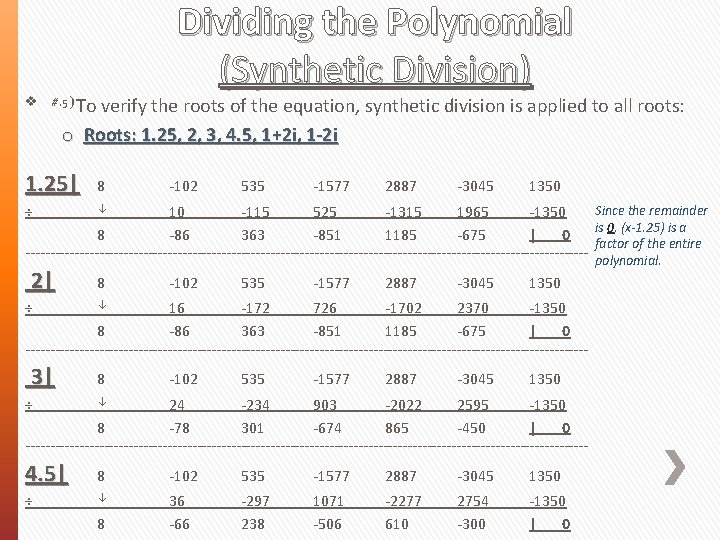
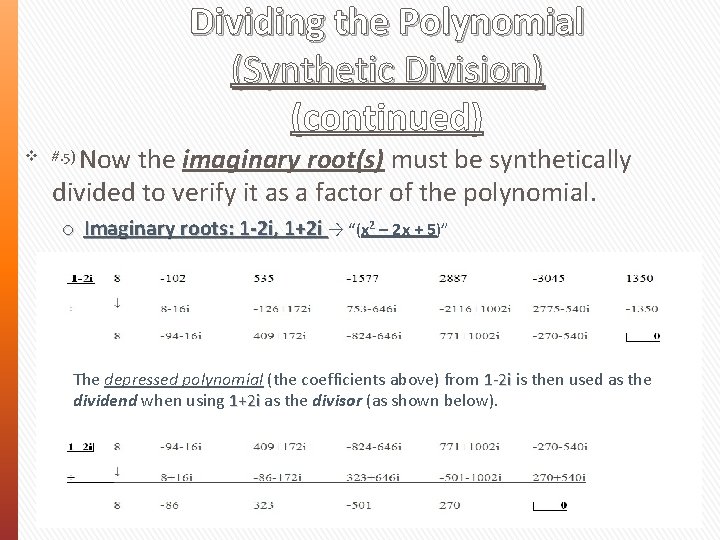
v Dividing the Polynomial (Synthetic Division) #. 5) To verify the roots of the equation, synthetic division is applied to all roots: o Roots: 1. 25, 2, 3, 4. 5, 1+2 i, 1 -2 i 1. 25| 8 ÷ ↓ -102 535 -1577 2887 -3045 1350 Since the remainder 10 -115 525 -1315 1965 -1350 is 0, (x-1. 25) is a 8 -86 363 -851 1185 -675 | 0 factor of the entire ---------------------------------------------------------- 2| ÷ polynomial. 8 -102 535 -1577 2887 -3045 1350 16 -172 726 -1702 2370 -1350 8 -86 363 -851 1185 -675 | 0 ---------------------------------------------------------- 3| ↓ 8 -102 535 -1577 2887 -3045 1350 ÷ ↓ 24 -234 903 -2022 2595 -1350 8 -78 301 -674 865 -450 | 0 ---------------------------------------------------------- 4. 5| 8 -102 535 -1577 2887 -3045 1350 ÷ ↓ 36 -66 -297 238 1071 -506 -2277 610 2754 -300 -1350 | 0 8
Dividing the Polynomial (Synthetic Division) (continued) Now the imaginary root(s) must be synthetically divided to verify it as a factor of the polynomial. v #. 5) o Imaginary roots: 1 -2 i, 1+2 i → “(x 2 – 2 x + 5)” The depressed polynomial (the coefficients above) from 1 -2 i is then used as the dividend when using 1+2 i as the divisor (as shown below).
End Behavior of Function v Since the leading coefficient An has an even degree “ 6” and An > 0 the graph will rise to both the left and the right. v At the decreasing interval at the end of the graph represents: oy approaches -∞ as x approaches (+)∞ v But there is a range and domain restriction that does not make this behavior continuous.
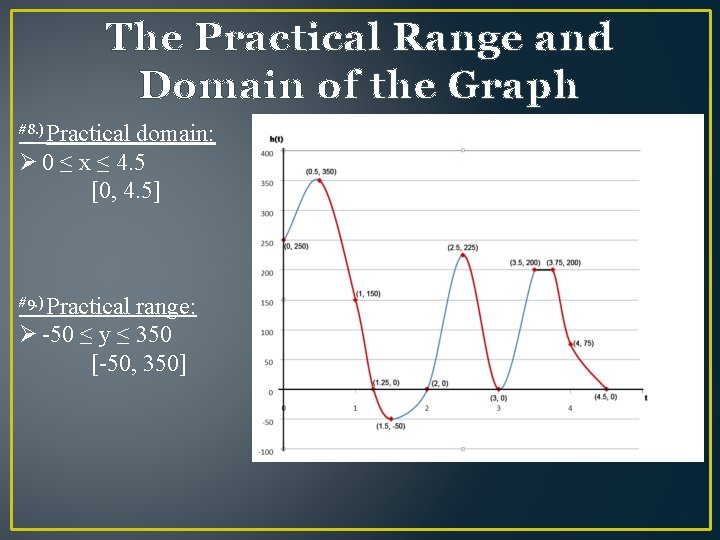
The Practical Range and Domain of the Graph Practical domain: Ø 0 ≤ x ≤ 4. 5 [0, 4. 5] #8. ) Practical range: Ø -50 ≤ y ≤ 350 [-50, 350] #9. )
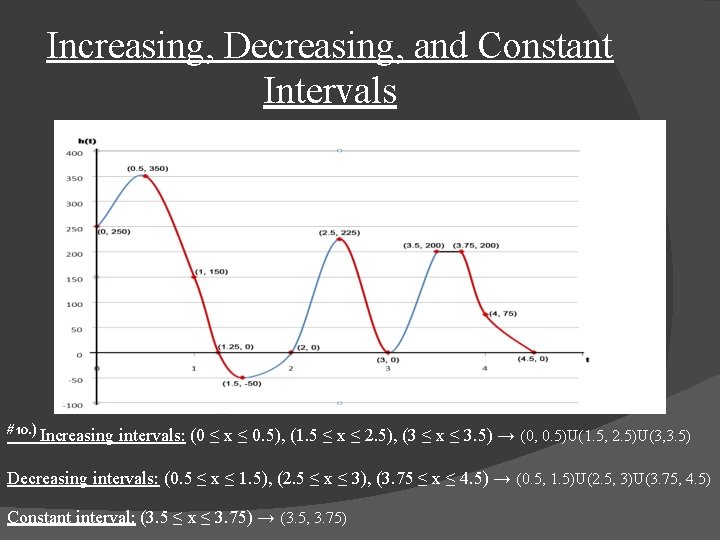
Increasing, Decreasing, and Constant Intervals #10. ) Increasing intervals: (0 ≤ x ≤ 0. 5), (1. 5 ≤ x ≤ 2. 5), (3 ≤ x ≤ 3. 5) → (0, 0. 5)U(1. 5, 2. 5)U(3, 3. 5) Decreasing intervals: (0. 5 ≤ x ≤ 1. 5), (2. 5 ≤ x ≤ 3), (3. 75 ≤ x ≤ 4. 5) → (0. 5, 1. 5)U(2. 5, 3)U(3. 75, 4. 5) Constant interval: (3. 5 ≤ x ≤ 3. 75) → (3. 5, 3. 75)