Political Corruption A comparative study of South Korea
- Slides: 33
Political Corruption A comparative study of South Korea & Indonesia Clarys Citounadin Raimonda Pasakinskaite Sandra Mai Huyen Svetlana Danchenko Sonja Frisch Nancy Wummel Understanding Korean Economy | Prof. Bokyeong Park
Political Corruption in South Korea & Indonesia Agenda 1. Historical Perspective on Corruption 2. General Information: Indexes, Media, NGO‘s, Public Opinion 3. Corruption Cases 4. Anti-Corruption Policies and Legal Framework 5. Conclusions and Recommendations Understanding Korean Economy 2
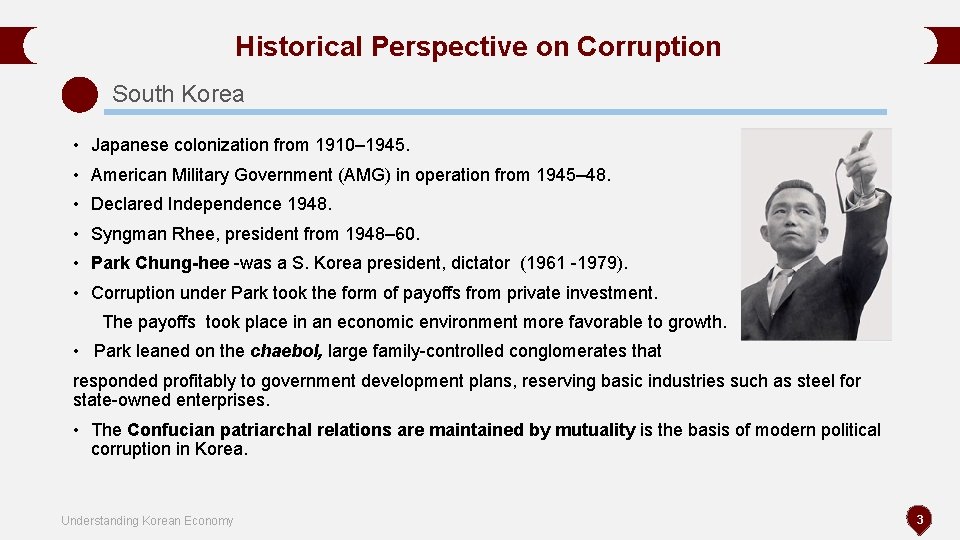
Historical Perspective on Corruption South Korea • Japanese colonization from 1910– 1945. • American Military Government (AMG) in operation from 1945– 48. • Declared Independence 1948. • Syngman Rhee, president from 1948– 60. • Park Chung-hee -was a S. Korea president, dictator (1961 -1979). • Corruption under Park took the form of payoffs from private investment. The payoffs took place in an economic environment more favorable to growth. • Park leaned on the chaebol, large family-controlled conglomerates that responded profitably to government development plans, reserving basic industries such as steel for state-owned enterprises. • The Confucian patriarchal relations are maintained by mutuality is the basis of modern political corruption in Korea. Understanding Korean Economy 3
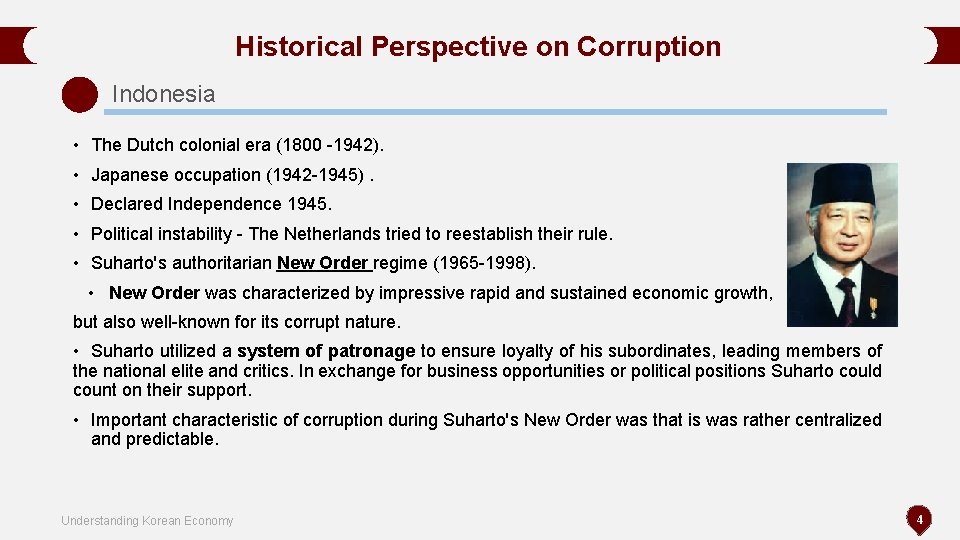
Historical Perspective on Corruption Indonesia • The Dutch colonial era (1800 -1942). • Japanese occupation (1942 -1945). • Declared Independence 1945. • Political instability - The Netherlands tried to reestablish their rule. • Suharto's authoritarian New Order regime (1965 -1998). • New Order was characterized by impressive rapid and sustained economic growth, but also well-known for its corrupt nature. • Suharto utilized a system of patronage to ensure loyalty of his subordinates, leading members of the national elite and critics. In exchange for business opportunities or political positions Suharto could count on their support. • Important characteristic of corruption during Suharto's New Order was that is was rather centralized and predictable. Understanding Korean Economy 4
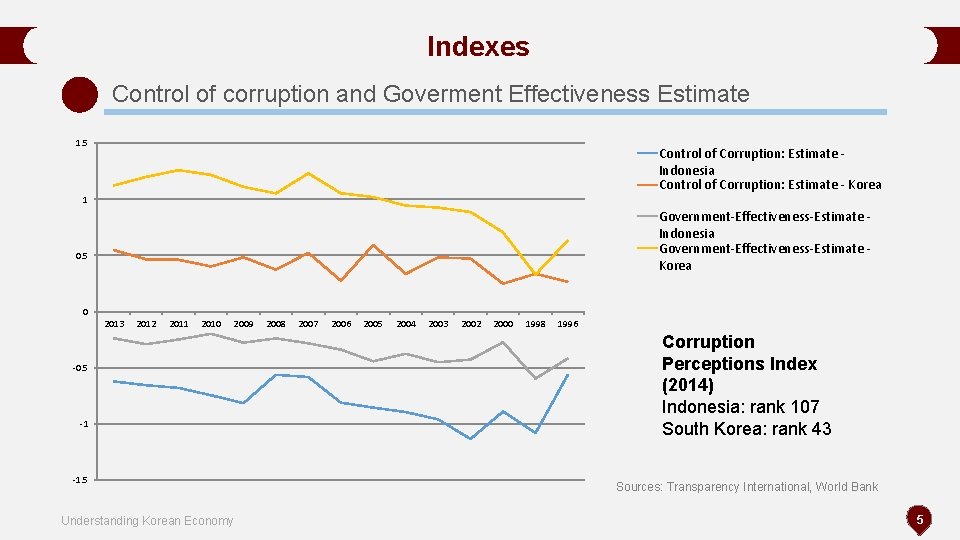
Indexes Control of corruption and Goverment Effectiveness Estimate 1. 5 Control of Corruption: Estimate Indonesia Control of Corruption: Estimate - Korea 1 Government-Effectiveness-Estimate Indonesia Government-Effectiveness-Estimate Korea 0. 5 0 2013 2012 2011 2010 2009 -0. 5 -1 -1. 5 Understanding Korean Economy 2008 2007 2006 2005 2004 2003 2002 2000 1998 1996 Corruption Perceptions Index (2014) Indonesia: rank 107 South Korea: rank 43 Sources: Transparency International, World Bank 5
General Information Media landscape The media environment in both countries is quite open and vibrant in comparison to other countries in the region, however there a lot of problems such are: Korea • Domination of conservative newspapers • Heavy influence from large conglomerates and major corporations on the newspapers for advertisement but also because of severe political interference • Lack of investigative journalism • Internet censorship, limiting anonymity in the web and prosecuting bloggers for posting critical comments Indonesia • Restrictions of press freedom by legal and regulatory provisions, foreign ownership of broadcast media is forbidden • Journalists experience physical attacks (including kidnapping being killed) • Self-censorship to avoid criminal prosecution Understanding Korean Economy 6
General Information NGOs Korea • NGOs are trusted much more than other institutions (62% of population) • Numbers of NGOs covering corruption topics such are Citizens’ Coalition for Economic Justice (CCEJ), the People’s Solidarity for Participatory Democracy (PSPD) are very influential in shaping public opinion. Indonesia • Indonesian CSOs are able to exert some degree of influence on the political decision-making process • CSOs actively engage in various social and political issues, including corruption However: • Civil society organizations (CSOs) are restricted and must receive a special approval at the Home Affairs Ministry to operate in Indonesia Understanding Korean Economy 7
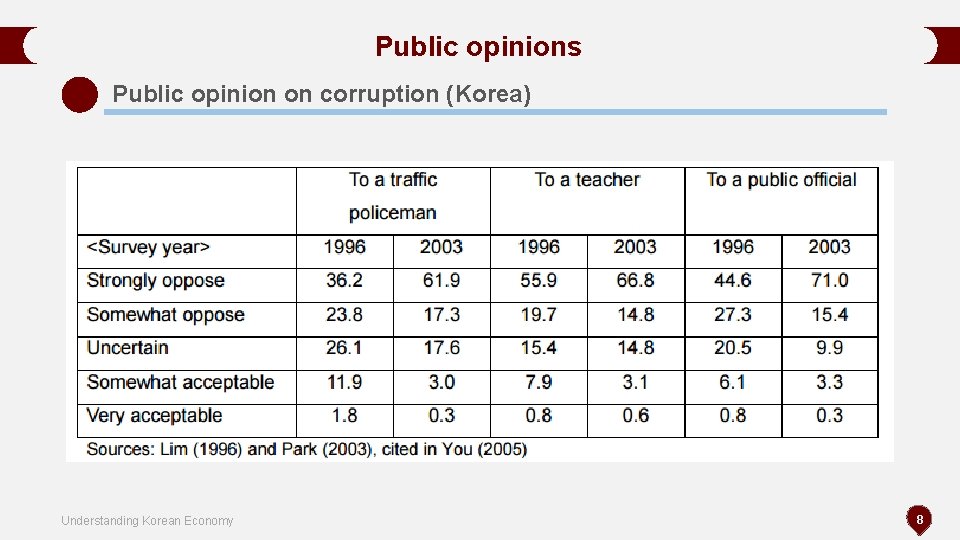
Public opinions Public opinion on corruption (Korea) Understanding Korean Economy 8
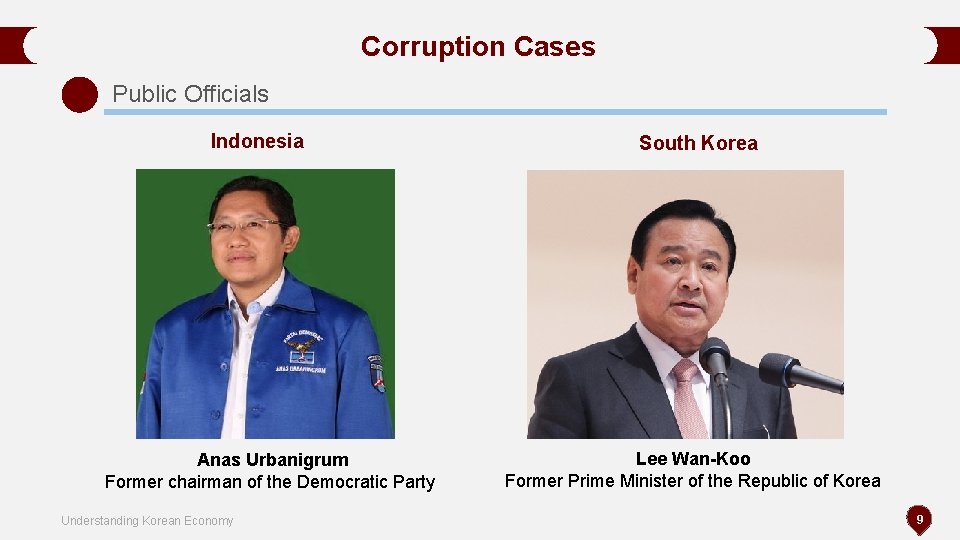
Corruption Cases Public Officials Indonesia Anas Urbanigrum Former chairman of the Democratic Party Understanding Korean Economy South Korea Lee Wan-Koo Former Prime Minister of the Republic of Korea 9
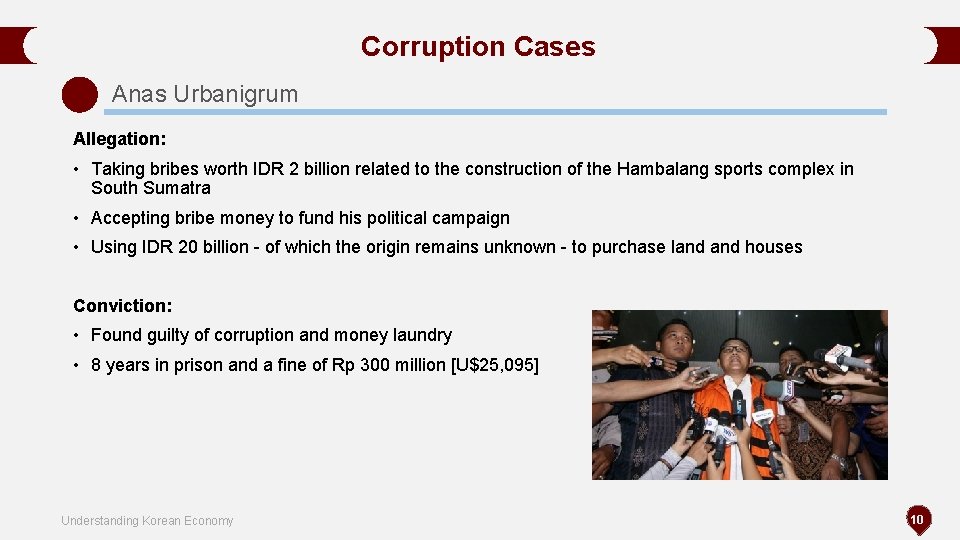
Corruption Cases Anas Urbanigrum Allegation: • Taking bribes worth IDR 2 billion related to the construction of the Hambalang sports complex in South Sumatra • Accepting bribe money to fund his political campaign • Using IDR 20 billion - of which the origin remains unknown - to purchase land houses Conviction: • Found guilty of corruption and money laundry • 8 years in prison and a fine of Rp 300 million [U$25, 095] Understanding Korean Economy 10
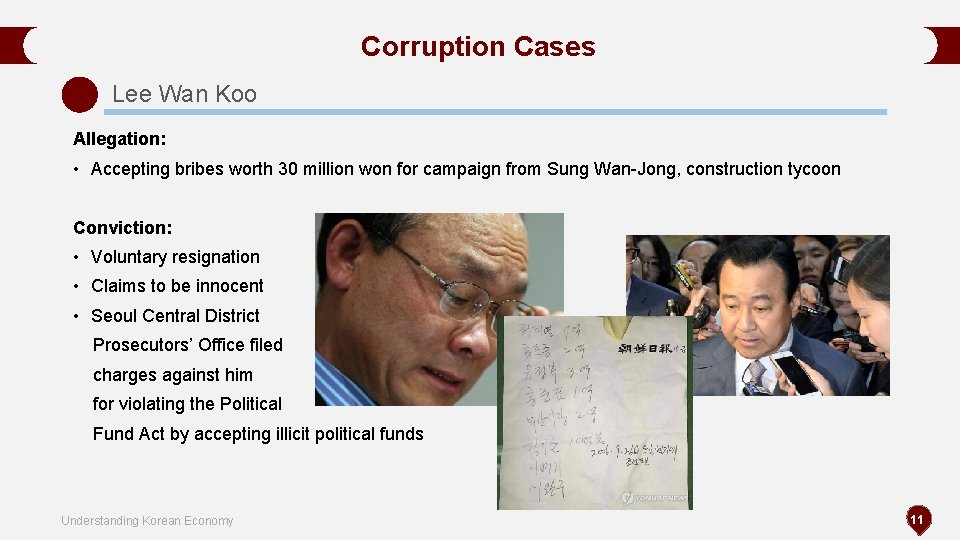
Corruption Cases Lee Wan Koo Allegation: • Accepting bribes worth 30 million won for campaign from Sung Wan-Jong, construction tycoon Conviction: • Voluntary resignation • Claims to be innocent • Seoul Central District Prosecutors’ Office filed charges against him for violating the Political Fund Act by accepting illicit political funds Understanding Korean Economy 11
Corruption Cases Companies Indonesia South Korea Ibnu Sutowu Pertamina Lee Kun Hee Samsung Understanding Korean Economy 12
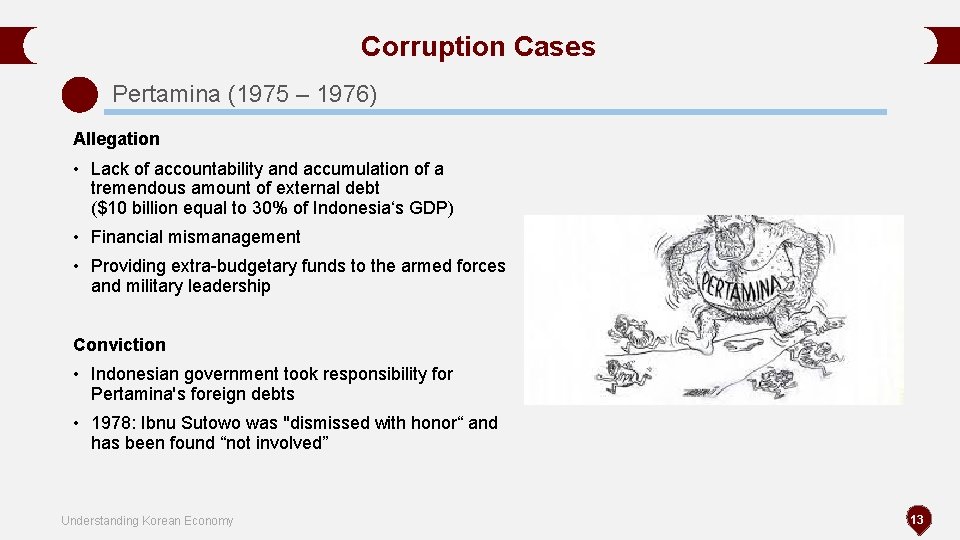
Corruption Cases Pertamina (1975 – 1976) Allegation • Lack of accountability and accumulation of a tremendous amount of external debt ($10 billion equal to 30% of Indonesia‘s GDP) • Financial mismanagement • Providing extra-budgetary funds to the armed forces and military leadership Conviction • Indonesian government took responsibility for Pertamina's foreign debts • 1978: Ibnu Sutowo was "dismissed with honor“ and has been found “not involved” Understanding Korean Economy 13
Corruption Cases Lee Kun Hee - Samsung Allegation • 1996: Slush fund, bribery • 2008: Embezzlement, illegal bond trading, tax evasion, breach of trust, maintenance of slush fund used to bribe influential prosecutors, judges and political figures Conviction • 1996: 2 years suspended jail time pardoned in the following year by then-President Kim Young-Sam • 2008: Found guilty for financial wrong-doing and tax-evasion fined more than 110 billion won + three year suspended jail time pardoned in December 2009 by then-President Lee Myung-Bak + resignation as group president (later instated as Chairman of Samsung Electronics) Understanding Korean Economy 14
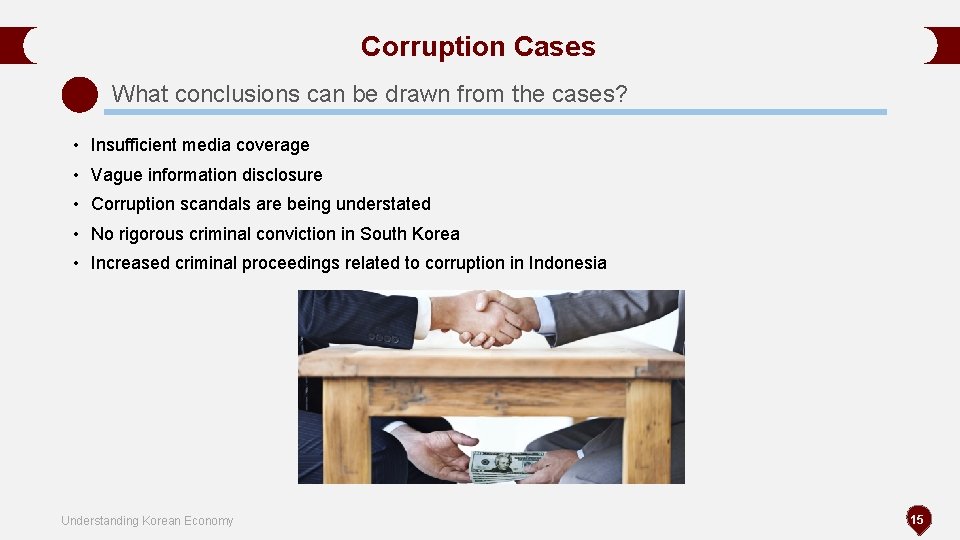
Corruption Cases What conclusions can be drawn from the cases? • Insufficient media coverage • Vague information disclosure • Corruption scandals are being understated • No rigorous criminal conviction in South Korea • Increased criminal proceedings related to corruption in Indonesia Understanding Korean Economy 15
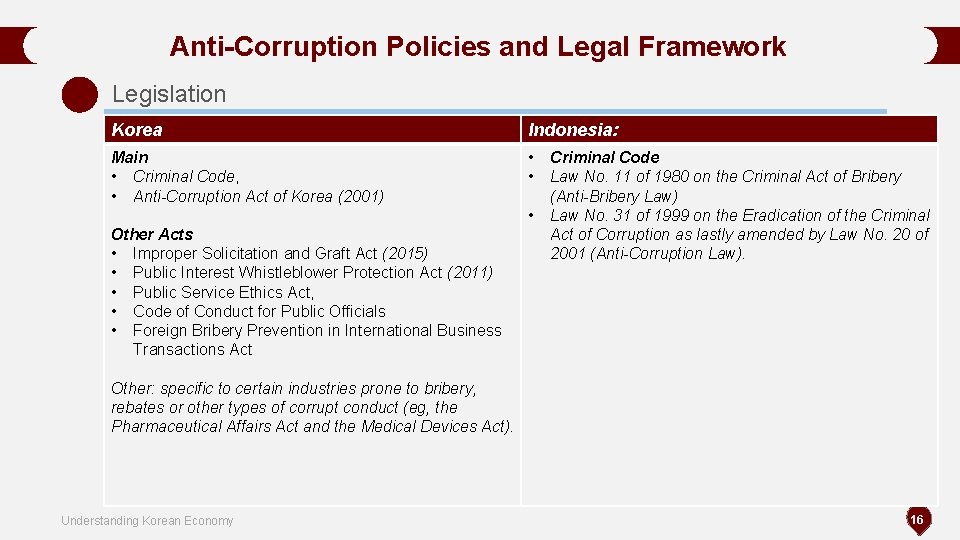
Anti-Corruption Policies and Legal Framework Legislation Korea Indonesia: Main • Criminal Code, • Anti-Corruption Act of Korea (2001) • • • Other Acts • Improper Solicitation and Graft Act (2015) • Public Interest Whistleblower Protection Act (2011) • Public Service Ethics Act, • Code of Conduct for Public Officials • Foreign Bribery Prevention in International Business Transactions Act Criminal Code Law No. 11 of 1980 on the Criminal Act of Bribery (Anti-Bribery Law) Law No. 31 of 1999 on the Eradication of the Criminal Act of Corruption as lastly amended by Law No. 20 of 2001 (Anti-Corruption Law). Other: specific to certain industries prone to bribery, rebates or other types of corrupt conduct (eg, the Pharmaceutical Affairs Act and the Medical Devices Act). Understanding Korean Economy 16
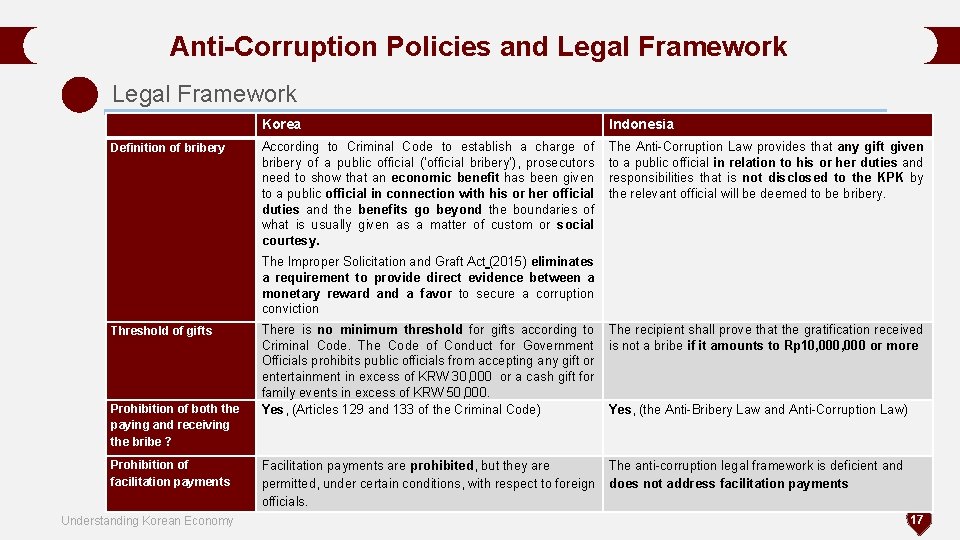
Anti-Corruption Policies and Legal Framework Korea Indonesia Definition of bribery According to Criminal Code to establish a charge of bribery of a public official (‘official bribery’), prosecutors need to show that an economic benefit has been given to a public official in connection with his or her official duties and the benefits go beyond the boundaries of what is usually given as a matter of custom or social courtesy. The Anti-Corruption Law provides that any gift given to a public official in relation to his or her duties and responsibilities that is not disclosed to the KPK by the relevant official will be deemed to be bribery. The Improper Solicitation and Graft Act (2015) eliminates a requirement to provide direct evidence between a monetary reward and a favor to secure a corruption conviction Threshold of gifts Prohibition of both the paying and receiving the bribe ? Prohibition of facilitation payments Understanding Korean Economy There is no minimum threshold for gifts according to The recipient shall prove that the gratification received Criminal Code. The Code of Conduct for Government is not a bribe if it amounts to Rp 10, 000 or more Officials prohibits public officials from accepting any gift or entertainment in excess of KRW 30, 000 or a cash gift for family events in excess of KRW 50, 000. Yes, (Articles 129 and 133 of the Criminal Code) Yes, (the Anti-Bribery Law and Anti-Corruption Law) Facilitation payments are prohibited, but they are The anti-corruption legal framework is deficient and permitted, under certain conditions, with respect to foreign does not address facilitation payments officials. 17
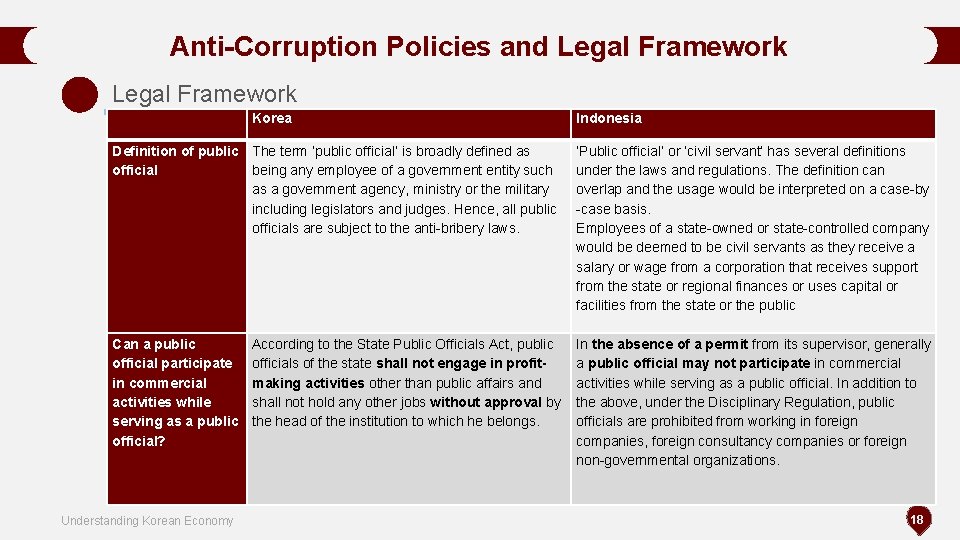
Anti-Corruption Policies and Legal Framework Korea Indonesia Definition of public The term ‘public official’ is broadly defined as official being any employee of a government entity such as a government agency, ministry or the military including legislators and judges. Hence, all public officials are subject to the anti-bribery laws. ‘Public official’ or ‘civil servant’ has several definitions under the laws and regulations. The definition can overlap and the usage would be interpreted on a case-by -case basis. Employees of a state-owned or state-controlled company would be deemed to be civil servants as they receive a salary or wage from a corporation that receives support from the state or regional finances or uses capital or facilities from the state or the public Can a public official participate in commercial activities while serving as a public official? In the absence of a permit from its supervisor, generally a public official may not participate in commercial activities while serving as a public official. In addition to the above, under the Disciplinary Regulation, public officials are prohibited from working in foreign companies, foreign consultancy companies or foreign non-governmental organizations. Understanding Korean Economy According to the State Public Officials Act, public officials of the state shall not engage in profitmaking activities other than public affairs and shall not hold any other jobs without approval by the head of the institution to which he belongs. 18
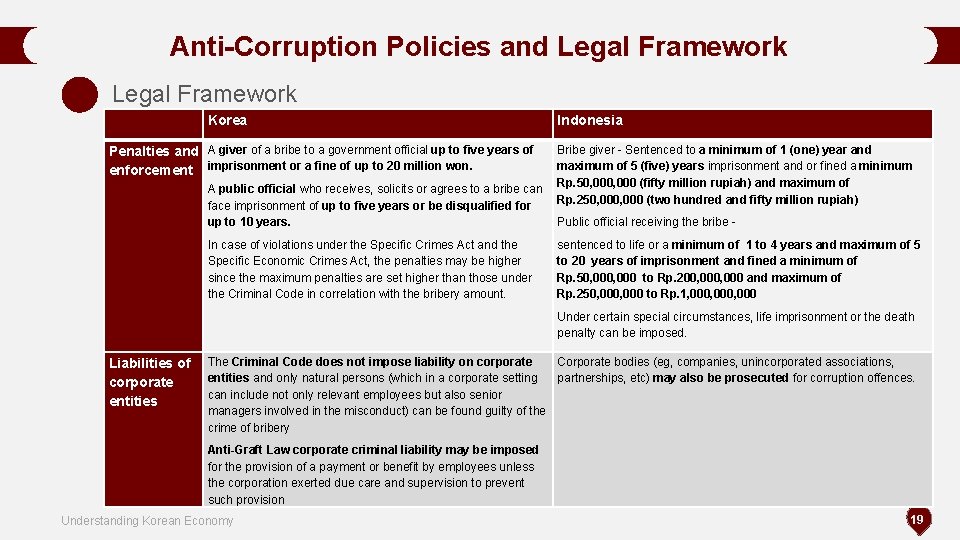
Anti-Corruption Policies and Legal Framework Korea Indonesia Penalties and A giver of a bribe to a government official up to five years of enforcement imprisonment or a fine of up to 20 million won. Bribe giver - Sentenced to a minimum of 1 (one) year and maximum of 5 (five) years imprisonment and or fined a minimum A public official who receives, solicits or agrees to a bribe can Rp. 50, 000 (fifty million rupiah) and maximum of Rp. 250, 000 (two hundred and fifty million rupiah) face imprisonment of up to five years or be disqualified for up to 10 years. Public official receiving the bribe - In case of violations under the Specific Crimes Act and the Specific Economic Crimes Act, the penalties may be higher since the maximum penalties are set higher than those under the Criminal Code in correlation with the bribery amount. sentenced to life or a minimum of 1 to 4 years and maximum of 5 to 20 years of imprisonment and fined a minimum of Rp. 50, 000 to Rp. 200, 000 and maximum of Rp. 250, 000 to Rp. 1, 000, 000 Under certain special circumstances, life imprisonment or the death penalty can be imposed. Liabilities of The Criminal Code does not impose liability on corporate entities and only natural persons (which in a corporate setting corporate can include not only relevant employees but also senior entities Corporate bodies (eg, companies, unincorporated associations, partnerships, etc) may also be prosecuted for corruption offences. managers involved in the misconduct) can be found guilty of the crime of bribery Anti-Graft Law corporate criminal liability may be imposed for the provision of a payment or benefit by employees unless the corporation exerted due care and supervision to prevent such provision Understanding Korean Economy 19
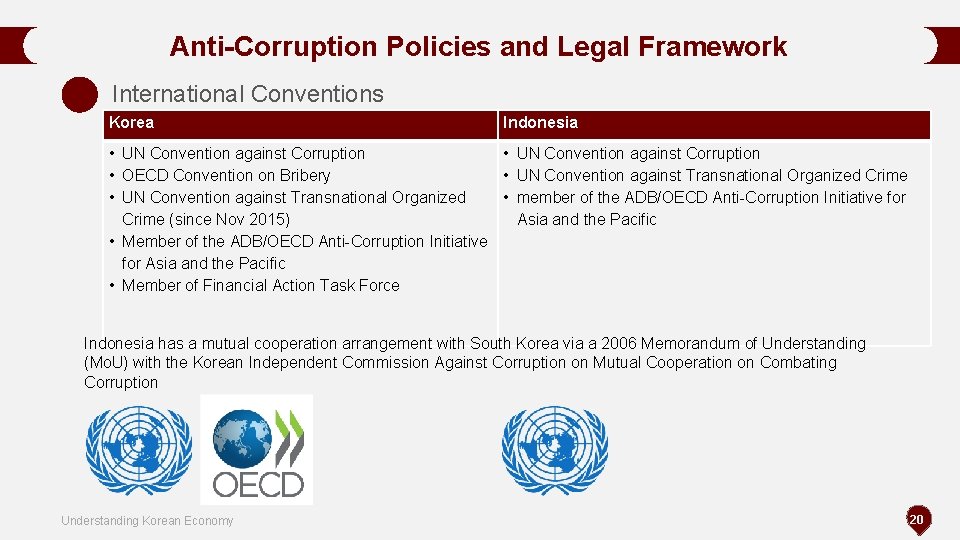
Anti-Corruption Policies and Legal Framework International Conventions Korea Indonesia • UN Convention against Corruption • OECD Convention on Bribery • UN Convention against Transnational Organized Crime (since Nov 2015) • Member of the ADB/OECD Anti-Corruption Initiative for Asia and the Pacific • Member of Financial Action Task Force • UN Convention against Corruption • UN Convention against Transnational Organized Crime • member of the ADB/OECD Anti-Corruption Initiative for Asia and the Pacific Indonesia has a mutual cooperation arrangement with South Korea via a 2006 Memorandum of Understanding (Mo. U) with the Korean Independent Commission Against Corruption on Mutual Cooperation on Combating Corruption Understanding Korean Economy 20
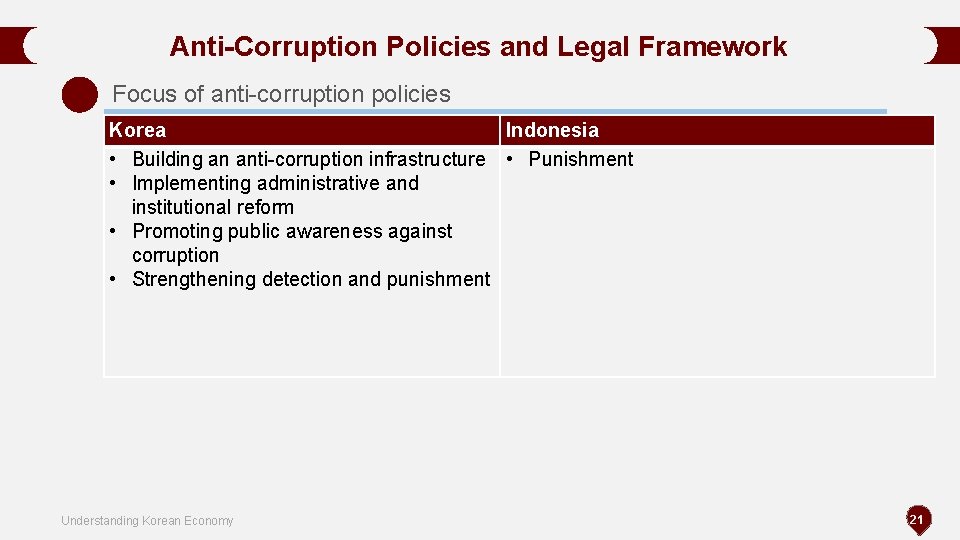
Anti-Corruption Policies and Legal Framework Focus of anti-corruption policies Korea Indonesia • Building an anti-corruption infrastructure • Punishment • Implementing administrative and institutional reform • Promoting public awareness against corruption • Strengthening detection and punishment Understanding Korean Economy 21
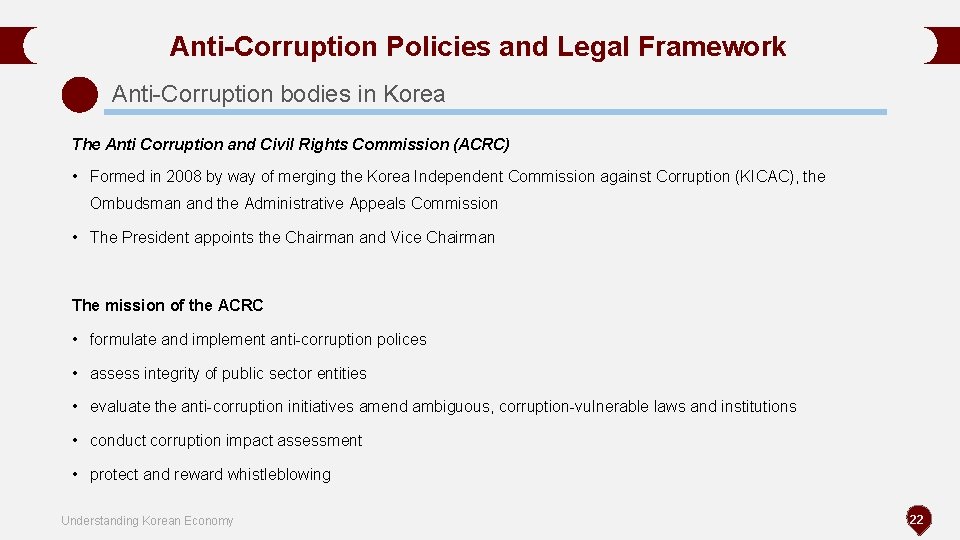
Anti-Corruption Policies and Legal Framework Anti-Corruption bodies in Korea The Anti Corruption and Civil Rights Commission (ACRC) • Formed in 2008 by way of merging the Korea Independent Commission against Corruption (KICAC), the Ombudsman and the Administrative Appeals Commission • The President appoints the Chairman and Vice Chairman The mission of the ACRC • formulate and implement anti-corruption polices • assess integrity of public sector entities • evaluate the anti-corruption initiatives amend ambiguous, corruption-vulnerable laws and institutions • conduct corruption impact assessment • protect and reward whistleblowing Understanding Korean Economy 22
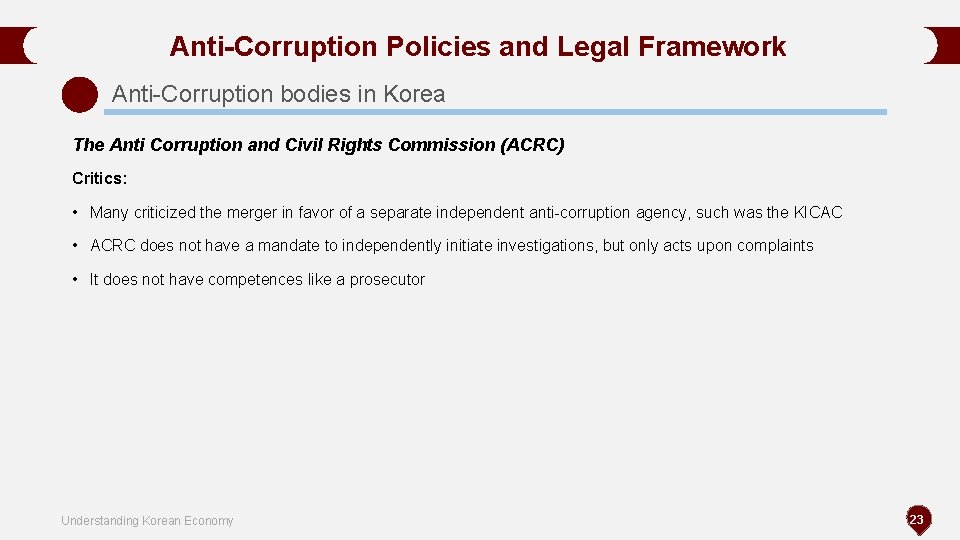
Anti-Corruption Policies and Legal Framework Anti-Corruption bodies in Korea The Anti Corruption and Civil Rights Commission (ACRC) Critics: • Many criticized the merger in favor of a separate independent anti-corruption agency, such was the KICAC • ACRC does not have a mandate to independently initiate investigations, but only acts upon complaints • It does not have competences like a prosecutor Understanding Korean Economy 23
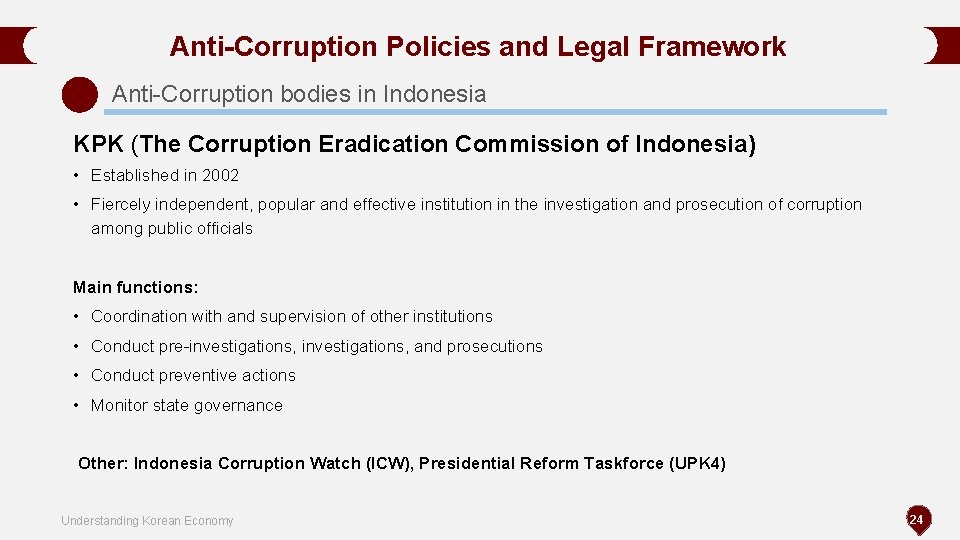
Anti-Corruption Policies and Legal Framework Anti-Corruption bodies in Indonesia KPK (The Corruption Eradication Commission of Indonesia) • Established in 2002 • Fiercely independent, popular and effective institution in the investigation and prosecution of corruption among public officials Main functions: • Coordination with and supervision of other institutions • Conduct pre-investigations, and prosecutions • Conduct preventive actions • Monitor state governance Other: Indonesia Corruption Watch (ICW), Presidential Reform Taskforce (UPK 4) Understanding Korean Economy 24
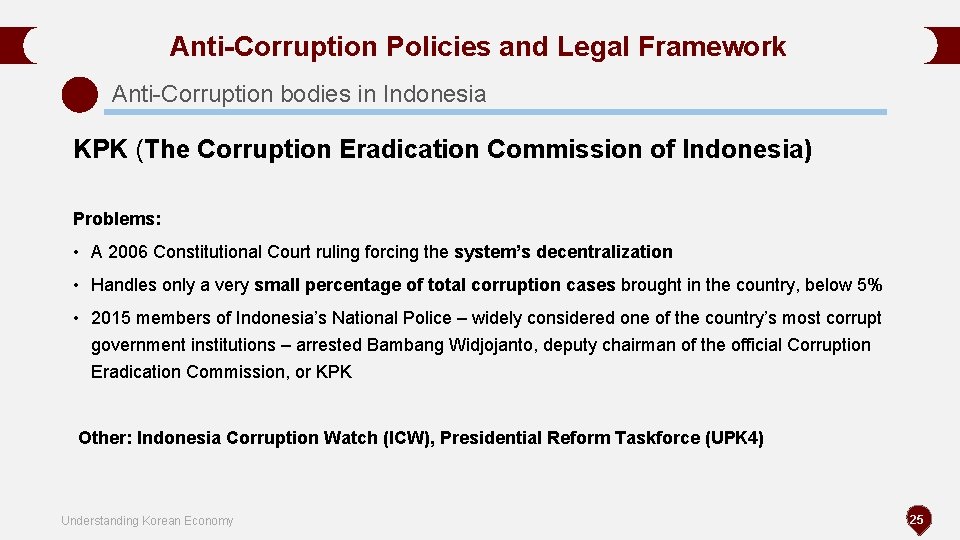
Anti-Corruption Policies and Legal Framework Anti-Corruption bodies in Indonesia KPK (The Corruption Eradication Commission of Indonesia) Problems: • A 2006 Constitutional Court ruling forcing the system’s decentralization • Handles only a very small percentage of total corruption cases brought in the country, below 5% • 2015 members of Indonesia’s National Police – widely considered one of the country’s most corrupt government institutions – arrested Bambang Widjojanto, deputy chairman of the official Corruption Eradication Commission, or KPK Other: Indonesia Corruption Watch (ICW), Presidential Reform Taskforce (UPK 4) Understanding Korean Economy 25
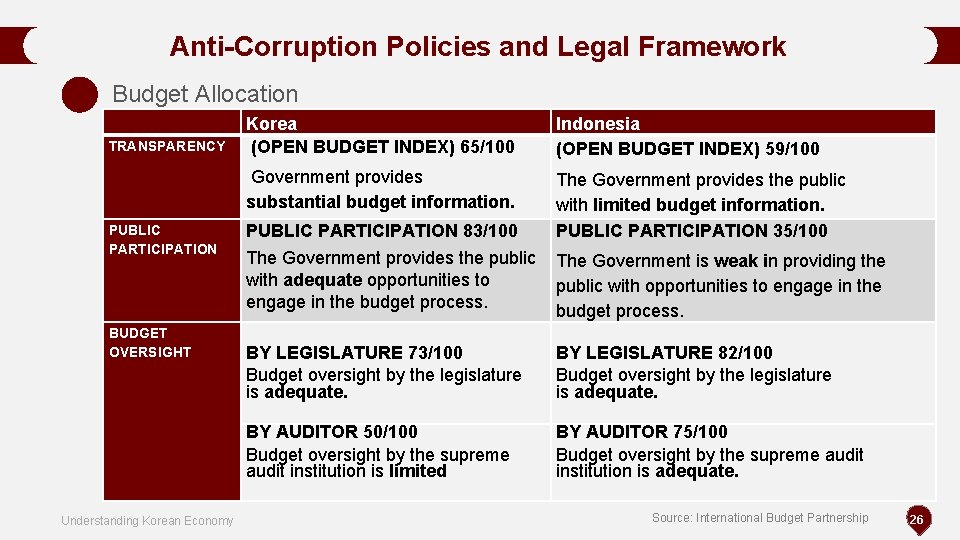
Anti-Corruption Policies and Legal Framework Budget Allocation TRANSPARENCY PUBLIC PARTICIPATION BUDGET OVERSIGHT Understanding Korean Economy Korea (OPEN BUDGET INDEX) 65/100 Indonesia (OPEN BUDGET INDEX) 59/100 Government provides substantial budget information. The Government provides the public with limited budget information. PUBLIC PARTICIPATION 35/100 PUBLIC PARTICIPATION 83/100 The Government provides the public The Government is weak in providing the with adequate opportunities to public with opportunities to engage in the budget process. BY LEGISLATURE 73/100 Budget oversight by the legislature is adequate. BY LEGISLATURE 82/100 Budget oversight by the legislature is adequate. BY AUDITOR 50/100 Budget oversight by the supreme audit institution is limited BY AUDITOR 75/100 Budget oversight by the supreme audit institution is adequate. Source: International Budget Partnership 26
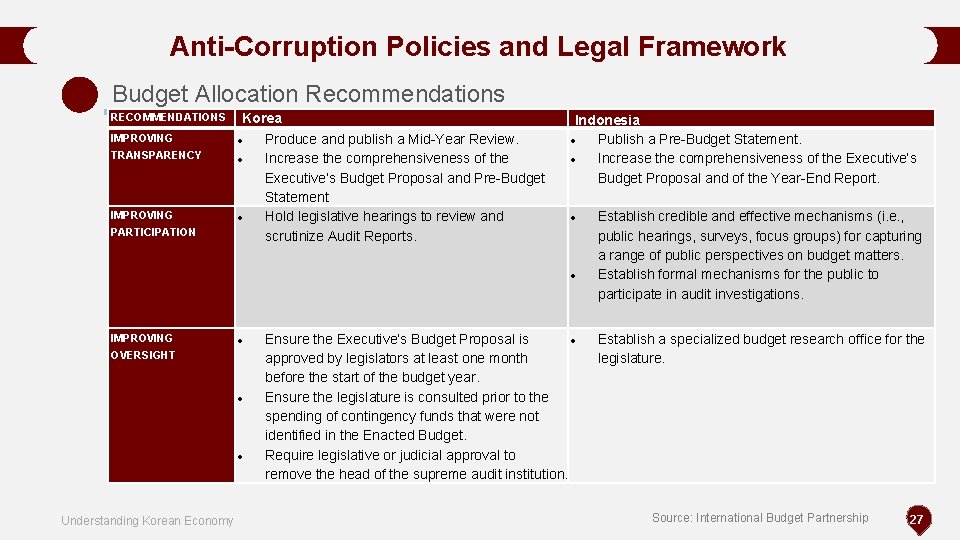
Anti-Corruption Policies and Legal Framework Budget Allocation Recommendations RECOMMENDATIONS Korea IMPROVING TRANSPARENCY IMPROVING PARTICIPATION IMPROVING OVERSIGHT Understanding Korean Economy Produce and publish a Mid-Year Review. Increase the comprehensiveness of the Executive’s Budget Proposal and Pre-Budget Statement Hold legislative hearings to review and scrutinize Audit Reports. Indonesia Publish a Pre-Budget Statement. Increase the comprehensiveness of the Executive’s Budget Proposal and of the Year-End Report. Establish credible and effective mechanisms (i. e. , public hearings, surveys, focus groups) for capturing a range of public perspectives on budget matters. Establish formal mechanisms for the public to participate in audit investigations. Ensure the Executive’s Budget Proposal is approved by legislators at least one month before the start of the budget year. Ensure the legislature is consulted prior to the spending of contingency funds that were not identified in the Enacted Budget. Require legislative or judicial approval to remove the head of the supreme audit institution. Establish a specialized budget research office for the legislature. Source: International Budget Partnership 27
Anti-Corruption Policies and Legal Framework Korean Achievements in Budget Allocation • Allowing citizens to request special investigations by the national audit office into government programs with suspected corruption or inefficiencies. • Introducing E-government system which allows to track e-applications and merge different online channels for civil complaints and petitions. • Portal for public procurement, which digitalized the entire process from order to payment for all public organizations. • A database collecting information on contractors, including previous sanctions imposed on a company making this data available to governmental bodies. Understanding Korean Economy Source: International Budget Partnership 28
Anti-Corruption Policies and Legal Framework Other Issues Implementation of IFRS: Korea - K-IFRS are required for all listed companies as well as all financial institutions in Korea since 2011. Indonesia has not adopted IFRS yet however committed is to support IFRS as the globally accepted accounting standard and to continue with the IFRS convergence process. Bureaucracy in Korea • efficient bureaucracy • highly competitive examinations for public officials Understanding Korean Economy 29
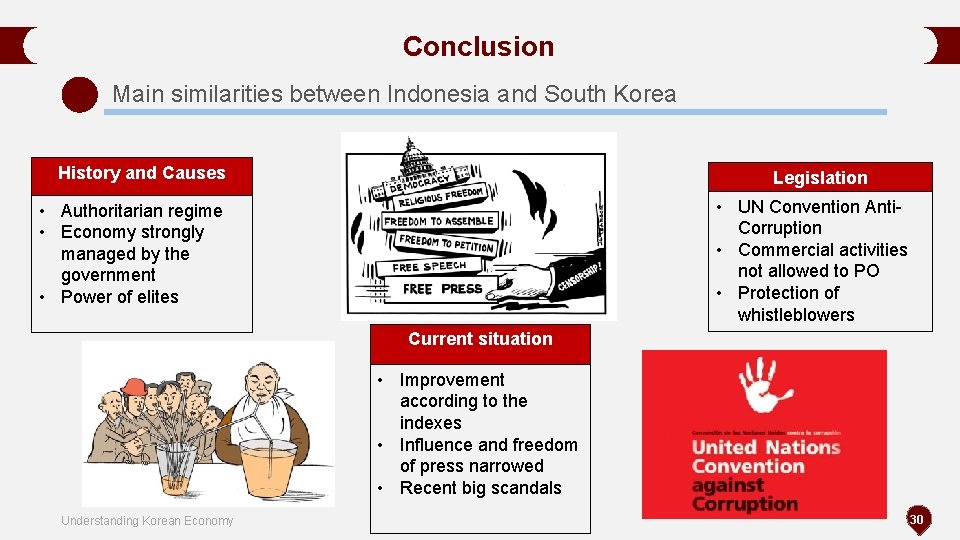
Conclusion Main similarities between Indonesia and South Korea History and Causes Legislation • UN Convention Anti. Corruption • Commercial activities not allowed to PO • Protection of whistleblowers • Authoritarian regime • Economy strongly managed by the government • Power of elites Current situation • Improvement according to the indexes • Influence and freedom of press narrowed • Recent big scandals Understanding Korean Economy 30
Conclusion Main differences between Indonesia and South Korea Current situation • Indexes • Types of censorship • Restriction of the NGO/CSO’s Legislation • Definitions and limitations • Penalizations • Transparency and public participation on the budget allocation • Solutions implemented Understanding Korean Economy 31
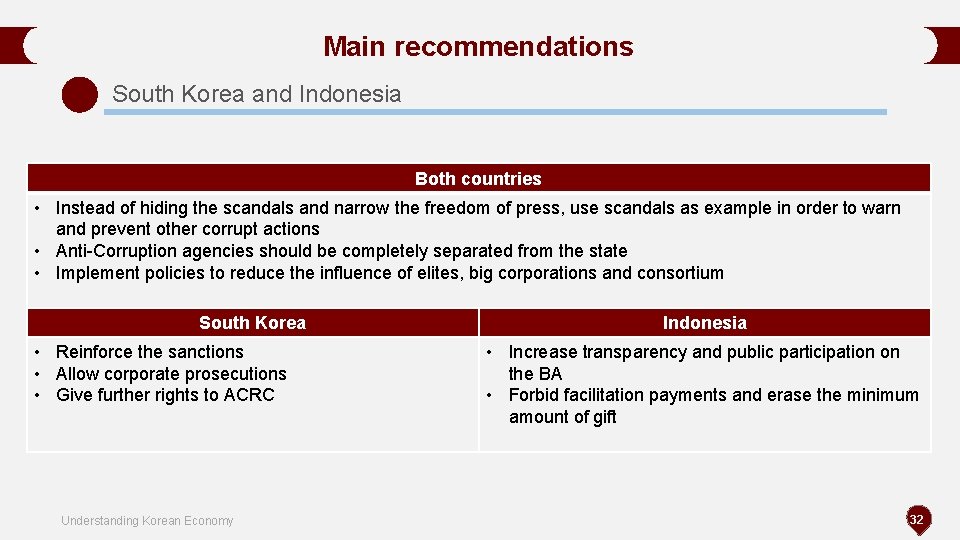
Main recommendations South Korea and Indonesia Both countries • Instead of hiding the scandals and narrow the freedom of press, use scandals as example in order to warn and prevent other corrupt actions • Anti-Corruption agencies should be completely separated from the state • Implement policies to reduce the influence of elites, big corporations and consortium South Korea • Reinforce the sanctions • Allow corporate prosecutions • Give further rights to ACRC Understanding Korean Economy Indonesia • Increase transparency and public participation on the BA • Forbid facilitation payments and erase the minimum amount of gift 32
Thank you for your attention! Understanding Korean Economy 33