Physical Education California Physical Education Content Standards Adopted



- Slides: 14
Physical Education
California Physical Education Content Standards Adopted January 2005 Written into AUSD Administrative Regulations
Content Standards Emphasize: û k-1 Me/myself/I û 2 -3 My partner and I û 4 th-5 th Object manipulation û 6 -8 Team play û H. S. Put it all together
Motor Skills skip hop jump K-8 th Standards 1 and 2 û High School Standard 1 û roll balance throw catch bounce dribble rhythm direction flotation bat forehand slap shot weight transfer
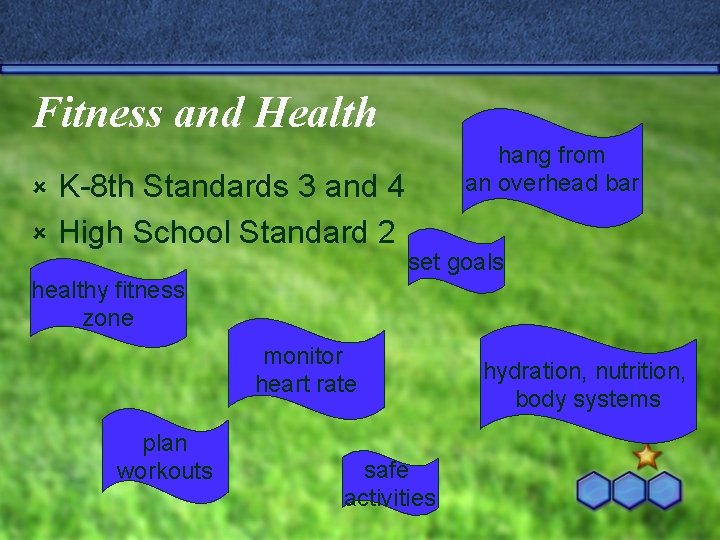
Fitness and Health K-8 th Standards 3 and 4 û High School Standard 2 hang from an overhead bar û set goals healthy fitness zone monitor heart rate plan workouts safe activities hydration, nutrition, body systems
Psychological and Sociological self Concepts encourage motivation K-8 th Standard 5 û High School Standard 3 û sharing acceptance of differences participation personal enjoyment cooperation
Content Standard Example Standard 1: Demonstrate motor skills and movement patterns needed to perform a variety of physical activities.
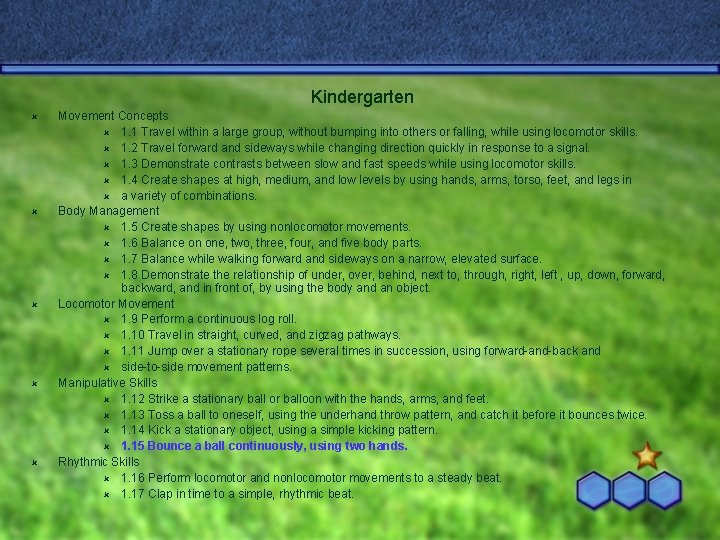
Kindergarten û û û Movement Concepts û 1. 1 Travel within a large group, without bumping into others or falling, while using locomotor skills. û 1. 2 Travel forward and sideways while changing direction quickly in response to a signal. û 1. 3 Demonstrate contrasts between slow and fast speeds while using locomotor skills. û 1. 4 Create shapes at high, medium, and low levels by using hands, arms, torso, feet, and legs in û a variety of combinations. Body Management û 1. 5 Create shapes by using nonlocomotor movements. û 1. 6 Balance on one, two, three, four, and five body parts. û 1. 7 Balance while walking forward and sideways on a narrow, elevated surface. û 1. 8 Demonstrate the relationship of under, over, behind, next to, through, right, left , up, down, forward, backward, and in front of, by using the body and an object. Locomotor Movement û 1. 9 Perform a continuous log roll. û 1. 10 Travel in straight, curved, and zigzag pathways. û 1. 11 Jump over a stationary rope several times in succession, using forward-and-back and û side-to-side movement patterns. Manipulative Skills û 1. 12 Strike a stationary ball or balloon with the hands, arms, and feet. û 1. 13 Toss a ball to oneself, using the underhand throw pattern, and catch it before it bounces twice. û 1. 14 Kick a stationary object, using a simple kicking pattern. û 1. 15 Bounce a ball continuously, using two hands. Rhythmic Skills û 1. 16 Perform locomotor and nonlocomotor movements to a steady beat. û 1. 17 Clap in time to a simple, rhythmic beat.
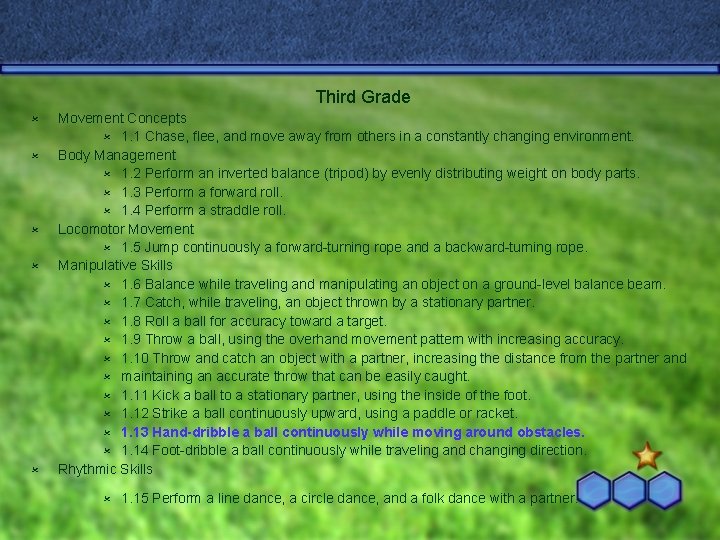
Third Grade û û û Movement Concepts û 1. 1 Chase, flee, and move away from others in a constantly changing environment. Body Management û 1. 2 Perform an inverted balance (tripod) by evenly distributing weight on body parts. û 1. 3 Perform a forward roll. û 1. 4 Perform a straddle roll. Locomotor Movement û 1. 5 Jump continuously a forward-turning rope and a backward-turning rope. Manipulative Skills û 1. 6 Balance while traveling and manipulating an object on a ground-level balance beam. û 1. 7 Catch, while traveling, an object thrown by a stationary partner. û 1. 8 Roll a ball for accuracy toward a target. û 1. 9 Throw a ball, using the overhand movement pattern with increasing accuracy. û 1. 10 Throw and catch an object with a partner, increasing the distance from the partner and û maintaining an accurate throw that can be easily caught. û 1. 11 Kick a ball to a stationary partner, using the inside of the foot. û 1. 12 Strike a ball continuously upward, using a paddle or racket. û 1. 13 Hand-dribble a ball continuously while moving around obstacles. û 1. 14 Foot-dribble a ball continuously while traveling and changing direction. Rhythmic Skills û 1. 15 Perform a line dance, a circle dance, and a folk dance with a partner.
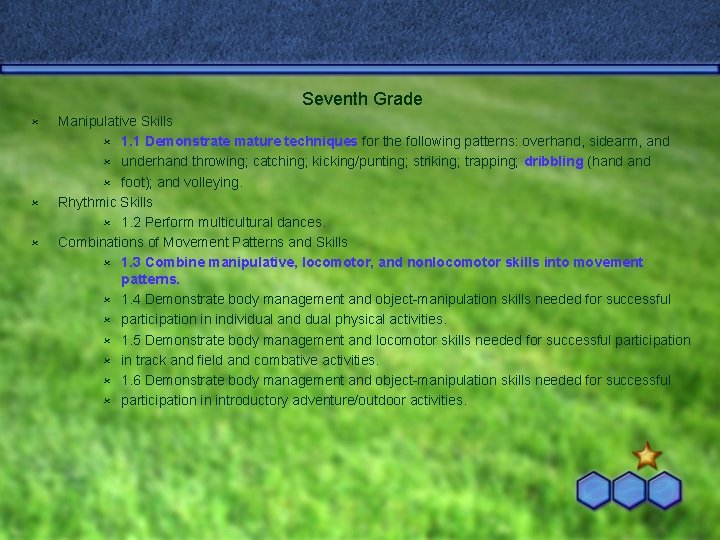
Seventh Grade û û û Manipulative Skills û 1. 1 Demonstrate mature techniques for the following patterns: overhand, sidearm, and û underhand throwing; catching; kicking/punting; striking; trapping; dribbling (hand û foot); and volleying. Rhythmic Skills û 1. 2 Perform multicultural dances. Combinations of Movement Patterns and Skills û 1. 3 Combine manipulative, locomotor, and nonlocomotor skills into movement patterns. û 1. 4 Demonstrate body management and object-manipulation skills needed for successful û participation in individual and dual physical activities. û 1. 5 Demonstrate body management and locomotor skills needed for successful participation û in track and field and combative activities. û 1. 6 Demonstrate body management and object-manipulation skills needed for successful û participation in introductory adventure/outdoor activities.
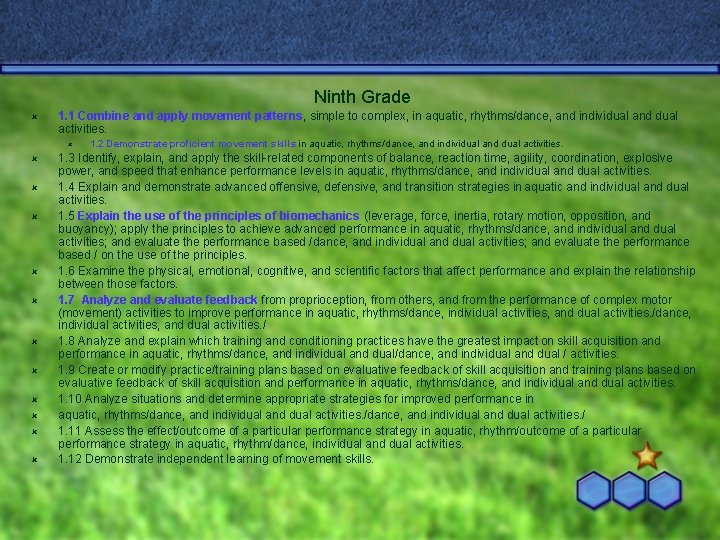
Ninth Grade û 1. 1 Combine and apply movement patterns, simple to complex, in aquatic, rhythms/dance, and individual and dual activities. û û û 1. 2 Demonstrate proficient movement skills in aquatic, rhythms/dance, and individual and dual activities. 1. 3 Identify, explain, and apply the skill-related components of balance, reaction time, agility, coordination, explosive power, and speed that enhance performance levels in aquatic, rhythms/dance, and individual and dual activities. 1. 4 Explain and demonstrate advanced offensive, defensive, and transition strategies in aquatic and individual and dual activities. 1. 5 Explain the use of the principles of biomechanics (leverage, force, inertia, rotary motion, opposition, and buoyancy); apply the principles to achieve advanced performance in aquatic, rhythms/dance, and individual and dual activities; and evaluate the performance based / on the use of the principles. 1. 6 Examine the physical, emotional, cognitive, and scientific factors that affect performance and explain the relationship between those factors. 1. 7 Analyze and evaluate feedback from proprioception, from others, and from the performance of complex motor (movement) activities to improve performance in aquatic, rhythms/dance, individual activities, and dual activities. / 1. 8 Analyze and explain which training and conditioning practices have the greatest impact on skill acquisition and performance in aquatic, rhythms/dance, and individual and dual / activities. 1. 9 Create or modify practice/training plans based on evaluative feedback of skill acquisition and performance in aquatic, rhythms/dance, and individual and dual activities. 1. 10 Analyze situations and determine appropriate strategies for improved performance in aquatic, rhythms/dance, and individual and dual activities. / 1. 11 Assess the effect/outcome of a particular performance strategy in aquatic, rhythm/dance, individual and dual activities. 1. 12 Demonstrate independent learning of movement skills.
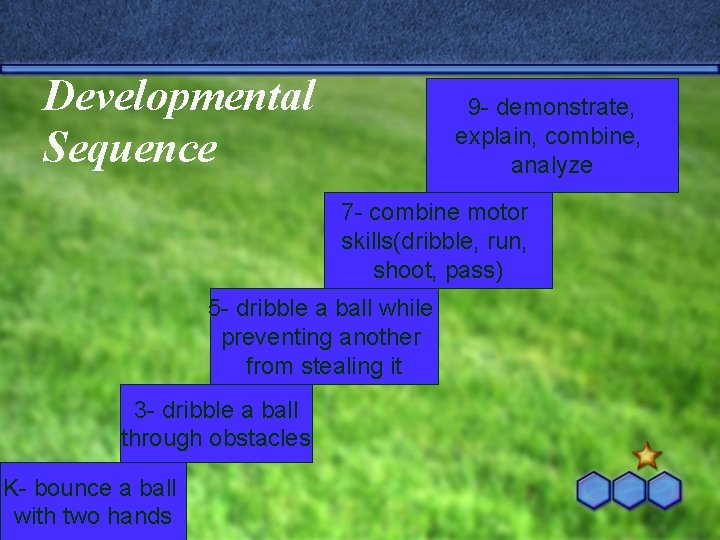
Developmental Sequence 9 - demonstrate, explain, combine, analyze 7 - combine motor skills(dribble, run, shoot, pass) 5 - dribble a ball while preventing another from stealing it 3 - dribble a ball through obstacles K- bounce a ball with two hands
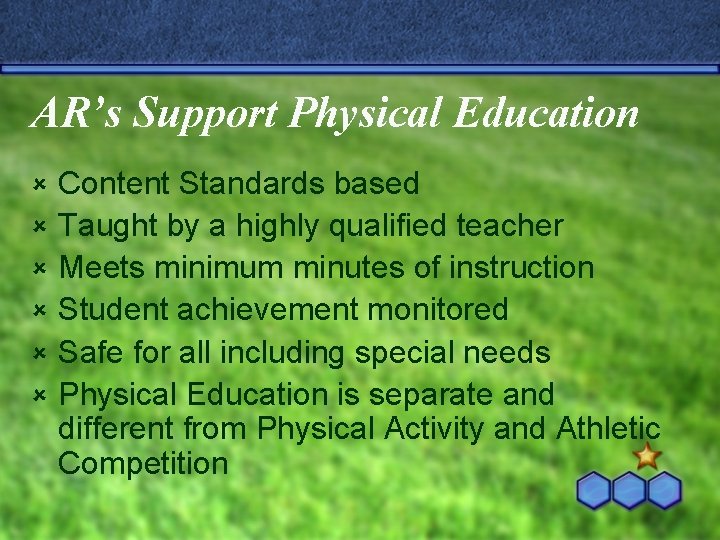
AR’s Support Physical Education û û û Content Standards based Taught by a highly qualified teacher Meets minimum minutes of instruction Student achievement monitored Safe for all including special needs Physical Education is separate and different from Physical Activity and Athletic Competition
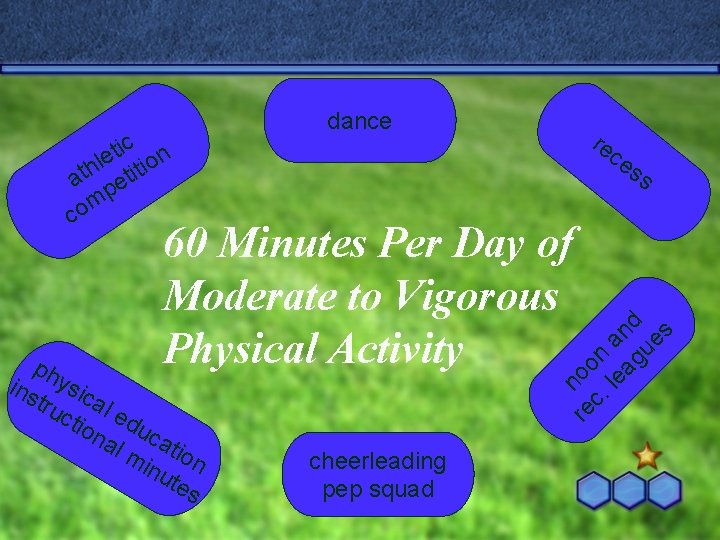
c n i t e tio l h at peti m o c dance re ce ss ph ins ysic tru al cti ed on uc ati al mi on nu tes re noo c. n le an ag d ue s 60 Minutes Per Day of Moderate to Vigorous Physical Activity cheerleading pep squad