Phased Energy Development and the Precautionary Principle Good
- Slides: 18
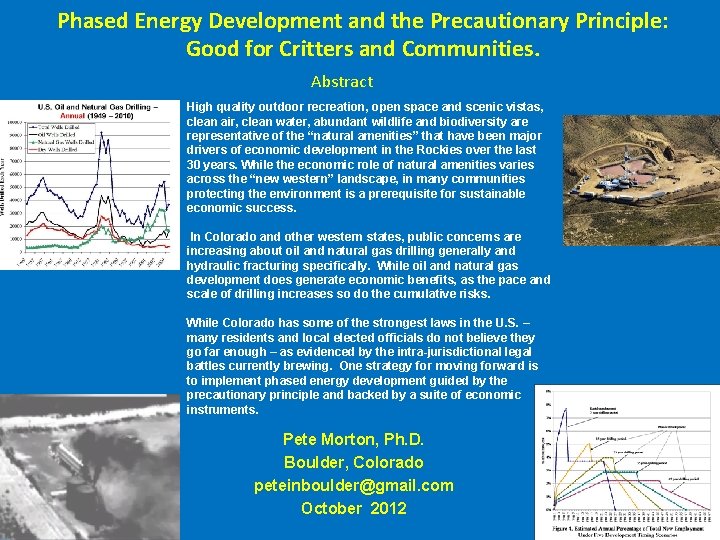
Phased Energy Development and the Precautionary Principle: Good for Critters and Communities. Abstract High quality outdoor recreation, open space and scenic vistas, clean air, clean water, abundant wildlife and biodiversity are representative of the “natural amenities” that have been major drivers of economic development in the Rockies over the last 30 years. While the economic role of natural amenities varies across the “new western” landscape, in many communities protecting the environment is a prerequisite for sustainable economic success. In Colorado and other western states, public concerns are increasing about oil and natural gas drilling generally and hydraulic fracturing specifically. While oil and natural gas development does generate economic benefits, as the pace and scale of drilling increases so do the cumulative risks. While Colorado has some of the strongest laws in the U. S. – many residents and local elected officials do not believe they go far enough – as evidenced by the intra-jurisdictional legal battles currently brewing. One strategy for moving forward is to implement phased energy development guided by the precautionary principle and backed by a suite of economic instruments. Pete Morton, Ph. D. Boulder, Colorado peteinboulder@gmail. com October 2012
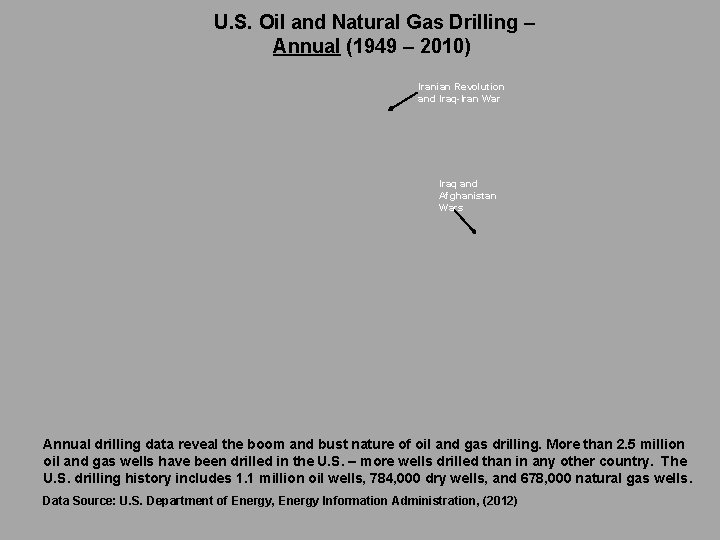
U. S. Oil and Natural Gas Drilling – Annual (1949 – 2010) Iranian Revolution and Iraq-Iran War Iraq and Afghanistan Wars Annual drilling data reveal the boom and bust nature of oil and gas drilling. More than 2. 5 million oil and gas wells have been drilled in the U. S. – more wells drilled than in any other country. The U. S. drilling history includes 1. 1 million oil wells, 784, 000 dry wells, and 678, 000 natural gas wells. Data Source: U. S. Department of Energy, Energy Information Administration, (2012)
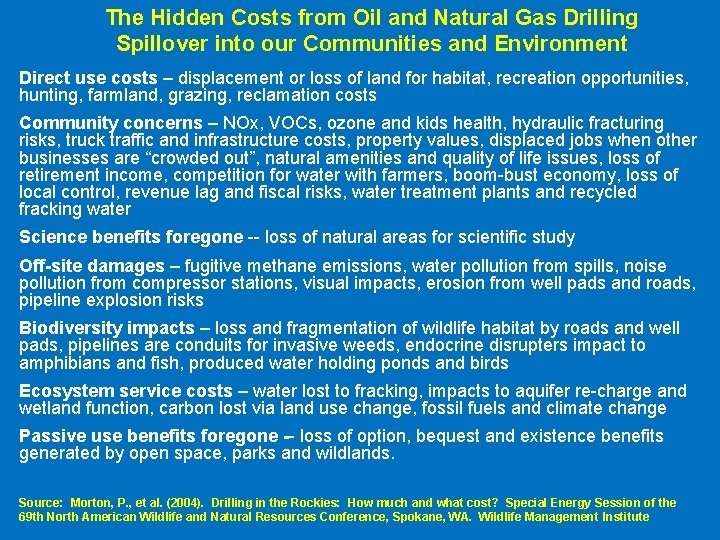
The Hidden Costs from Oil and Natural Gas Drilling Spillover into our Communities and Environment Direct use costs – displacement or loss of land for habitat, recreation opportunities, hunting, farmland, grazing, reclamation costs Community concerns – NOx, VOCs, ozone and kids health, hydraulic fracturing risks, truck traffic and infrastructure costs, property values, displaced jobs when other businesses are “crowded out”, natural amenities and quality of life issues, loss of retirement income, competition for water with farmers, boom-bust economy, loss of local control, revenue lag and fiscal risks, water treatment plants and recycled fracking water Science benefits foregone -- loss of natural areas for scientific study Off-site damages – fugitive methane emissions, water pollution from spills, noise pollution from compressor stations, visual impacts, erosion from well pads and roads, pipeline explosion risks Biodiversity impacts – loss and fragmentation of wildlife habitat by roads and well pads, pipelines are conduits for invasive weeds, endocrine disrupters impact to amphibians and fish, produced water holding ponds and birds Ecosystem service costs – water lost to fracking, impacts to aquifer re-charge and wetland function, carbon lost via land use change, fossil fuels and climate change Passive use benefits foregone -- loss of option, bequest and existence benefits generated by open space, parks and wildlands. Source: Morton, P. , et al. (2004). Drilling in the Rockies: How much and what cost? Special Energy Session of the 69 th North American Wildlife and Natural Resources Conference, Spokane, WA. Wildlife Management Institute
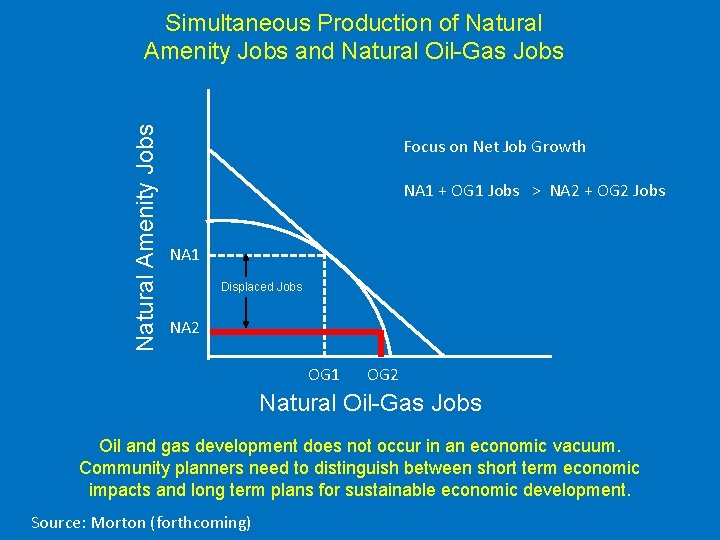
Natural Amenity Jobs Simultaneous Production of Natural Amenity Jobs and Natural Oil-Gas Jobs Focus on Net Job Growth NA 1 + OG 1 Jobs > NA 2 + OG 2 Jobs NA 1 Displaced Jobs NA 2 OG 1 OG 2 Natural Oil-Gas Jobs Oil and gas development does not occur in an economic vacuum. Community planners need to distinguish between short term economic impacts and long term plans for sustainable economic development. Source: Morton (forthcoming)
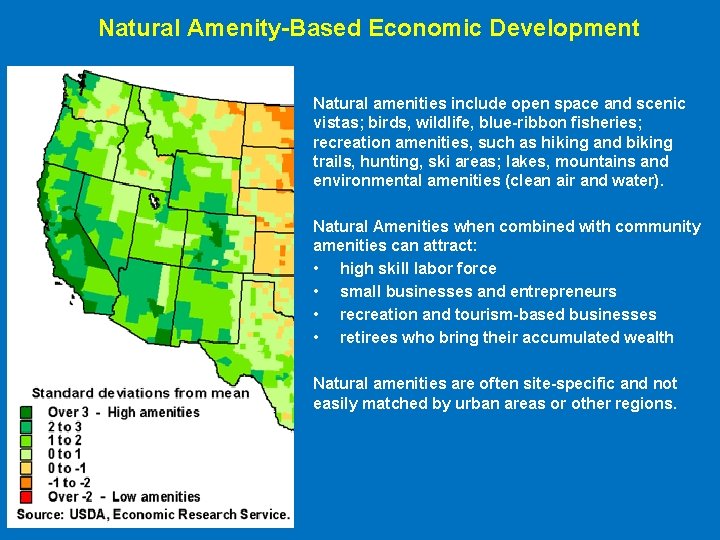
Natural Amenity-Based Economic Development Natural amenities include open space and scenic vistas; birds, wildlife, blue-ribbon fisheries; recreation amenities, such as hiking and biking trails, hunting, ski areas; lakes, mountains and environmental amenities (clean air and water). Natural Amenities when combined with community amenities can attract: • high skill labor force • small businesses and entrepreneurs • recreation and tourism-based businesses • retirees who bring their accumulated wealth Natural amenities are often site-specific and not easily matched by urban areas or other regions.
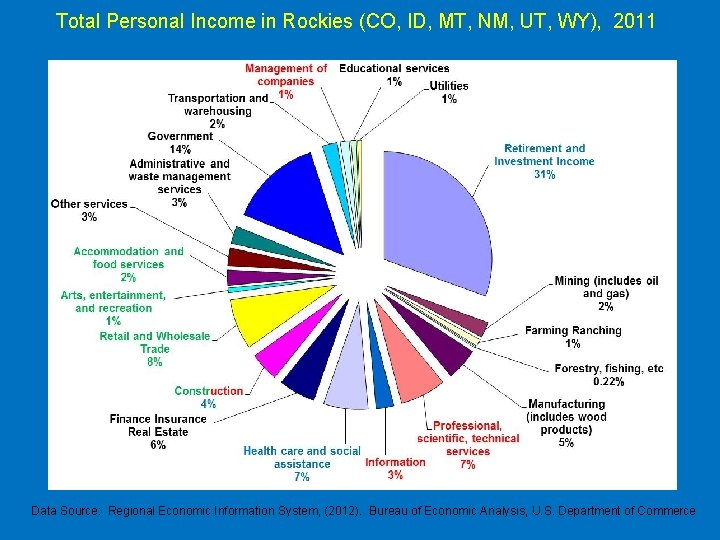
Total Personal Income in Rockies (CO, ID, MT, NM, UT, WY), 2011 Data Source: Regional Economic Information System, (2012). Bureau of Economic Analysis, U. S. Department of Commerce
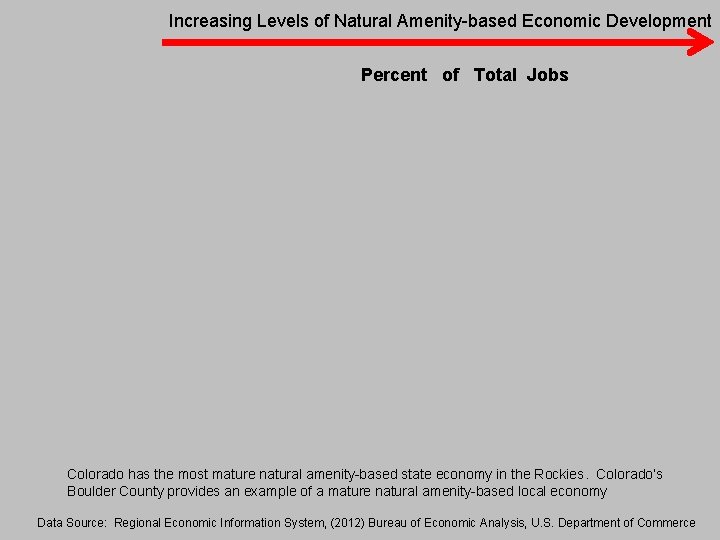
Increasing Levels of Natural Amenity-based Economic Development Percent of Total Jobs Colorado has the most mature natural amenity-based state economy in the Rockies. Colorado’s Boulder County provides an example of a mature natural amenity-based local economy Data Source: Regional Economic Information System, (2012) Bureau of Economic Analysis, U. S. Department of Commerce
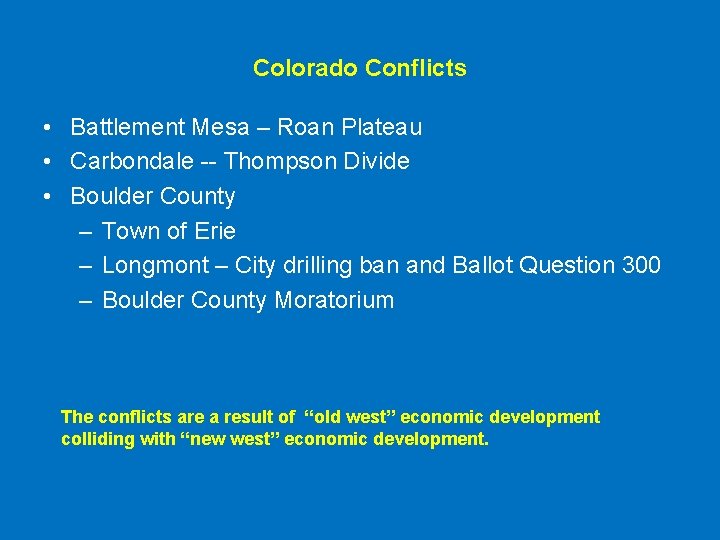
Colorado Conflicts • Battlement Mesa – Roan Plateau • Carbondale -- Thompson Divide • Boulder County – Town of Erie – Longmont – City drilling ban and Ballot Question 300 – Boulder County Moratorium The conflicts are a result of “old west” economic development colliding with “new west” economic development.
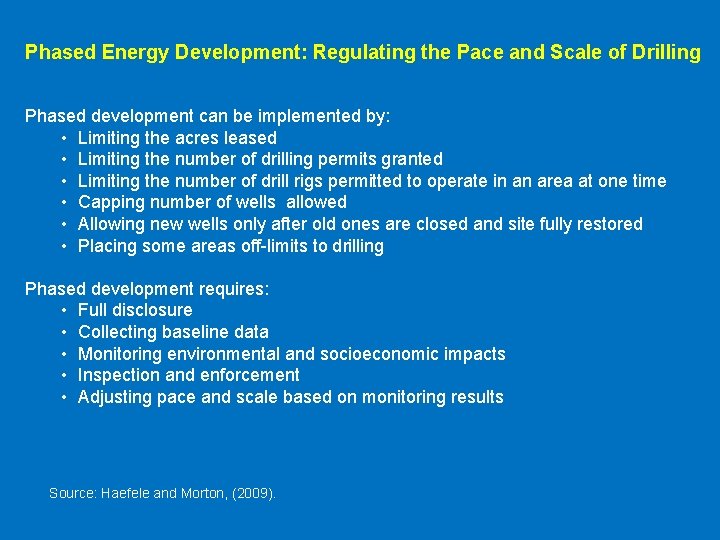
Phased Energy Development: Regulating the Pace and Scale of Drilling Phased development can be implemented by: • Limiting the acres leased • Limiting the number of drilling permits granted • Limiting the number of drill rigs permitted to operate in an area at one time • Capping number of wells allowed • Allowing new wells only after old ones are closed and site fully restored • Placing some areas off-limits to drilling Phased development requires: • Full disclosure • Collecting baseline data • Monitoring environmental and socioeconomic impacts • Inspection and enforcement • Adjusting pace and scale based on monitoring results Source: Haefele and Morton, (2009).
Percent of Total New Jobs Slowing the Pace and Scale of Drilling Can Provide a more Sustainable Economic Development Path for Communities Source: Haefele and Morton (2009)
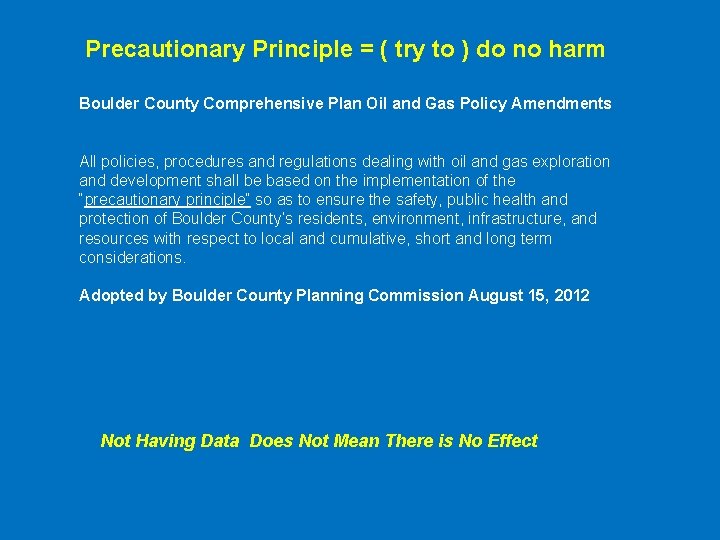
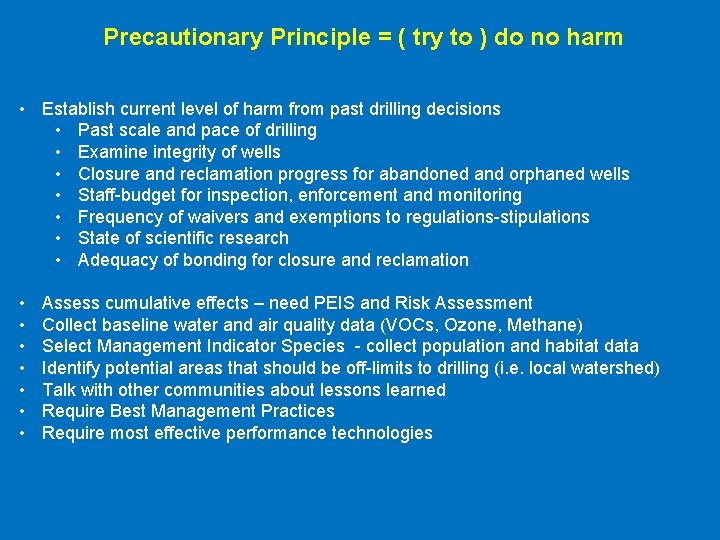
Precautionary Principle = ( try to ) do no harm Boulder County Comprehensive Plan Oil and Gas Policy Amendments All policies, procedures and regulations dealing with oil and gas exploration and development shall be based on the implementation of the “precautionary principle” so as to ensure the safety, public health and protection of Boulder County’s residents, environment, infrastructure, and resources with respect to local and cumulative, short and long term considerations. Adopted by Boulder County Planning Commission August 15, 2012 Not Having Data Does Not Mean There is No Effect
Precautionary Principle = ( try to ) do no harm • Establish current level of harm from past drilling decisions • Past scale and pace of drilling • Examine integrity of wells • Closure and reclamation progress for abandoned and orphaned wells • Staff-budget for inspection, enforcement and monitoring • Frequency of waivers and exemptions to regulations-stipulations • State of scientific research • Adequacy of bonding for closure and reclamation • • Assess cumulative effects – need PEIS and Risk Assessment Collect baseline water and air quality data (VOCs, Ozone, Methane) Select Management Indicator Species - collect population and habitat data Identify potential areas that should be off-limits to drilling (i. e. local watershed) Talk with other communities about lessons learned Require Best Management Practices Require most effective performance technologies
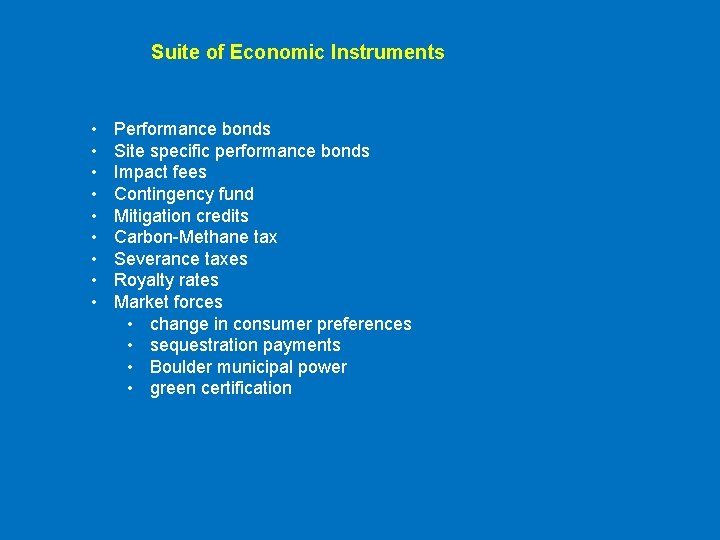
Suite of Economic Instruments • • • Performance bonds Site specific performance bonds Impact fees Contingency fund Mitigation credits Carbon-Methane tax Severance taxes Royalty rates Market forces • change in consumer preferences • sequestration payments • Boulder municipal power • green certification
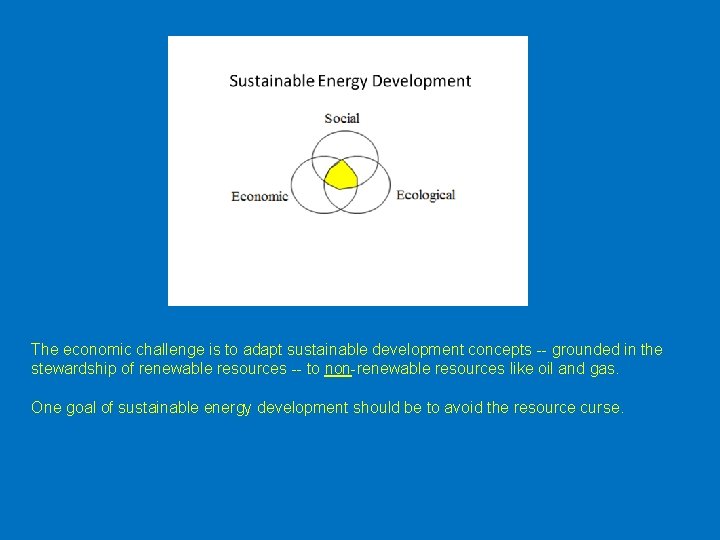
The economic challenge is to adapt sustainable development concepts -- grounded in the stewardship of renewable resources -- to non-renewable resources like oil and gas. One goal of sustainable energy development should be to avoid the resource curse.
The Land Ethic “All ethics so far evolved rest upon a single premise that the individual is a member of a community of interdependent parts…. The land ethic simply enlarges the boundaries of the community to include soils, waters, plants, and animals, or collectively: the land. In short, a land ethic changes the role of Homo sapiens from conqueror of the land-community to plain member and citizen of it. It implies respect for his fellow-members, and also respect for the community as such. ” Aldo Leopold (1949), A Sand County Almanac.
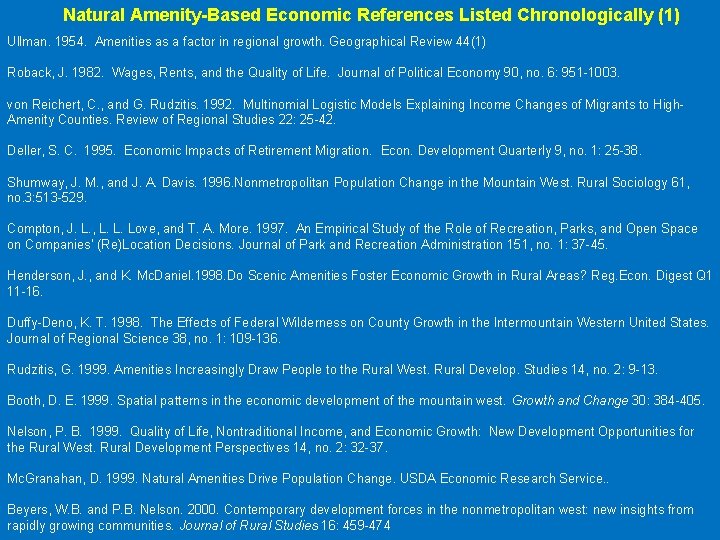
Natural Amenity-Based Economic References Listed Chronologically (1) Ullman. 1954. Amenities as a factor in regional growth. Geographical Review 44(1) Roback, J. 1982. Wages, Rents, and the Quality of Life. Journal of Political Economy 90, no. 6: 951 -1003. von Reichert, C. , and G. Rudzitis. 1992. Multinomial Logistic Models Explaining Income Changes of Migrants to High. Amenity Counties. Review of Regional Studies 22: 25 -42. Deller, S. C. 1995. Economic Impacts of Retirement Migration. Econ. Development Quarterly 9, no. 1: 25 -38. Shumway, J. M. , and J. A. Davis. 1996. Nonmetropolitan Population Change in the Mountain West. Rural Sociology 61, no. 3: 513 -529. Compton, J. L. , L. L. Love, and T. A. More. 1997. An Empirical Study of the Role of Recreation, Parks, and Open Space on Companies' (Re)Location Decisions. Journal of Park and Recreation Administration 151, no. 1: 37 -45. Henderson, J. , and K. Mc. Daniel. 1998. Do Scenic Amenities Foster Economic Growth in Rural Areas? Reg. Econ. Digest Q 1 11 -16. Duffy-Deno, K. T. 1998. The Effects of Federal Wilderness on County Growth in the Intermountain Western United States. Journal of Regional Science 38, no. 1: 109 -136. Rudzitis, G. 1999. Amenities Increasingly Draw People to the Rural West. Rural Develop. Studies 14, no. 2: 9 -13. Booth, D. E. 1999. Spatial patterns in the economic development of the mountain west. Growth and Change 30: 384 -405. Nelson, P. B. 1999. Quality of Life, Nontraditional Income, and Economic Growth: New Development Opportunities for the Rural West. Rural Development Perspectives 14, no. 2: 32 -37. Mc. Granahan, D. 1999. Natural Amenities Drive Population Change. USDA Economic Research Service. . Beyers, W. B. and P. B. Nelson. 2000. Contemporary development forces in the nonmetropolitan west: new insights from rapidly growing communities. Journal of Rural Studies 16: 459 -474
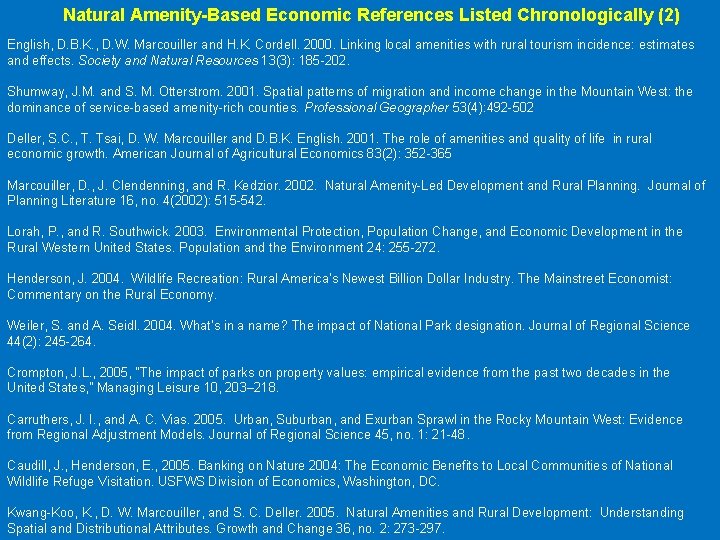
Natural Amenity-Based Economic References Listed Chronologically (2) English, D. B. K. , D. W. Marcouiller and H. K. Cordell. 2000. Linking local amenities with rural tourism incidence: estimates and effects. Society and Natural Resources 13(3): 185 -202. Shumway, J. M. and S. M. Otterstrom. 2001. Spatial patterns of migration and income change in the Mountain West: the dominance of service-based amenity-rich counties. Professional Geographer 53(4): 492 -502 Deller, S. C. , T. Tsai, D. W. Marcouiller and D. B. K. English. 2001. The role of amenities and quality of life in rural economic growth. American Journal of Agricultural Economics 83(2): 352 -365 Marcouiller, D. , J. Clendenning, and R. Kedzior. 2002. Natural Amenity-Led Development and Rural Planning. Journal of Planning Literature 16, no. 4(2002): 515 -542. Lorah, P. , and R. Southwick. 2003. Environmental Protection, Population Change, and Economic Development in the Rural Western United States. Population and the Environment 24: 255 -272. Henderson, J. 2004. Wildlife Recreation: Rural America's Newest Billion Dollar Industry. The Mainstreet Economist: Commentary on the Rural Economy. Weiler, S. and A. Seidl. 2004. What’s in a name? The impact of National Park designation. Journal of Regional Science 44(2): 245 -264. Crompton, J. L. , 2005, “The impact of parks on property values: empirical evidence from the past two decades in the United States, ” Managing Leisure 10, 203– 218. Carruthers, J. I. , and A. C. Vias. 2005. Urban, Suburban, and Exurban Sprawl in the Rocky Mountain West: Evidence from Regional Adjustment Models. Journal of Regional Science 45, no. 1: 21 -48. Caudill, J. , Henderson, E. , 2005. Banking on Nature 2004: The Economic Benefits to Local Communities of National Wildlife Refuge Visitation. USFWS Division of Economics, Washington, DC. Kwang-Koo, K. , D. W. Marcouiller, and S. C. Deller. 2005. Natural Amenities and Rural Development: Understanding Spatial and Distributional Attributes. Growth and Change 36, no. 2: 273 -297.
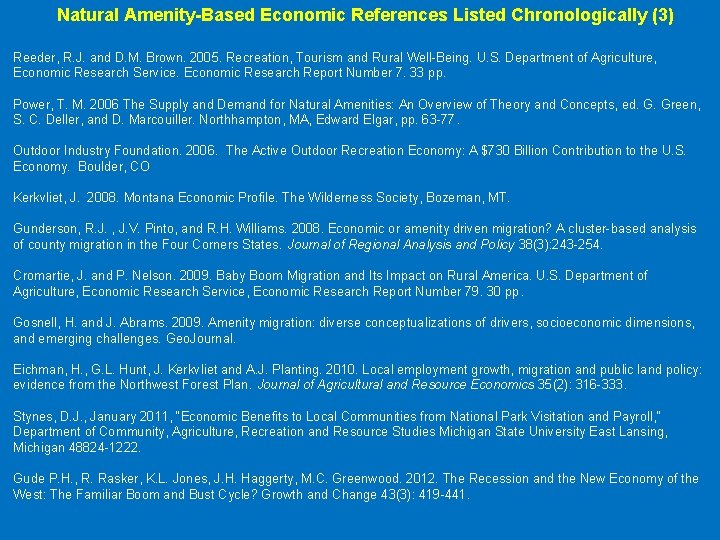
Natural Amenity-Based Economic References Listed Chronologically (3) Reeder, R. J. and D. M. Brown. 2005. Recreation, Tourism and Rural Well-Being. U. S. Department of Agriculture, Economic Research Service. Economic Research Report Number 7. 33 pp. Power, T. M. 2006 The Supply and Demand for Natural Amenities: An Overview of Theory and Concepts, ed. G. Green, S. C. Deller, and D. Marcouiller. Northhampton, MA, Edward Elgar, pp. 63 -77. Outdoor Industry Foundation. 2006. The Active Outdoor Recreation Economy: A $730 Billion Contribution to the U. S. Economy. Boulder, CO Kerkvliet, J. 2008. Montana Economic Profile. The Wilderness Society, Bozeman, MT. Gunderson, R. J. , J. V. Pinto, and R. H. Williams. 2008. Economic or amenity driven migration? A cluster-based analysis of county migration in the Four Corners States. Journal of Regional Analysis and Policy 38(3): 243 -254. Cromartie, J. and P. Nelson. 2009. Baby Boom Migration and Its Impact on Rural America. U. S. Department of Agriculture, Economic Research Service, Economic Research Report Number 79. 30 pp. Gosnell, H. and J. Abrams. 2009. Amenity migration: diverse conceptualizations of drivers, socioeconomic dimensions, and emerging challenges. Geo. Journal. Eichman, H. , G. L. Hunt, J. Kerkvliet and A. J. Planting. 2010. Local employment growth, migration and public land policy: evidence from the Northwest Forest Plan. Journal of Agricultural and Resource Economics 35(2): 316 -333. Stynes, D. J. , January 2011, “Economic Benefits to Local Communities from National Park Visitation and Payroll, ” Department of Community, Agriculture, Recreation and Resource Studies Michigan State University East Lansing, Michigan 48824 -1222. Gude P. H. , R. Rasker, K. L. Jones, J. H. Haggerty, M. C. Greenwood. 2012. The Recession and the New Economy of the West: The Familiar Boom and Bust Cycle? Growth and Change 43(3): 419 -441.