
EHR GoLive Strategies This work is licensed under

- Slides: 15
EHR Go-Live Strategies This work is licensed under a Creative Commons Attribution-Non. Commercial-Share. Alike 4. 0 International License. Based on a work at https: //www. healthit. gov/. This workforce product was funded by a grant awarded by the U. S. Department of Labor's Employment and Training Administration. The product was created by the grantee and does not necessarily reflect the official position of the U. S. Department of Labor. The Department of Labor makes no guarantees, warranties, or assurances of any kind, express or implied, with respect to such information, including any information on linked sites and including, but not limited to, accuracy of the information or its completeness, timeliness, usefulness, adequacy, continued availability, or ownership. 1
Overview 1. Describe characteristics of training and go-live strategies that would facilitate implementation of a new Electronic Health Record (EHR) system 2. Compare the advantages and disadvantages of a bigbang roll-out versus a phased roll-out and vice-versa 3. Identify staffing, command center and on-site consultant considerations 4. Compare strategies for monitoring system usage and change management 2
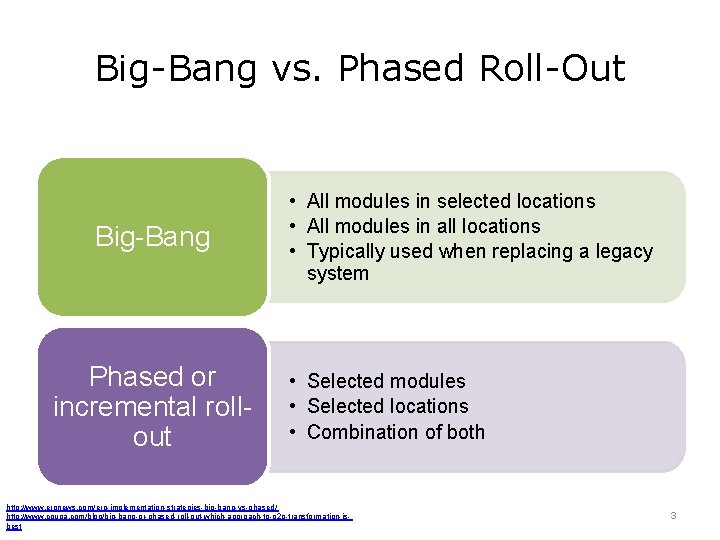
Big-Bang vs. Phased Roll-Out Big-Bang Phased or incremental rollout • All modules in selected locations • All modules in all locations • Typically used when replacing a legacy system • Selected modules • Selected locations • Combination of both http: //www. erpnews. com/erp-implementation-strategies-big-bang-vs-phased/ http: //www. coupa. com/blog/big-bang-or-phased-roll-out-which-approach-to-p 2 p-transformation-isbest 3
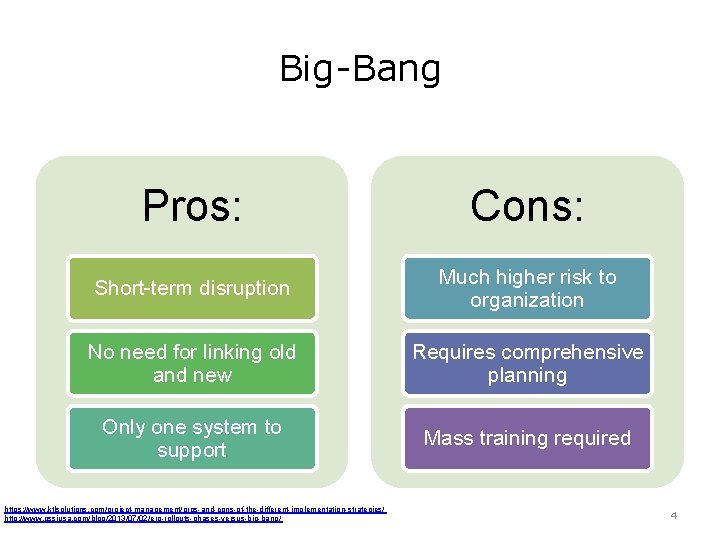
Big-Bang Pros: Cons: Short-term disruption Much higher risk to organization No need for linking old and new Requires comprehensive planning Only one system to support Mass training required https: //www. ktlsolutions. com/project-management/pros-and-cons-of-the-different-implementation-strategies/ http: //www. pssiusa. com/blog/2013/07/02/erp-rollouts-phases-versus-big-bang/ 4
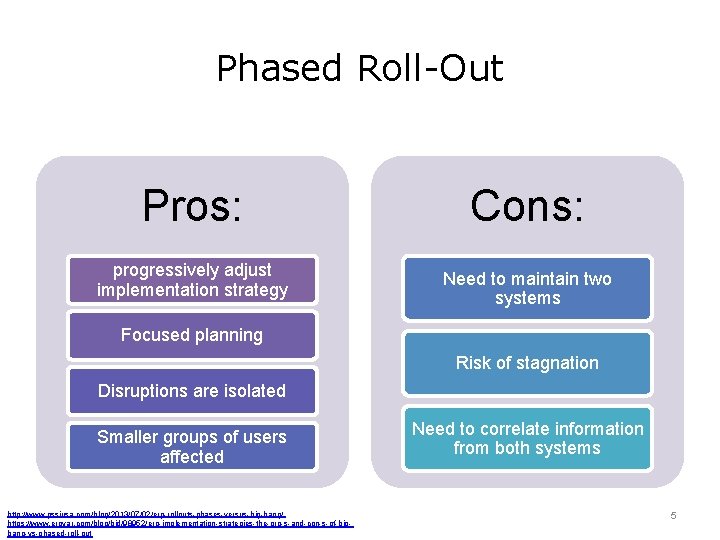
Phased Roll-Out Pros: progressively adjust implementation strategy Cons: Need to maintain two systems Focused planning Risk of stagnation Disruptions are isolated Smaller groups of users affected http: //www. pssiusa. com/blog/2013/07/02/erp-rollouts-phases-versus-big-bang/ https: //www. erpvar. com/blog/bid/98952/erp-implementation-strategies-the-pro-s-and-con-s-of-bigbang-vs-phased-roll-out Need to correlate information from both systems 5
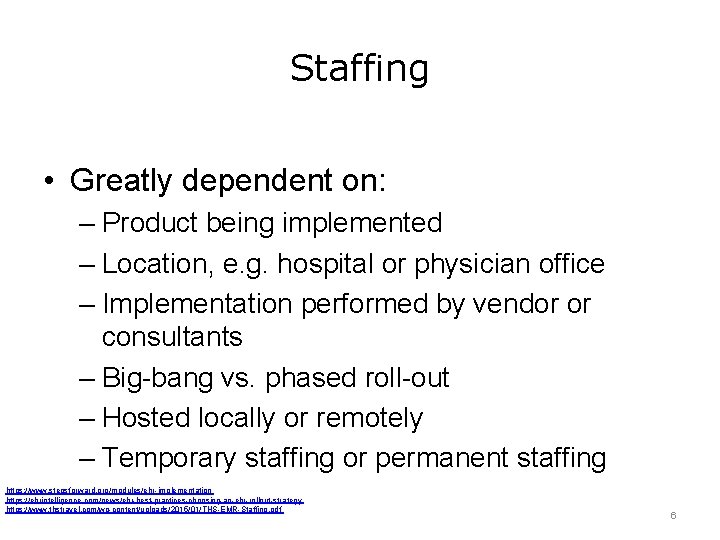
Staffing • Greatly dependent on: – Product being implemented – Location, e. g. hospital or physician office – Implementation performed by vendor or consultants – Big-bang vs. phased roll-out – Hosted locally or remotely – Temporary staffing or permanent staffing https: //www. stepsforward. org/modules/ehr-implementation https: //ehrintelligence. com/news/ehr-best-practices-choosing-an-ehr-rollout-strategy https: //www. thstravel. com/wp-content/uploads/2015/01/THS-EMR-Staffing. pdf 6
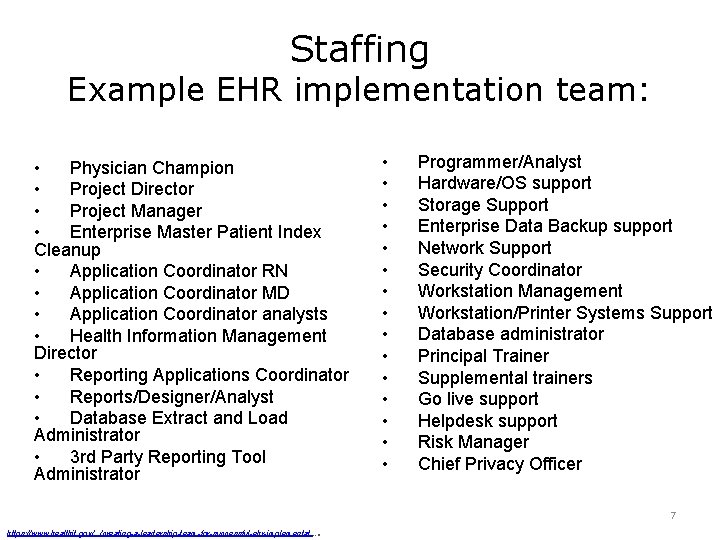
Staffing Example EHR implementation team: • Physician Champion • Project Director • Project Manager • Enterprise Master Patient Index Cleanup • Application Coordinator RN • Application Coordinator MD • Application Coordinator analysts • Health Information Management Director • Reporting Applications Coordinator • Reports/Designer/Analyst • Database Extract and Load Administrator • 3 rd Party Reporting Tool Administrator https: //www. healthit. gov/. . . /creating-a-leadership-team-for-successful-ehr-implementat. . . • • • • Programmer/Analyst Hardware/OS support Storage Support Enterprise Data Backup support Network Support Security Coordinator Workstation Management Workstation/Printer Systems Support Database administrator Principal Trainer Supplemental trainers Go live support Helpdesk support Risk Manager Chief Privacy Officer 7
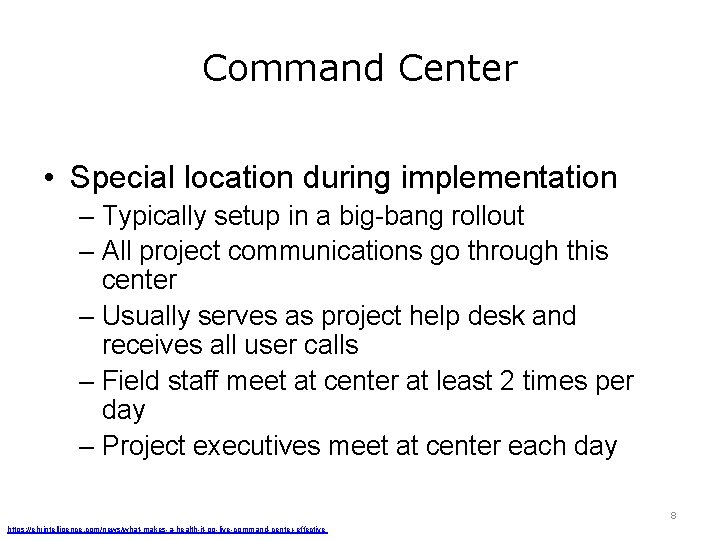
Command Center • Special location during implementation – Typically setup in a big-bang rollout – All project communications go through this center – Usually serves as project help desk and receives all user calls – Field staff meet at center at least 2 times per day – Project executives meet at center each day 8 https: //ehrintelligence. com/news/what-makes-a-health-it-go-live-command-center-effective
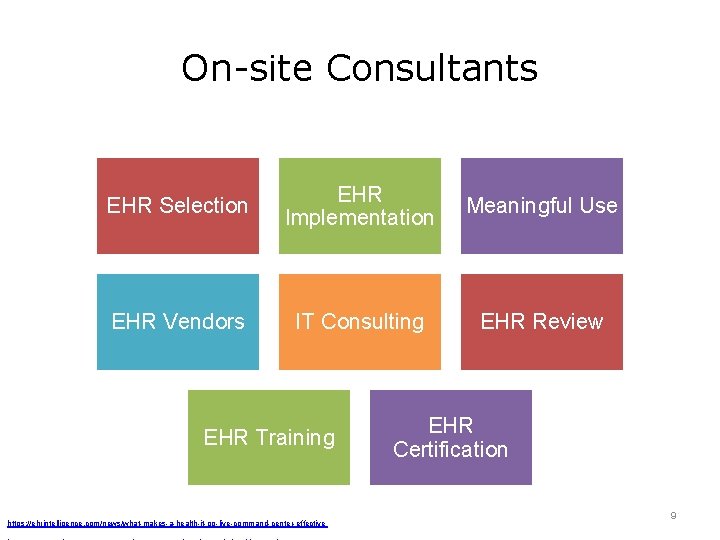
On-site Consultants EHR Selection EHR Implementation Meaningful Use EHR Vendors IT Consulting EHR Review EHR Training https: //ehrintelligence. com/news/what-makes-a-health-it-go-live-command-center-effective EHR Certification 9
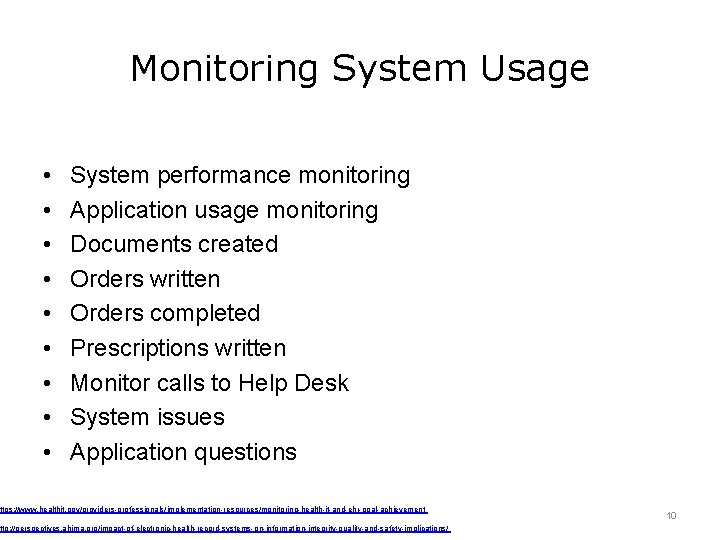
Monitoring System Usage • • • System performance monitoring Application usage monitoring Documents created Orders written Orders completed Prescriptions written Monitor calls to Help Desk System issues Application questions ttps: //www. healthit. gov/providers-professionals/implementation-resources/monitoring-health-it-and-ehr-goal-achievement ttp: //perspectives. ahima. org/impact-of-electronic-health-record-systems-on-information-integrity-quality-and-safety-implications/ 10
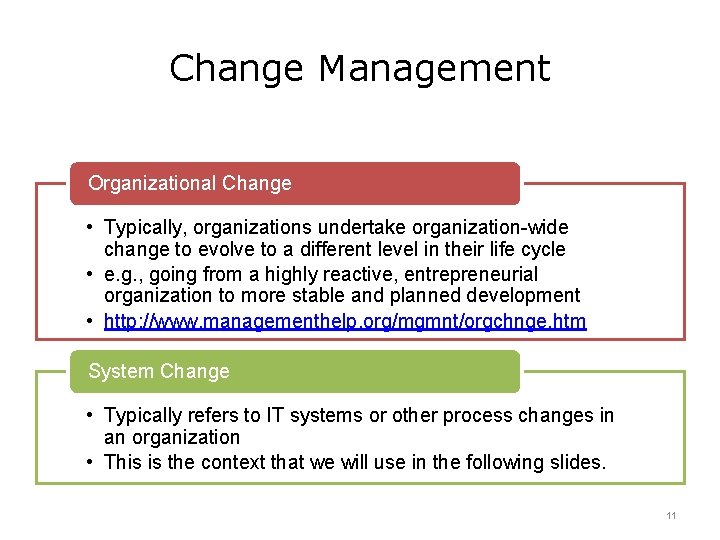
Change Management Organizational Change • Typically, organizations undertake organization-wide change to evolve to a different level in their life cycle • e. g. , going from a highly reactive, entrepreneurial organization to more stable and planned development • http: //www. managementhelp. org/mgmnt/orgchnge. htm System Change • Typically refers to IT systems or other process changes in an organization • This is the context that we will use in the following slides. 11
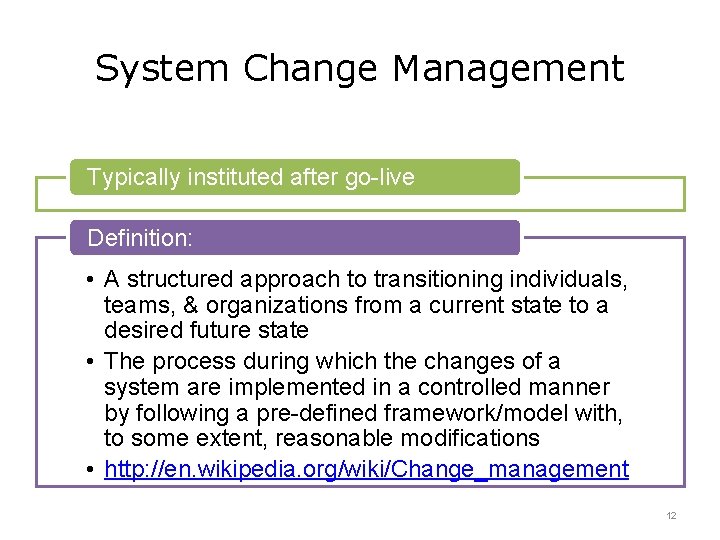
System Change Management Typically instituted after go-live Definition: • A structured approach to transitioning individuals, teams, & organizations from a current state to a desired future state • The process during which the changes of a system are implemented in a controlled manner by following a pre-defined framework/model with, to some extent, reasonable modifications • http: //en. wikipedia. org/wiki/Change_management 12
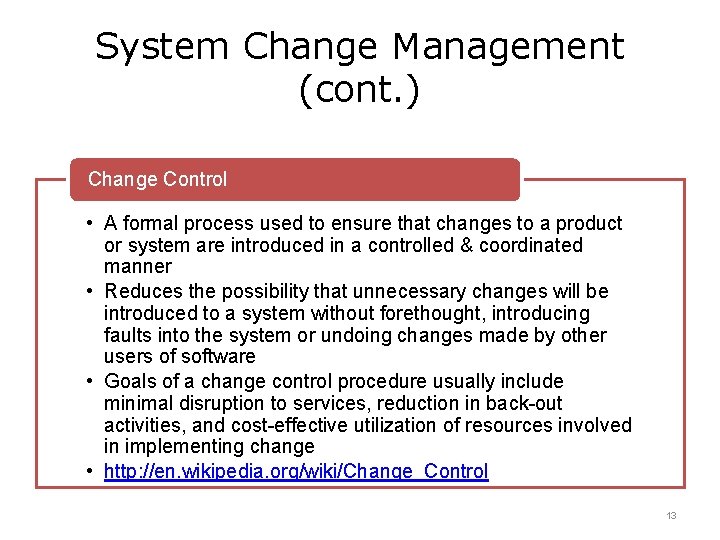
System Change Management (cont. ) Change Control • A formal process used to ensure that changes to a product or system are introduced in a controlled & coordinated manner • Reduces the possibility that unnecessary changes will be introduced to a system without forethought, introducing faults into the system or undoing changes made by other users of software • Goals of a change control procedure usually include minimal disruption to services, reduction in back-out activities, and cost-effective utilization of resources involved in implementing change • http: //en. wikipedia. org/wiki/Change_Control 13
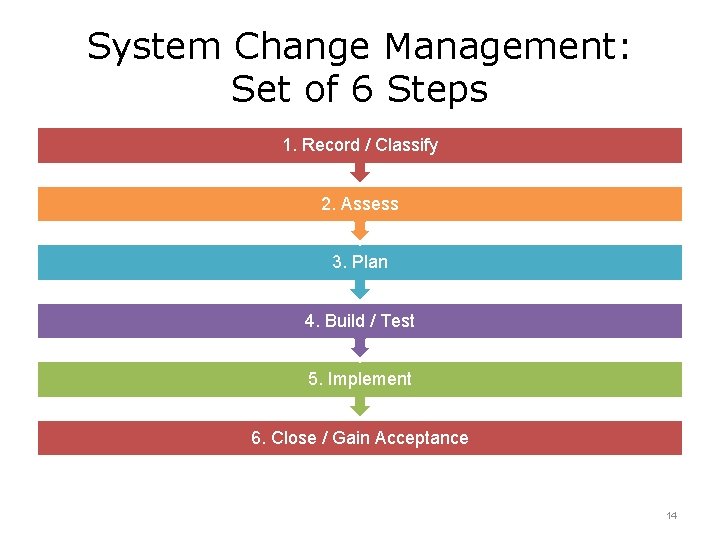
System Change Management: Set of 6 Steps 1. Record / Classify 2. Assess 3. Plan 4. Build / Test 5. Implement 6. Close / Gain Acceptance 14
EHR Go-Live Strategies Summary • We have covered a few of the most important go-live strategies • Reviewed staffing, command centers, use of consultants and change management • These are just a few of the very important aspects of go-live strategies that have to be considered during implementation 15