Peter Dicken 2015 We Are What We Eat






- Slides: 19
© Peter Dicken 2015
‘We Are What We Eat’: The Agro-food Industries Global Shift Chapter 13
• Transformation of the food economy: The “Local” becomes “Global” • Agro-food production circuits • Global shifts in the high-value agro-food industries • Consumer choices and consumer resistances • Transforming technologies in agro-food production • The role of state • Corporate strategies in the agro-food industries
Transformation of the food economy: The “Local” becomes “Global” • Food production is a renewable activity and an intensively local process • Production, distribution and consumption of foods were transformed in past four decades and became increasingly industrialized • Distribution and consumption of high-value foods has become increasingly global • Concerns with food safety and genetic modification
Agro-food production circuits • Focus on high-value foods (HVF) • HVF refers to agricultural products that are high in value, often but not necessarily due to processing • The HVF are processed chicken, fresh vegetables and coffee
Figure 13. 1 The US chicken production circuit Source: based on Boyd and Watts, 1997: Figure 8. 4
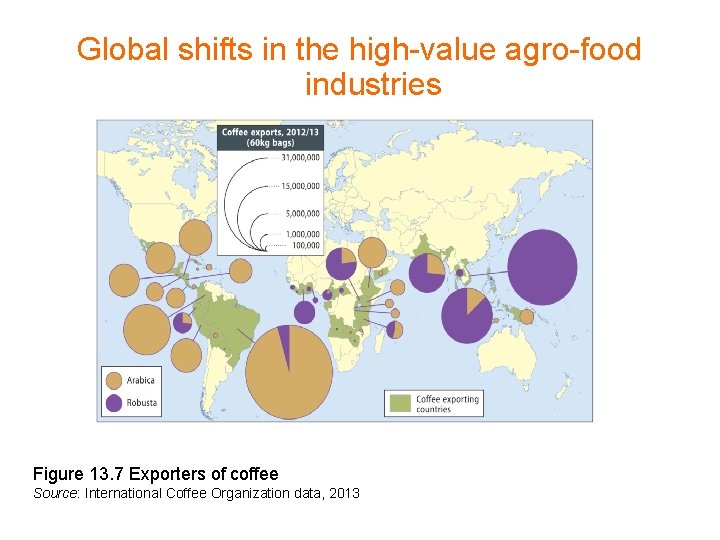
Global shifts in the high-value agro-food industries Figure 13. 7 Exporters of coffee Source: International Coffee Organization data, 2013
Consumer choices and consumer resistances • Demand for food has changed dramatically • Choice of eating involves taste, culture, religion, health concerns, ethical position and lifestyle besides disposable income • Changing patterns of demand consumption implies greater choice in food products and market segmentation • Genetically modified foods and consumer resistance
Transforming technologies in agro-food production • Global cool chains • Development of transportation with innovations in refrigeration and food-freezing technologies caused much wider range of products over vast geographical distances
Transforming technologies in agro-food production • Industrialization of food production and the shift towards biotechnology • Increasing role of agro-food corporations • Genetic modification (GM) improve plants resistance, increase yields, improve nutritional value and can only be afforded by big biotech and agro-food companies • GM seeds belong to the seed company in contrast to traditional farms which used to set aside their seeds from one year for use in next year • Increasing industrialization of food production remove taste, texture, colour and other attributes that causes producers use food chemical additives to counteract these changes
Transforming technologies in agro-food production • What about the workers? • People who work in agriculture are highly affected • Labour force has migrated from field to factory or packaging plant • Use of casual labour has raised and contributed to very low wages and very long hours of work • ‘Sweatshops in the fields’
The role of state • The agro-food industries are the most regulated, subsidized and protected of all economic activities • Regulating agro-food industries • Primary focus is food safety • Before 1970 90% of world food production was consumed in production country, but it has changed dramatically • Regulatory policies are dominated by major food producers • GM food: US permit but EU resist to it • Protection of national food retailers
The role of state • Subsidizing and protecting agro-food industries: the major focus of trade conflict • Protection policies for agro-food industries: tariffs and subsidies • Subsidy per cow in EU is equal to $2 per day. It is how much half the population of the globe has to live • Protection damages poor countries economies • A new phenomenon: state land grabs • Land grabbing is done by capital-exporting countries with worries about feeding their own people • Lack of jobs, tech and skills transfers and tax revenues
Corporate strategies in the agro-food industries • Concentration and consolidation • Transnational companies (TNC) dominate world production circuit of food: seeds, growing, processing and retailing • Concentration is the result of mergers and acquisitions
Figure 13. 8 Dominant firms in the global agro-food industries Source: based on data in ETC Group, 2008 • • Almost three-quarters of the world seed market is controlled by the leading 10 companies, compared with two-thirds in 1967 Almost 90 per cent of the world pesticide market is controlled by the leading 10 firms
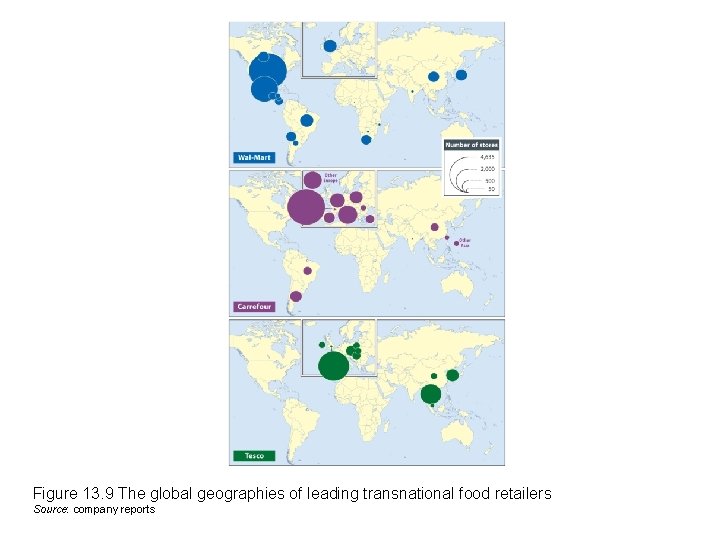
Corporate strategies in the agro-food industries • Strategies of combining ‘global’ brands with ‘local products • Global brands are sold under local label and packaging • Changes in architectures organizational and geographical • Large-scale reorganization programmes • ‘Big Food’ and ‘Big Retail’: two sides of the same coin • Transnational food retailers are gaining more power compared to big food producers • Local competition remains a very serious issue for transnational food retailers • Biggest food retailers have been domestically oriented for most of their histories
Figure 13. 9 The global geographies of leading transnational food retailers Source: company reports
Corporate strategies in the agro-food industries • Supplier relationships • Huge financial benefits by delaying payments to suppliers • Distribution centers instead of per store procurement system
THANK YOU!