Percent yield The efficiency of reactions The Equation
- Slides: 6
Percent yield The efficiency of reactions
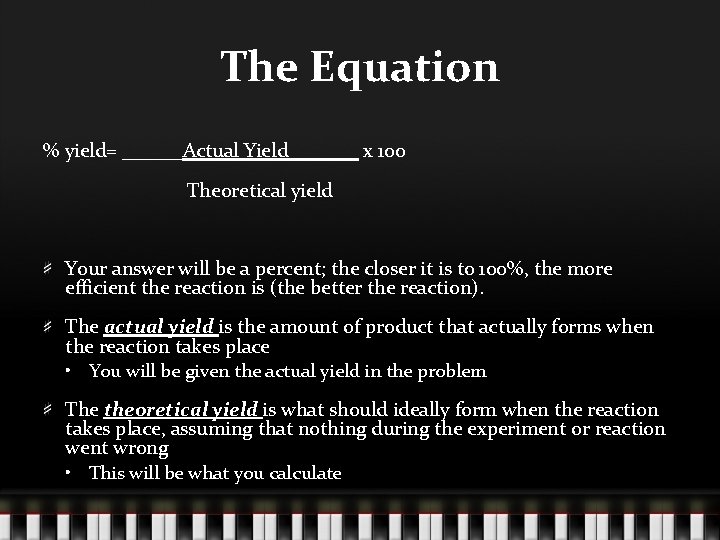
The Equation % yield= ______Actual Yield_______ x 100 Theoretical yield Your answer will be a percent; the closer it is to 100%, the more efficient the reaction is (the better the reaction). The actual yield is the amount of product that actually forms when the reaction takes place • You will be given the actual yield in the problem The theoretical yield is what should ideally form when the reaction takes place, assuming that nothing during the experiment or reaction went wrong • This will be what you calculate
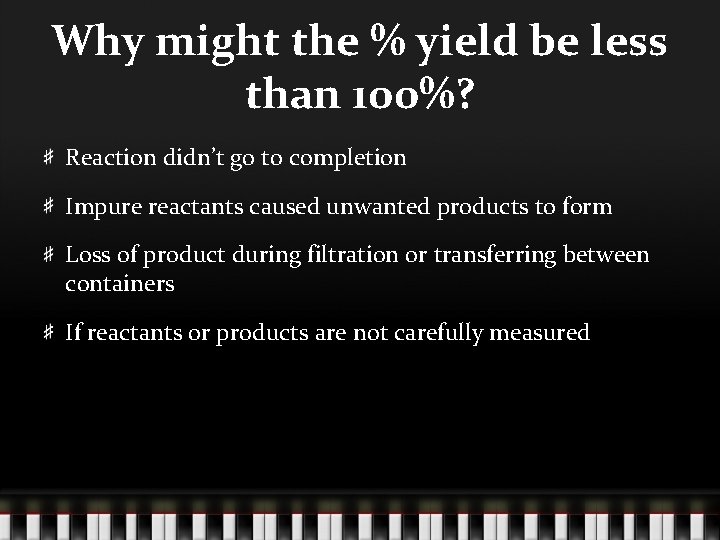
Why might the % yield be less than 100%? Reaction didn’t go to completion Impure reactants caused unwanted products to form Loss of product during filtration or transferring between containers If reactants or products are not carefully measured
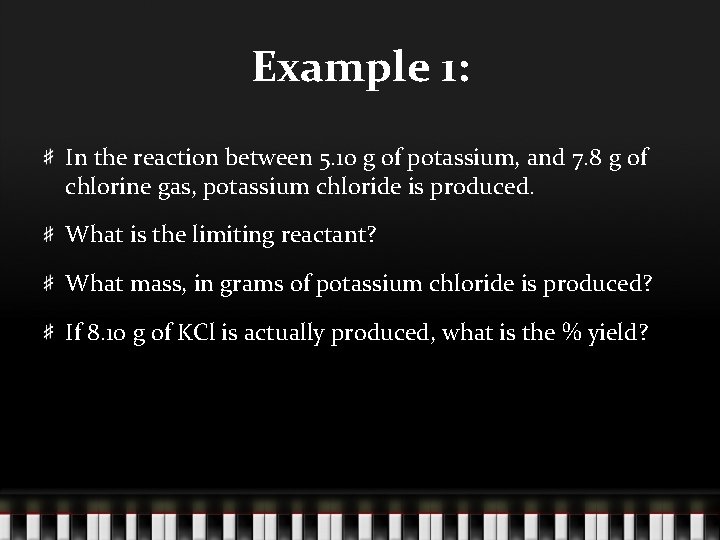
Example 1: In the reaction between 5. 10 g of potassium, and 7. 8 g of chlorine gas, potassium chloride is produced. What is the limiting reactant? What mass, in grams of potassium chloride is produced? If 8. 10 g of KCl is actually produced, what is the % yield?
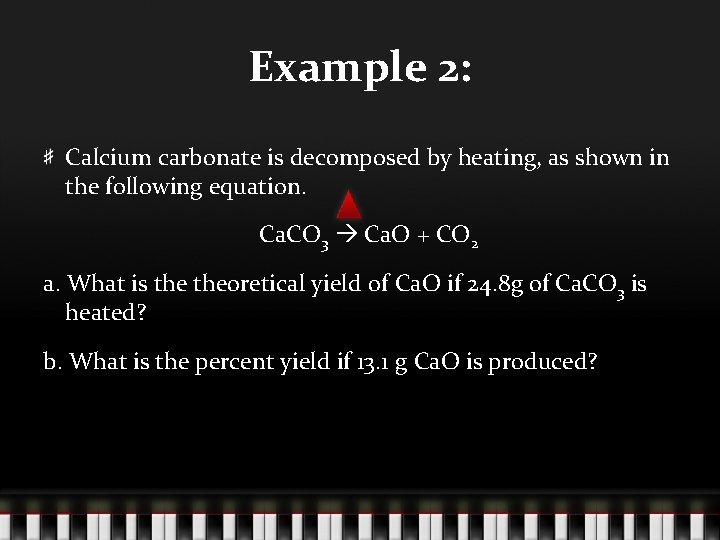
Example 2: Calcium carbonate is decomposed by heating, as shown in the following equation. Ca. CO 3 Ca. O + CO 2 a. What is theoretical yield of Ca. O if 24. 8 g of Ca. CO 3 is heated? b. What is the percent yield if 13. 1 g Ca. O is produced?
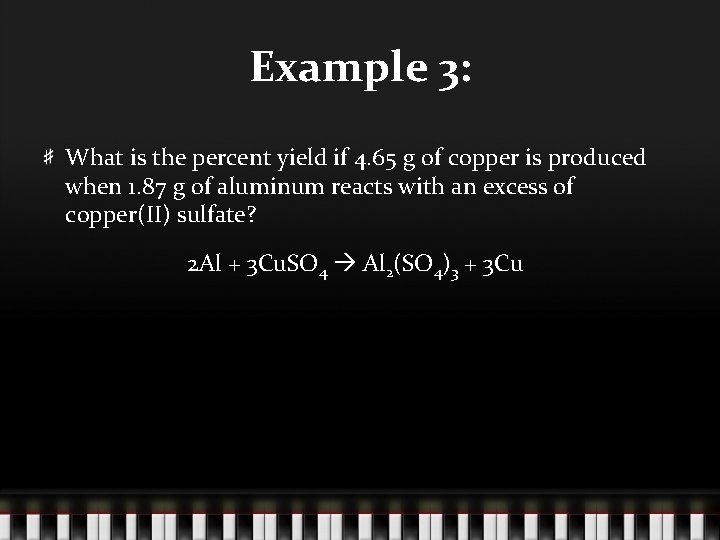
Example 3: What is the percent yield if 4. 65 g of copper is produced when 1. 87 g of aluminum reacts with an excess of copper(II) sulfate? 2 Al + 3 Cu. SO 4 Al 2(SO 4)3 + 3 Cu