Overview of NCI COVID19 in Cancer Patients Study
- Slides: 12
Overview of NCI COVID-19 in Cancer Patients Study (NCCAPS): A Longitudinal Natural History Study Tina Yen, MD, MS June 26, 2020
Background: COVID-19 in Cancer Patients Study Rationale: COVID-19 may disrupt cancerdirected therapy, possibly resulting in worse outcomes. Long-term outcomes of patients with COVID-19 and cancer are unknown. Results from this natural history study will guide future care for cancer patients who acquire COVID-19. Cancer patient risk factors: Age Comorbidities Exposure ↓ Immunity China: cancer patients had higher risk of severe events: admission to the ICU need for mechanical ventilation Death CCC-19: 30 -day mortality of 13% Higher for older age, smokers, active treatment Dai, M-Y, The Lancet, April 8, 2020 Guan, WJ, Eur Respir J, March 26, 2020 Warner, JL ASCO LBA 110, May 31, 2020 2
NCCAPS Natural History Study Goals Enroll a large cohort of patients undergoing cancer therapy who test positive for SARS-Co. V-2 to characterize factors associated with COVID-19 severity. Describe modifications to cancer treatment made due to COVID-19. Evaluate the association of COVID-19 with cancer outcomes in clinico-pathologic subgroups. Assess anti-SARS-Co. V-2 antibody development, cytokine abnormalities, and genetic polymorphisms associated with severe COVID-19. Create a bank of clinical data, research blood specimens, and radiological images for future research. 3
NCCAPS Eligibility: Current Cancer Treatment Active treatment for metastatic cancer (within the past 6 weeks) Chemotherapy Immunotherapy Monoclonal antibody therapy Targeted therapy Endocrine therapy Radiation therapy Treatment for non-metastatic cancer Stage I-III (within the past 6 weeks): chemotherapy, immunotherapy, targeted therapy or radiation therapy Allogenic stem cell transplant (at any time) CAR-T cell or other modified cellular therapy (at any time) Active treatment or prophylaxis for Graft vs. Host Disease Autologous bone marrow transplant (within the past 2 years) 4
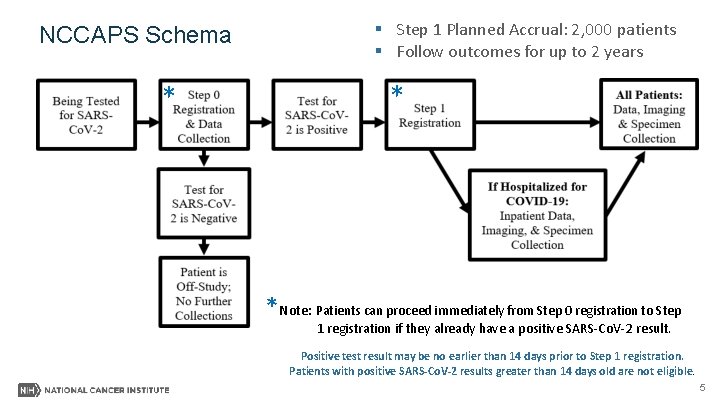
NCCAPS Schema * Step 1 Planned Accrual: 2, 000 patients Follow outcomes for up to 2 years * *Note: Patients can proceed immediately from Step 0 registration to Step 1 registration if they already have a positive SARS-Co. V-2 result. Positive test result may be no earlier than 14 days prior to Step 1 registration. Patients with positive SARS-Co. V-2 results greater than 14 days old are not eligible. 5
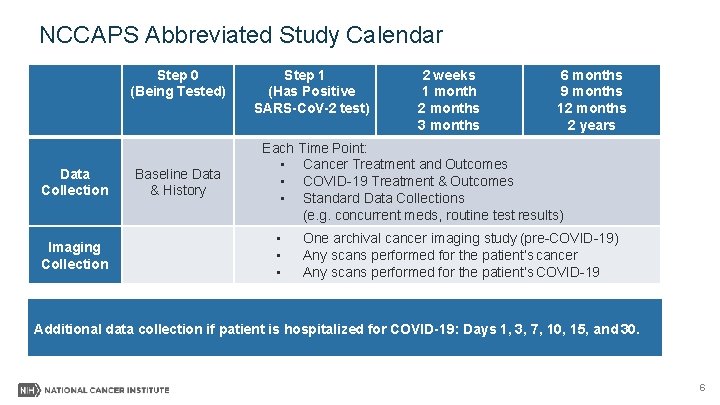
NCCAPS Abbreviated Study Calendar Step 0 (Being Tested) Data Collection Imaging Collection Baseline Data & History Step 1 (Has Positive SARS-Co. V-2 test) 2 weeks 1 month 2 months 3 months 6 months 9 months 12 months 2 years Each Time Point: • Cancer Treatment and Outcomes • COVID-19 Treatment & Outcomes • Standard Data Collections (e. g. concurrent meds, routine test results) • • • One archival cancer imaging study (pre-COVID-19) Any scans performed for the patient’s cancer Any scans performed for the patient’s COVID-19 Additional data collection if patient is hospitalized for COVID-19: Days 1, 3, 7, 10, 15, and 30. 6
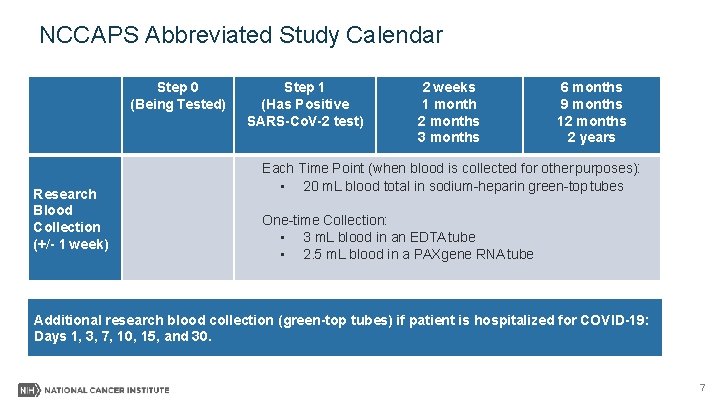
NCCAPS Abbreviated Study Calendar Step 0 (Being Tested) Research Blood Collection (+/- 1 week) Step 1 (Has Positive SARS-Co. V-2 test) 2 weeks 1 month 2 months 3 months 6 months 9 months 12 months 2 years Each Time Point (when blood is collected for other purposes): • 20 m. L blood total in sodium-heparin green-top tubes One-time Collection: • 3 m. L blood in an EDTA tube • 2. 5 m. L blood in a PAXgene RNA tube Additional research blood collection (green-top tubes) if patient is hospitalized for COVID-19: Days 1, 3, 7, 10, 15, and 30. 7
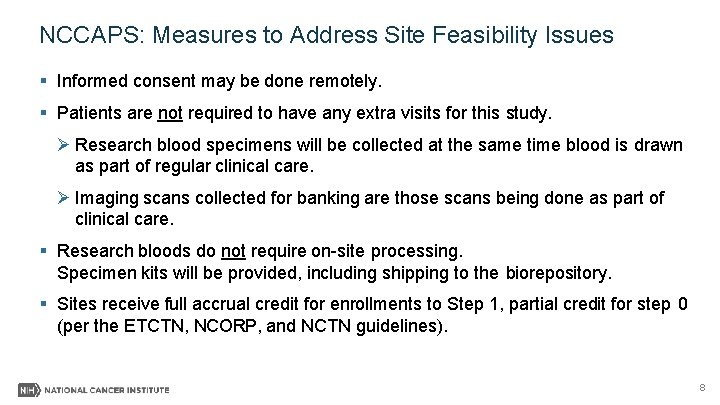
NCCAPS: Measures to Address Site Feasibility Issues Informed consent may be done remotely. Patients are not required to have any extra visits for this study. Research blood specimens will be collected at the same time blood is drawn as part of regular clinical care. Imaging scans collected for banking are those scans being done as part of clinical care. Research bloods do not require on-site processing. Specimen kits will be provided, including shipping to the biorepository. Sites receive full accrual credit for enrollments to Step 1, partial credit for step 0 (per the ETCTN, NCORP, and NCTN guidelines). 8
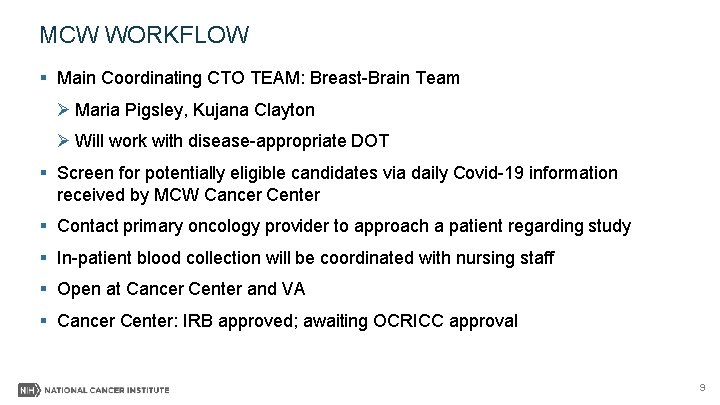
MCW WORKFLOW Main Coordinating CTO TEAM: Breast-Brain Team Maria Pigsley, Kujana Clayton Will work with disease-appropriate DOT Screen for potentially eligible candidates via daily Covid-19 information received by MCW Cancer Center Contact primary oncology provider to approach a patient regarding study In-patient blood collection will be coordinated with nursing staff Open at Cancer Center and VA Cancer Center: IRB approved; awaiting OCRICC approval 9
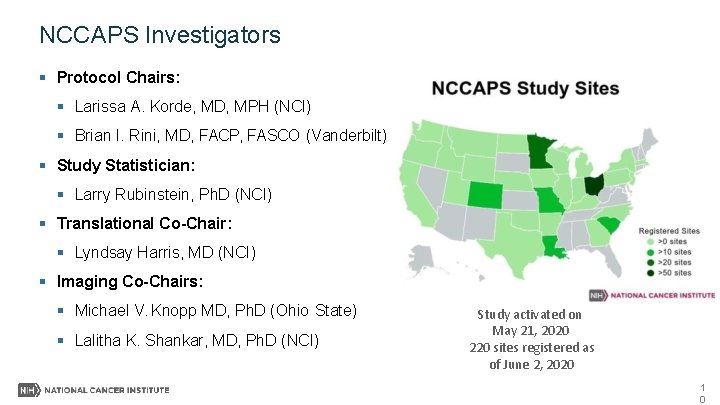
NCCAPS Investigators Protocol Chairs: Larissa A. Korde, MD, MPH (NCI) Brian I. Rini, MD, FACP, FASCO (Vanderbilt) Study Statistician: Larry Rubinstein, Ph. D (NCI) Translational Co-Chair: Lyndsay Harris, MD (NCI) Imaging Co-Chairs: Michael V. Knopp MD, Ph. D (Ohio State) Lalitha K. Shankar, MD, Ph. D (NCI) Study activated on May 21, 2020 220 sites registered as of June 2, 2020 1 0
NCCAPS : FAQs Will SARS-Co. V-2 testing be provided by this study? No. Patients must have received SARS-Co. V-2 testing prior to enrollment. Will any results from the research blood testing be returned to patients or their physicians? No. Research assays are not clinical-grade, and are for research only. Can sites participate in other COVID-19 in cancer studies? Yes, many sites are already participating in other studies. NCCAPS is designed to complement ongoing treatment and registry studies. 1 1
NCCAPS : FAQs What is different about this NCI COVID-19 in cancer study? It is designed to complement the COVID-19 and Cancer Consortium (CCC 19) study and other research efforts. The NCI study is unique as it is collecting longitudinal data, biospecimens and images to better understand patient outcomes over time. Are there other NIH COVID-19 studies? Yes, new NIH research efforts are announced at: https: //www. nih. gov/health-information/coronavirus 1 2