Occurrence of Silicon Silicon is a metalloid and
- Slides: 9
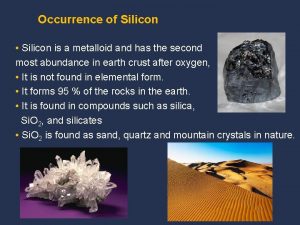
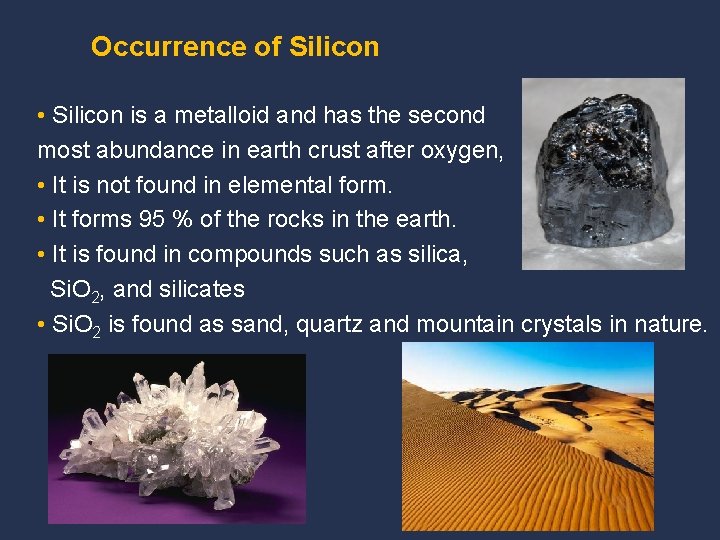
Occurrence of Silicon • Silicon is a metalloid and has the second most abundance in earth crust after oxygen, • It is not found in elemental form. • It forms 95 % of the rocks in the earth. • It is found in compounds such as silica, Si. O 2, and silicates • Si. O 2 is found as sand, quartz and mountain crystals in nature.
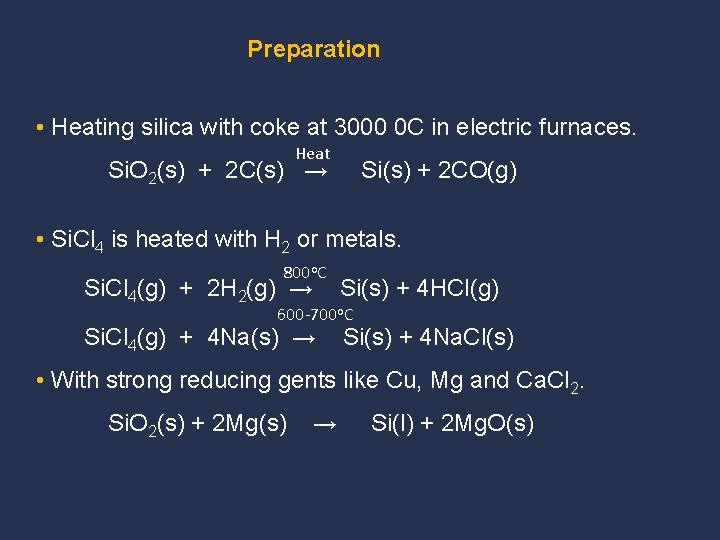
Preparation • Heating silica with coke at 3000 0 C in electric furnaces. Heat Si. O 2(s) + 2 C(s) → Si(s) + 2 CO(g) • Si. Cl 4 is heated with H 2 or metals. 800 o. C Si. Cl 4(g) + 2 H 2(g) → Si(s) + 4 HCl(g) Si. Cl 4(g) + 4 Na(s) → Si(s) + 4 Na. Cl(s) 600 -700 o. C • With strong reducing gents like Cu, Mg and Ca. Cl 2. Si. O 2(s) + 2 Mg(s) → Si(l) + 2 Mg. O(s)
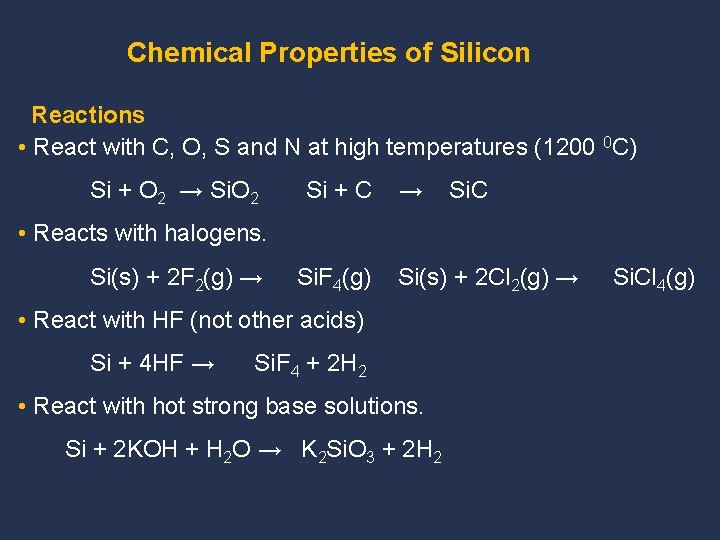
Chemical Properties of Silicon Reactions • React with C, O, S and N at high temperatures (1200 0 C) Si + O 2 → Si. O 2 Si + C → Si. C • Reacts with halogens. Si(s) + 2 F 2(g) → Si. F 4(g) Si(s) + 2 Cl 2(g) → • React with HF (not other acids) Si + 4 HF → Si. F 4 + 2 H 2 • React with hot strong base solutions. Si + 2 KOH + H 2 O → K 2 Si. O 3 + 2 H 2 Si. Cl 4(g)
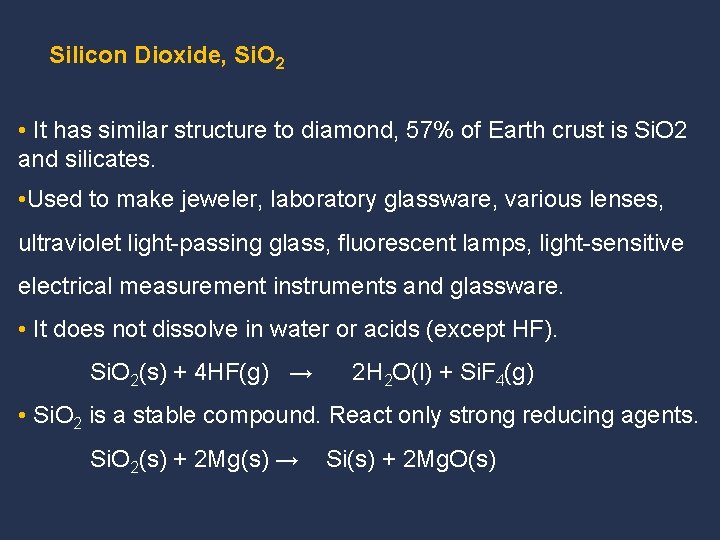
Silicon Dioxide, Si. O 2 • It has similar structure to diamond, 57% of Earth crust is Si. O 2 and silicates. • Used to make jeweler, laboratory glassware, various lenses, ultraviolet light-passing glass, fluorescent lamps, light-sensitive electrical measurement instruments and glassware. • It does not dissolve in water or acids (except HF). Si. O 2(s) + 4 HF(g) → 2 H 2 O(l) + Si. F 4(g) • Si. O 2 is a stable compound. React only strong reducing agents. Si. O 2(s) + 2 Mg(s) → Si(s) + 2 Mg. O(s)
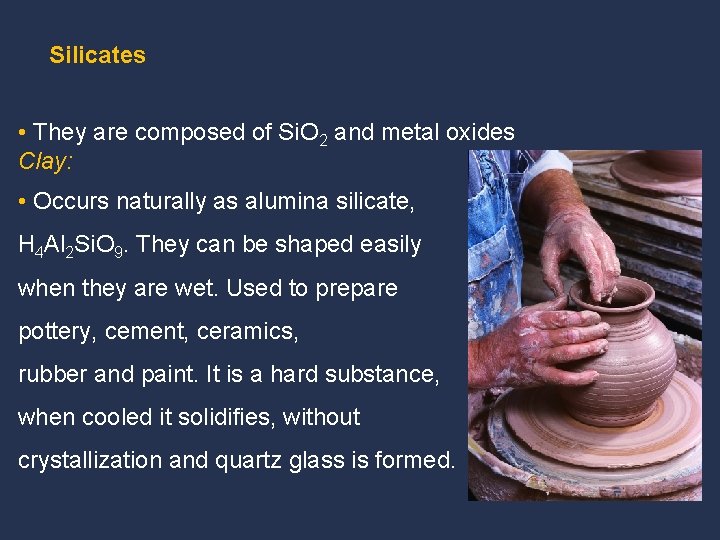
Silicates • They are composed of Si. O 2 and metal oxides Clay: • Occurs naturally as alumina silicate, H 4 Al 2 Si. O 9. They can be shaped easily when they are wet. Used to prepare pottery, cement, ceramics, rubber and paint. It is a hard substance, when cooled it solidifies, without crystallization and quartz glass is formed.
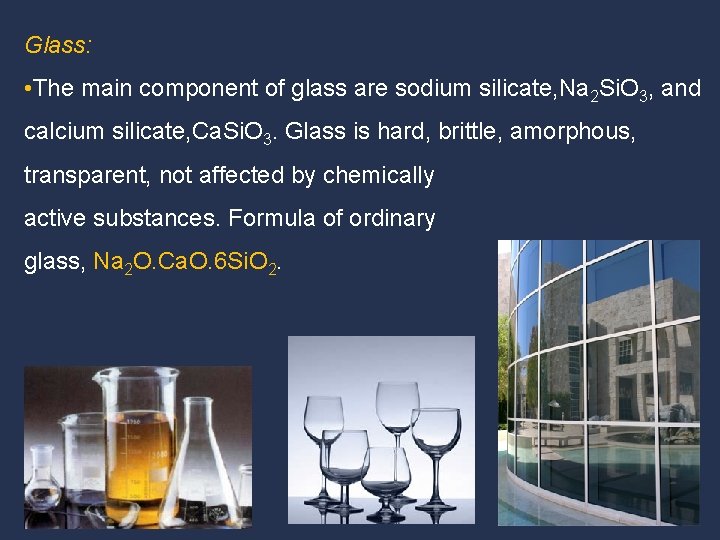
Glass: • The main component of glass are sodium silicate, Na 2 Si. O 3, and calcium silicate, Ca. Si. O 3. Glass is hard, brittle, amorphous, transparent, not affected by chemically active substances. Formula of ordinary glass, Na 2 O. Ca. O. 6 Si. O 2.
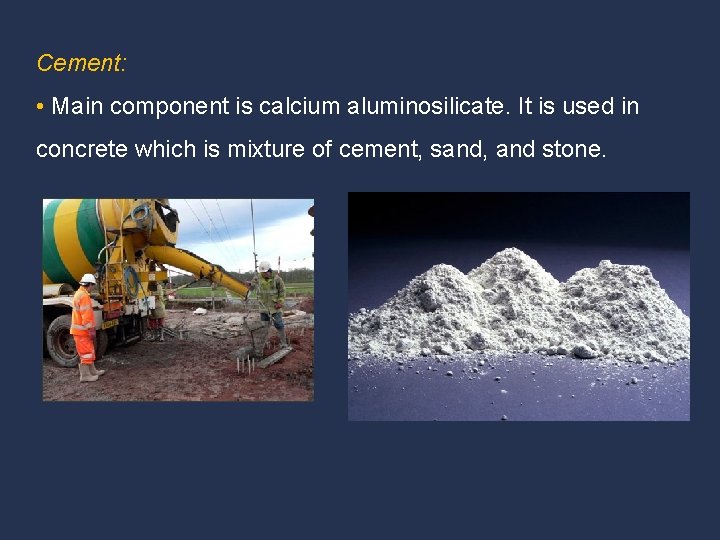
Cement: • Main component is calcium aluminosilicate. It is used in concrete which is mixture of cement, sand, and stone.
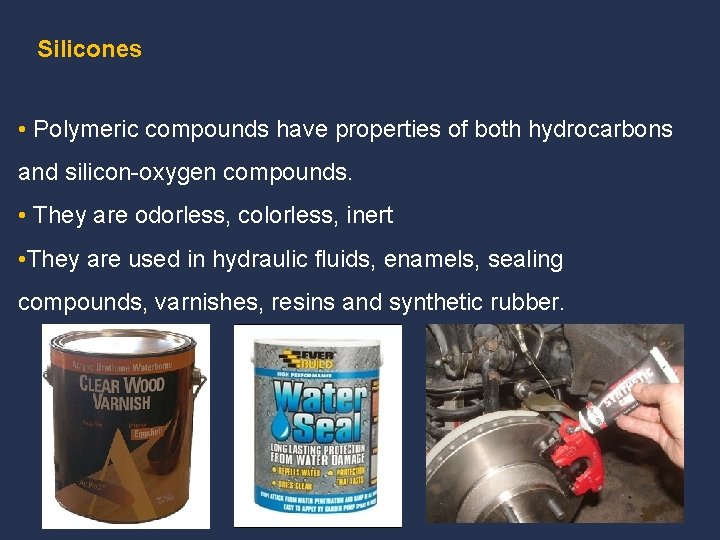
Silicones • Polymeric compounds have properties of both hydrocarbons and silicon-oxygen compounds. • They are odorless, colorless, inert • They are used in hydraulic fluids, enamels, sealing compounds, varnishes, resins and synthetic rubber.
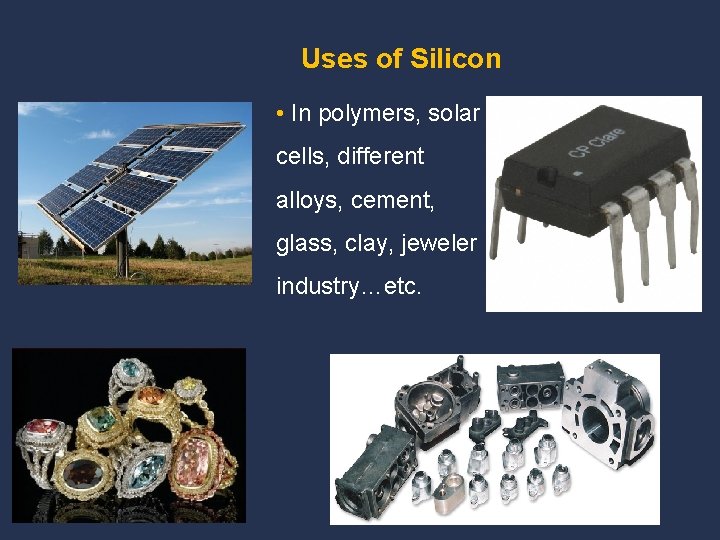
Uses of Silicon • In polymers, solar cells, different alloys, cement, glass, clay, jeweler industry…etc.