NOMEN ADJECTIVUM ADJECTIVE Adjective is a word expressing

- Slides: 39
NOMEN ADJECTIVUM (ADJECTIVE)
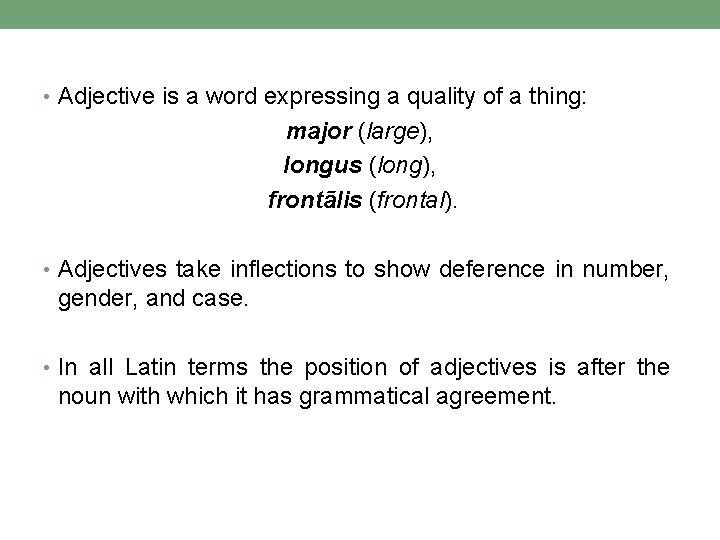
• Adjective is a word expressing a quality of a thing: major (large), longus (long), frontālis (frontal). • Adjectives take inflections to show deference in number, gender, and case. • In all Latin terms the position of adjectives is after the noun with which it has grammatical agreement.
The grammatical categories of adjectives There are two great groups of adjectives in Latin according to their endings: • the adjectives of the 1 st and the 2 nd declension • the adjectives of the 3 rd declension. • Each group of the adjectives is declined according to the corresponding declension of nouns. • Adjectives have the same endings as nouns.
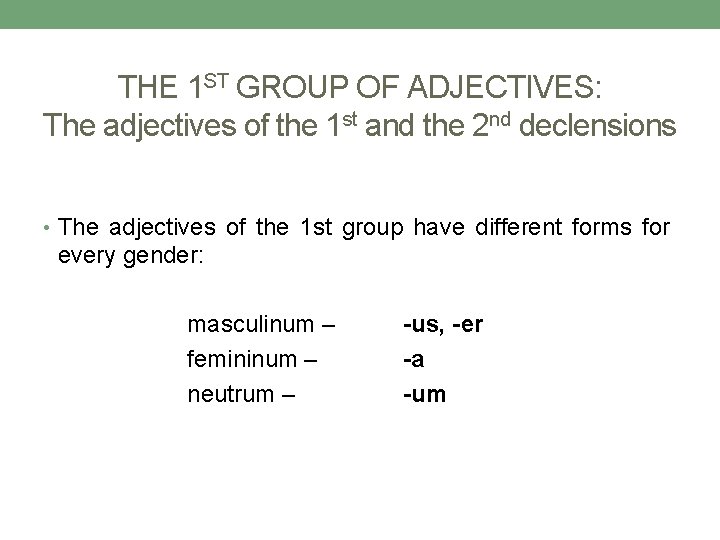
THE 1 ST GROUP OF ADJECTIVES: The adjectives of the 1 st and the 2 nd declensions • The adjectives of the 1 st group have different forms for every gender: masculinum – femininum – neutrum – -us, -er -a -um
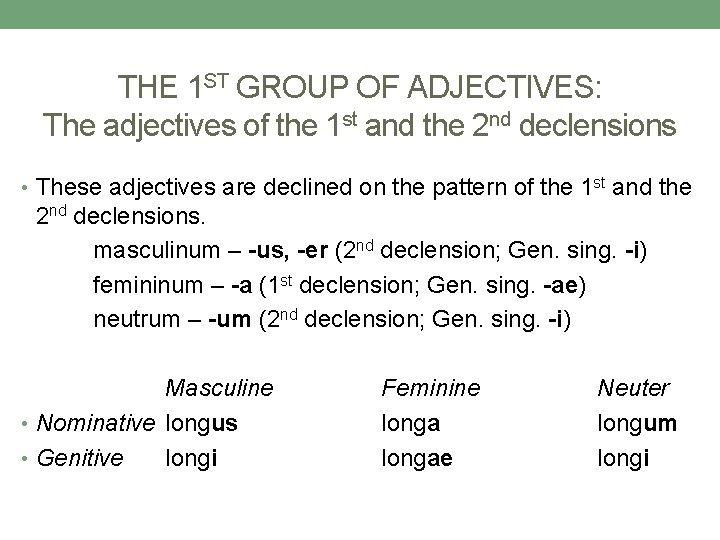
THE 1 ST GROUP OF ADJECTIVES: The adjectives of the 1 st and the 2 nd declensions • These adjectives are declined on the pattern of the 1 st and the 2 nd declensions. masculinum – -us, -er (2 nd declension; Gen. sing. -i) femininum – -a (1 st declension; Gen. sing. -ae) neutrum – -um (2 nd declension; Gen. sing. -i) Masculine • Nominative longus • Genitive longi Feminine longae Neuter longum longi
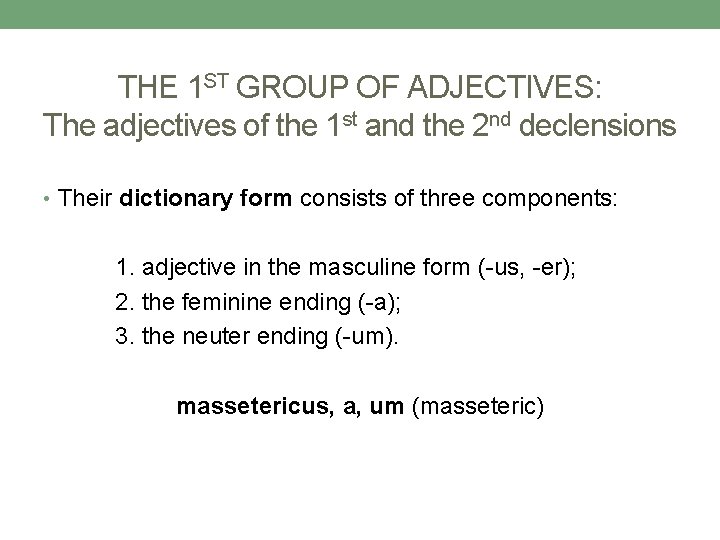
THE 1 ST GROUP OF ADJECTIVES: The adjectives of the 1 st and the 2 nd declensions • Their dictionary form consists of three components: 1. adjective in the masculine form (-us, -er); 2. the feminine ending (-a); 3. the neuter ending (-um). massetericus, a, um (masseteric)
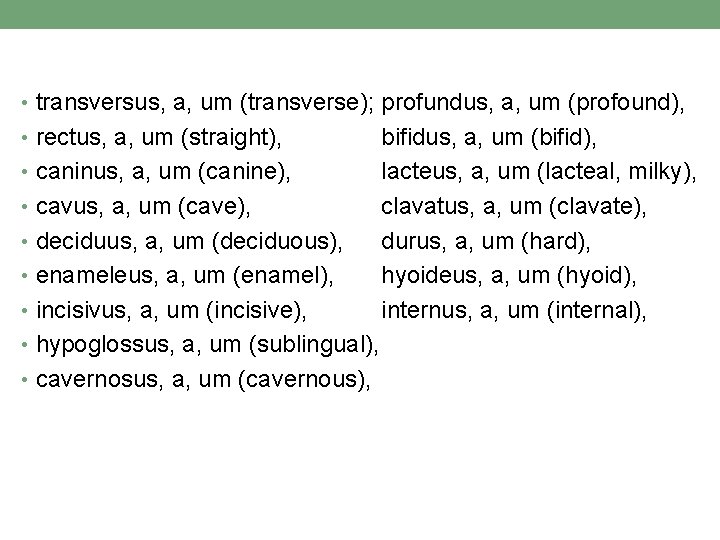
• transversus, a, um (transverse); profundus, a, um (profound), • rectus, a, um (straight), • caninus, a, um (canine), • cavus, a, um (cave), • deciduus, a, um (deciduous), • enameleus, a, um (enamel), • incisivus, a, um (incisive), • hypoglossus, a, um (sublingual), • cavernosus, a, um (cavernous), bifidus, a, um (bifid), lacteus, a, um (lacteal, milky), clavatus, a, um (clavate), durus, a, um (hard), hyoideus, a, um (hyoid), internus, a, um (internal),
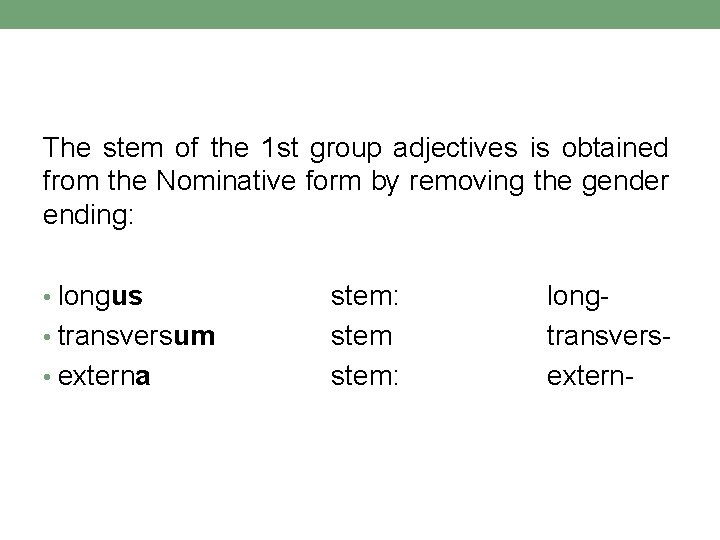
The stem of the 1 st group adjectives is obtained from the Nominative form by removing the gender ending: • longus • transversum • externa stem: longtransversextern-
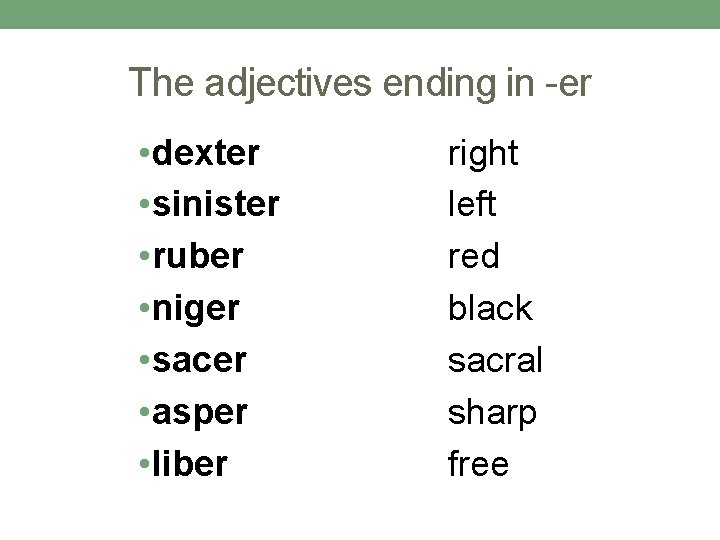
The adjectives ending in -er • dexter • sinister • ruber • niger • sacer • asper • liber right left red black sacral sharp free
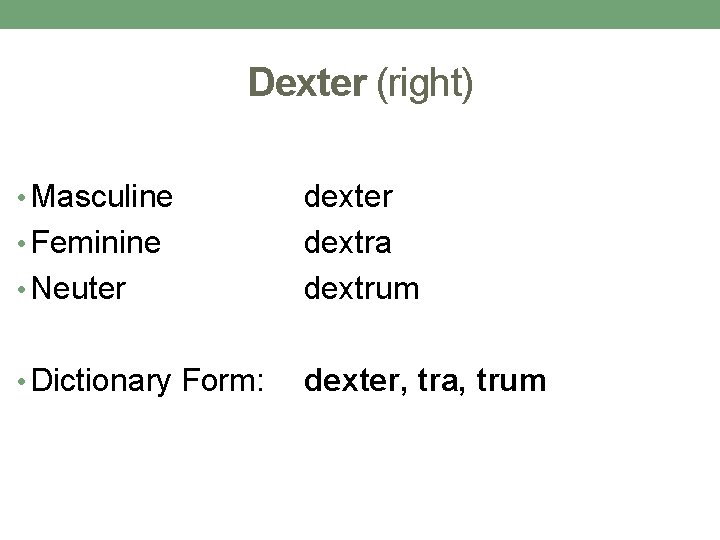
Dexter (right) • Masculine • Neuter dextra dextrum • Dictionary Form: dexter, tra, trum • Feminine
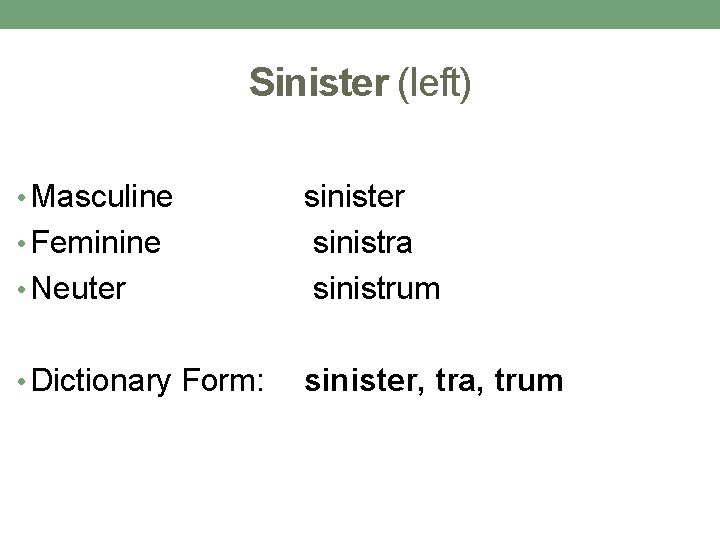
Sinister (left) • Masculine • Neuter sinistra sinistrum • Dictionary Form: sinister, tra, trum • Feminine
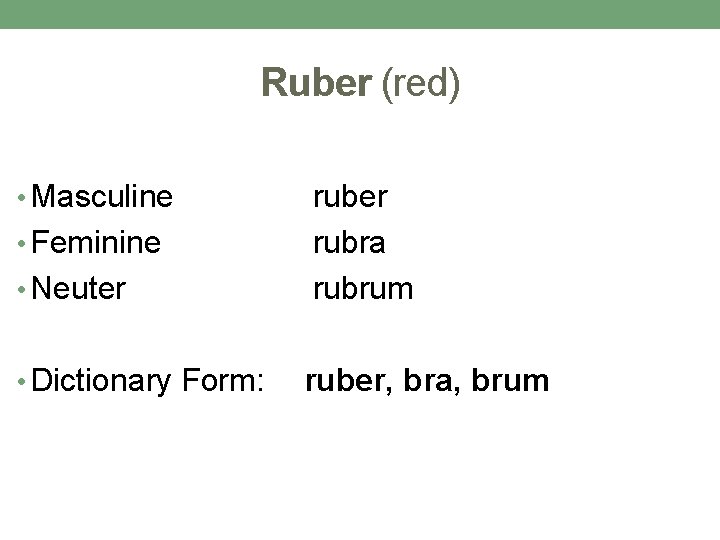
Ruber (red) • Masculine • Feminine • Neuter • Dictionary Form: ruber rubra rubrum ruber, bra, brum
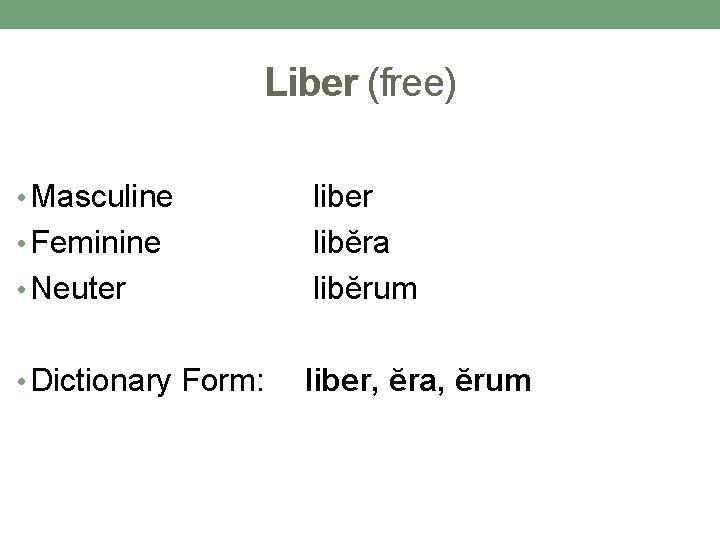
Liber (free) • Masculine • Feminine • Neuter • Dictionary Form: liber libĕra libĕrum liber, ĕra, ĕrum
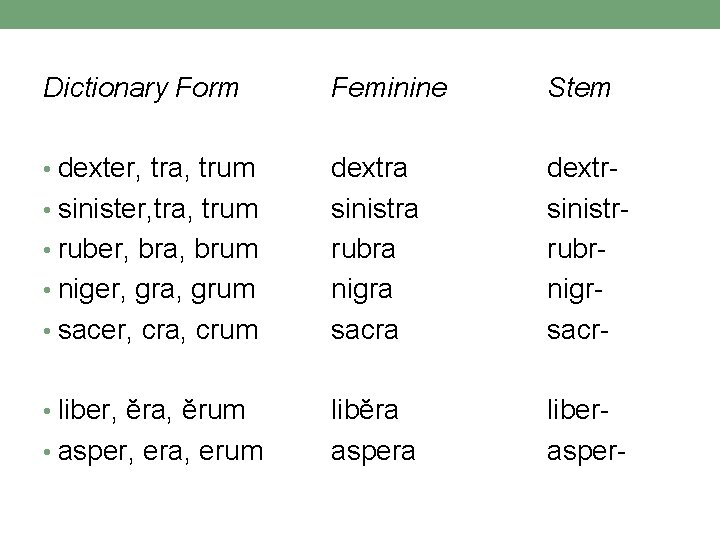
Dictionary Form Feminine Stem • dexter, tra, trum dextra sinistra rubra nigra sacra dextrsinistrrubrnigrsacr- libĕra aspera liberasper- • sinister, tra, trum • ruber, bra, brum • niger, gra, grum • sacer, cra, crum • liber, ĕra, ĕrum • asper, era, erum
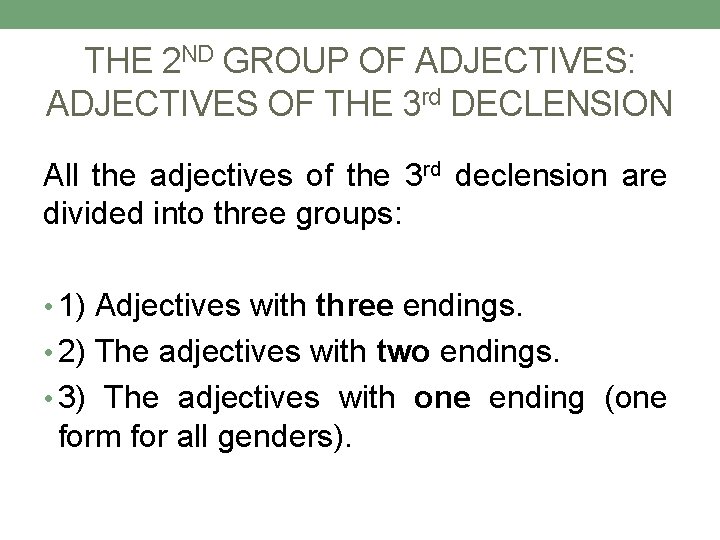
THE 2 ND GROUP OF ADJECTIVES: ADJECTIVES OF THE 3 rd DECLENSION All the adjectives of the 3 rd declension are divided into three groups: • 1) Adjectives with three endings. • 2) The adjectives with two endings. • 3) The adjectives with one ending (one form for all genders).
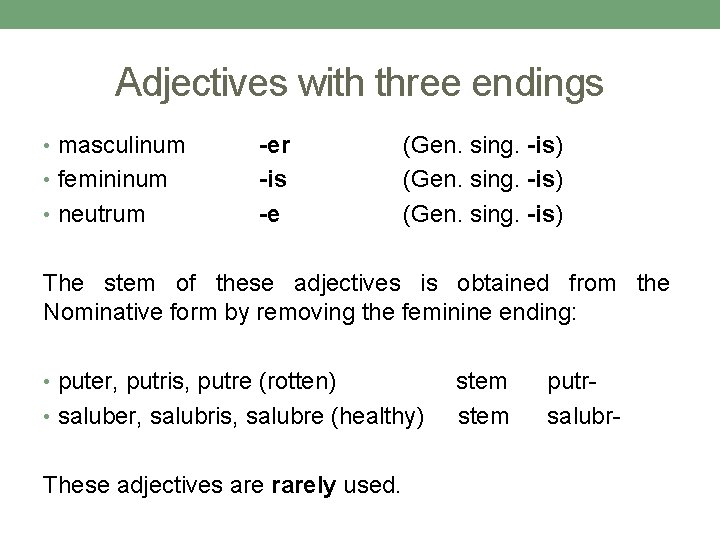
Adjectives with three endings • masculinum • femininum • neutrum -er -is -e (Gen. sing. -is) The stem of these adjectives is obtained from the Nominative form by removing the feminine ending: • puter, putris, putre (rotten) • saluber, salubris, salubre (healthy) These adjectives are rarely used. stem putrsalubr-
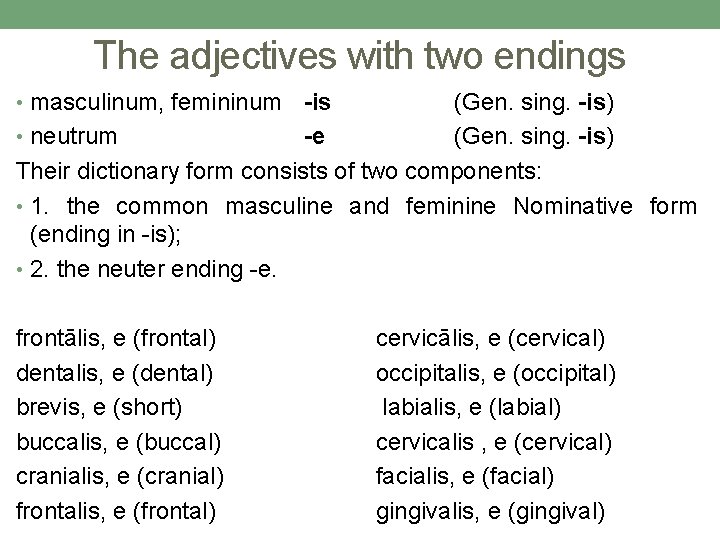
The adjectives with two endings • masculinum, femininum -is (Gen. sing. -is) • neutrum -e (Gen. sing. -is) Their dictionary form consists of two components: • 1. the common masculine and feminine Nominative form (ending in -is); • 2. the neuter ending -e. frontālis, e (frontal) dentalis, e (dental) brevis, e (short) buccalis, e (buccal) cranialis, e (cranial) frontalis, e (frontal) cervicālis, e (cervical) occipitalis, e (occipital) labialis, e (labial) cervicalis , e (cervical) facialis, e (facial) gingivalis, e (gingival)
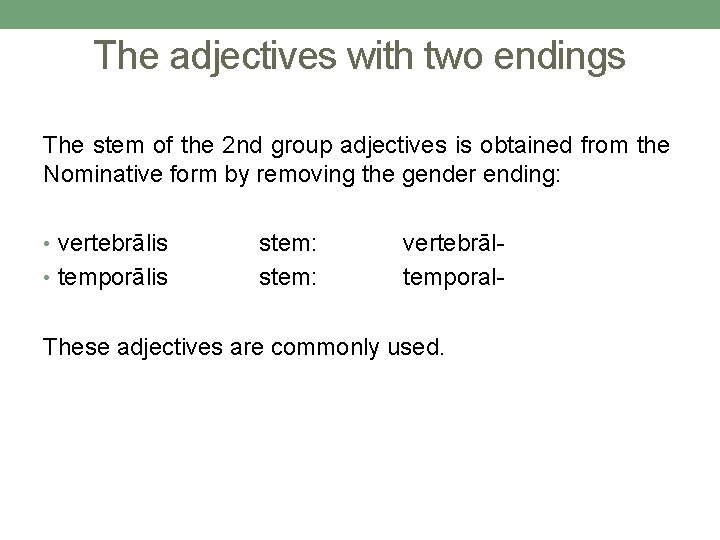
The adjectives with two endings The stem of the 2 nd group adjectives is obtained from the Nominative form by removing the gender ending: • vertebrālis • temporālis stem: vertebrāltemporal- These adjectives are commonly used.
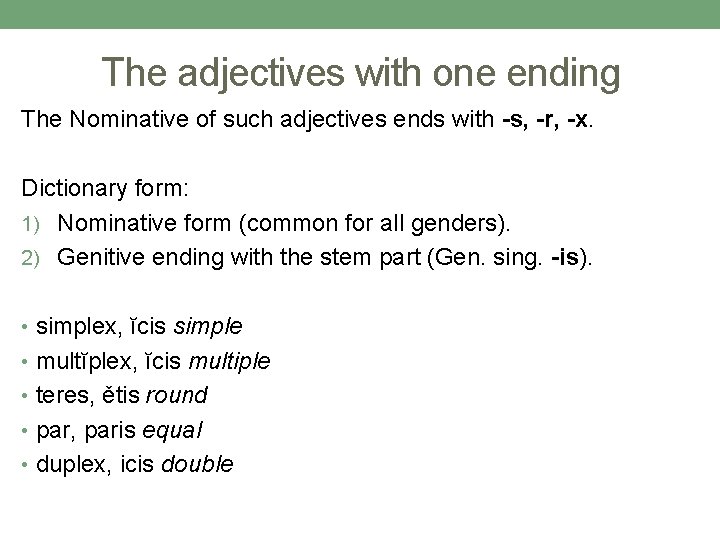
The adjectives with one ending The Nominative of such adjectives ends with -s, -r, -x. Dictionary form: 1) Nominative form (common for all genders). 2) Genitive ending with the stem part (Gen. sing. -is). • simplex, ĭcis simple • multĭplex, ĭcis multiple • teres, ětis round • par, paris equal • duplex, icis double
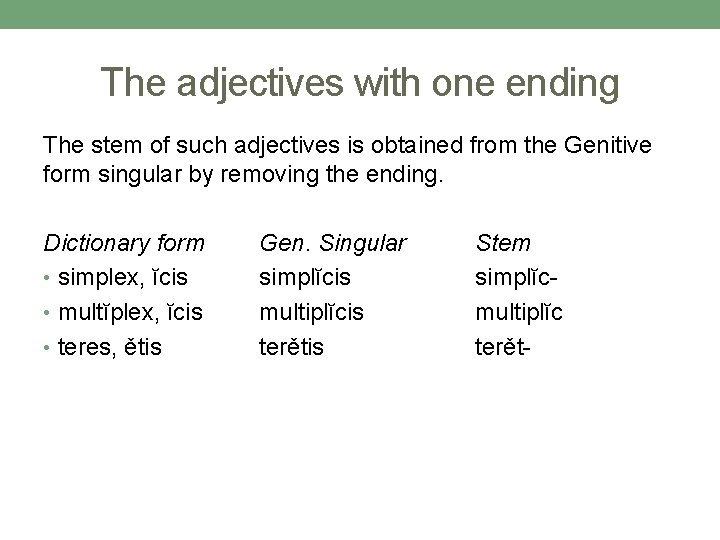
The adjectives with one ending The stem of such adjectives is obtained from the Genitive form singular by removing the ending. Dictionary form • simplex, ĭcis • multĭplex, ĭcis • teres, ětis Gen. Singular simplĭcis multiplĭcis terětis Stem simplĭcmultiplĭc terět-
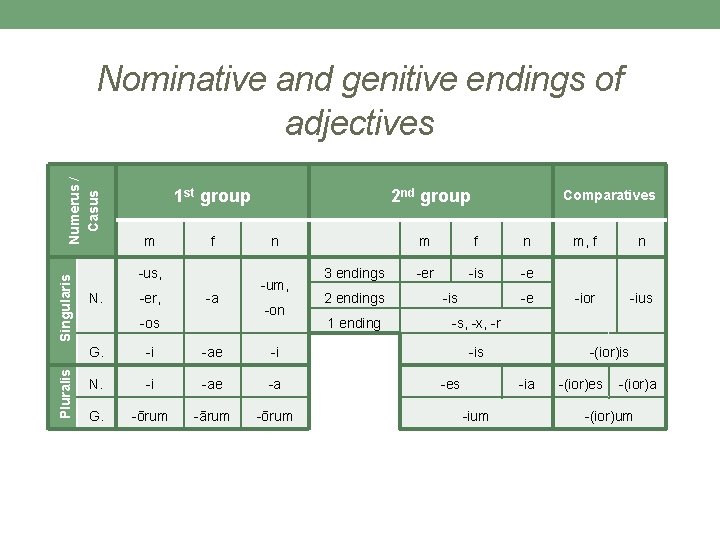
Pluralis Singularis Numerus / Casus Nominative and genitive endings of adjectives 1 st group m f -us, N. -er, -a -os 2 nd group n -um, -on G. -i -ae -i N. -i -ae -a G. -ōrum -ārum -ōrum 3 endings 2 endings 1 ending Comparatives m f n -er -is -e m, f n -ior -ius -s, -x, -r -is -es -(ior)is -ia -ium -(ior)es -(ior)a -(ior)um
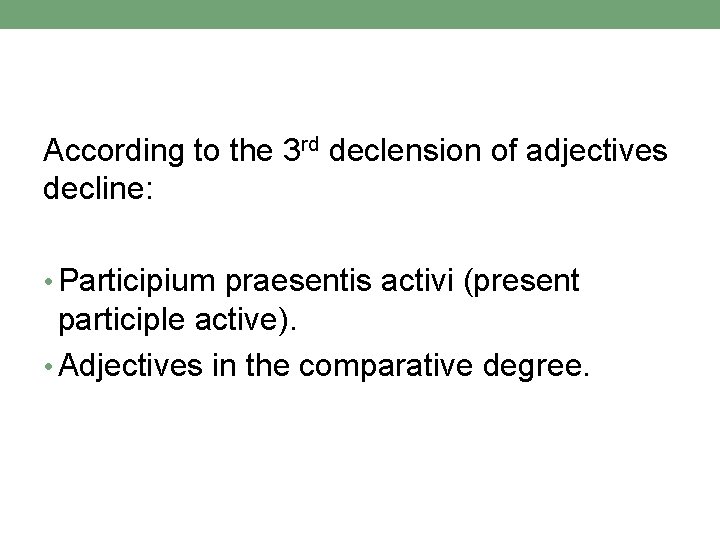
According to the 3 rd declension of adjectives decline: • Participium praesentis activi (present participle active). • Adjectives in the comparative degree.
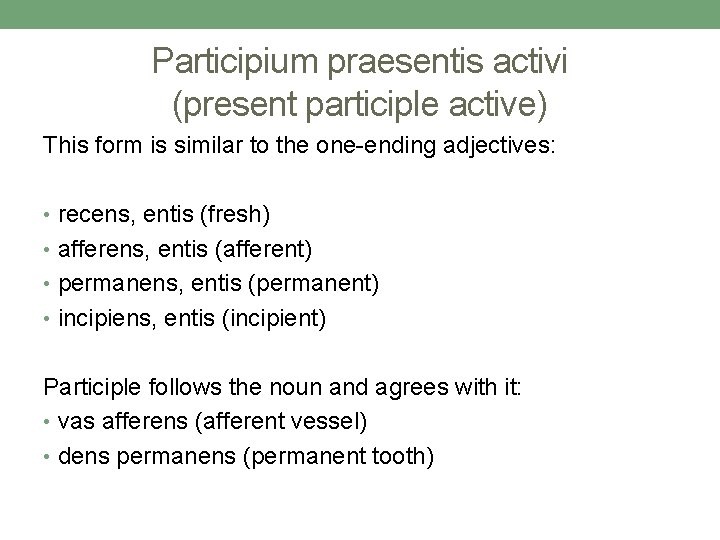
Participium praesentis activi (present participle active) This form is similar to the one-ending adjectives: • recens, entis (fresh) • afferens, entis (afferent) • permanens, entis (permanent) • incipiens, entis (incipient) Participle follows the noun and agrees with it: • vas afferens (afferent vessel) • dens permanens (permanent tooth)
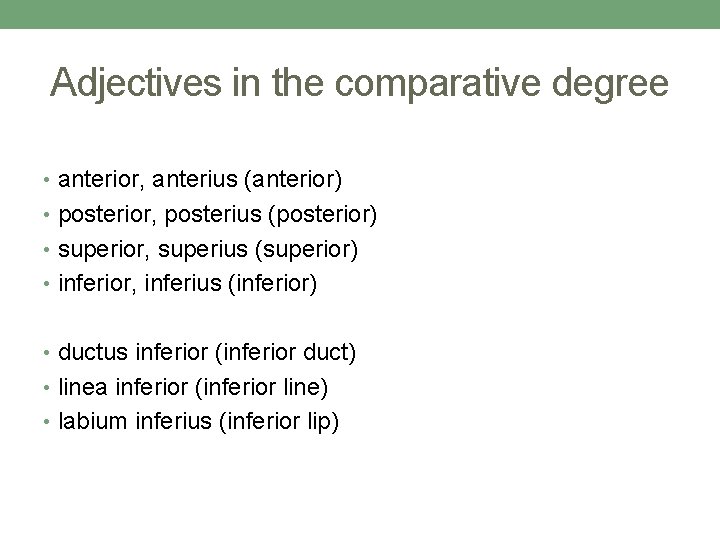
Adjectives in the comparative degree • anterior, anterius (anterior) • posterior, posterius (posterior) • superior, superius (superior) • inferior, inferius (inferior) • ductus inferior (inferior duct) • linea inferior (inferior line) • labium inferius (inferior lip)
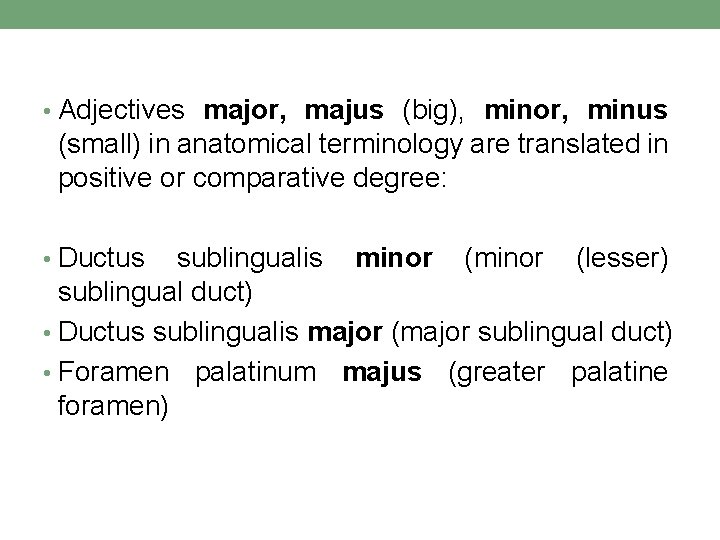
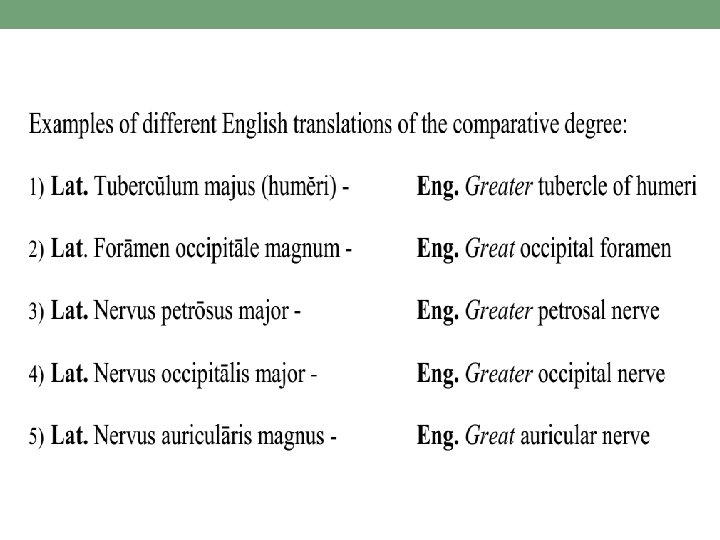
• Adjectives major, majus (big), minor, minus (small) in anatomical terminology are translated in positive or comparative degree: • Ductus sublingualis minor (lesser) sublingual duct) • Ductus sublingualis major (major sublingual duct) • Foramen palatinum majus (greater palatine foramen)
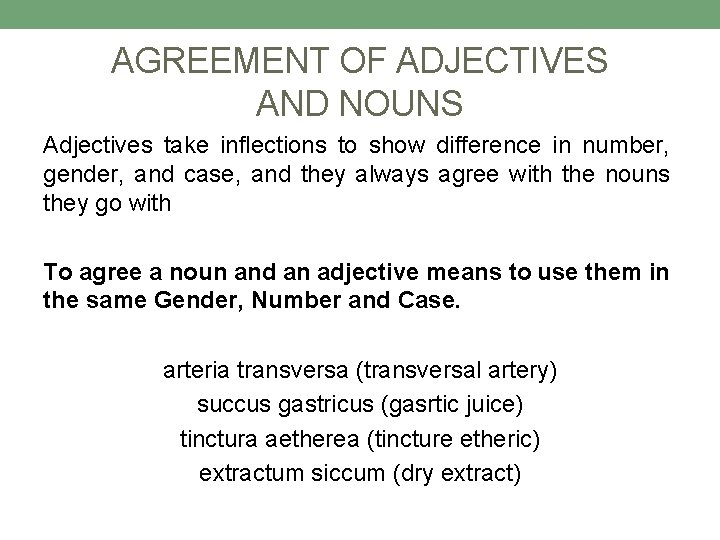
AGREEMENT OF ADJECTIVES AND NOUNS Adjectives take inflections to show difference in number, gender, and case, and they always agree with the nouns they go with To agree a noun and an adjective means to use them in the same Gender, Number and Case. arteria transversa (transversal artery) succus gastricus (gasrtic juice) tinctura aetherea (tincture etheric) extractum siccum (dry extract)
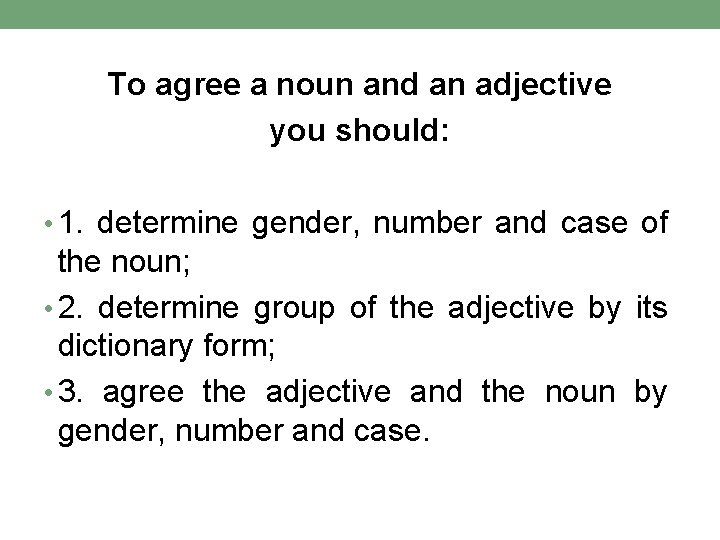
To agree a noun and an adjective you should: • 1. determine gender, number and case of the noun; • 2. determine group of the adjective by its dictionary form; • 3. agree the adjective and the noun by gender, number and case.
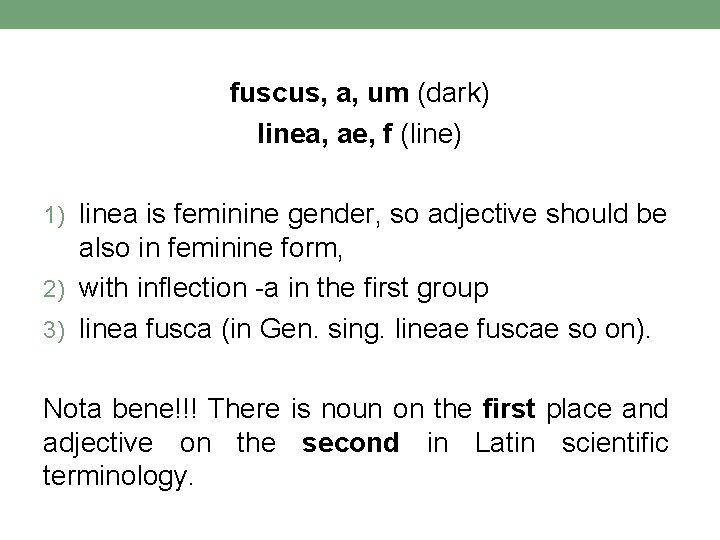
fuscus, a, um (dark) linea, ae, f (line) 1) linea is feminine gender, so adjective should be also in feminine form, 2) with inflection -a in the first group 3) linea fusca (in Gen. sing. lineae fuscae so on). Nota bene!!! There is noun on the first place and adjective on the second in Latin scientific terminology.
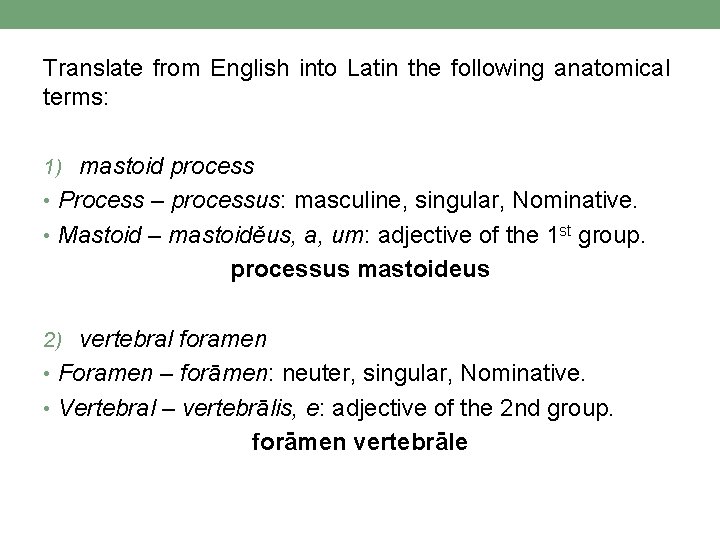
Translate from English into Latin the following anatomical terms: 1) mastoid process • Process – processus: masculine, singular, Nominative. • Mastoid – mastoiděus, a, um: adjective of the 1 st group. processus mastoideus 2) vertebral foramen • Foramen – forāmen: neuter, singular, Nominative. • Vertebral – vertebrālis, e: adjective of the 2 nd group. forāmen vertebrāle
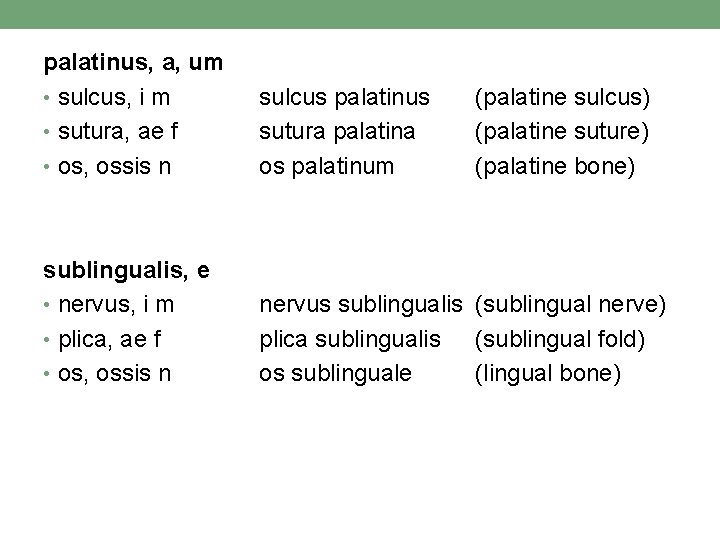
palatinus, a, um • sulcus, i m • sutura, ae f • os, ossis n sulcus palatinus sutura palatina os palatinum sublingualis, e • nervus, i m • plica, ae f • os, ossis n nervus sublingualis (sublingual nerve) plica sublingualis (sublingual fold) os sublinguale (lingual bone) (palatine sulcus) (palatine suture) (palatine bone)
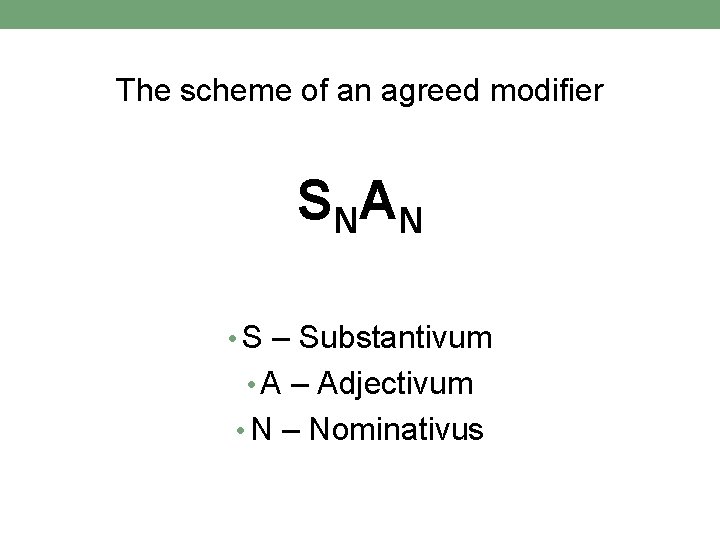
The scheme of an agreed modifier S NA N • S – Substantivum • A – Adjectivum • N – Nominativus
EXERCISES
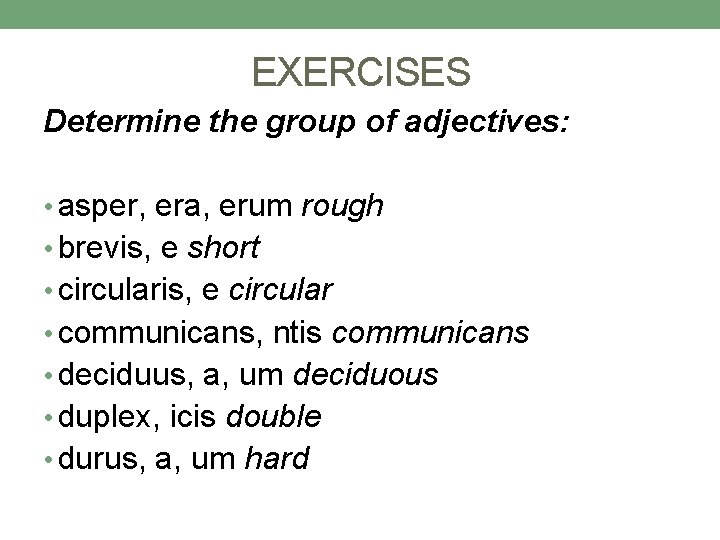
EXERCISES Determine the group of adjectives: • asper, era, erum rough • brevis, e short • circularis, e circular • communicans, ntis communicans • deciduus, a, um deciduous • duplex, icis double • durus, a, um hard
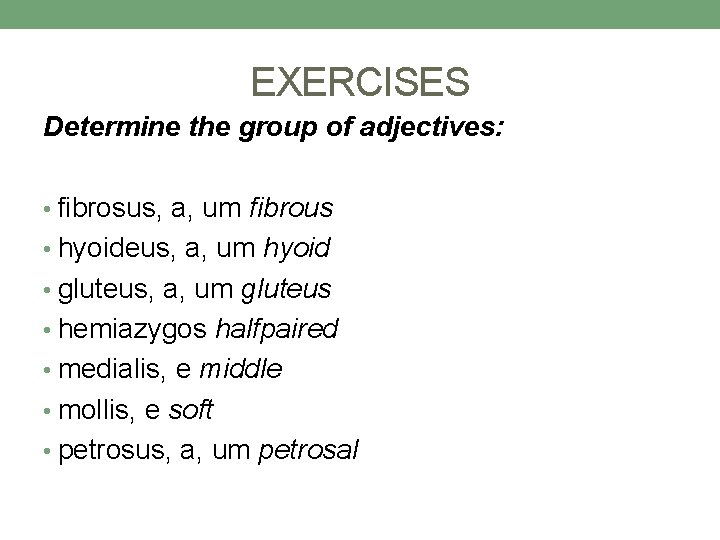
EXERCISES Determine the group of adjectives: • fibrosus, a, um fibrous • hyoideus, a, um hyoid • gluteus, a, um gluteus • hemiazygos halfpaired • medialis, e middle • mollis, e soft • petrosus, a, um petrosal
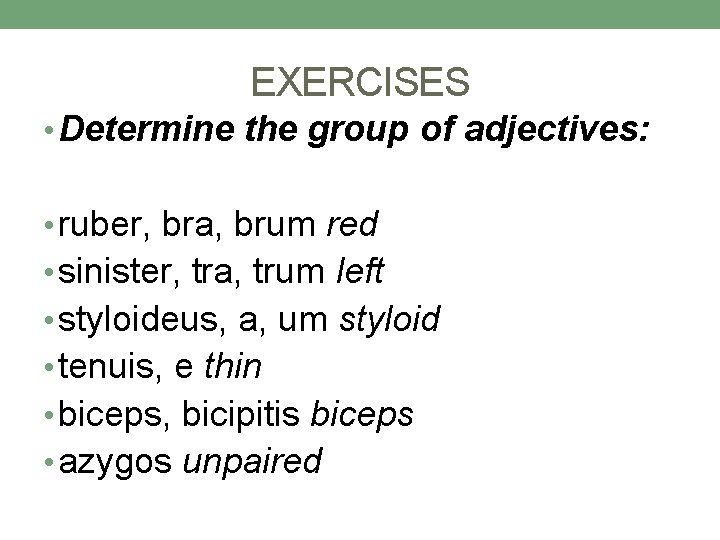
EXERCISES • Determine the group of adjectives: • ruber, bra, brum red • sinister, tra, trum left • styloideus, a, um styloid • tenuis, e thin • biceps, bicipitis biceps • azygos unpaired
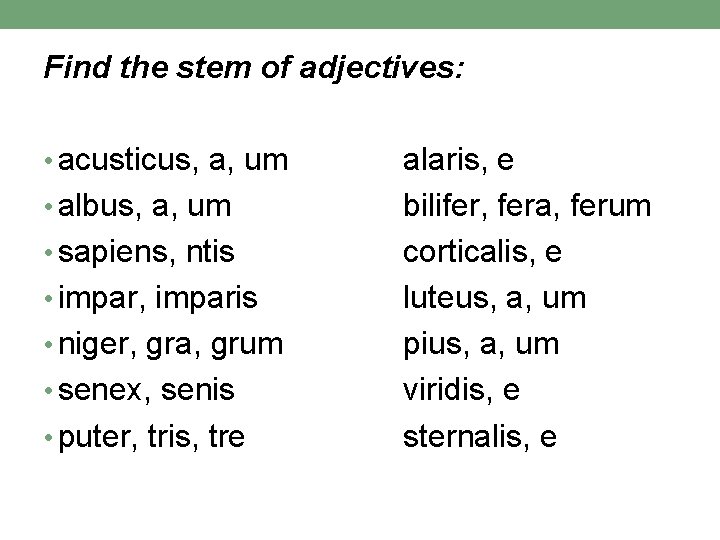
Find the stem of adjectives: • acusticus, a, um • albus, a, um • sapiens, ntis • impar, imparis • niger, gra, grum • senex, senis • puter, tris, tre alaris, e bilifer, fera, ferum corticalis, e luteus, a, um pius, a, um viridis, e sternalis, e
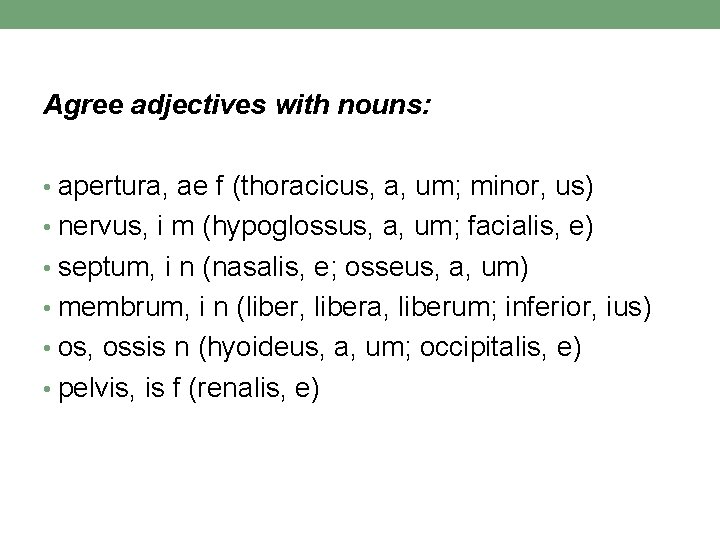
Agree adjectives with nouns: • apertura, ae f (thoracicus, a, um; minor, us) • nervus, i m (hypoglossus, a, um; facialis, e) • septum, i n (nasalis, e; osseus, a, um) • membrum, i n (liber, libera, liberum; inferior, ius) • os, ossis n (hyoideus, a, um; occipitalis, e) • pelvis, is f (renalis, e)
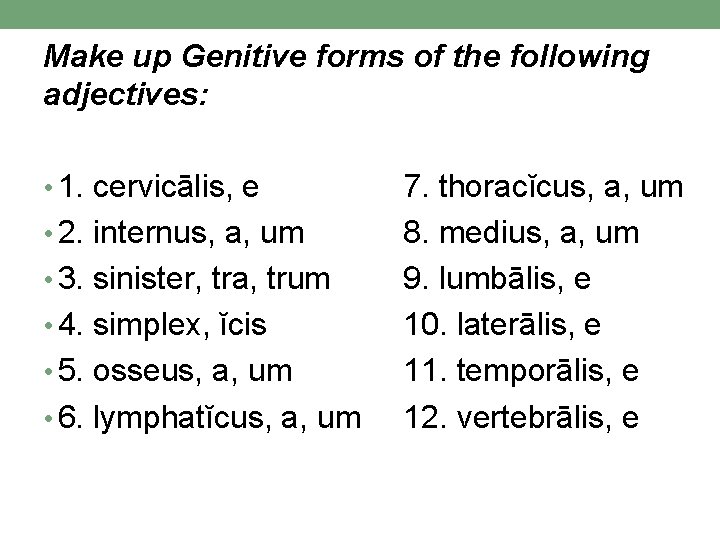
Make up Genitive forms of the following adjectives: • 1. cervicālis, e • 2. internus, a, um • 3. sinister, tra, trum • 4. simplex, ĭcis • 5. osseus, a, um • 6. lymphatĭcus, a, um 7. thoracĭcus, a, um 8. medius, a, um 9. lumbālis, e 10. laterālis, e 11. temporālis, e 12. vertebrālis, e