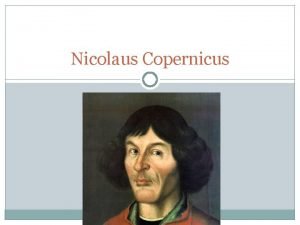
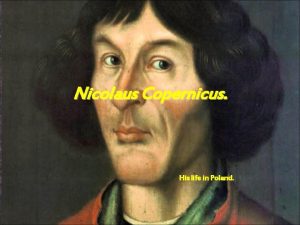
Nicolaus Copernicus Polish 1473 1543 Developed sun centered
- Slides: 7
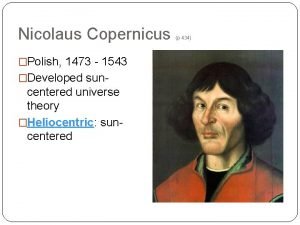
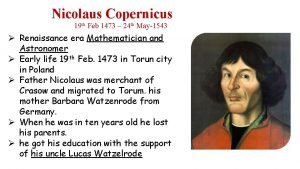
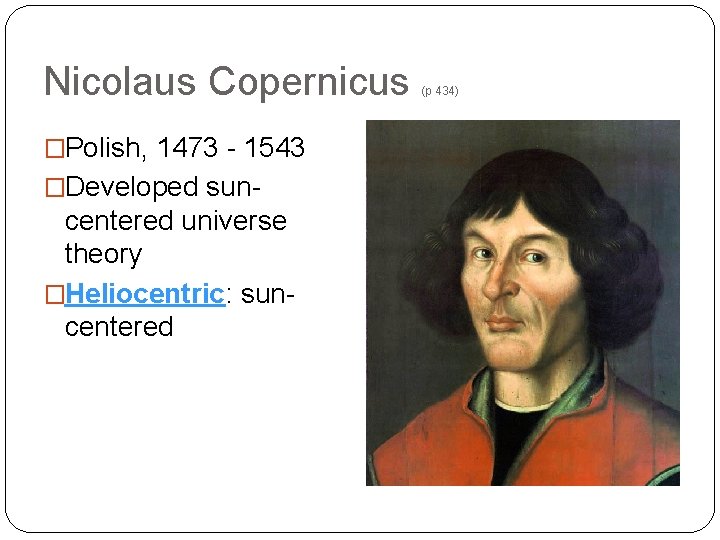
Nicolaus Copernicus �Polish, 1473 - 1543 �Developed sun- centered universe theory �Heliocentric: suncentered (p 434)
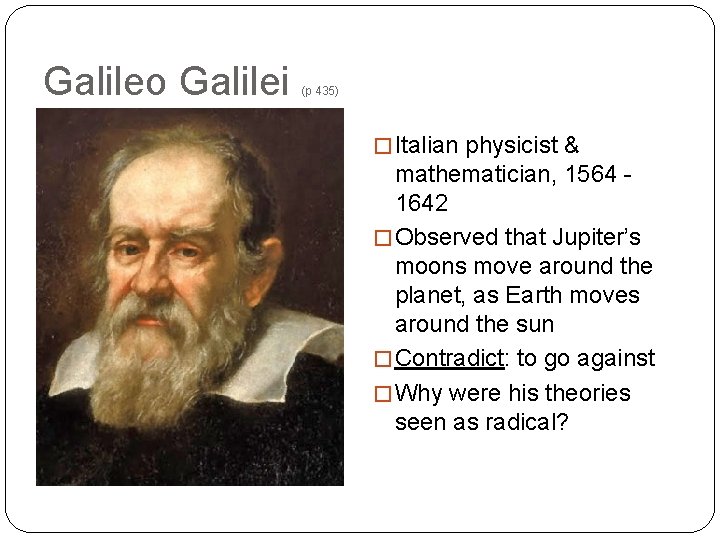
Galileo Galilei (p 435) � Italian physicist & mathematician, 1564 1642 � Observed that Jupiter’s moons move around the planet, as Earth moves around the sun � Contradict: to go against � Why were his theories seen as radical?
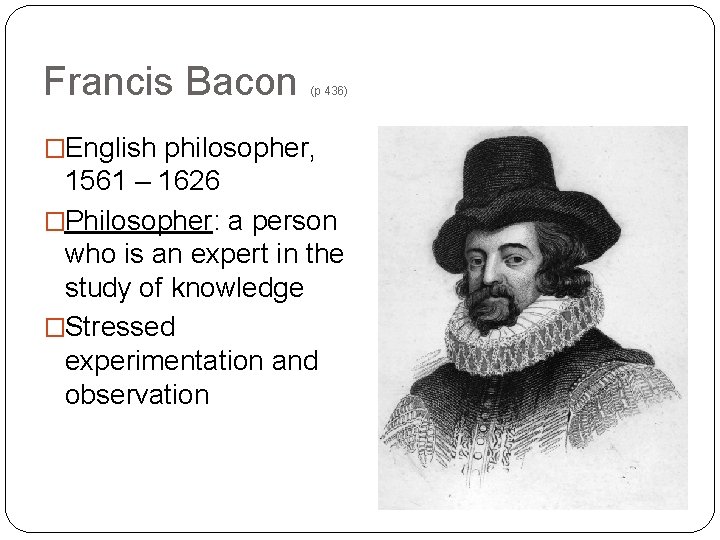
Francis Bacon (p 436) �English philosopher, 1561 – 1626 �Philosopher: a person who is an expert in the study of knowledge �Stressed experimentation and observation
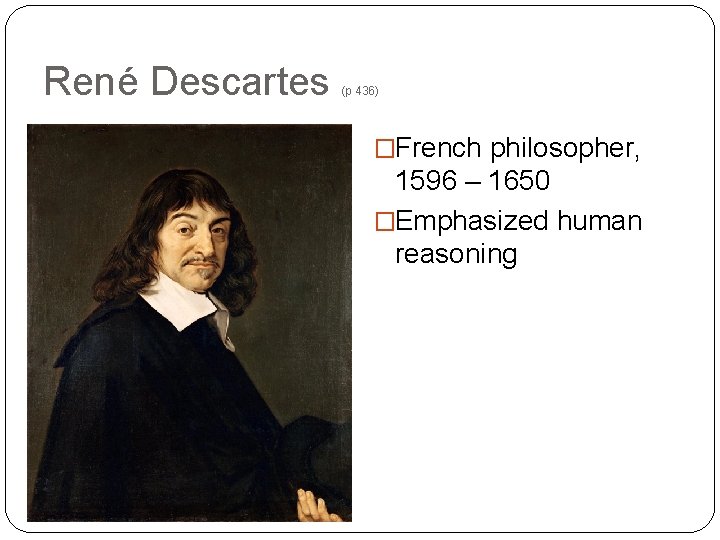
René Descartes (p 436) �French philosopher, 1596 – 1650 �Emphasized human reasoning
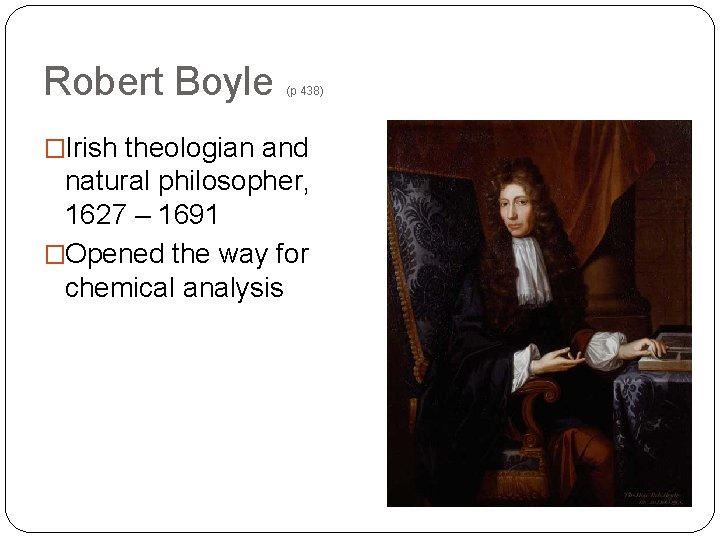
Robert Boyle (p 438) �Irish theologian and natural philosopher, 1627 – 1691 �Opened the way for chemical analysis
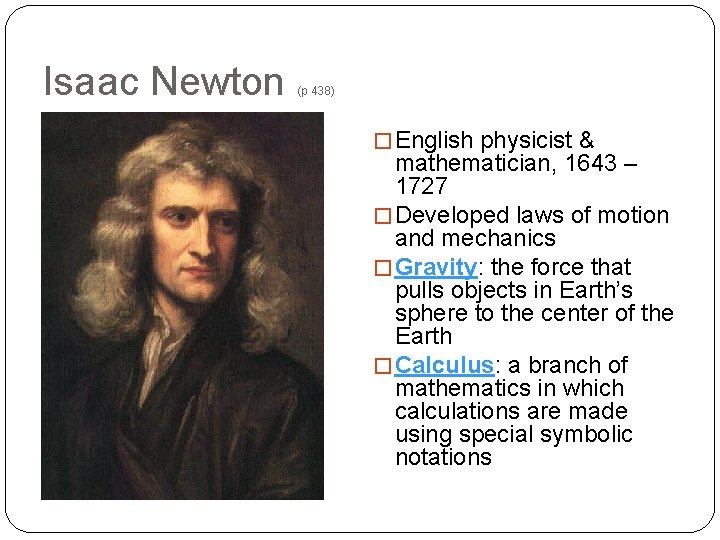
Isaac Newton (p 438) � English physicist & mathematician, 1643 – 1727 � Developed laws of motion and mechanics � Gravity: the force that pulls objects in Earth’s sphere to the center of the Earth � Calculus: a branch of mathematics in which calculations are made using special symbolic notations
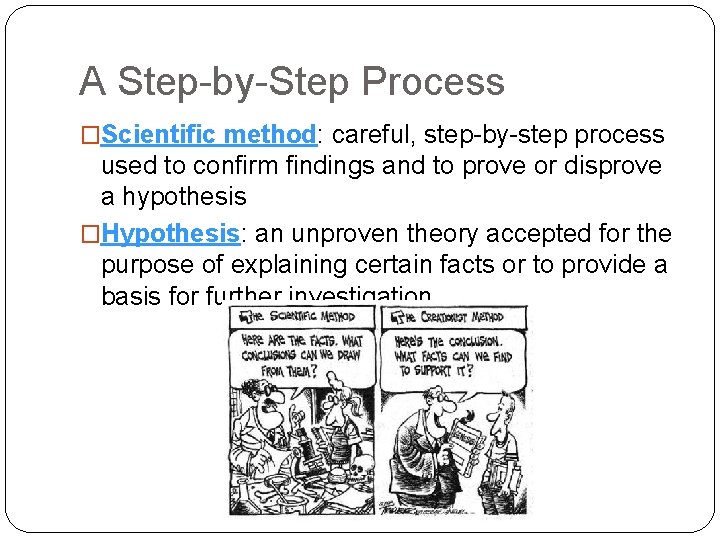
A Step-by-Step Process �Scientific method: careful, step-by-step process used to confirm findings and to prove or disprove a hypothesis �Hypothesis: an unproven theory accepted for the purpose of explaining certain facts or to provide a basis for further investigation