
Nicolaus Copernicus 19 th Feb 1473 24 th
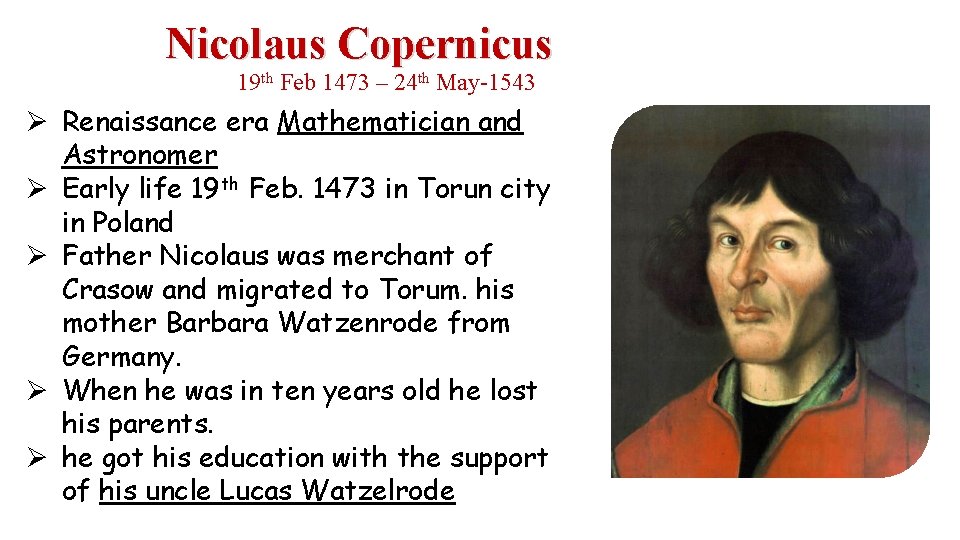
Nicolaus Copernicus 19 th Feb 1473 – 24 th May-1543 Ø Renaissance era Mathematician and Astronomer Ø Early life 19 th Feb. 1473 in Torun city in Poland Ø Father Nicolaus was merchant of Crasow and migrated to Torum. his mother Barbara Watzenrode from Germany. Ø When he was in ten years old he lost his parents. Ø he got his education with the support of his uncle Lucas Watzelrode
Education Ø he studied Astronomy and Astrology at University of Cracow, in Poland from 1491 -94 Ø he went to Italy for Medical Studies in 1501 -03 Ø he received Doctorate from University of Ferrara in Italy in May 1503.
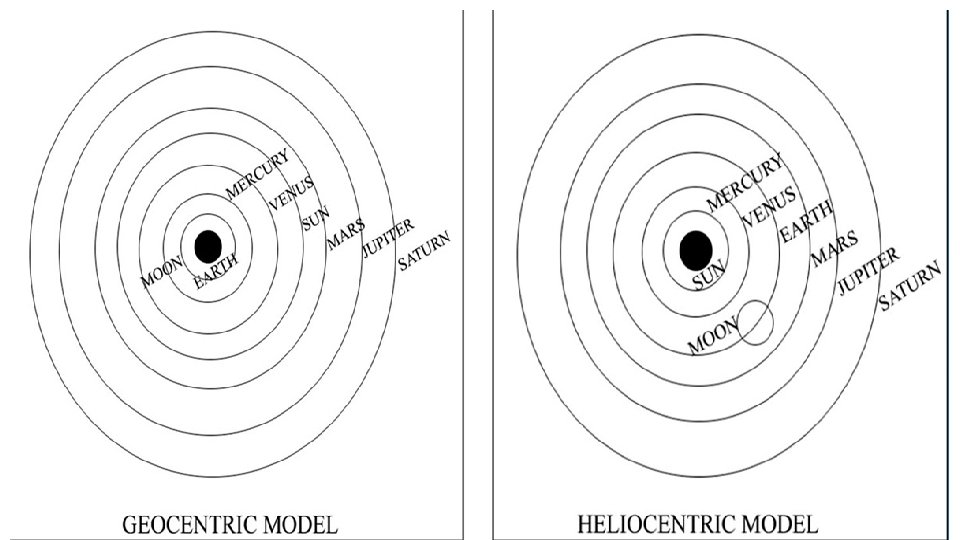
Contribution to Astronomy q During his period Aristotle's ideas of the Geocentric theory followed by the Greek astronomers. q between 1510 -1514 he wrote on essay where he introduced his new idea of Heliocentric Theory. q Pythagoras and Copernicus supported theory of Heliocentric Theory or Sun centred theory. q Initially his theory of Heliocentric was not accepted but later it was followed and recognized.

His major work Ø 1. “Commentariolus” (Little Commentary) in 1514 Ø 2. “On the Revolutions of Heavenly Spheres”. it was the enlarged versions of little commentary. Ø It was published after his death. Ø it consists of six divisions Ø i. Trigonometry and catalogue of stars (777 nos. ) Ø ii. about eclipses Ø iii. motions of sun Ø iv. movement of moon Ø v and vi deals about planets Ø Roman Catholic banned this book till 1758
Ø Ø Ø Ø he argued, all the planets revolved around the Sun, therefore the Sun is the centre of the Solar System. argued Earth is not centre of the universe. he discovered that Earth moves in two ways 1. it rotates on an own axis (period - 1 day) 2. it revolves (orbit) around the Sun (period 1 year) he discovered the ideas of gravity (15 th c. itself) before Newton who discovered during the 16 th C. died on 24 th may 1543 at Frombork in Poland at the age of 70
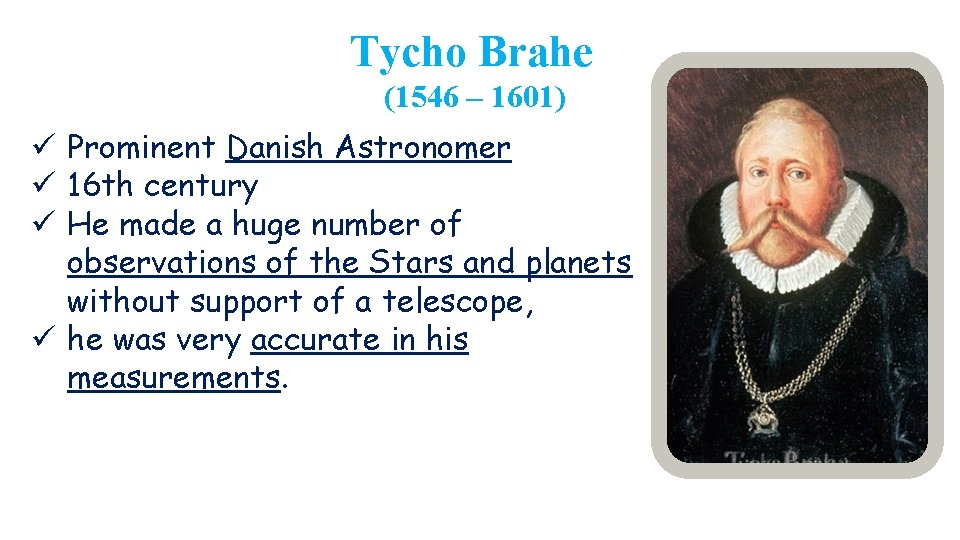
Tycho Brahe (1546 – 1601) ü Prominent Danish Astronomer ü 16 th century ü He made a huge number of observations of the Stars and planets without support of a telescope, ü he was very accurate in his measurements.
Early Life: Ø Born December 14, 1546 at Knud Strup in Skane, Denmark. Ø Son of Otto Brahe and Beate Bille. Father was nobleman and governor in the Court of Denmark. Ø Kidnapped by his uncle Jorgen Brahe (Brother of Otto) Ø According to one account, Otto and Beate promised Jorgen their first son, but changed their minds. Ø Jorgen kidnapped Tycho after 1 year, while Beate was pregnant with their second. Ø In all of the accounts, Uncle Jorgen illegally took Tycho.
Contribution v He studied about Stars and published a book called 'De Nova Stella' (On the New Star) in 1573. v He proved that stars were beyond the moon. v Earth stationary and Planets rotates around Sun v More then 20 years he worked at Uraniborg, as collecting observations of the positions and motions of the planets and the stars. v in 1597 series of disputes with the inhabitants of the island he was forced to leave from Uraniburg. v then he moved towards Prague and finally settled the island Ven in Sweden in 1599. v On 24 th October 1601 he passed.
Johannes Kepler 1571 - 1630 Ø Ø Ø German Astronomer Mathematics professor in Austria (Graz) astrologer born on December 27, 1571 at Weil in Wurttenberg, Germany. father, Heinrich was a officer in the Duke of Wurttenberg's army. his mother Catherine came from a noble family
Education 1. in 1588 he obtained his bachelor degree from University of Tubingen. 2. after his studies, he appointed as Mathematician and Astronomer in the School at Graz in Southern Austria. Major Work ü 'Mysterium Cosmographicum' It is an astronomy book which published at Tubingen in 1596. ü He was an assistant of Tycho Brahe when he was in Prague. ü after the death of Tycho, he carried his research work. ü Tyco Brahe's catalogue of stars was increased from 777 to 1000 by Kepler.
Law of Planetary Motion: The Law of Ellipses(1609) ü "every planet has an elliptical orbit with sun precisely at one focus“ The Law of Equal Areas(1609) ü The line joining a planet to the Sun cross over equal areas in equal intervals of time ü ‘The Optical Part of Astronomy’ (1604) dealt about ray of light. ü He published his findings on astronomical research in ‘Astronomia Nova’ (The New Astronomy) in 1609 The Harmony of the World (1619)
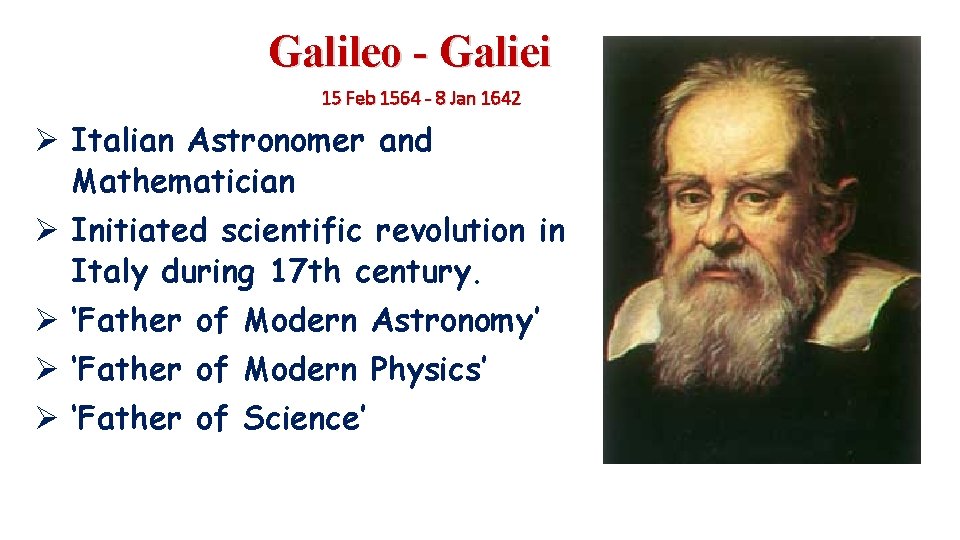
Galileo - Galiei 15 Feb 1564 - 8 Jan 1642 Ø Italian Astronomer and Mathematician Ø Initiated scientific revolution in Italy during 17 th century. Ø ‘Father of Modern Astronomy’ Ø ‘Father of Modern Physics’ Ø ‘Father of Science’
Early Life and Education Ø Born on 15 Feb 1564 in the city of Pisa in Italy. Ø His Father Vincinzo Galilei, a musician. Ø Father wanted him to be a medical doctor. Ø Therefore in 1581 he send him to University of Pisa to study about Medicine. Ø But he was more interested on Mathematics and Physical sciences. Ø Due to financial difficulties, he left the university in 1585 before earning his degree.
Ø At the age of 25 he began to lecture on Mathematics at the University of Pisa in 1589. Ø He worked for 18 years as Lecturer and established himself as a Scientist and inventor. Ø he disproved Aristotle's idea that different weights fall at different times. Ø Supported theory of Copernicaus's Heliocentric Theory
His Contribution towards Scientific Knowledge Ø He elected to the ‘Academia dei Lincei’ the first true scientific society founded in 1603 in Rome. Ø His astronomical observation work of “Starry Messenger “published in 1610. Ø He disproved theories of Aristotle’s moon to be a smooth and round ball, he discovered that it was rough and uneven shape. Ø He was the first scientist who observed sunspots. Ø He described an experimental method to measure the speed of light.
Ø in 1610 he was the first person to observe Saturn which had the rings. Ø in 1610 he discovered four satellites in orbit around Jupiter. he named Lo, Europa, Callisto and Ganymede. Ø He was the first to discover that the moon was rough and uneven. Ø in 1632 his work 'Dialogue Concerning the Two Chief World Systems' published.
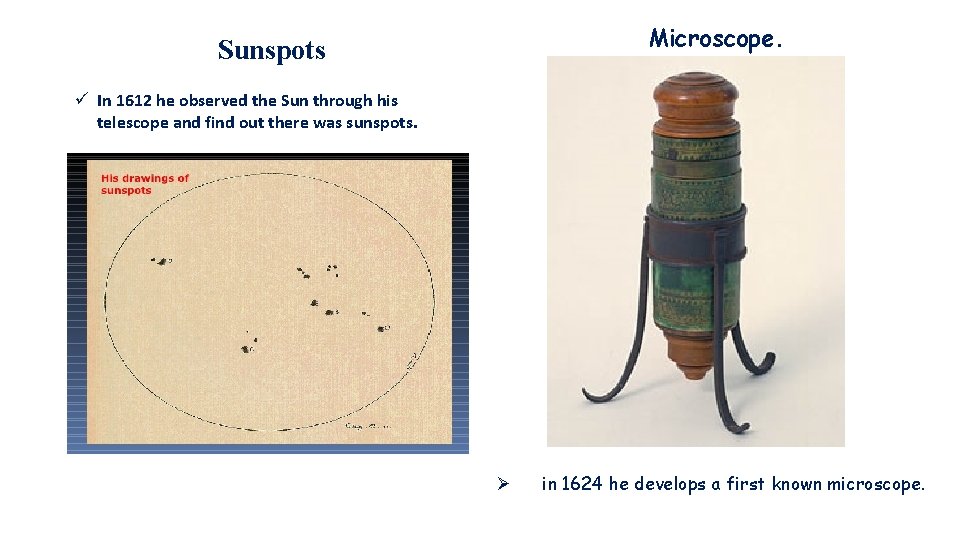
Microscope. Sunspots ü In 1612 he observed the Sun through his telescope and find out there was sunspots. Ø in 1624 he develops a first known microscope.
Trouble with the Church Ø Jesent Christoph Scheiner a german scientist he argued that, Galileo’s observation mistakenly noticed that Sunspots, it supposed to be tiny planets. But Galileo refused his comment. Ø It led to the opposition from the side of priests and professors. Ø He received many warning and threatening letters from the Catholic Church because he opposed geocentric theory and supported Heliocentric theory. Ø hence, Galileo was sent to prison and later on he lived under the house arrest under the care of the Arch Bishop of Siena, an old friend of Galileo.
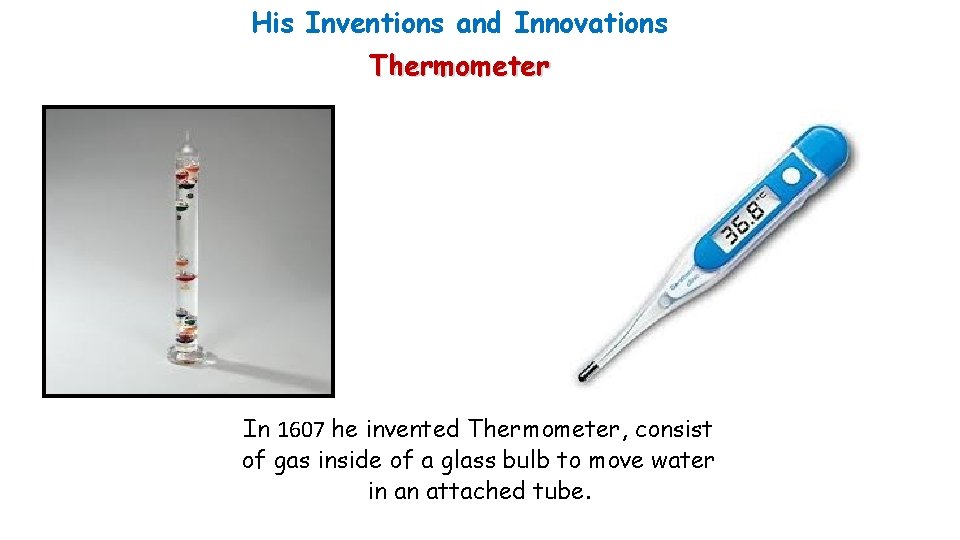
His Inventions and Innovations Thermometer In 1607 he invented Thermometer, consist of gas inside of a glass bulb to move water in an attached tube.
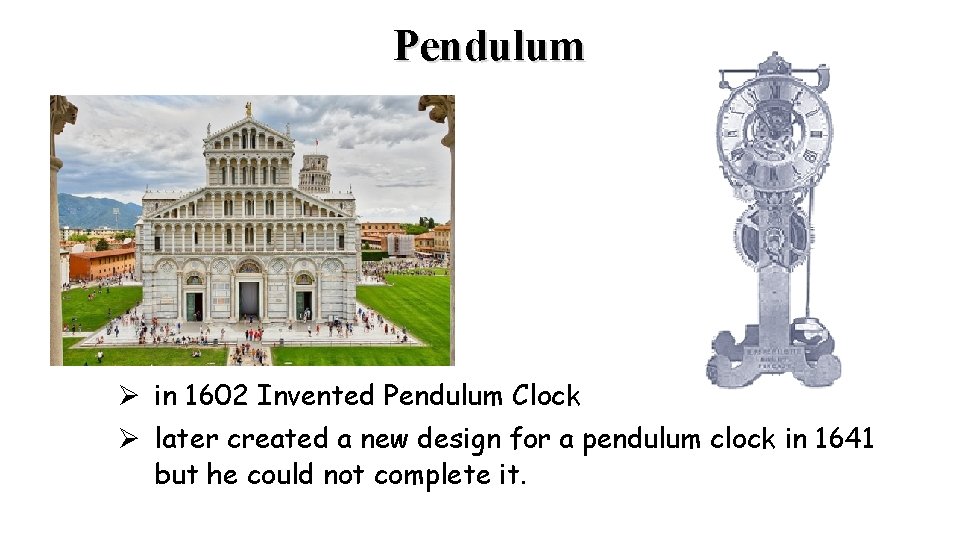
Pendulum Ø in 1602 Invented Pendulum Clock Ø later created a new design for a pendulum clock in 1641 but he could not complete it.
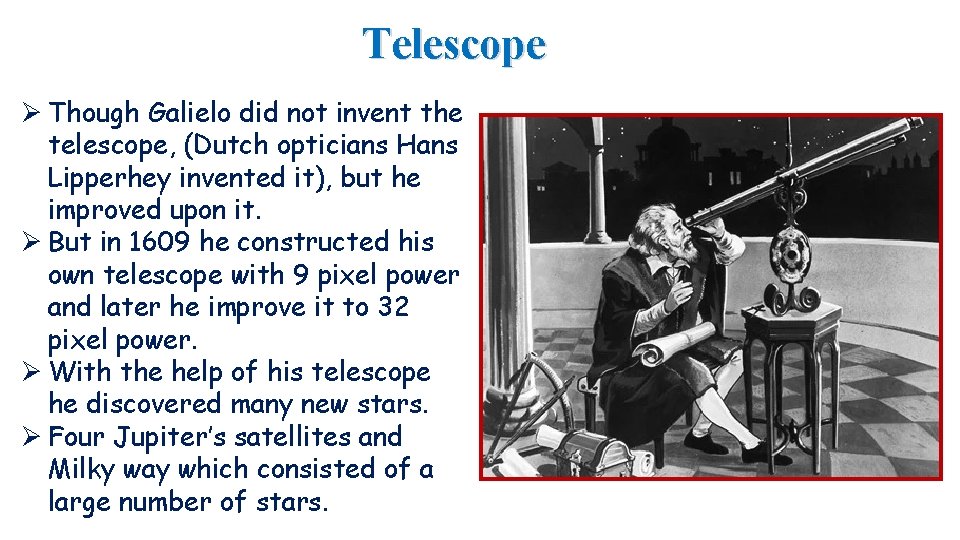
Telescope Ø Though Galielo did not invent the telescope, (Dutch opticians Hans Lipperhey invented it), but he improved upon it. Ø But in 1609 he constructed his own telescope with 9 pixel power and later he improve it to 32 pixel power. Ø With the help of his telescope he discovered many new stars. Ø Four Jupiter’s satellites and Milky way which consisted of a large number of stars.
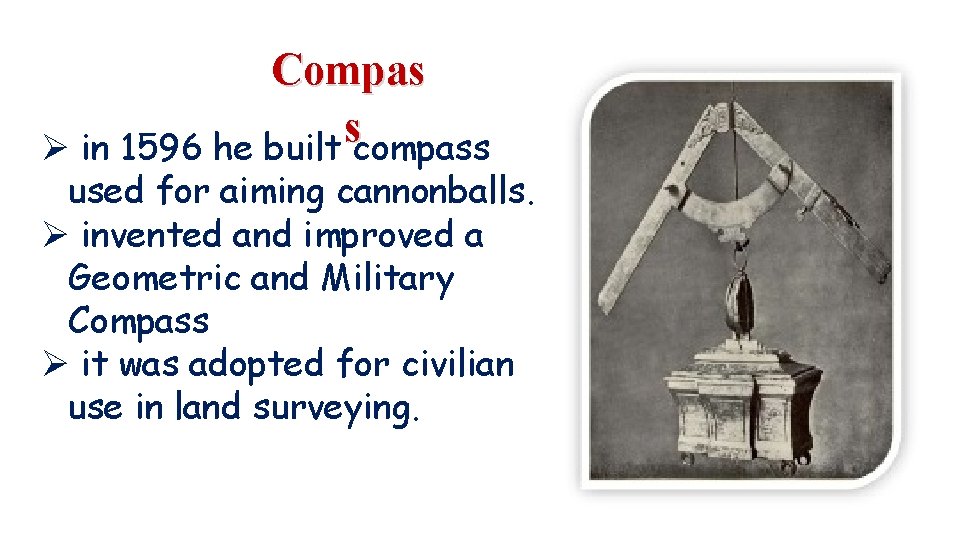
Compas s Ø in 1596 he built compass used for aiming cannonballs. Ø invented and improved a Geometric and Military Compass Ø it was adopted for civilian use in land surveying.
- Slides: 23