Newtons Second Law of Motion We are going


- Slides: 43
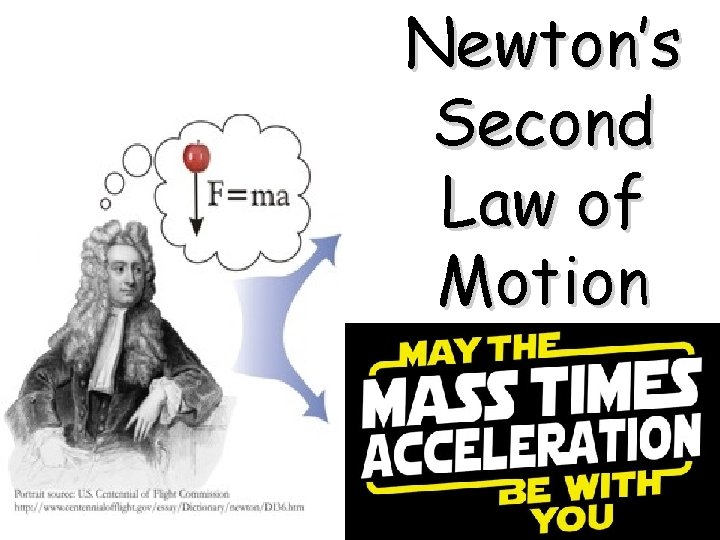
Newton’s Second Law of Motion
• We are going to talk about forces and acceleration. Football is a great place to start! Embed disabled, put into address bar http: //www. youtube. com/watch? v= c. Gh. KVNUf. Pcc 3 min video, football and physics
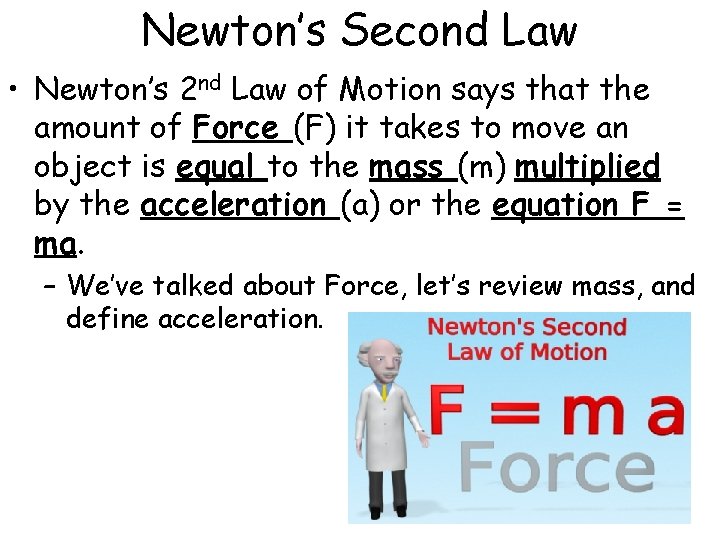
Newton’s Second Law • Newton’s 2 nd Law of Motion says that the amount of Force (F) it takes to move an object is equal to the mass (m) multiplied by the acceleration (a) or the equation F = ma. – We’ve talked about Force, let’s review mass, and define acceleration.
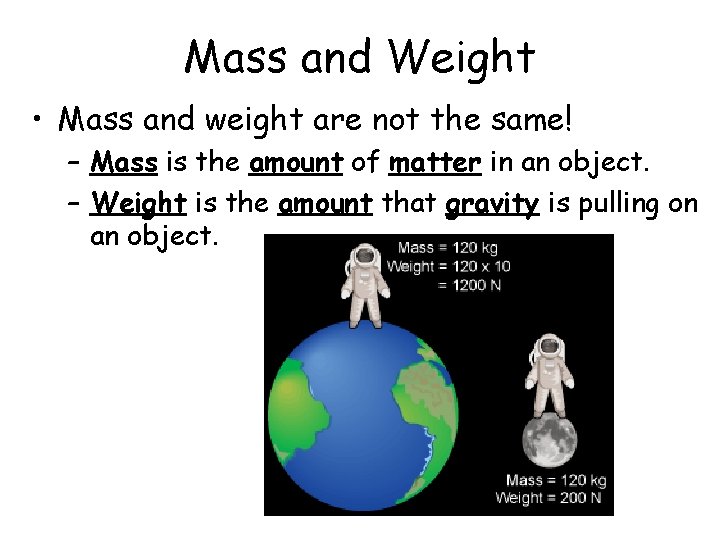
Mass and Weight • Mass and weight are not the same! – Mass is the amount of matter in an object. – Weight is the amount that gravity is pulling on an object.
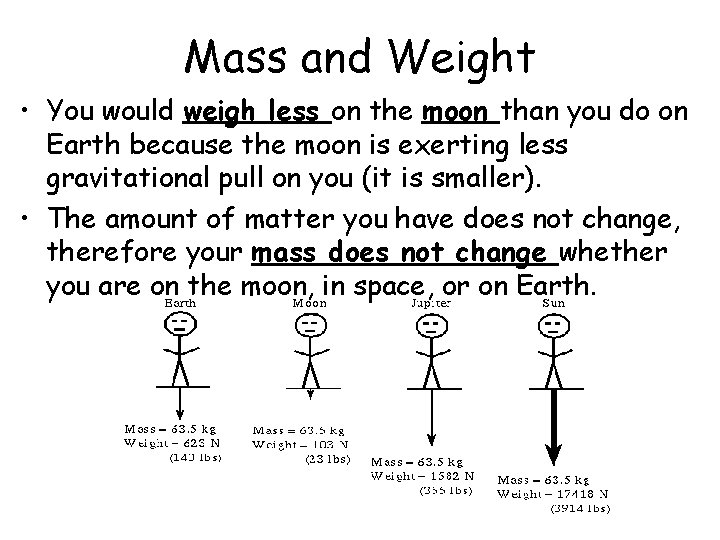
Mass and Weight • You would weigh less on the moon than you do on Earth because the moon is exerting less gravitational pull on you (it is smaller). • The amount of matter you have does not change, therefore your mass does not change whether you are on the moon, in space, or on Earth.
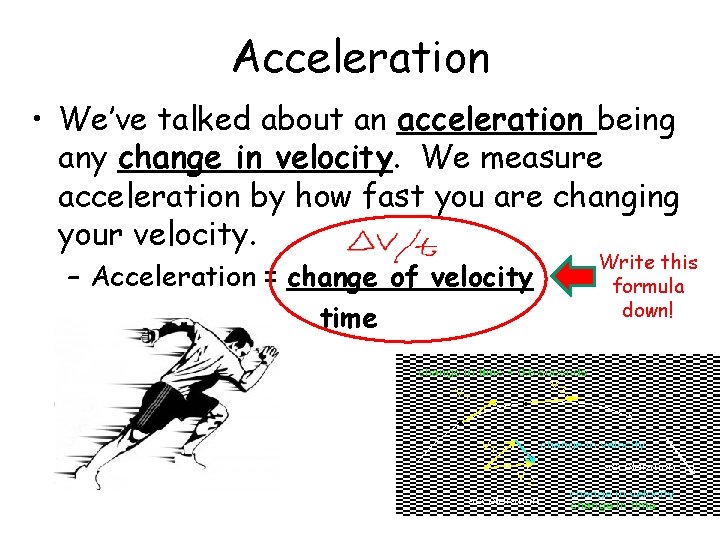
Acceleration • We’ve talked about an acceleration being any change in velocity. We measure acceleration by how fast you are changing your velocity. – Acceleration = change of velocity time Write this formula down!
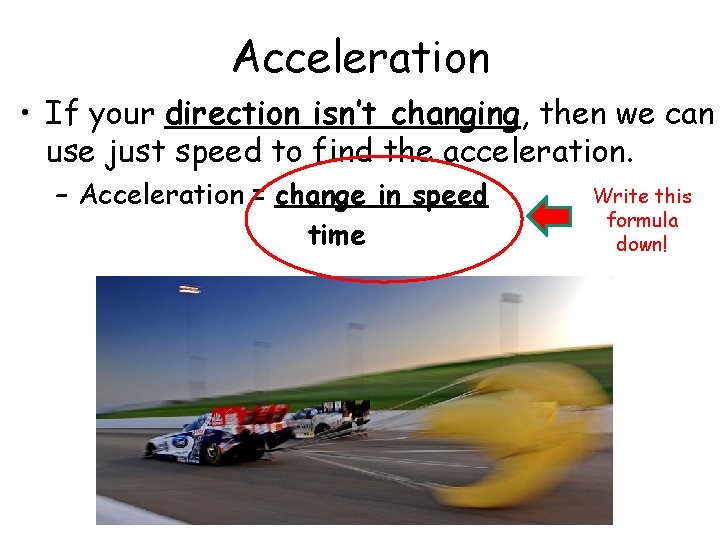
Acceleration • If your direction isn’t changing, then we can use just speed to find the acceleration. – Acceleration = change in speed time Write this formula down!
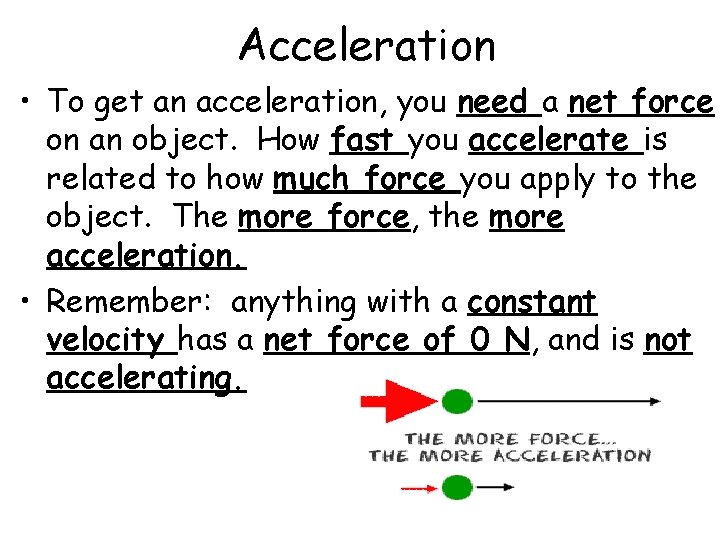
Acceleration • To get an acceleration, you need a net force on an object. How fast you accelerate is related to how much force you apply to the object. The more force, the more acceleration. • Remember: anything with a constant velocity has a net force of 0 N, and is not accelerating.
Check your understanding • 1. Your ______ does not change, but your _____ can change depending on the force of gravity. • 2. Would an object with a mass of 6 Kg on Earth weigh MORE or LESS on the moon? • 3. A bike undergoes acceleration when what is applied? • 4. True or False? Acceleration occurs when an object gains speed, decreases speed, or changes direction. • 5. What is the net force on a snow flake falling at a constant velocity? • 6. What is the acceleration of a snow flake falling at a constant velocity?
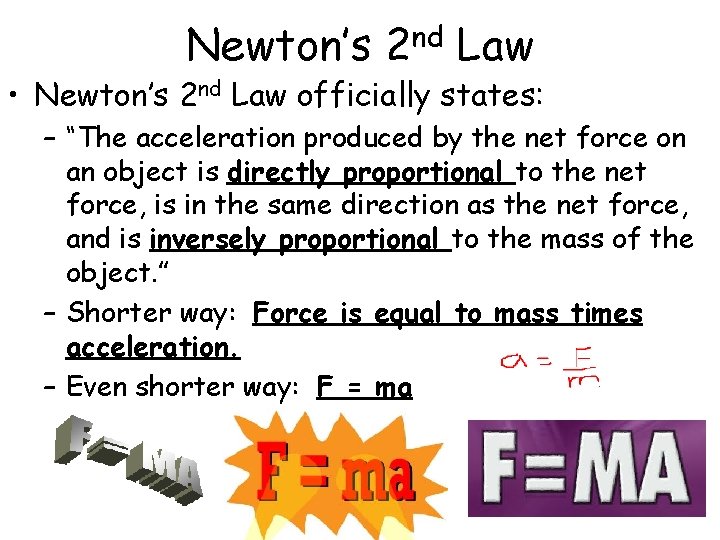
Newton’s nd 2 Law • Newton’s 2 nd Law officially states: – “The acceleration produced by the net force on an object is directly proportional to the net force, is in the same direction as the net force, and is inversely proportional to the mass of the object. ” – Shorter way: Force is equal to mass times acceleration. – Even shorter way: F = ma
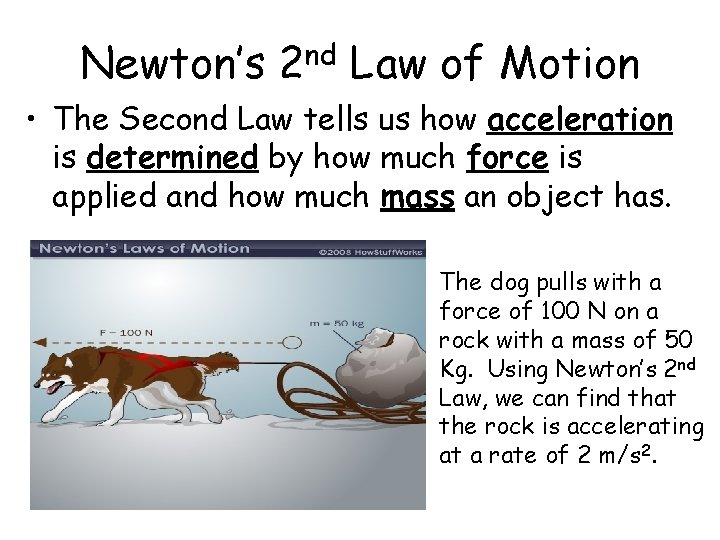
Newton’s 2 nd Law of Motion • The Second Law tells us how acceleration is determined by how much force is applied and how much mass an object has. The dog pulls with a force of 100 N on a rock with a mass of 50 Kg. Using Newton’s 2 nd Law, we can find that the rock is accelerating at a rate of 2 m/s 2.
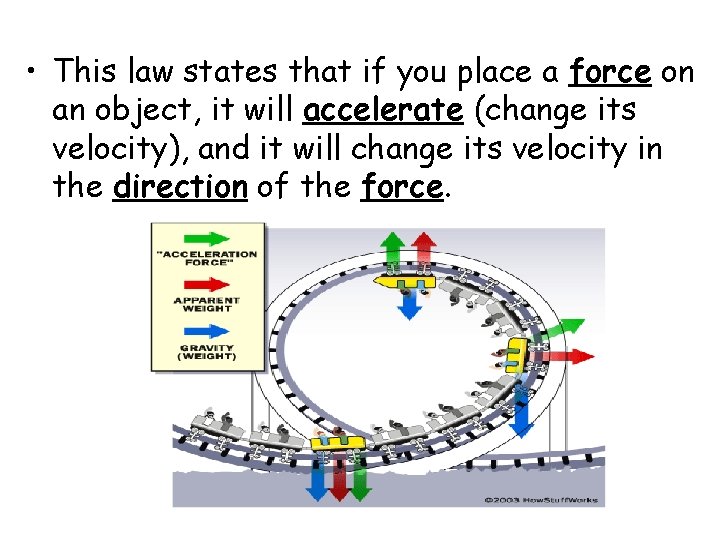
• This law states that if you place a force on an object, it will accelerate (change its velocity), and it will change its velocity in the direction of the force.
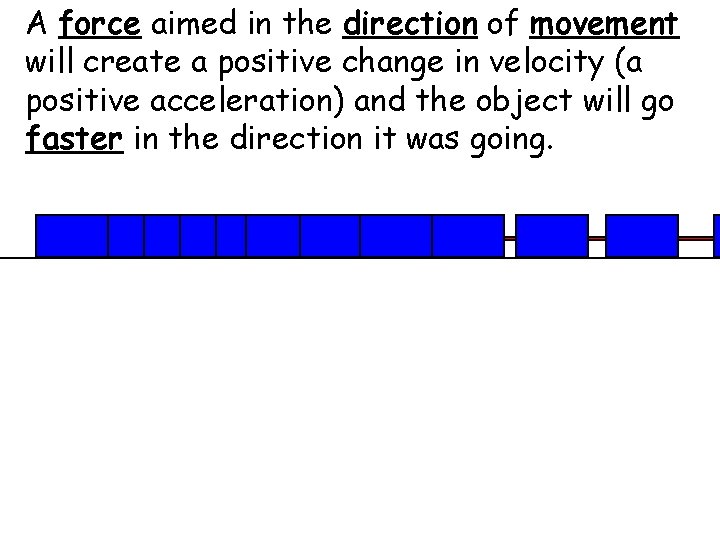
A force aimed in the direction of movement will create a positive change in velocity (a positive acceleration) and the object will go faster in the direction it was going.
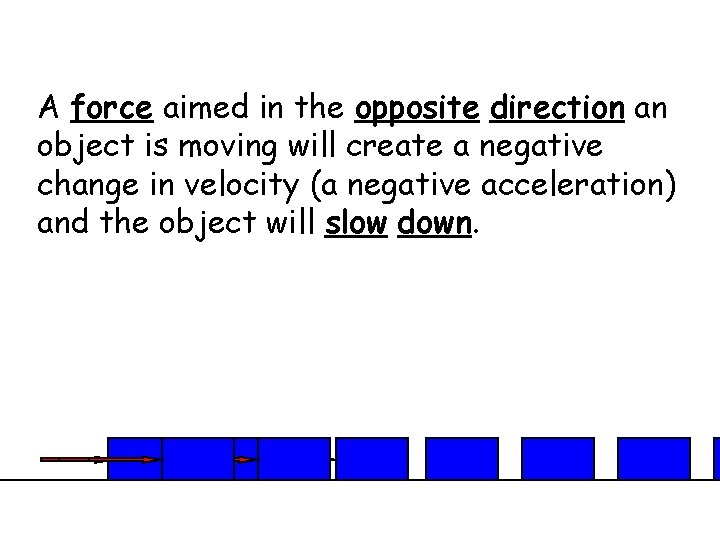
A force aimed in the opposite direction an object is moving will create a negative change in velocity (a negative acceleration) and the object will slow down.
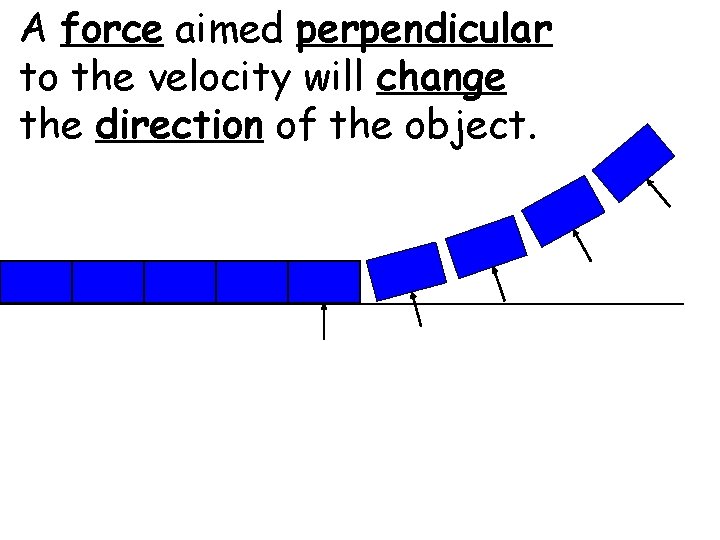
A force aimed perpendicular to the velocity will change the direction of the object.
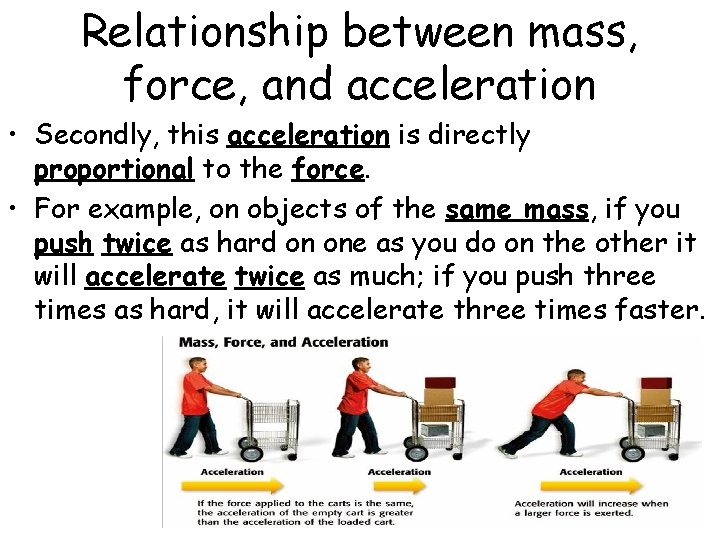
Relationship between mass, force, and acceleration • Secondly, this acceleration is directly proportional to the force. • For example, on objects of the same mass, if you push twice as hard on one as you do on the other it will accelerate twice as much; if you push three times as hard, it will accelerate three times faster.
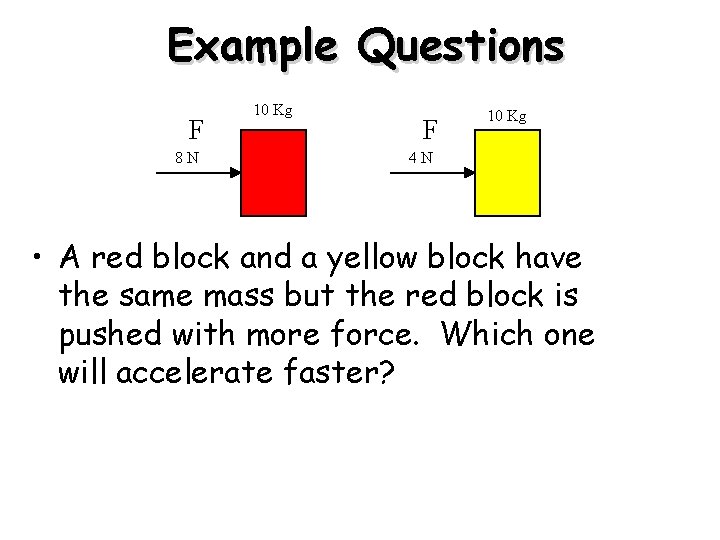
Example Questions F 8 N 10 Kg F 10 Kg 4 N • A red block and a yellow block have the same mass but the red block is pushed with more force. Which one will accelerate faster?
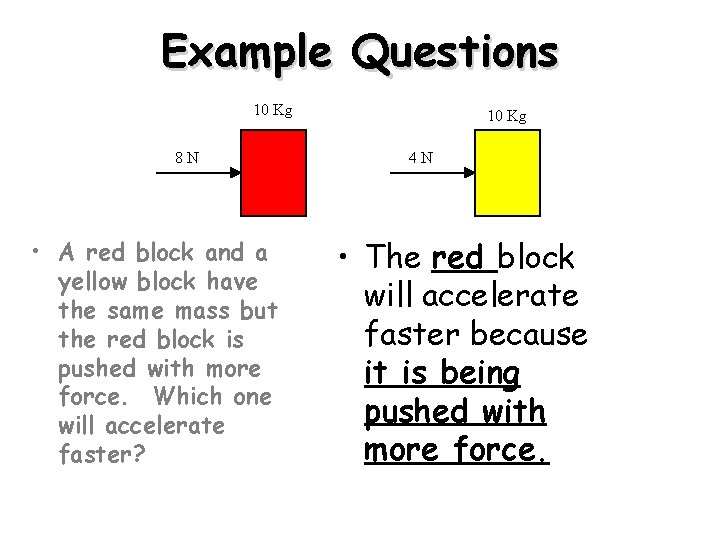
Example Questions 10 Kg 8 N • A red block and a yellow block have the same mass but the red block is pushed with more force. Which one will accelerate faster? 10 Kg 4 N • The red block will accelerate faster because it is being pushed with more force.
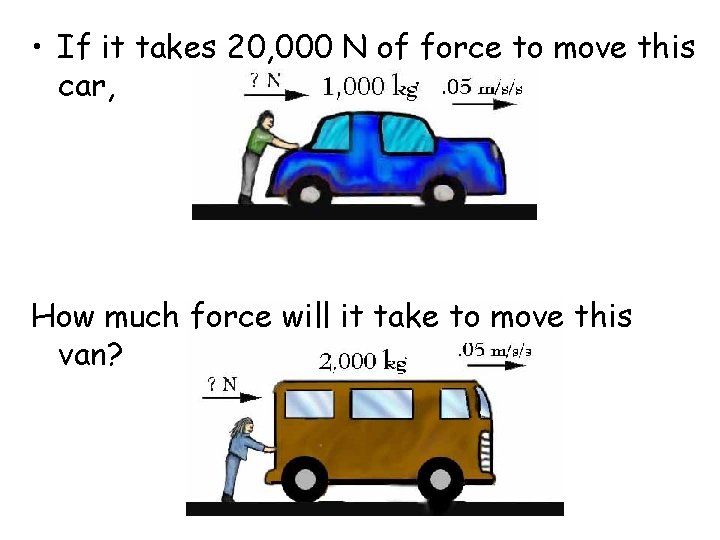
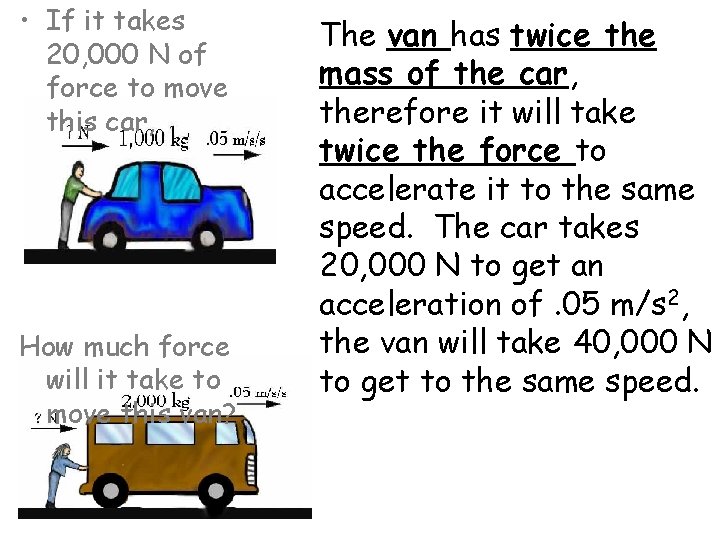
• If it takes 20, 000 N of force to move this car, How much force will it take to move this van?
• If it takes 20, 000 N of force to move this car, How much force will it take to move this van? The van has twice the mass of the car, therefore it will take twice the force to accelerate it to the same speed. The car takes 20, 000 N to get an acceleration of. 05 m/s 2, the van will take 40, 000 N to get to the same speed.
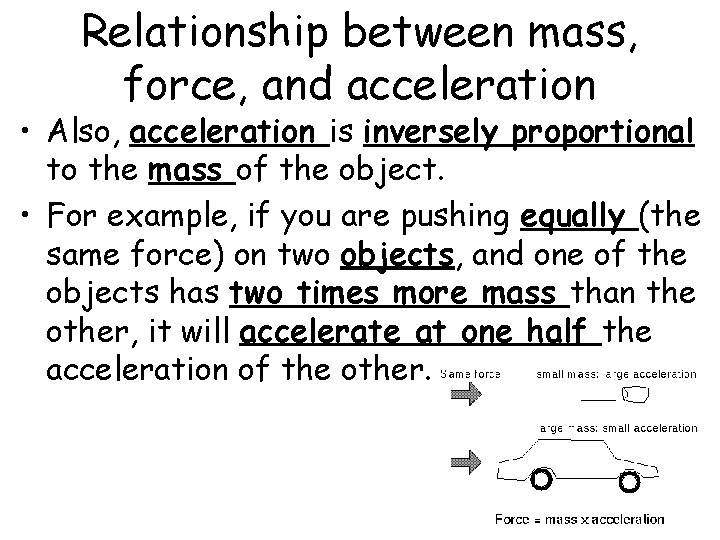
Relationship between mass, force, and acceleration • Also, acceleration is inversely proportional to the mass of the object. • For example, if you are pushing equally (the same force) on two objects, and one of the objects has two times more mass than the other, it will accelerate at one half the acceleration of the other.
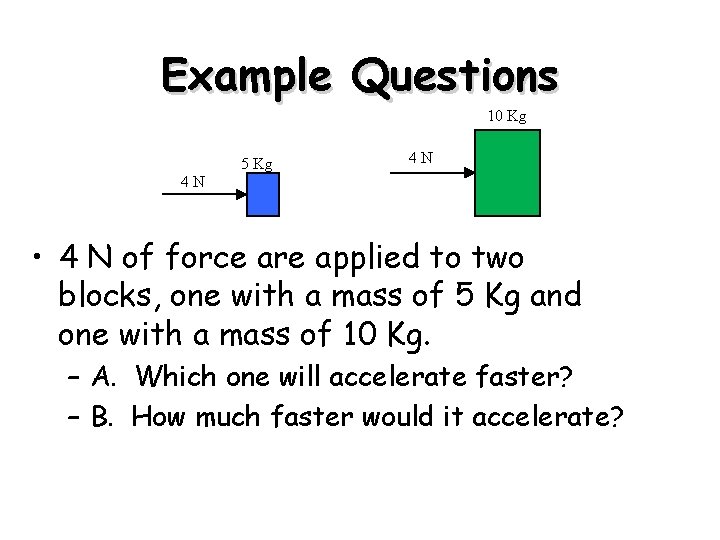
Example Questions 10 Kg 5 Kg 4 N 4 N • 4 N of force are applied to two blocks, one with a mass of 5 Kg and one with a mass of 10 Kg. – A. Which one will accelerate faster? – B. How much faster would it accelerate?
Example Questions F F 5 Kg 10 Kg 4 N 4 N • 4 N of force are applied to two blocks. • A. The blue block would accelerate faster because it has less mass. – A. Which one will • B. It would accelerate faster? twice as fast as the green – B. How much faster block. would it accelerate?
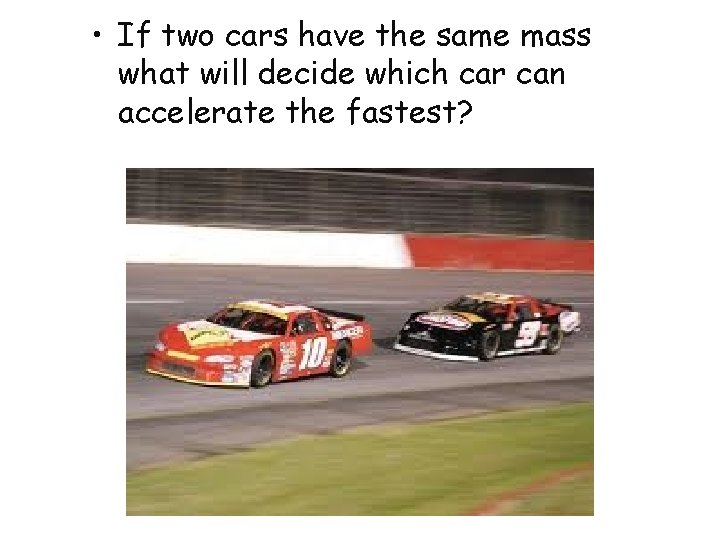
• If two cars have the same mass what will decide which car can accelerate the fastest?
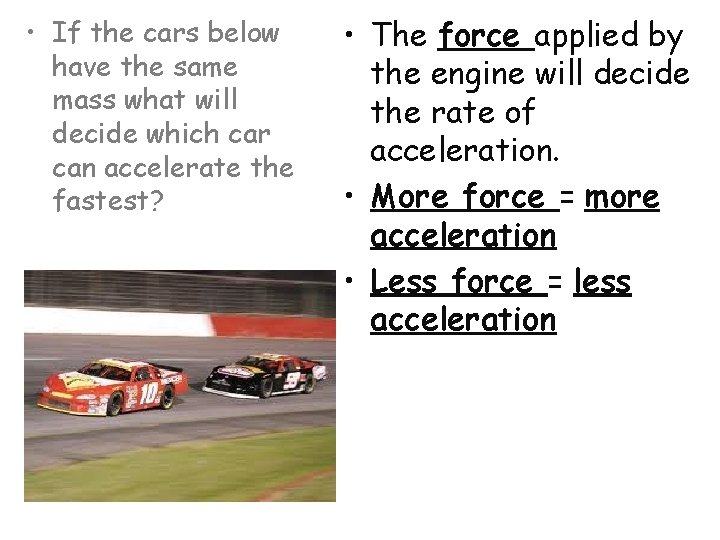
• If the cars below have the same mass what will decide which car can accelerate the fastest? • The force applied by the engine will decide the rate of acceleration. • More force = more acceleration • Less force = less acceleration
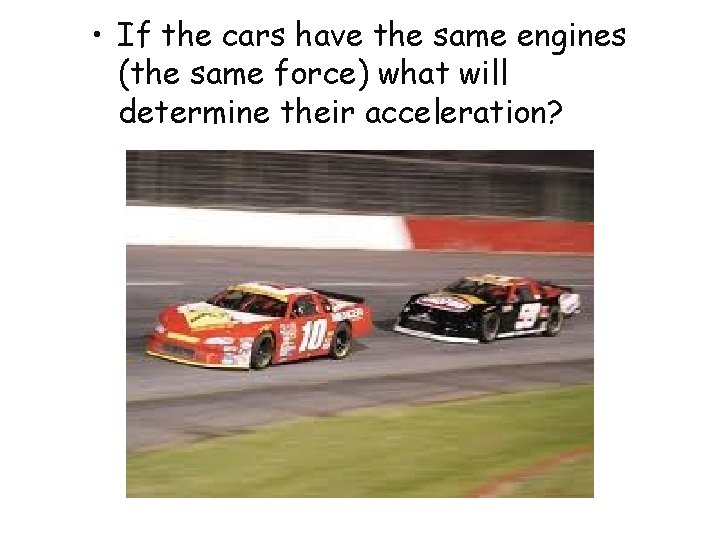
• If the cars have the same engines (the same force) what will determine their acceleration?
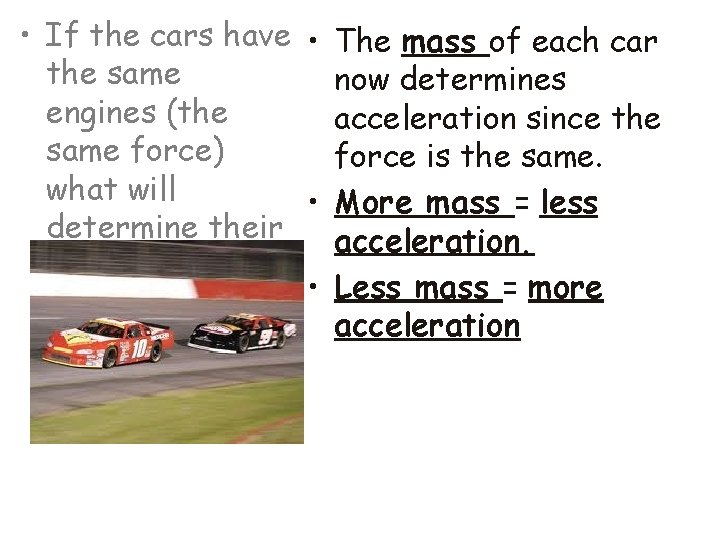
• If the cars have • The mass of each car the same now determines engines (the acceleration since the same force) force is the same. what will • More mass = less determine their acceleration? • Less mass = more acceleration
Check your understanding • 1. When a net force acts on an object, its acceleration depends on the object’s ______. # 2 -5 Circle the correct answer. The possible answers are in BOLD. • 2. As mass is added to a pushed object, its acceleration increases/decreases. • 3. As mass is subtracted from a pushed object, its acceleration increases/decreases. • 4. As force is added to a pushed object, its acceleration increases/decreases. • 5. As force is subtracted from a pushed object, its acceleration increases/decreases. • 6. You are pushing a cart at a constant acceleration but you are getting tired. What change could you make to push the cart with the same acceleration, but with only half the force?
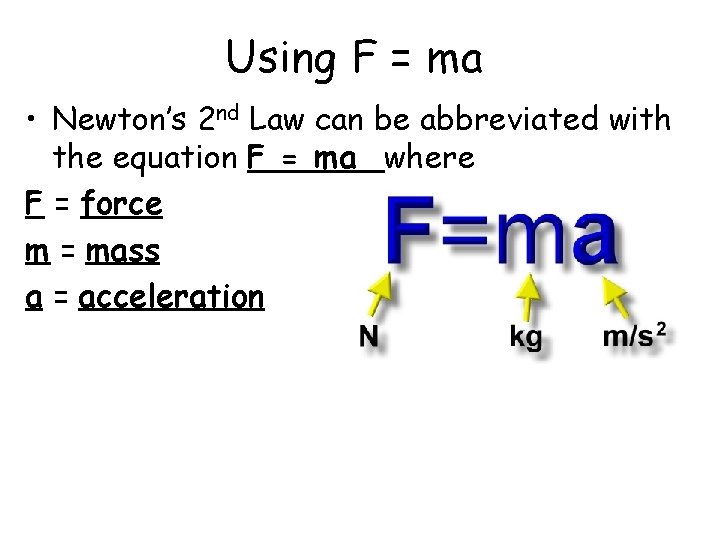
Using F = ma • Newton’s 2 nd Law can be abbreviated with the equation F = ma where F = force m = mass a = acceleration
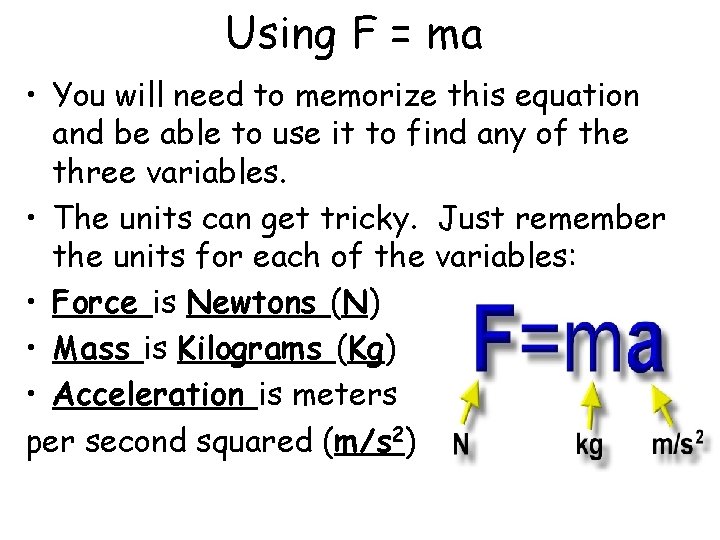
Using F = ma • You will need to memorize this equation and be able to use it to find any of the three variables. • The units can get tricky. Just remember the units for each of the variables: • Force is Newtons (N) • Mass is Kilograms (Kg) • Acceleration is meters per second squared (m/s 2)
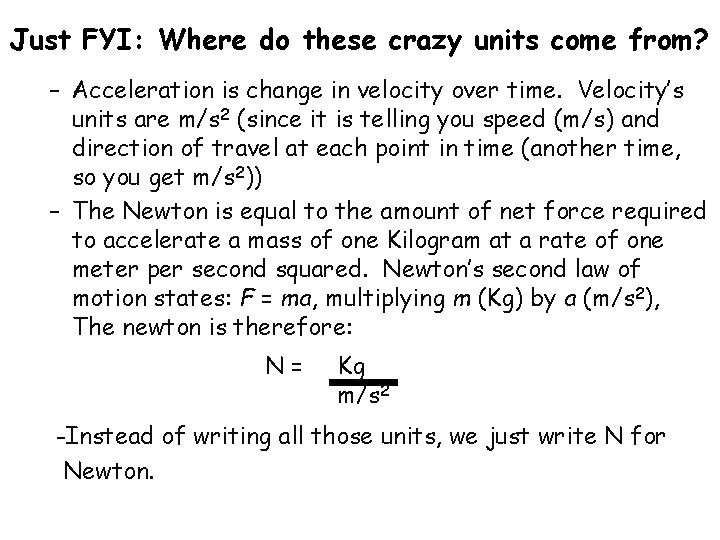
Just FYI: Where do these crazy units come from? – Acceleration is change in velocity over time. Velocity’s units are m/s 2 (since it is telling you speed (m/s) and direction of travel at each point in time (another time, so you get m/s 2)) – The Newton is equal to the amount of net force required to accelerate a mass of one Kilogram at a rate of one meter per second squared. Newton’s second law of motion states: F = ma, multiplying m (Kg) by a (m/s 2), The newton is therefore: N= Kg m/s 2 -Instead of writing all those units, we just write N for Newton.
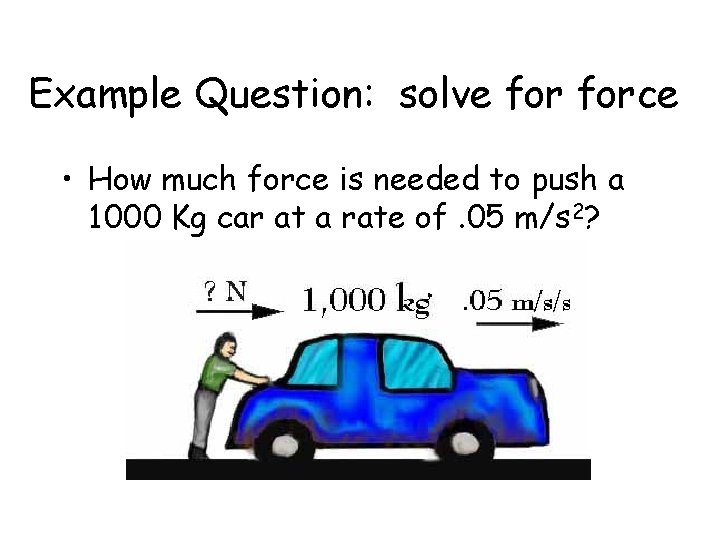
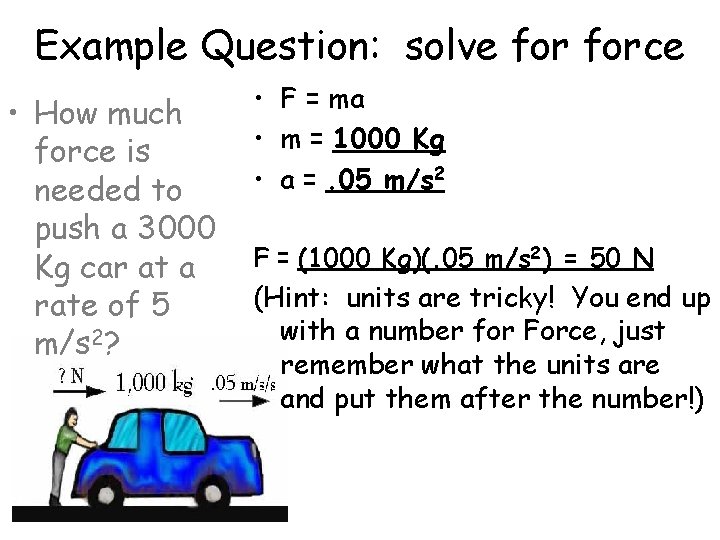
Example Question: solve force • How much force is needed to push a 1000 Kg car at a rate of. 05 m/s 2?
Example Question: solve force • How much force is needed to push a 3000 Kg car at a rate of 5 m/s 2? • F = ma • m = 1000 Kg • a =. 05 m/s 2 F = (1000 Kg)(. 05 m/s 2) = 50 N (Hint: units are tricky! You end up with a number for Force, just remember what the units are and put them after the number!)
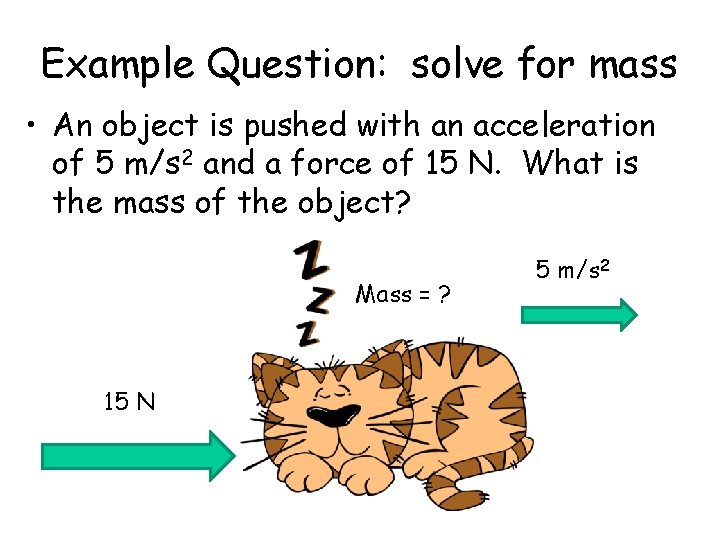
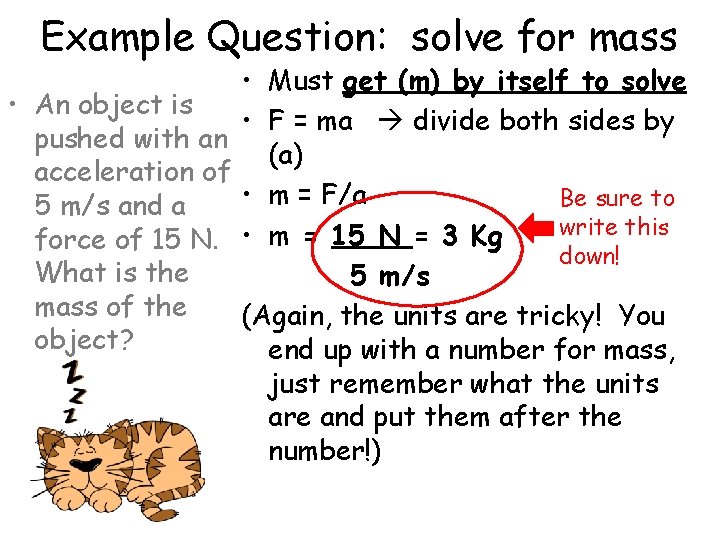
Example Question: solve for mass • An object is pushed with an acceleration of 5 m/s 2 and a force of 15 N. What is the mass of the object? Mass = ? 15 N 5 m/s 2
Example Question: solve for mass • Must get (m) by itself to solve • An object is • F = ma divide both sides by pushed with an (a) acceleration of • m = F/a Be sure to 5 m/s and a write this • m = 15 N = 3 Kg force of 15 N. down! What is the 5 m/s mass of the (Again, the units are tricky! You object? end up with a number for mass, just remember what the units are and put them after the number!)
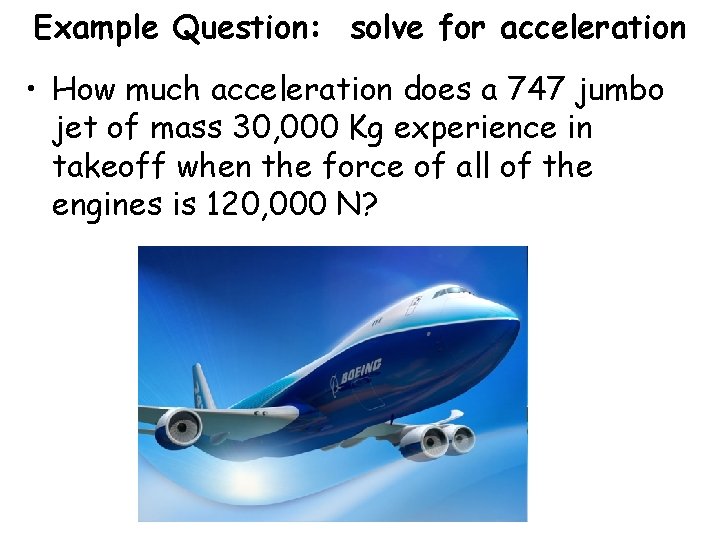
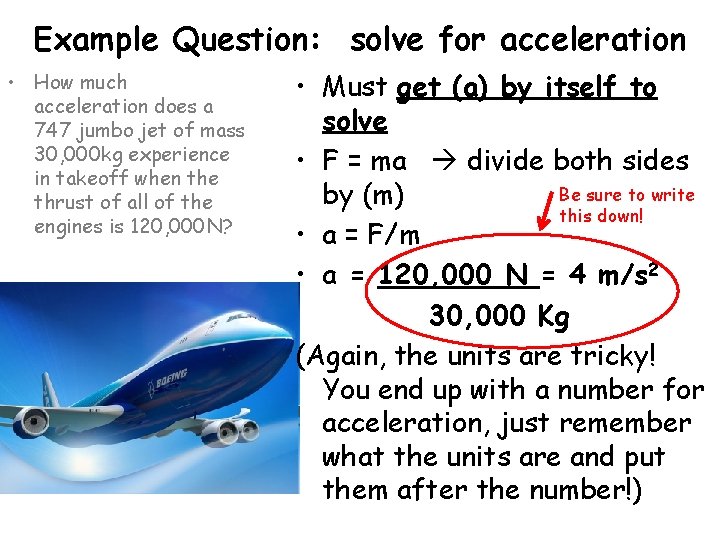
Example Question: solve for acceleration • How much acceleration does a 747 jumbo jet of mass 30, 000 Kg experience in takeoff when the force of all of the engines is 120, 000 N?
Example Question: solve for acceleration • How much acceleration does a 747 jumbo jet of mass 30, 000 kg experience in takeoff when the thrust of all of the engines is 120, 000 N? • Must get (a) by itself to solve • F = ma divide both sides Be sure to write by (m) this down! • a = F/m • a = 120, 000 N = 4 m/s 2 30, 000 Kg (Again, the units are tricky! You end up with a number for acceleration, just remember what the units are and put them after the number!)
Check your understanding • Solve the problems below using the formula for Newton’s 2 nd Law. Show your work and include all units. • 1. What is the force needed to push a stubborn mule with a mass of 800 Kg at a rate of 4 m/s 2? • 2. What is the mass of a dog running at a rate of 6 m/s 2 and exerting a force of 18 N? • 3. What is the acceleration of a large, 15 Kg cat jumping at you with a force of 5 N?
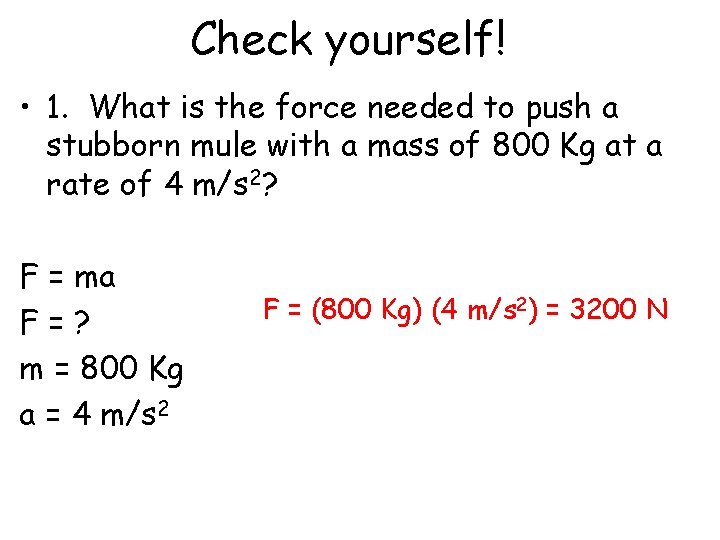
Check yourself! • 1. What is the force needed to push a stubborn mule with a mass of 800 Kg at a rate of 4 m/s 2? F = ma F=? m = 800 Kg a = 4 m/s 2 F = (800 Kg) (4 m/s 2) = 3200 N
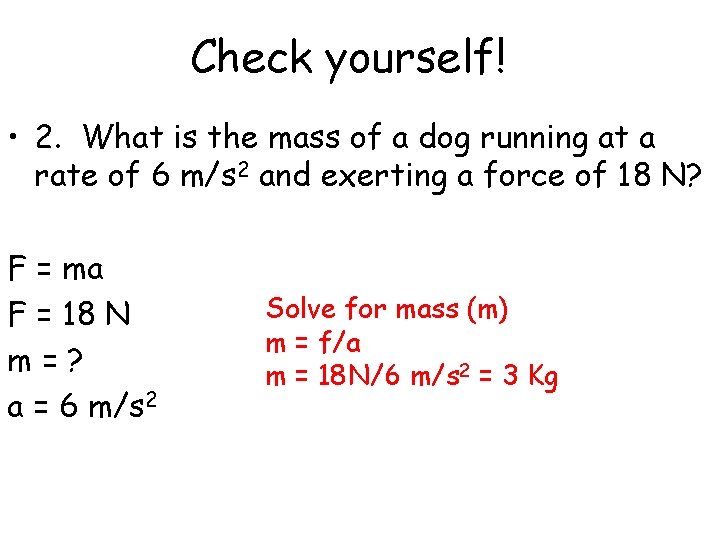
Check yourself! • 2. What is the mass of a dog running at a rate of 6 m/s 2 and exerting a force of 18 N? F = ma F = 18 N m=? a = 6 m/s 2 Solve for mass (m) m = f/a m = 18 N/6 m/s 2 = 3 Kg
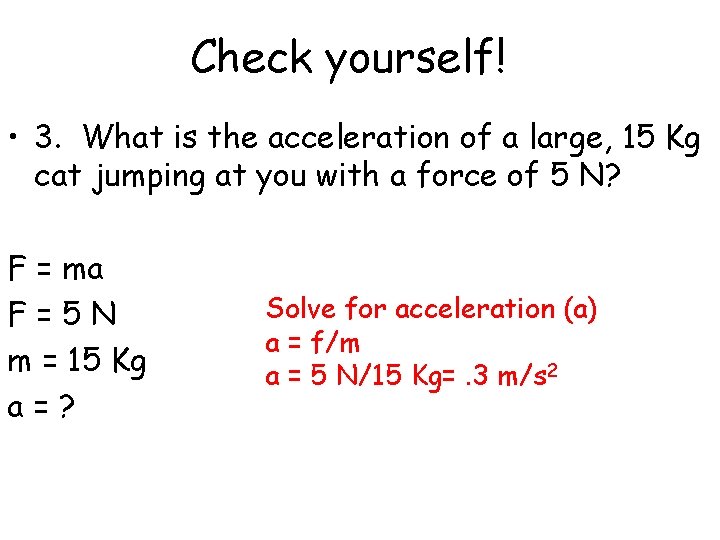
Check yourself! • 3. What is the acceleration of a large, 15 Kg cat jumping at you with a force of 5 N? F = ma F=5 N m = 15 Kg a=? Solve for acceleration (a) a = f/m a = 5 N/15 Kg=. 3 m/s 2
You should know • 1. The difference between mass and weight and how it changes between the Earth, the moon, and space. • 2. To get an acceleration (change in velocity), you must apply a net force (push or pull). • 3. The relationship between mass and acceleration (as mass increases, acceleration decreases). • 4. The relationship between force and acceleration (as force increases, acceleration increases). • 5. The relationship between mass and force. The more mass an object has, the more force needed to move it. • 6. Newton’s 2 nd Law, F = ma, and be able to use the equation to solve for any of the variables.