New Historicism Historical Contexts Frankenstein and Conflict in


- Slides: 33
“New Historicism, ” Historical Contexts: Frankenstein, and Conflict in Frankenstein Monday January 11, 2016
Homework On Jan. 18 students must: Read: Frankenstein: Chapters 3 -7 Turn in summary/ reflection 2 (with 5 vocabulary words and 2 discussion questions)- Focus on writing about what conflict you feel is most important at this point in the novel. 6 Entries in Dialectical Journal Grammar HW 1 - Comma Handout
Literary Lenses: New Historicism
Literary Lenses “A very basic way of thinking about literary theory is that these ideas act as different lenses critics use to view and talk about art, literature, and even culture. ” “These different lenses allow critics to consider works of art based on certain assumptions within that school of theory. ” “The different lenses also allow critics to focus on particular aspects of a work they consider important. ”
Major Schools of Criticism Marxist- Focuses on the interplay between the classes (the “haves” and the “have nots”). A major factor for investigation is economics. Post Colonial- Looks at how colonial powers treat those whom they colonize…for example novels that investigate how the British treated their foreign “subjects” Psychoanalytic- this school looks at investigating Freudian theories in literature. Feminist/ Gender: this school typically looks how the feminine voice may be oppressed in a text, or perhaps investigates an example of a strong feminine character. …And for the purposes of our own investigation
New Historicism Defined: “This school, influenced by structuralist and poststructuralist theories, seeks to reconnect a work with the time period in which it was produced and identify it with the cultural and political movements of the time” Key Structuralist Tennant- “structuralist realization that all human systems are symbolic and subject to the rules of language” “New Historicism assumes that every work is a product of the historic moment that created it. ”
New Historicism “New historicists do not believe that we can look at history objectively, but rather that we interpret events as products of our time and culture. ” “Moreover, New Historicism holds that we are hopelessly subjective interpreters of what we observe. ”
New Historicism (cont. ) “What language/characters/events present in the work reflect the current events of the author’s day? ” “Are there words in the text that have changed their meaning from the time of the writing? ” “How are such events interpreted and presented? ” “How are events' interpretation and presentation a product of the culture of the author? ” “Does the work's presentation support or condemn the event? ” “Can it be seen to do both? ”
New Historicism (cont. ) “How does this portrayal criticize the leading political figures or movements of the day? ” “How does the literary text function as part of a continuum with other historical/cultural texts from the same period. . . ? ” “How can we use a literary work to "map" the interplay of both traditional and subversive discourses circulating in the culture in which that work emerged and/or the cultures in which the work has been interpreted? ” “How does the work consider traditionally marginalized populations? ”
Characters/ narrators are not typically direct representations of the author, but you cannot discount that a text is product of its time.
Resources/ References https: //owl. english. purdue. edu/owl/resource/722/ 01/ https: //owl. english. purdue. edu/owl/resource/722/ 09/
Historical Contexts: Mary Shelley
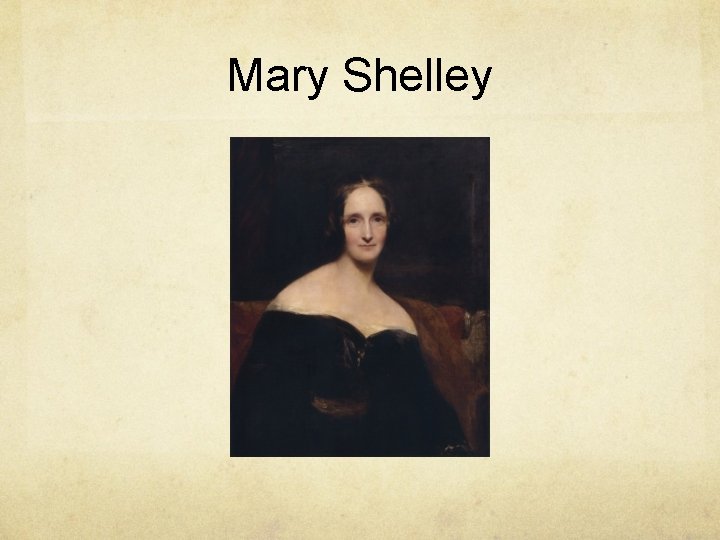
Mary Shelley
Bio “Her mother, Mary Wollstonecraft, published the classic manifesto of sexual equality, A Vindication of the Rights of Woman (1792). ” “Her father, William Godwin, established his preeminence in radical British political thought with his Enquiry Concerning Political Justice (1793) and won a permanent place in literary history with his novel Caleb Williams (1794), often considered the first English detective novel. ” “The toast of radical social circles, the two were bound to meet. When they did, in the summer of 1796, an immediate mutual attraction began, and they were married on 29 March 1797. ” “On 30 August of that year Mary Wollstonecraft Godwin was born. ” “Complications from her birth resulted in her mother's death 10 September. ”
“In 1801, when little Mary was four, Godwin remarried. The only memories of her stepmother that Mary recorded are bad ones. ” “Godwin's second wife, Mary Jane Clairmont, brought her own children, Charles and Jane, into the family, and young Mary felt displaced. ” “In 1808, at the age of eleven, Mary Wollstonecraft Godwin published a booklet in the series, a rhymed children's tale called Mounseer Nongtongpaw; or, the Discoveries of John Bull in a Trip to Paris”
“Threatened by her stepdaughter's attention to Godwin, especially when adolescence transformed the child into a beautiful image of the first wife, Mary Jane Godwin sent the teenaged Mary to Scotland on 7 June 1812, ostensibly for the girl's health. ” “In this period, during a brief visit home on 11 November 1812, Mary first met Percy Bysshe Shelley, who was in the company of his first wife, Harriet Westbrook. ”
“When they eloped, they carried with them a box of her early writings, which were lost in Paris during the trip. ” “Mary responded to the loss by beginning immediately a novel called ‘Hate, ’ and, when back in England, she started an historical novel, ‘The Life of Louvet. ’” “Neither novel was ever finished, as pregnancy and illness stole her energy. On 22 February 1815 her first daughter was born prematurely, and died 6 March. ”
“On 3 May the Shelleys, including the boy William, and Mary's stepsister, Jane Clairmont (who had come to be known as Claire) left for Geneva to meet George Gordon, Lord Byron. ” “There, with the promise of a lengthier stay on the Continent, and in the company of the most celebrated literary figure in Europe, Mary began to write her masterpiece, Frankenstein”.
“Sometime in mid June, the literary discussion of the Shelley-Byron party turned toward German ghost stories. ” “Byron suggested each member of the group (Shelley, Byron, Claire Clairmont, Mary, and Dr. John William Polidori) write a ghost story in the same vein. ” “ In the next few weeks Mary produced a short story which, when expanded, became Frankenstein. ”
“Though the year 1818 opened with the publication of Frankenstein on New Year's Day, and the Shelleys began a much longer stay on the Continent, this period saw another series of emotional shocks to Mary Shelley: in September her daughter, barely a year old, died in Venice, and the following June her son died in Rome. ” “But again Mary's joy was cut short. On 16 June 1822 she suffered a miscarriage, and on 8 July Percy Shelley drowned while sailing in the Gulf of Spezia. ” “On 1 February 1851 Mary Shelley died in London at the age of fifty-three. ” http: //www. poetryfoundation. org/bio/mary-wollstonecraftshelley
Revisit Conflict/ Frankenstein
Grammar Homework: Revisiting the Comma
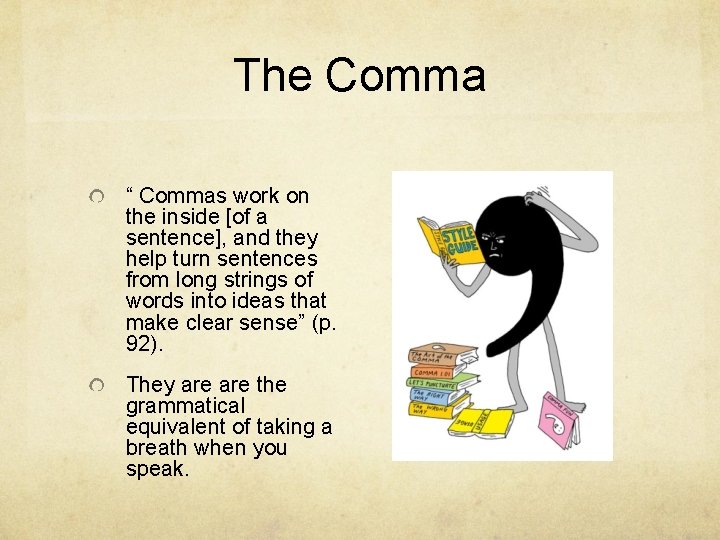
The Comma “ Commas work on the inside [of a sentence], and they help turn sentences from long strings of words into ideas that make clear sense” (p. 92). They are the grammatical equivalent of taking a breath when you speak.
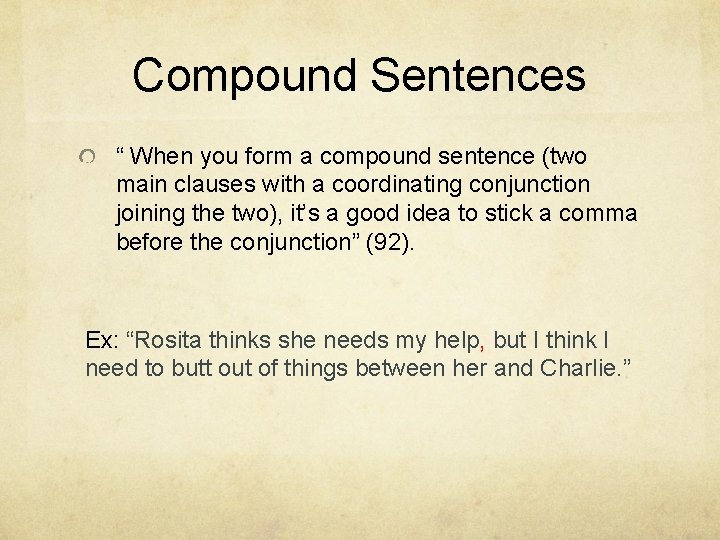
Compound Sentences “ When you form a compound sentence (two main clauses with a coordinating conjunction joining the two), it’s a good idea to stick a comma before the conjunction” (92). Ex: “Rosita thinks she needs my help, but I think I need to butt out of things between her and Charlie. ”
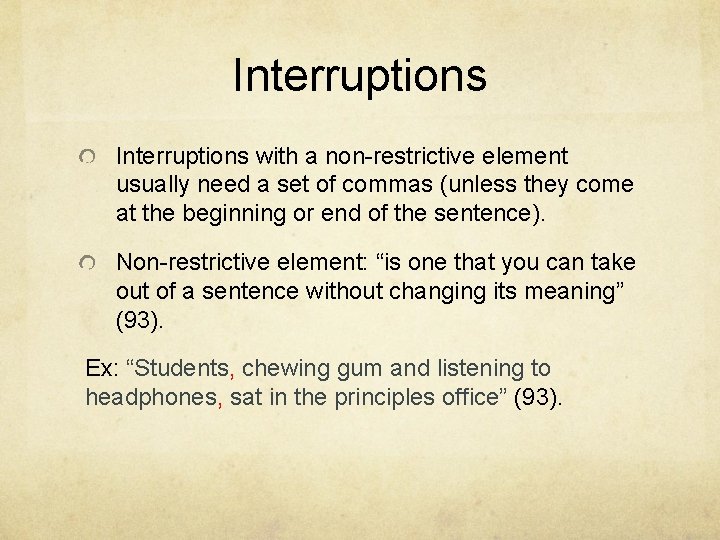
Interruptions with a non-restrictive element usually need a set of commas (unless they come at the beginning or end of the sentence). Non-restrictive element: “is one that you can take out of a sentence without changing its meaning” (93). Ex: “Students, chewing gum and listening to headphones, sat in the principles office” (93).
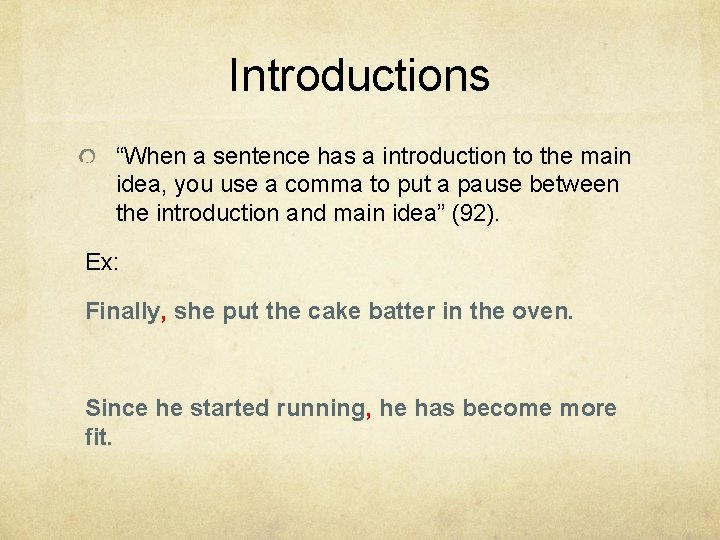
Introductions “When a sentence has a introduction to the main idea, you use a comma to put a pause between the introduction and main idea” (92). Ex: Finally, she put the cake batter in the oven. Since he started running, he has become more fit.
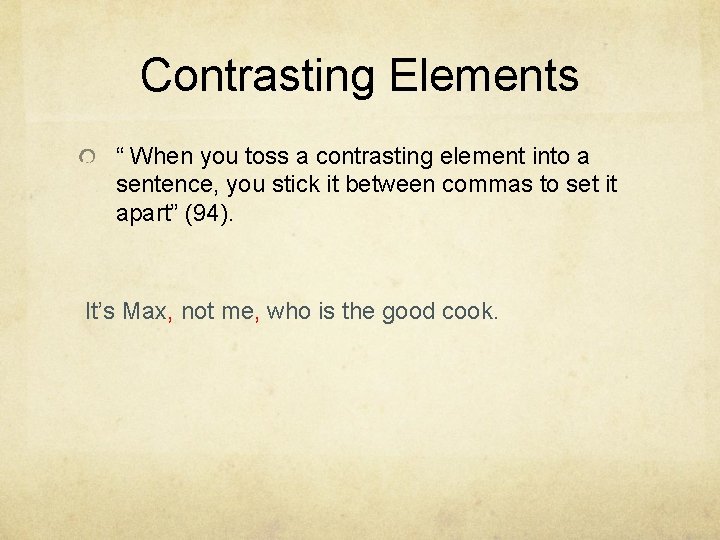
Contrasting Elements “ When you toss a contrasting element into a sentence, you stick it between commas to set it apart” (94). It’s Max, not me, who is the good cook.
Interjections are words or phrases that, “express surprise or some other kind of emotion” (86). Ex: “Yikes, Eek, Ouch, Hey, Wow” “When they introduce, end, or even interrupt sentences, they need commas” (94). “I thought I was over Charlie a long time ago, but, yikes, I learned how fast I was wrong. ”
Direct Address If you are directly addressing someone, a comma should follow the individual you are addressing. Ex: Sir, could you please write me a letter of recommendation.
Tag Questions “ A tag question is a little question that gets tacked onto the end of a regular sentence, using a single comma” (94 -95). Ex: “Tag questions are pretty simple, aren’t they? ”
Lists, Dates, Addresses “ My favorite colors are red, blue, and green. ” “On Monday, August 23, 2007, I started attending the university. ” “I live at 543 Main, Las Cruces, New Mexico 51234.
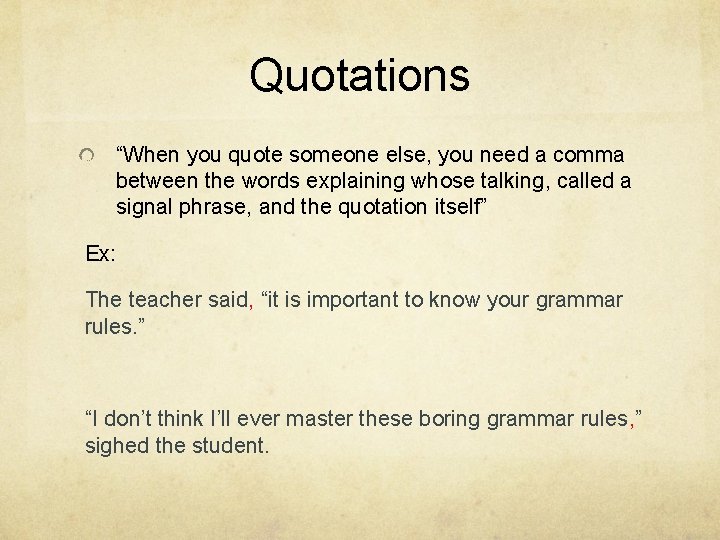
Quotations “When you quote someone else, you need a comma between the words explaining whose talking, called a signal phrase, and the quotation itself” Ex: The teacher said, “it is important to know your grammar rules. ” “I don’t think I’ll ever master these boring grammar rules, ” sighed the student.
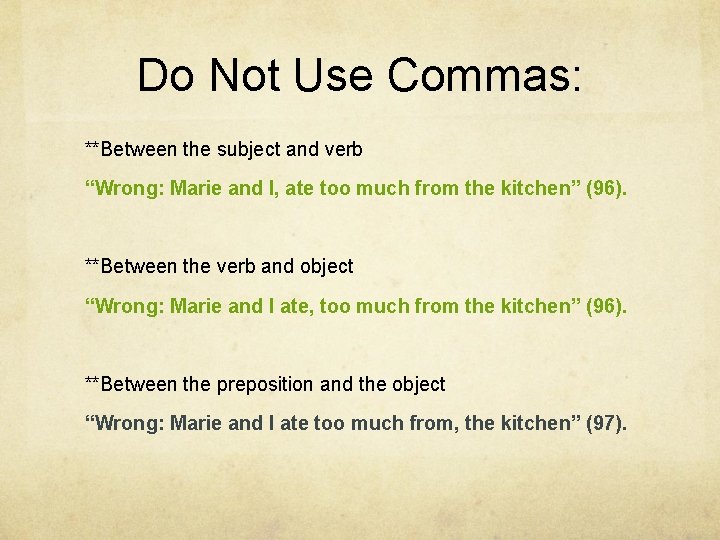
Do Not Use Commas: **Between the subject and verb “Wrong: Marie and I, ate too much from the kitchen” (96). **Between the verb and object “Wrong: Marie and I ate, too much from the kitchen” (96). **Between the preposition and the object “Wrong: Marie and I ate too much from, the kitchen” (97).