the Use of History in Literary Criticism Literary

- Slides: 35
the Use of History in Literary Criticism Literary History, New Criticism and New Historicism
Outline Starting Questions Historical Methods Literary History – another example of traditional historicism New Historicism & Foucault References Next Few Weeks
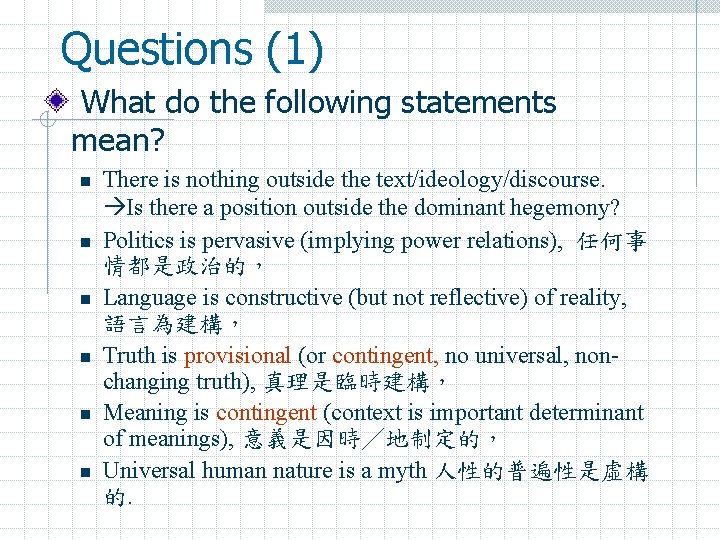
Questions (1) What do the following statements mean? n n n There is nothing outside the text/ideology/discourse. Is there a position outside the dominant hegemony? Politics is pervasive (implying power relations), 任何事 情都是政治的, Language is constructive (but not reflective) of reality, 語言為建構, Truth is provisional (or contingent, no universal, nonchanging truth), 真理是臨時建構, Meaning is contingent (context is important determinant of meanings), 意義是因時/地制定的, Universal human nature is a myth 人性的普遍性是虛構 的.
Questions (2) What’s the difference between seeing a novel as a work or a text? How do we examine 'the textuality of history, the historicity of texts‘?
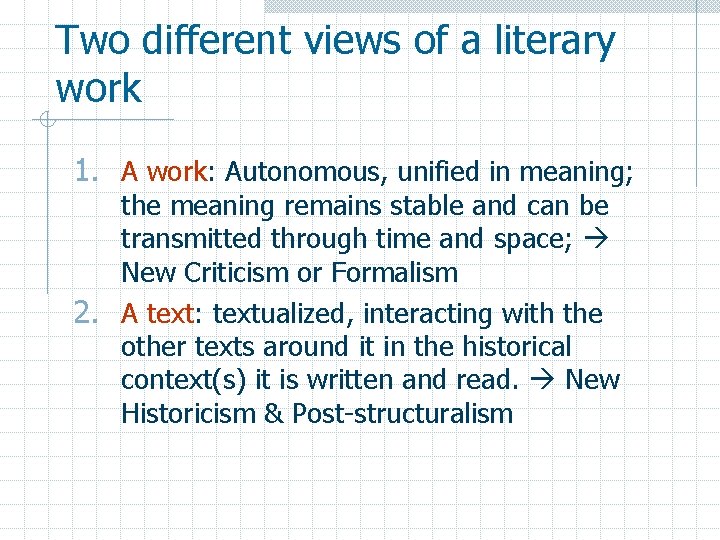
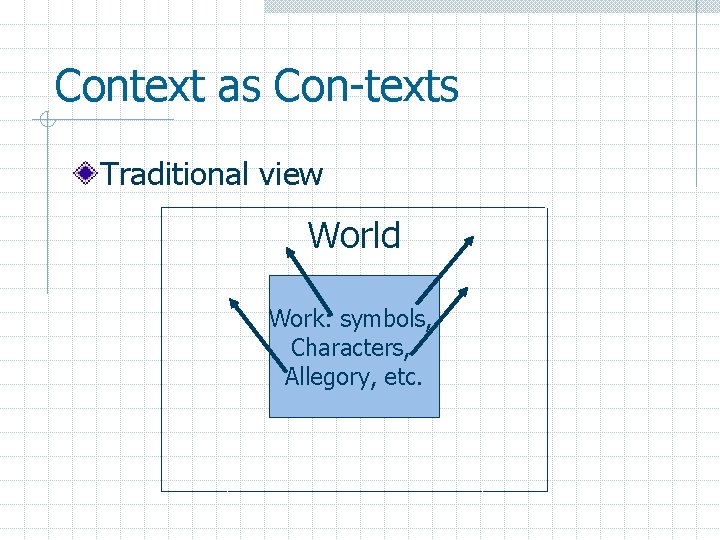
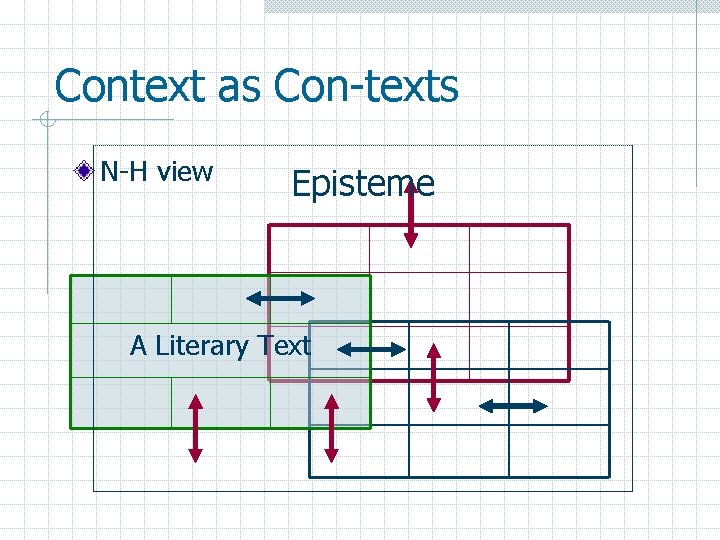
Two different views of a literary work 1. A work: Autonomous, unified in meaning; the meaning remains stable and can be transmitted through time and space; New Criticism or Formalism 2. A text: textualized, interacting with the other texts around it in the historical context(s) it is written and read. New Historicism & Post-structuralism
Context as Con-texts Traditional view World Work: symbols, Characters, Allegory, etc.
Context as Con-texts N-H view Episteme A Literary Text
Historical methods n n not just used by historians and fiction writers. They are ways of knowing/representing our past. History has never been so prevalent and yet so easily forgotten as it is nowadays.
Historical methods History as a broad field: Ref. WWW-VL: HISTORY: METHODOLOGIES http: //vlib. iue. it/history/methods/methodologi es. html 1. 2. 3. 4. Studying history as ‘text’: (Textbook 1: pp. 94 -) Generalization; Authoritative/neutral tone Tense –Simple past Collection and Interpretation of “facts. ” how?
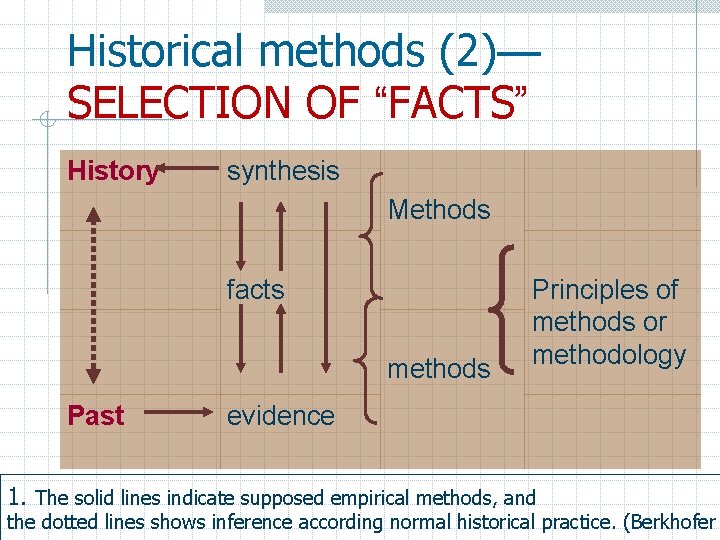
Historical methods (2)— SELECTION OF “FACTS” History synthesis Methods facts methods Past Principles of methods or methodology evidence 1. The solid lines indicate supposed empirical methods, and the dotted lines shows inference according normal historical practice. (Berkhofer
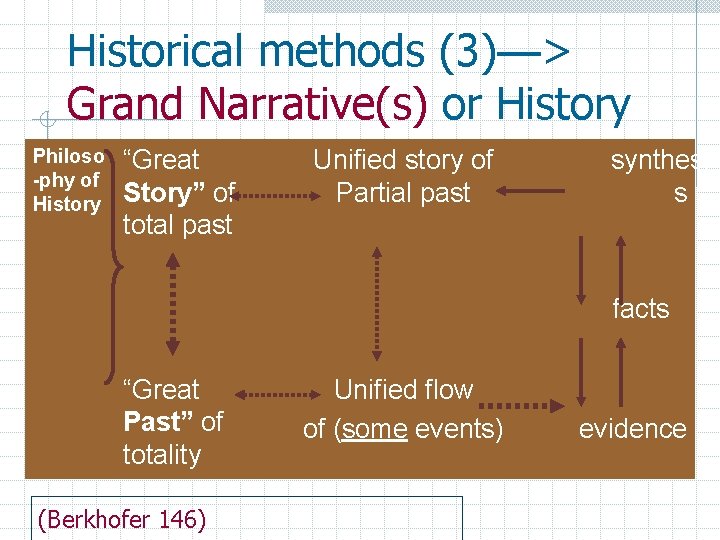
Historical methods (3)—> Grand Narrative(s) or History Philoso -phy of History “Great Story” of total past Unified story of Partial past synthesi s facts “Great Past” of totality (Berkhofer 146) Unified flow of (some events) evidence
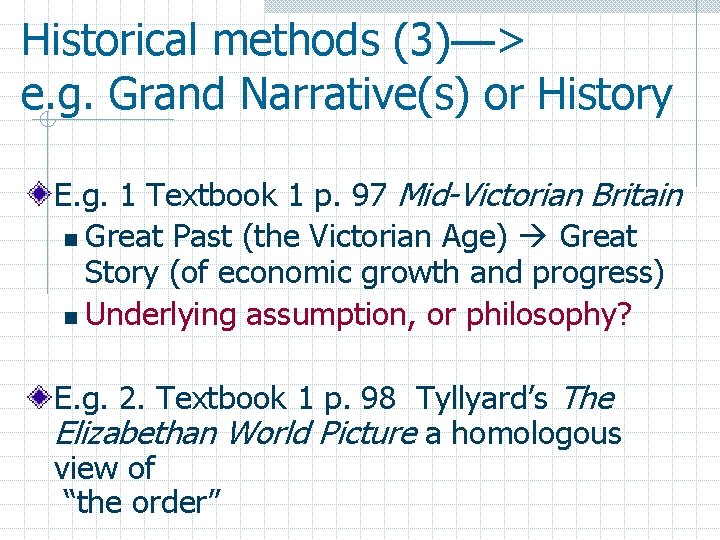
Historical methods (3)—> e. g. Grand Narrative(s) or History E. g. 1 Textbook 1 p. 97 Mid-Victorian Britain n Great Past (the Victorian Age) Great Story (of economic growth and progress) n Underlying assumption, or philosophy? E. g. 2. Textbook 1 p. 98 Tyllyard’s The Elizabethan World Picture a homologous view of “the order”
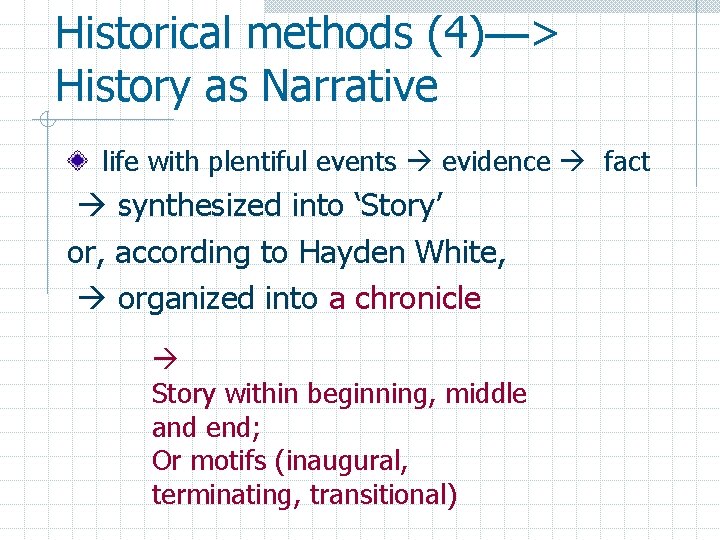
Historical methods (4)—> History as Narrative life with plentiful events evidence fact synthesized into ‘Story’ or, according to Hayden White, organized into a chronicle Story within beginning, middle and end; Or motifs (inaugural, terminating, transitional)
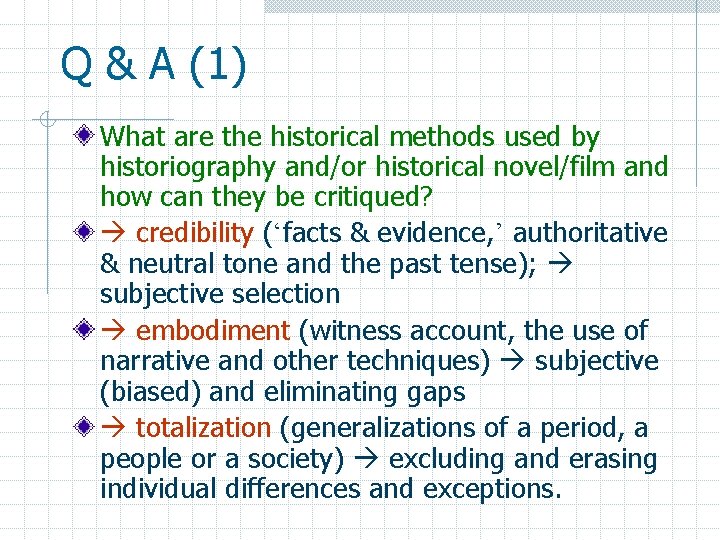
Q & A (1) What are the historical methods used by historiography and/or historical novel/film and how can they be critiqued? credibility (‘facts & evidence, ’ authoritative & neutral tone and the past tense); subjective selection embodiment (witness account, the use of narrative and other techniques) subjective (biased) and eliminating gaps totalization (generalizations of a period, a people or a society) excluding and erasing individual differences and exceptions.
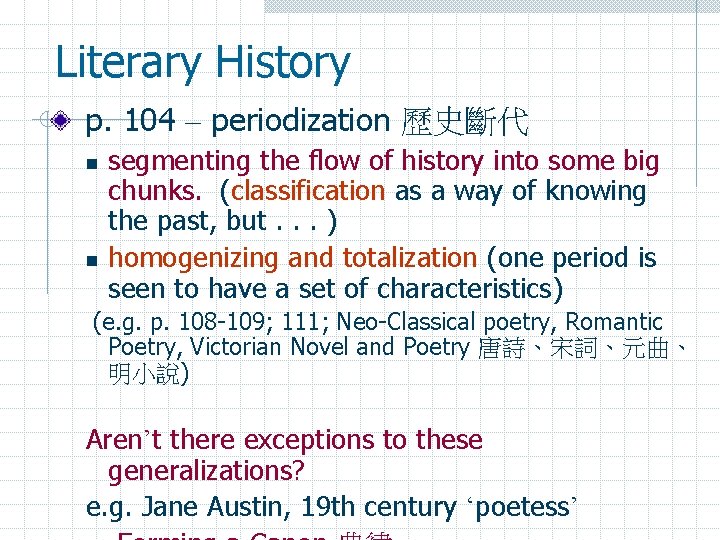
Literary History p. 104 – periodization 歷史斷代 n segmenting the flow of history into some big chunks. (classification as a way of knowing the past, but. . . ) n homogenizing and totalization (one period is seen to have a set of characteristics) (e. g. p. 108 -109; 111; Neo-Classical poetry, Romantic Poetry, Victorian Novel and Poetry 唐詩、宋詞、元曲、 明小說) Aren’t there exceptions to these generalizations? e. g. Jane Austin, 19 th century ‘poetess’
New Historicism History is brought back to literary studies and literature de-centered. Both are in a network of text. The assumptions of history – influenced by Michel Foucault.
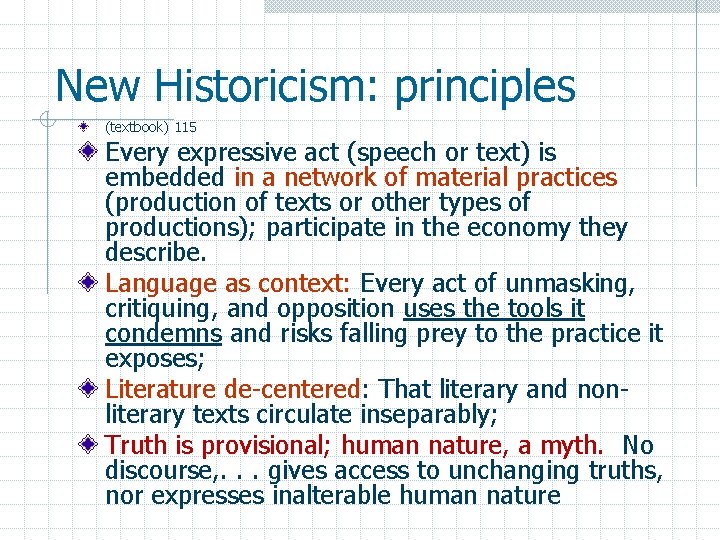
New Historicism: principles (textbook) 115 Every expressive act (speech or text) is embedded in a network of material practices (production of texts or other types of productions); participate in the economy they describe. Language as context: Every act of unmasking, critiquing, and opposition uses the tools it condemns and risks falling prey to the practice it exposes; Literature de-centered: That literary and nonliterary texts circulate inseparably; Truth is provisional; human nature, a myth. No discourse, . . . gives access to unchanging truths, nor expresses inalterable human nature
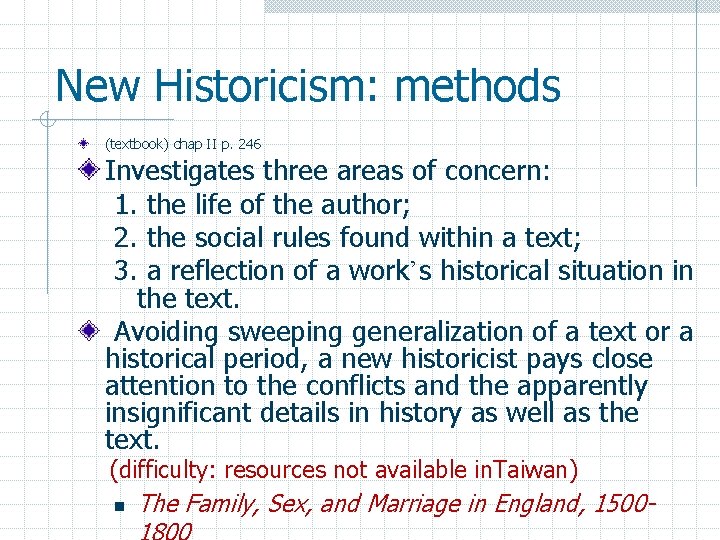
New Historicism: methods (textbook) chap II p. 246 Investigates three areas of concern: 1. the life of the author; 2. the social rules found within a text; 3. a reflection of a work’s historical situation in the text. Avoiding sweeping generalization of a text or a historical period, a new historicist pays close attention to the conflicts and the apparently insignificant details in history as well as the text. (difficulty: resources not available in. Taiwan) n The Family, Sex, and Marriage in England, 1500 -
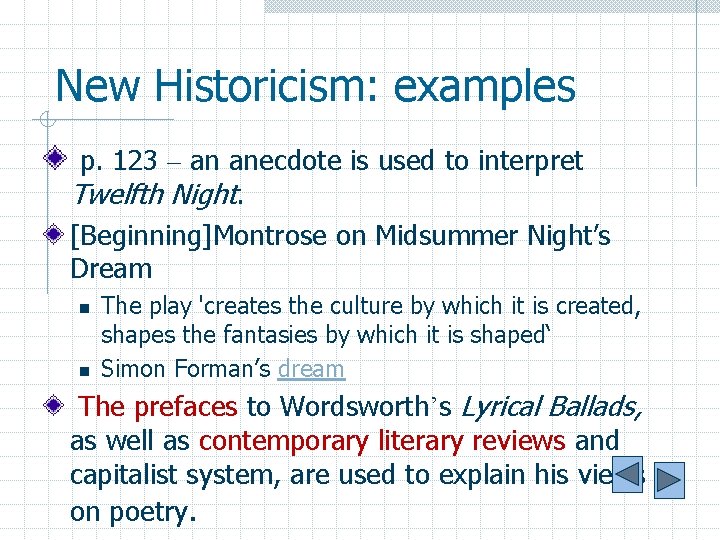
New Historicism: examples p. 123 – an anecdote is used to interpret Twelfth Night. [Beginning]Montrose on Midsummer Night’s Dream n n The play 'creates the culture by which it is created, shapes the fantasies by which it is shaped‘ Simon Forman’s dream The prefaces to Wordsworth’s Lyrical Ballads, as well as contemporary literary reviews and capitalist system, are used to explain his views on poetry.
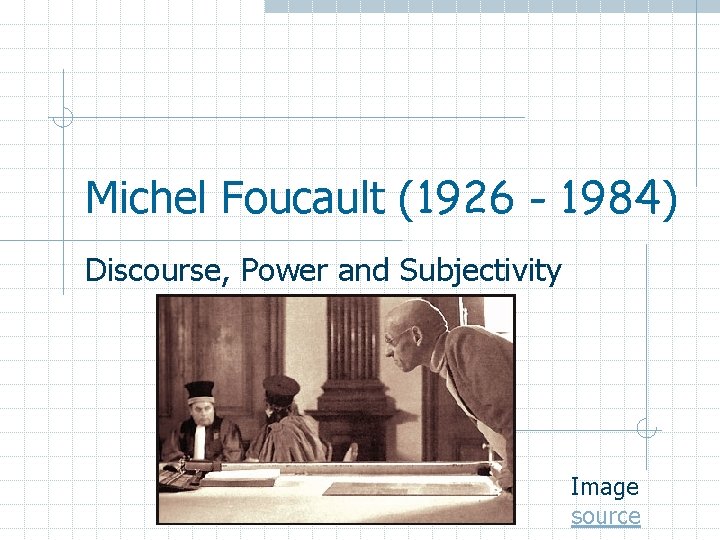
Michel Foucault (1926 - 1984) Discourse, Power and Subjectivity Image source
Foucault: Outline Discourse 1. 2. 3. Definition “What is an Author? ” Power and Knowledge (Truth) ‘effective history’ Power Discipline & Punish
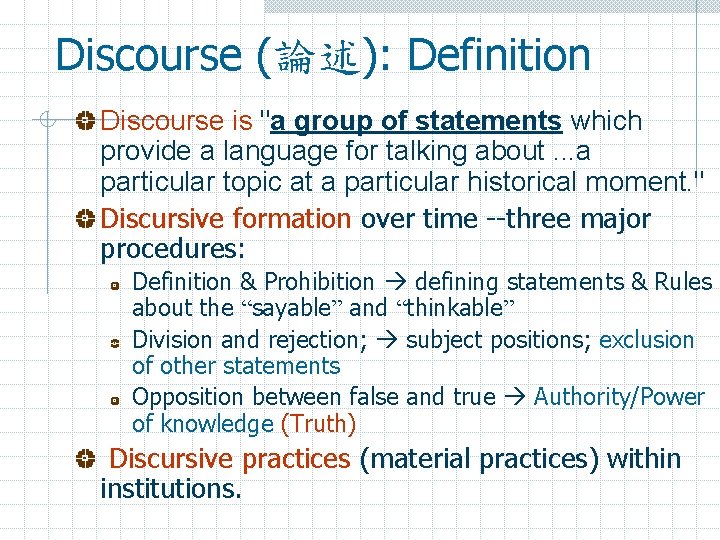
Discourse (論述): Definition Discourse is "a group of statements which provide a language for talking about. . . a particular topic at a particular historical moment. " Discursive formation over time --three major procedures: Definition & Prohibition defining statements & Rules about the “sayable” and “thinkable” Division and rejection; subject positions; exclusion of other statements Opposition between false and true Authority/Power of knowledge (Truth) Discursive practices (material practices) within institutions.
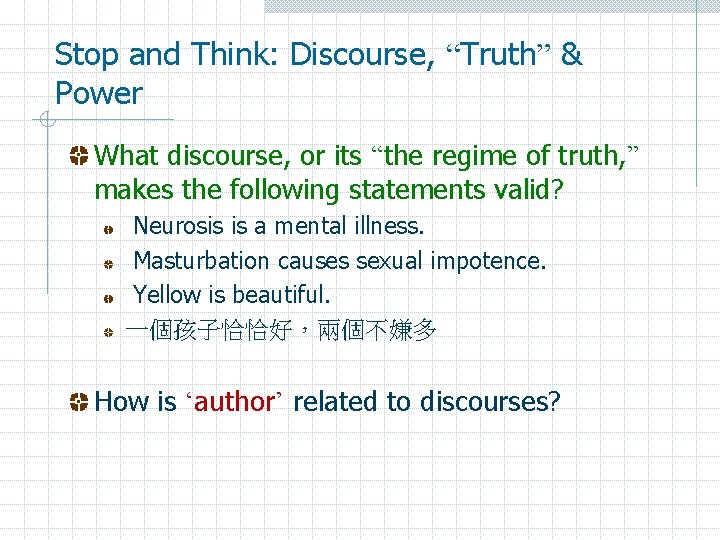
Stop and Think: Discourse, “Truth” & Power What discourse, or its “the regime of truth, ” makes the following statements valid? Neurosis is a mental illness. Masturbation causes sexual impotence. Yellow is beautiful. 一個孩子恰恰好,兩個不嫌多 How is ‘author’ related to discourses?
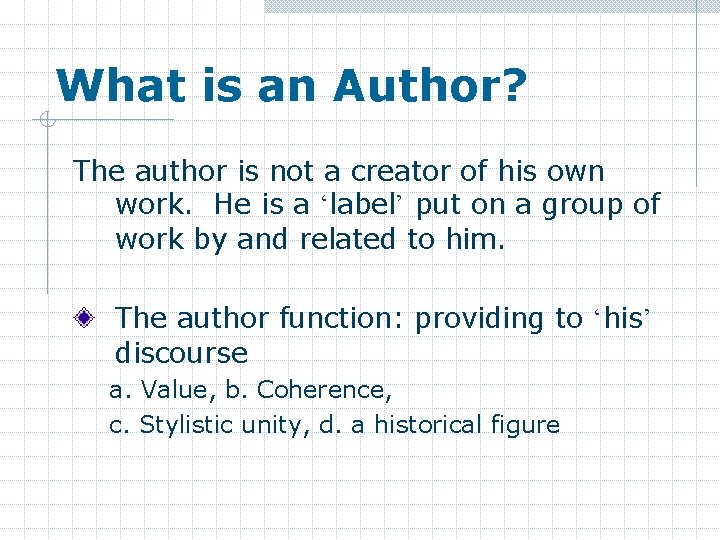
What is an Author? The author is not a creator of his own work. He is a ‘label’ put on a group of work by and related to him. The author function: providing to ‘his’ discourse a. Value, b. Coherence, c. Stylistic unity, d. a historical figure
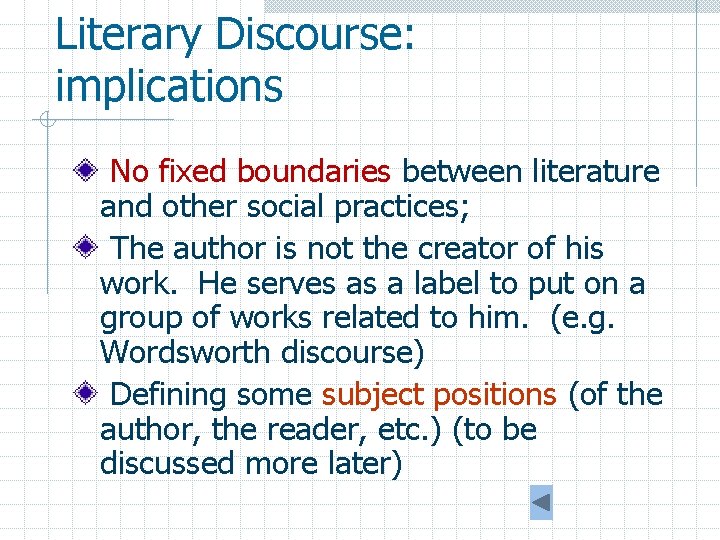
Literary Discourse: implications No fixed boundaries between literature and other social practices; The author is not the creator of his work. He serves as a label to put on a group of works related to him. (e. g. Wordsworth discourse) Defining some subject positions (of the author, the reader, etc. ) (to be discussed more later)
Power and Knowledge/Truth power – both repressive, controlling and productive -- not just top-down; it circulates, working in multiple direction like “capillary 血管movement. ” -- producing “Truth” – with a discursive formation sustaining a regime of truth.
Power and Knowledge/Truth (2) Since truth is provisionally produced by power in its system, Foucault argues for production of ‘effective history’ (117) e. g. the operation of power in a hospital – exertion of power through spatial arrangement, the doctor’s examination, the posters, pamphlets, the different examination room, registration system, pharmacy, insurance co. , etc.
Discipline and Punish Main purpose -- not so much the “birth of the prison” as “disciplinary technology” Or the carceral (監獄的) forms of discipline which exercise over individual a perpetual series of observation and modes of control of conduct.
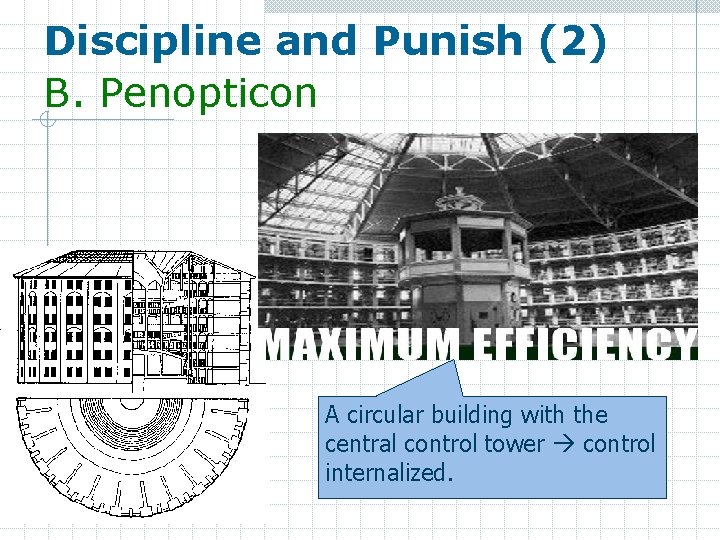
Discipline and Punish (2) B. Penopticon A circular building with the central control tower control internalized.
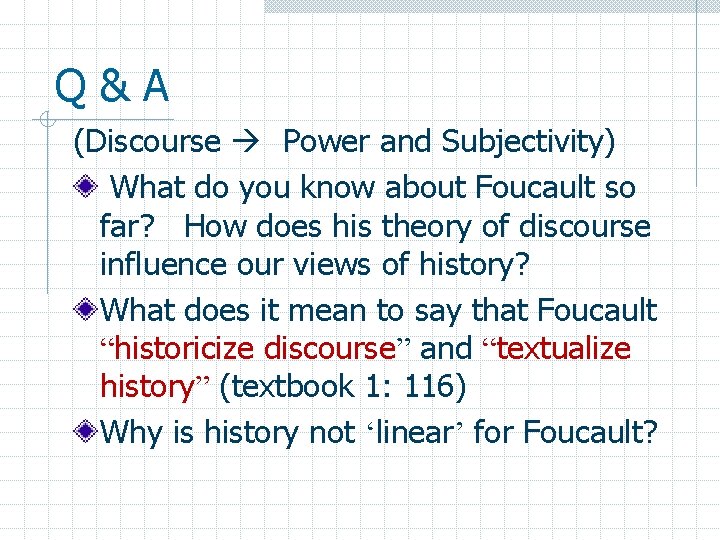
Q & A (Discourse Power and Subjectivity) What do you know about Foucault so far? How does his theory of discourse influence our views of history? What does it mean to say that Foucault “historicize discourse” and “textualize history” (textbook 1: 116) Why is history not ‘linear’ for Foucault?
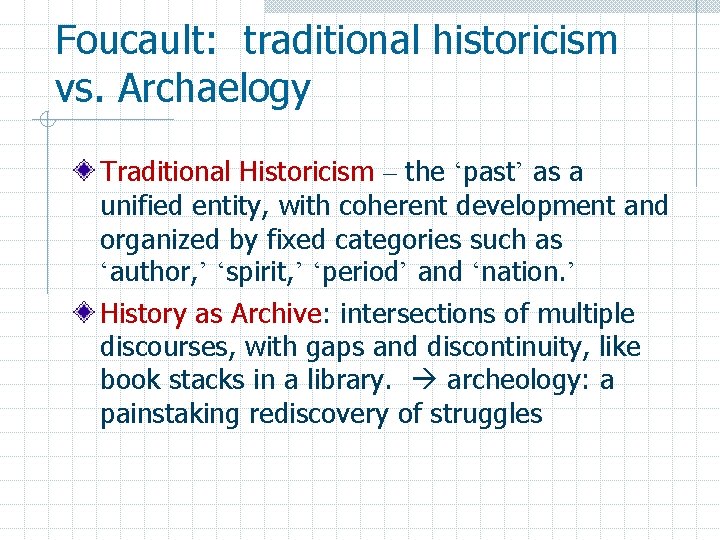
Foucault: traditional historicism vs. Archaelogy Traditional Historicism – the ‘past’ as a unified entity, with coherent development and organized by fixed categories such as ‘author, ’ ‘spirit, ’ ‘period’ and ‘nation. ’ History as Archive: intersections of multiple discourses, with gaps and discontinuity, like book stacks in a library. archeology: a painstaking rediscovery of struggles
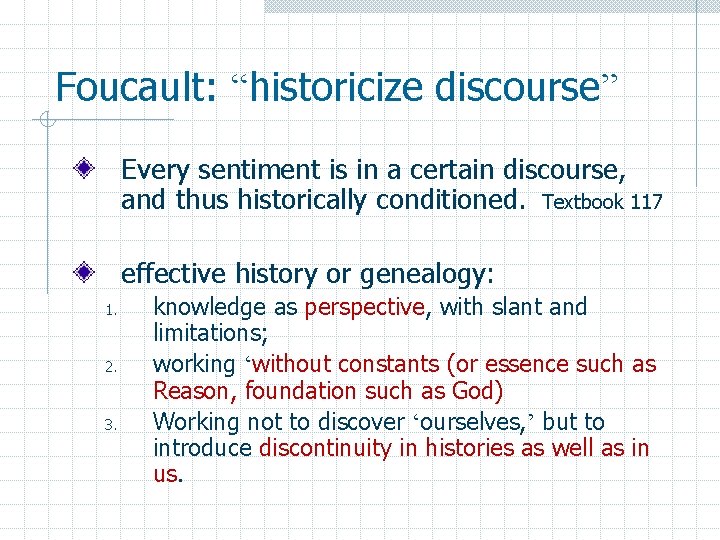
Foucault: “historicize discourse” Every sentiment is in a certain discourse, and thus historically conditioned. Textbook 117 effective history or genealogy: 1. 2. 3. knowledge as perspective, with slant and limitations; working ‘without constants (or essence such as Reason, foundation such as God) Working not to discover ‘ourselves, ’ but to introduce discontinuity in histories as well as in us.
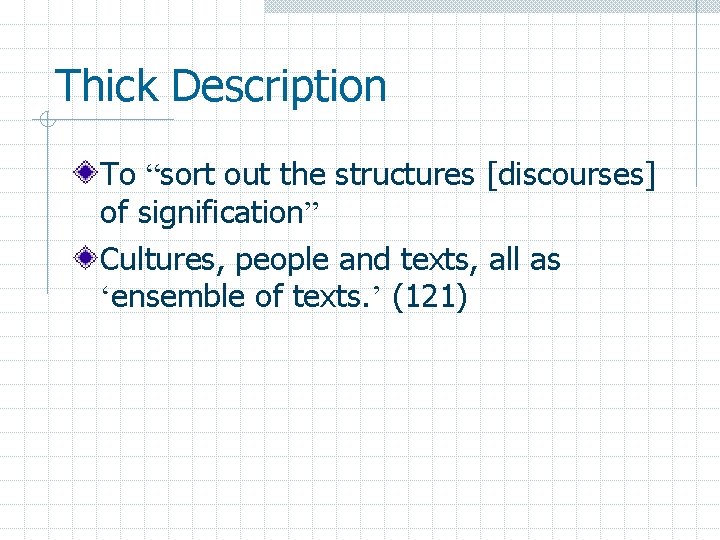
Thick Description To “sort out the structures [discourses] of signification” Cultures, people and texts, all as ‘ensemble of texts. ’ (121)
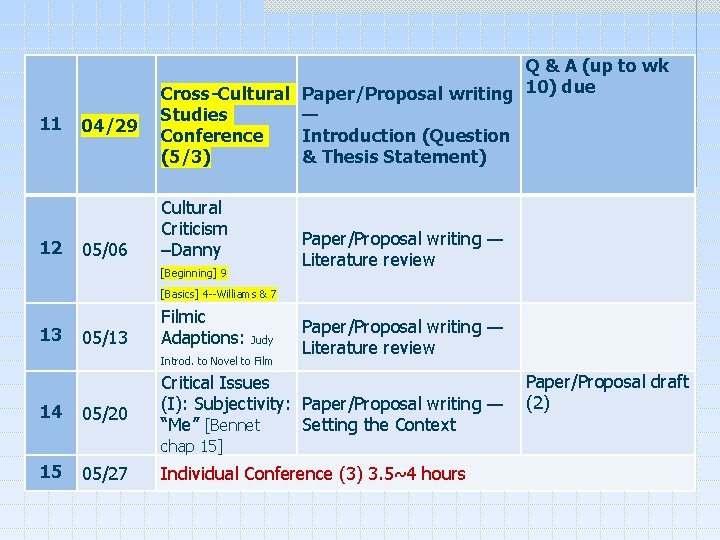
11 12 04/29 05/06 Q & A (up to wk Cross-Cultural Paper/Proposal writing 10) due Studies — Conference Introduction (Question (5/3) & Thesis Statement) Cultural Criticism –Danny [Beginning] 9 Paper/Proposal writing — Literature review [Basics] 4 --Williams & 7 13 05/13 Filmic Adaptions: Judy Introd. to Novel to Film 14 05/20 Paper/Proposal writing — Literature review Critical Issues (I): Subjectivity: Paper/Proposal writing — “Me” [Bennet Setting the Context chap 15] 15 05/27 Individual Conference (3) 3. 5~4 hours Paper/Proposal draft (2)
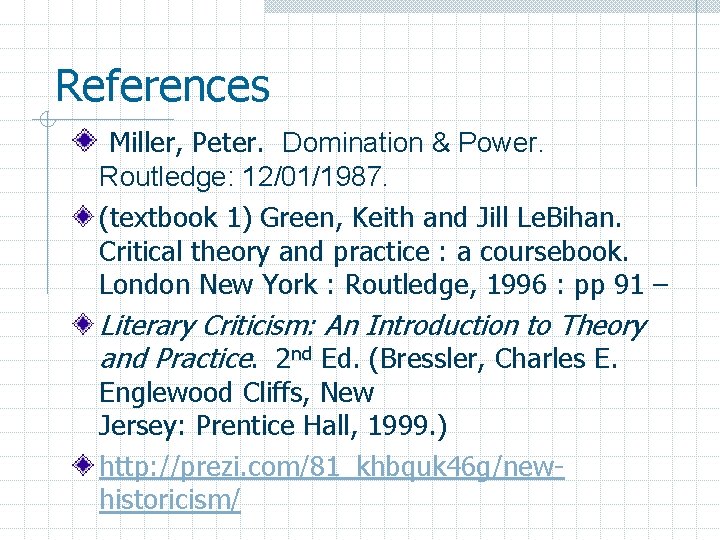
References Miller, Peter. Domination & Power. Routledge: 12/01/1987. (textbook 1) Green, Keith and Jill Le. Bihan. Critical theory and practice : a coursebook. London New York : Routledge, 1996 : pp 91 – Literary Criticism: An Introduction to Theory and Practice. 2 nd Ed. (Bressler, Charles E. Englewood Cliffs, New Jersey: Prentice Hall, 1999. ) http: //prezi. com/81_khbquk 46 g/newhistoricism/