NATURAL ENVIRONMENT TEACHING JU S T IN D

- Slides: 21
NATURAL ENVIRONMENT TEACHING JU S T IN D A IG LE , M A , B C B A , LB A
• Natural Environment Teaching • Often called “Incidental Teaching” • Effective way to address concerns of Autism WHAT IS NET?
• ABA – Applying behavioral principals in treatment • DTT – A form of teaching using discrete trials • NET – An alternative form of treatment BACKGROUND
• National Standards Project • NET is Effective • Does not have to be combined with other teaching methods (such as DTT), but often is. EFFECTIVE
• Our Goal: To teach target behaviors in a DTT setting, then using NET to generalize the behaviors to different situations. AT TCA
• • Not Structured Client Led Data is Recorded Separately No discrete ending/beginning REVIEW OF NET
• If client is reaching, you have a MO. • Require a mand to receive the item. TEACH TO REACH
• And Not A Taker • It’s best to anticipate the SR+ instead of removing the SR+ BE A GIVER
• You can still use principles of Errorless Learning in NET • Transfer Trials • Error Correction Trials • Differential Reinforcement TRANSFER TRIALS
• Vary your stimuli • Remember the goal is to have the client behavior spontaneously • Remember it’s all about the client’s motivation A FEW NOTES
• Where are they at? • Where should we “push” them? • What are the most important “battles”? KNOW YOUR CLIENT
• Work on skills mastered in DTT • Balance the amount of demands with the amount of free access ADDITIONAL NOTES
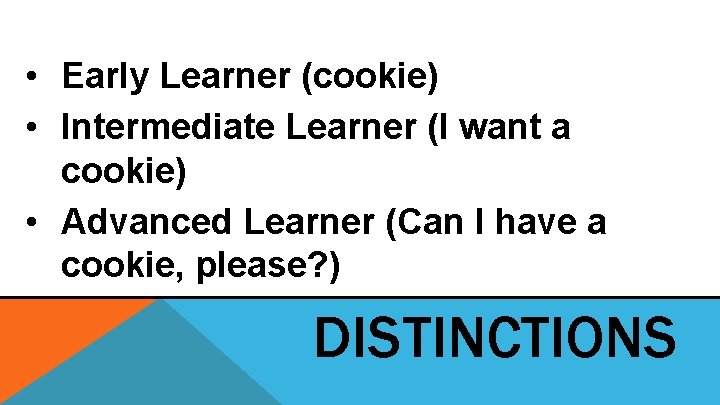
• Early Learner (cookie) • Intermediate Learner (I want a cookie) • Advanced Learner (Can I have a cookie, please? ) DISTINCTIONS
• Never bombard client with trials • Should be natural • Should have mastered in DTT EARLY LEARNERS
• • 1 word Mands Instruction Following Impure Tacting Intraverbal Fill-ins (if able) EARLY LEARNERS
• Manding with “Carrier Phrases” (I want, I need, give me, etc) • Manding for attention • 2 -step Instruction Following • Answering Basic Questions INT. LEARNERS
• • • Manding for Information Reciprocal Commenting Tacting using sentences Recalling Past Events Full Intraverbals ADV. LEARNERS
• It is considered more adventitious to teaching verbal behavior in an NET environment to Advanced Learners. • Why do you think that is? ADV. LEARNERS
• “Unstructured” means there is more emphasis placed on the talent of the instructor. • Data can be difficult to take because targets have to be broadly defined ISSUES WITH NET
• NET takes practice to learn • Try running intervals of NET trials with your clients after the data sheet has been completed. YOU AND NET
• Thank you for your time • Questions? THANK YOU