
WORKPLACE ENVIRONMENT ERGONOMICS CHAPTER 4 ERGONOMICSWhat is it

















- Slides: 45
WORKPLACE ENVIRONMENT & ERGONOMICS CHAPTER 4
ERGONOMICS-What is it? § Derived from two Greek words: § “Nomoi” meaning natural laws § “Ergon” meaning work § Hence, ergonomists study human capabilities in relationship to work demands
History • As early as 18 th century doctors noted that workers who required to maintain body positions for long periods of time developed musculoskeletal problems. • Within last 20 years research has clearly established connections between certain job tasks and RSI or MSD.
Focus and Objectives of Ergonomics cont… • The focus is that people (their abilities and limitations) and their requirements are considered when: a) Objects, systems which people use and operate b) c) within are being designed and developed; Procedures to carry out work are being developed; Facilities which involve and affect people are being evaluated.
Focus and Objectives of Ergonomics • The objectives of Ergonomics are: a) Enhance and optimize the effectiveness with b) c) which work and other human activities are carried out; Also to maintain certain desirable human values in the process, e. g. health, safety; Stimulate work interest and satisfaction.
Effects of poor Ergonomics • Discomfort • Accidents and injuries • Fatigue • Errors • Illness • Annoyance • Productivity down
What two elements are at work? 1) Static work: musculoskeletal effort required to hold a certain position, even a comfortable one. Example: sit & work at computers; keeping head and torso upright requires small or great amounts of static work depending on the efficiency of the body positions we chose.
Elements at work (cont) • Force: amount of tension our muscles generate Example: tilting your head forward or backward from a neutral, vertical position quadruples the amount of force acting on your lower neck vertebrae • Increased force is due to increase in muscular tension needed to support head in a tilted position
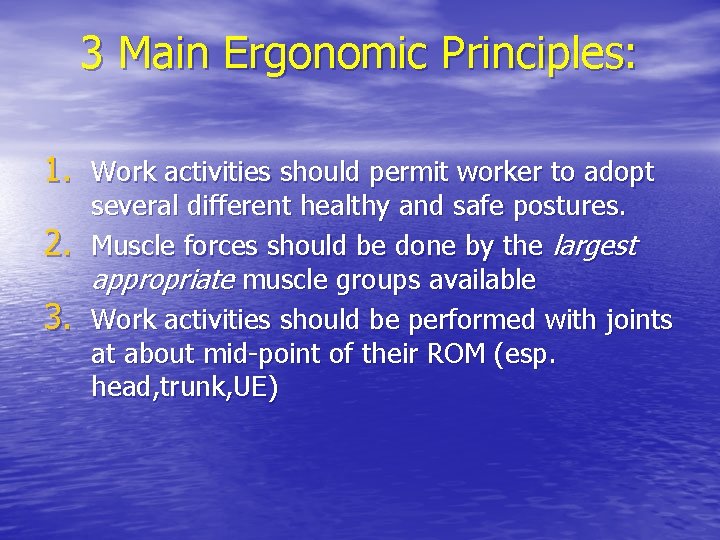
3 Main Ergonomic Principles: 1. Work activities should permit worker to adopt 2. 3. several different healthy and safe postures. Muscle forces should be done by the largest appropriate muscle groups available Work activities should be performed with joints at about mid-point of their ROM (esp. head, trunk, UE)
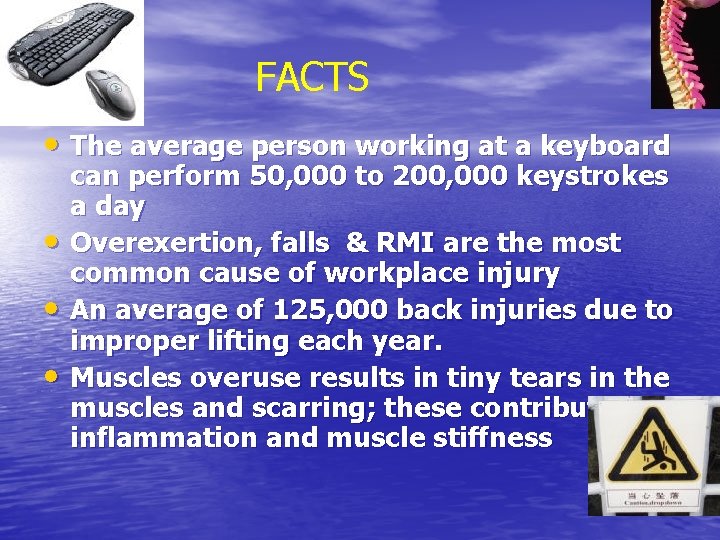
FACTS • The average person working at a keyboard • • • can perform 50, 000 to 200, 000 keystrokes a day Overexertion, falls & RMI are the most common cause of workplace injury An average of 125, 000 back injuries due to improper lifting each year. Muscles overuse results in tiny tears in the muscles and scarring; these contribute to inflammation and muscle stiffness
A Bit of Anatomy !! • Overuse and small repetitive movements ie: cumulative trauma disorder (CTD), repetitive stress injury ( repetitive stress injury RSI), musculoskeletal disorder ( musculoskeletal disorder MSD) disturb balance of muscles, tendons, ligaments and nerves
What causes Nerve Compression or Entrapment? 1) Repeated motions 2) Tight muscles 3) Inflammation of surrounding tissues 4) Misalignment of the nerve
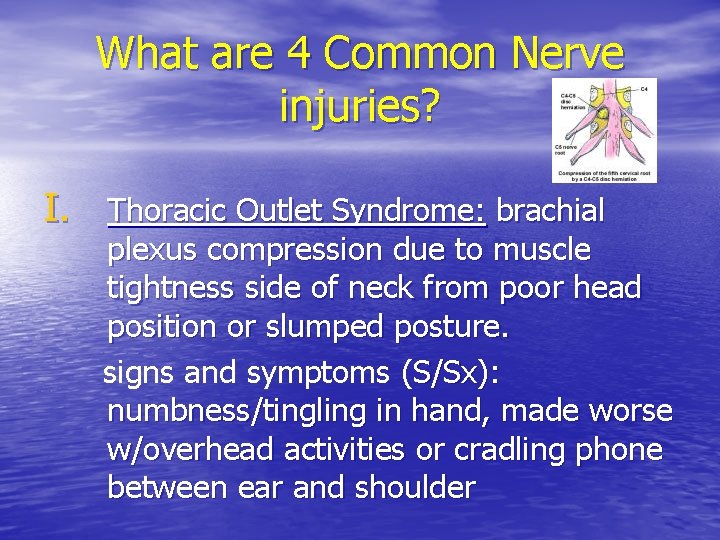
What are 4 Common Nerve injuries? I. Thoracic Outlet Syndrome: brachial plexus compression due to muscle tightness side of neck from poor head position or slumped posture. signs and symptoms ( S/Sx): numbness/tingling in hand, made worse w/overhead activities or cradling phone between ear and shoulder
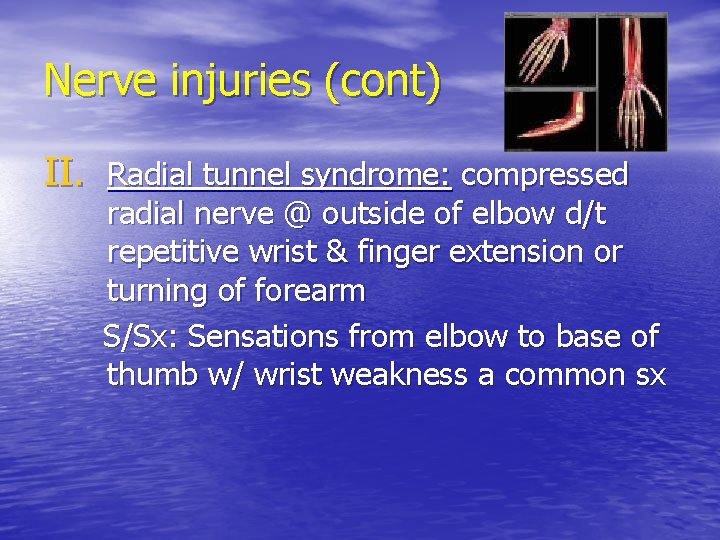
Nerve injuries (cont) II. Radial tunnel syndrome: compressed radial nerve @ outside of elbow d/t repetitive wrist & finger extension or turning of forearm S/Sx: Sensations from elbow to base of thumb w/ wrist weakness a common sx
Nerve injuries (cont) III. Cubital tunnel syndrome: ulnar nerve compression inside of the elbow d/t repetitive bending of elbow or resting your elbow on a hard surface S/Sx: numbness or tingling and inside of arm w/ tingling to ring & little fingers
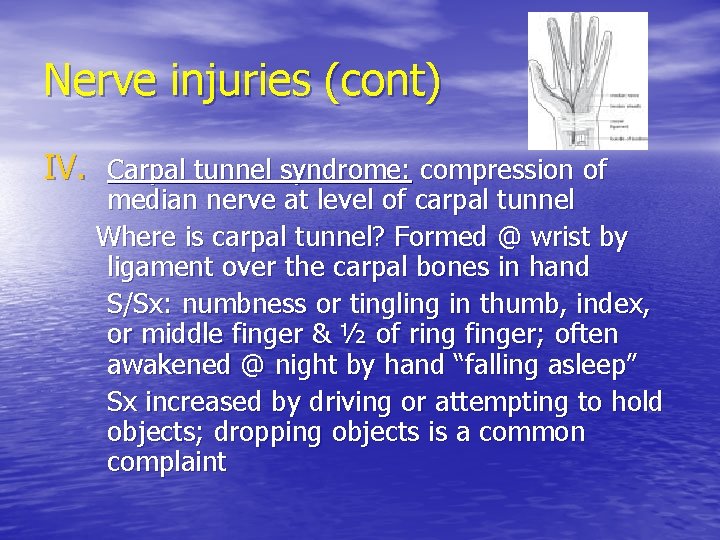
Nerve injuries (cont) IV. Carpal tunnel syndrome: compression of median nerve at level of carpal tunnel Where is carpal tunnel? Formed @ wrist by ligament over the carpal bones in hand S/Sx: numbness or tingling in thumb, index, or middle finger & ½ of ring finger; often awakened @ night by hand “falling asleep” Sx increased by driving or attempting to hold objects; dropping objects is a common complaint
Tendons and Tendonitis • Tendons are connective tissue that attach • • muscle to bone; have little stretch or rebound Tendon overuse, static or prolonged position=inflammation or tendonitis Tendons of wrist & hand very small; @ high risk for injury w/ overuse “Tennis elbow” or lateral epicondylitis affects finger extensor tendons outside of elbow “Golfer’s elbow” or medical epicondylitis affects finger flexor tendons inside of elbow
What to do ? ? PREVENT, PREVENT !!! a) Warm up & stretch before activities that are b) c) d) repetitive, static or prolonged Take frequent breaks from ANY sustained posture every 20 -30 minutes Respect pain- positions or stop painful activity Recognize early signs of inflammatory process, & tx early
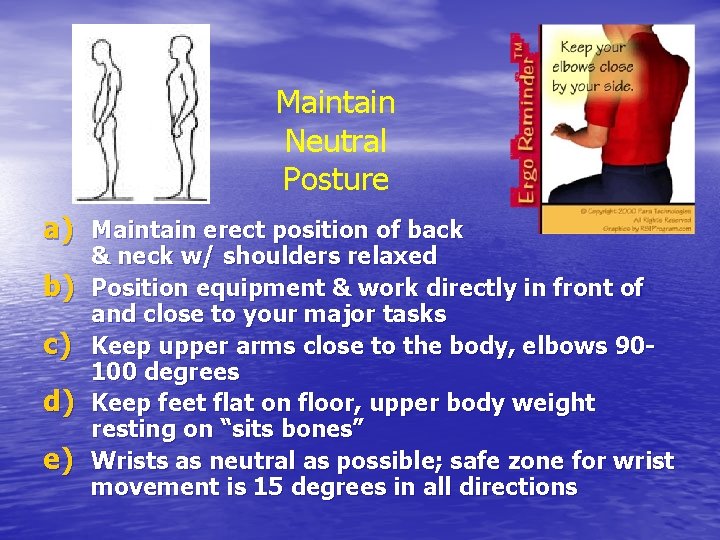
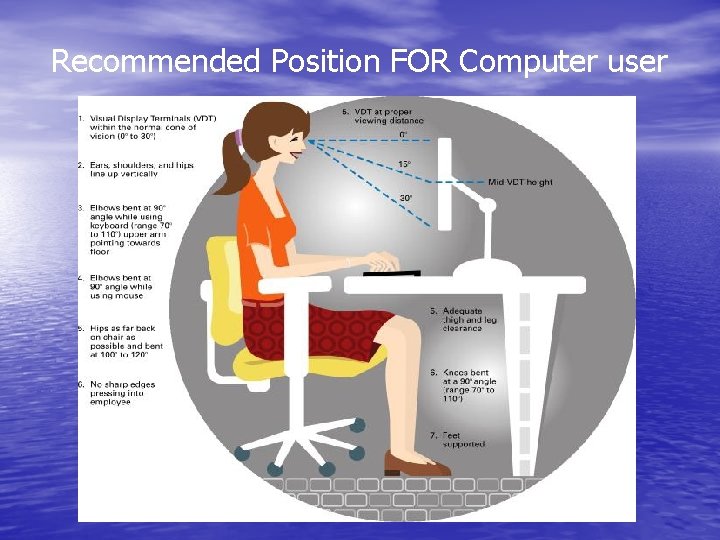
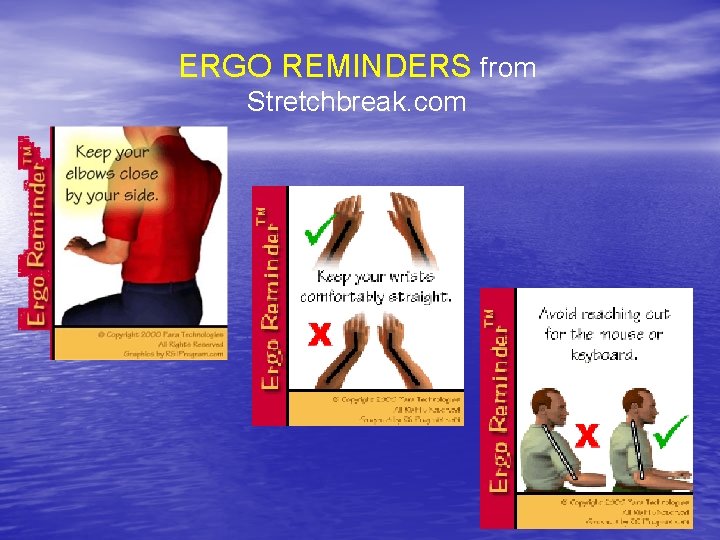
Maintain Neutral Posture a) Maintain erect position of back b) c) d) e) & neck w/ shoulders relaxed Position equipment & work directly in front of and close to your major tasks Keep upper arms close to the body, elbows 90100 degrees Keep feet flat on floor, upper body weight resting on “sits bones” Wrists as neutral as possible; safe zone for wrist movement is 15 degrees in all directions
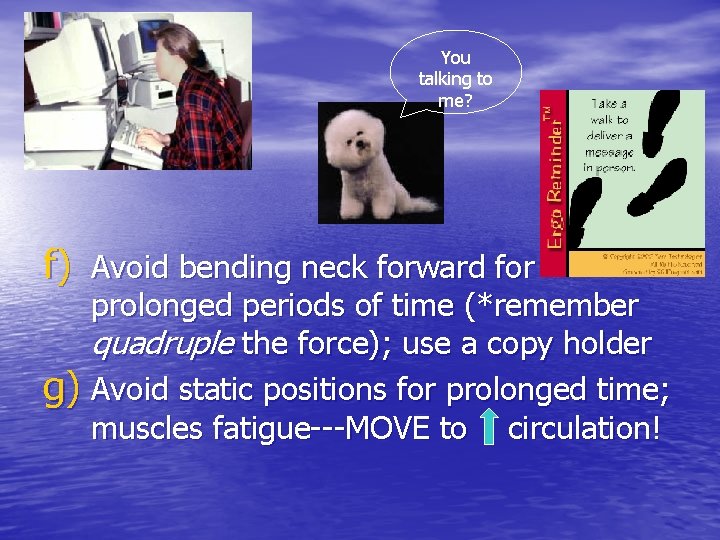
You talking to me? f) Avoid bending neck forward for g) prolonged periods of time (*remember quadruple the force); use a copy holder Avoid static positions for prolonged time; muscles fatigue---MOVE to circulation!
Modify Tasks: a) Alternate activities frequently; rotate heavy b) c) d) e) &/or repetitive tasks w/ lighter less repetitive ones. If sx become worse REASSESS task setup & look for alternative methods Avoid repetitive or prolonged grip activities Avoid pinching w/ wrist in flexion or wrist deviation (bending to side) Take frequent breaks to stretch & rest hands
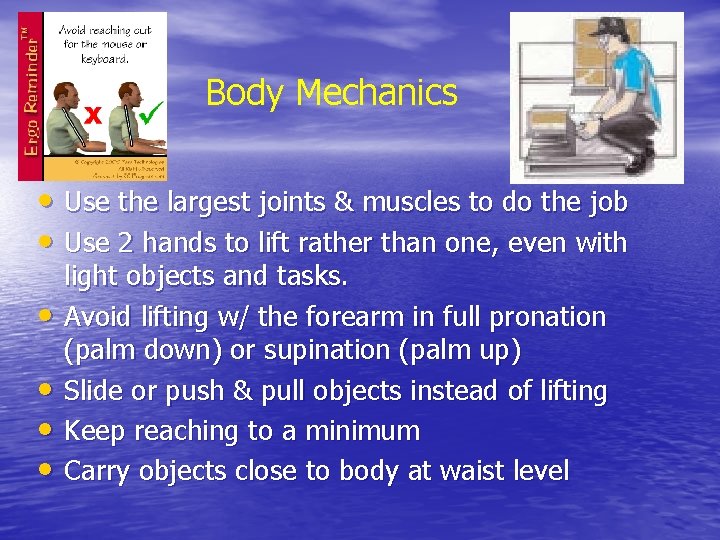
Body Mechanics • Use the largest joints & muscles to do the job • Use 2 hands to lift rather than one, even with • • light objects and tasks. Avoid lifting w/ the forearm in full pronation (palm down) or supination (palm up) Slide or push & pull objects instead of lifting Keep reaching to a minimum Carry objects close to body at waist level
Correct & Incorrect Techniques
Good and Bad of “ TIL T”
Recommended Position FOR Computer user
ERGO REMINDERS from Stretchbreak. com
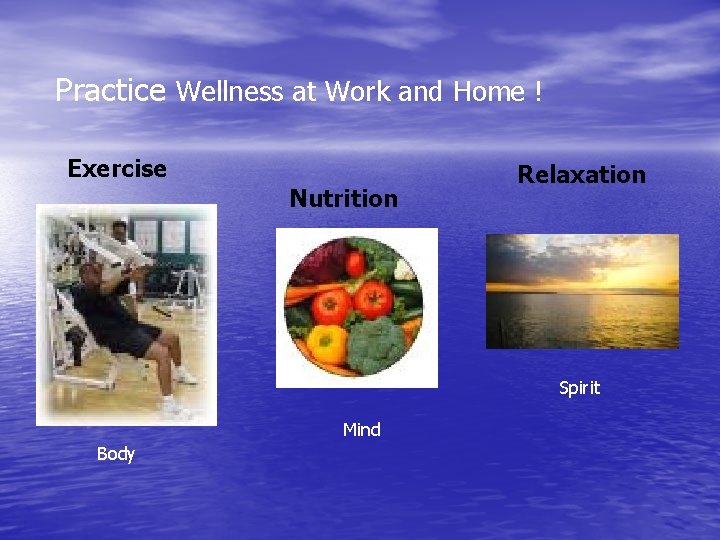
Practice Wellness at Work and Home ! Exercise Nutrition Relaxation Spirit Mind Body
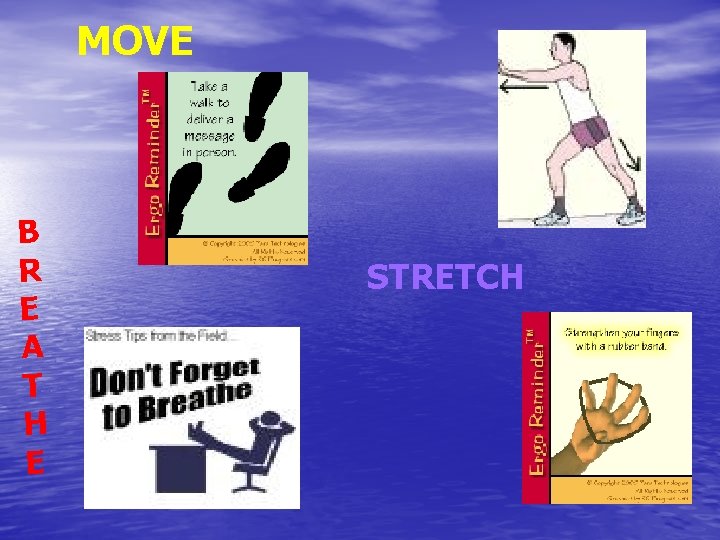
MOVE B R E A T H E STRETCH
An ounce of Prevention is worth a pound of cure !
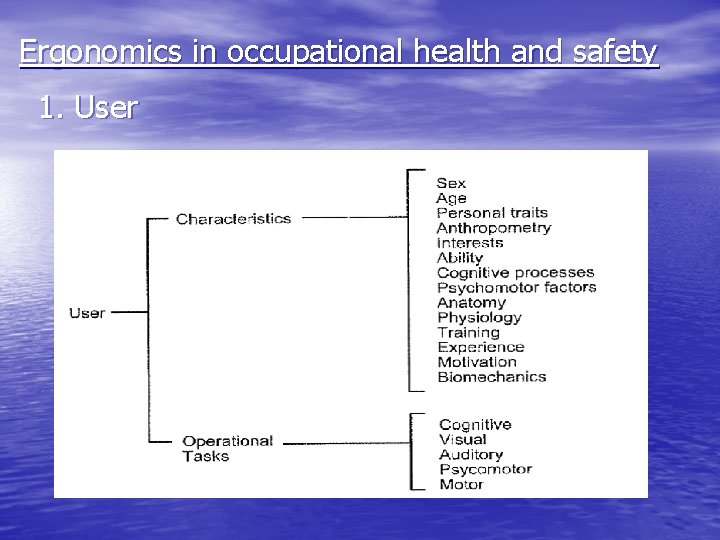
Ergonomics in occupational health and safety 1. User
2. Machine
3. Workplace
3. Environment
4. Special questions
Indoor Air Quality • Indoor air quality (IAQ) is a term referring to the air quality within and around buildings and structures, especially as it relates to the health and comfort of building occupants
Indoor Air Pollution • The National Health and Medical Research Council (NHMRC- Australia) defines indoor air as air within a building occupied for at least one hour by people of varying states of health. This can include the office, classroom, transport facility, shopping centre, hospital and home. • Indoor air quality can be defined as the
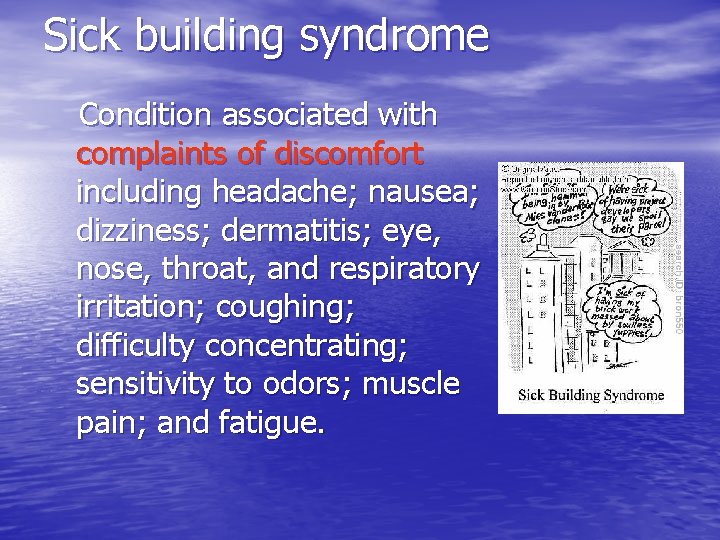
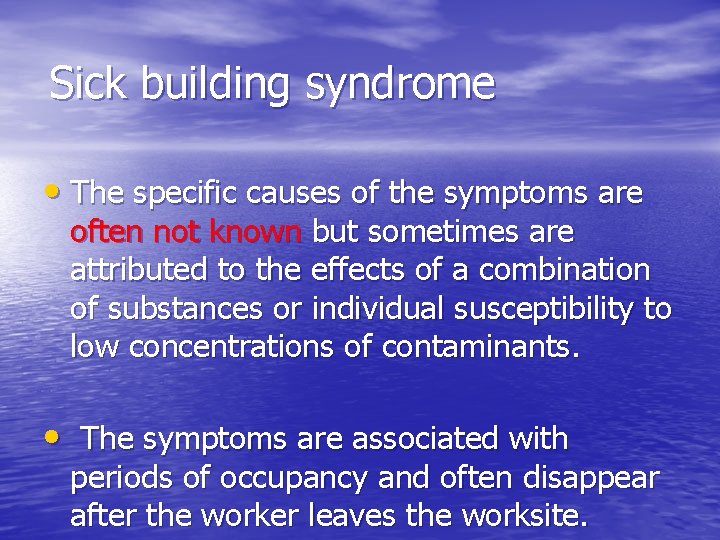
Sick building syndrome Condition associated with complaints of discomfort including headache; nausea; dizziness; dermatitis; eye, nose, throat, and respiratory irritation; coughing; difficulty concentrating; sensitivity to odors; muscle pain; and fatigue.
Sick building syndrome • The specific causes of the symptoms are often not known but sometimes are attributed to the effects of a combination of substances or individual susceptibility to low concentrations of contaminants. • The symptoms are associated with periods of occupancy and often disappear after the worker leaves the worksite.
Cause of SBS • Inadequate ventilation 52% • Contamination from inside building 16% • Contamination from outside building 10% • Microbial contamination 5% • Contamination from building fabric 4% • Unknown sources 13%
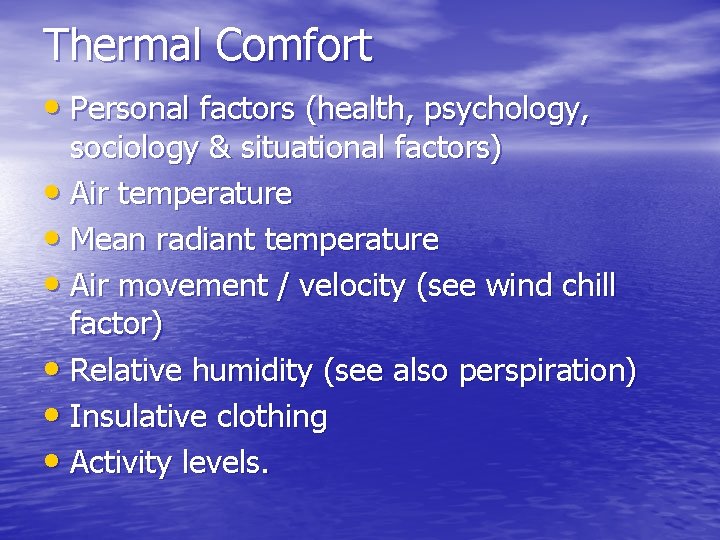
Thermal Comfort • Personal factors (health, psychology, sociology & situational factors) • Air temperature • Mean radiant temperature • Air movement / velocity (see wind chill factor) • Relative humidity (see also perspiration) • Insulative clothing • Activity levels.
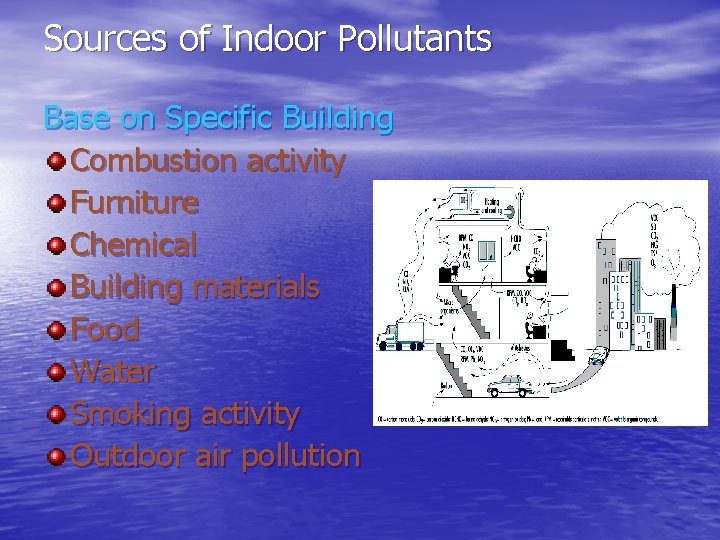
Sources of Indoor Pollutants Base on Specific Building Combustion activity Furniture Chemical Building materials Food Water Smoking activity Outdoor air pollution
Walkaround Inspection • Potential Problem Areas • Sample Collection
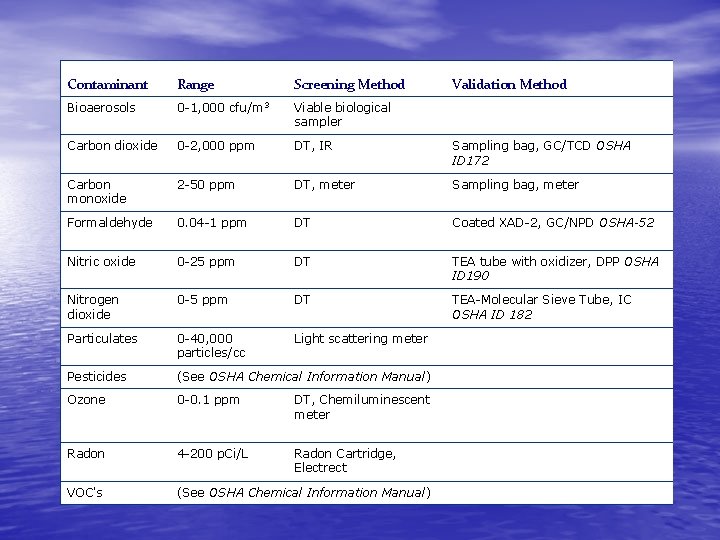
Contaminant Range Screening Method Validation Method Bioaerosols 0 -1, 000 cfu/m 3 Viable biological sampler Carbon dioxide 0 -2, 000 ppm DT, IR Sampling bag, GC/TCD OSHA ID 172 Carbon monoxide 2 -50 ppm DT, meter Sampling bag, meter Formaldehyde 0. 04 -1 ppm DT Coated XAD-2, GC/NPD OSHA-52 Nitric oxide 0 -25 ppm DT TEA tube with oxidizer, DPP OSHA ID 190 Nitrogen dioxide 0 -5 ppm DT TEA-Molecular Sieve Tube, IC OSHA ID 182 Particulates 0 -40, 000 particles/cc Light scattering meter Pesticides (See OSHA Chemical Information Manual) Ozone 0 -0. 1 ppm DT, Chemiluminescent meter Radon 4 -200 p. Ci/L Radon Cartridge, Electrect VOC's (See OSHA Chemical Information Manual)