Mutual Support Know the plan share the plan
- Slides: 24
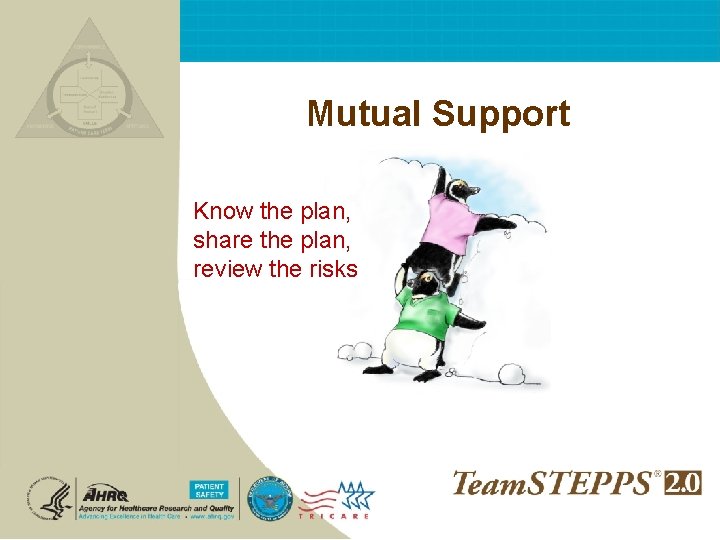
Mutual Support Know the plan, share the plan, review the risks
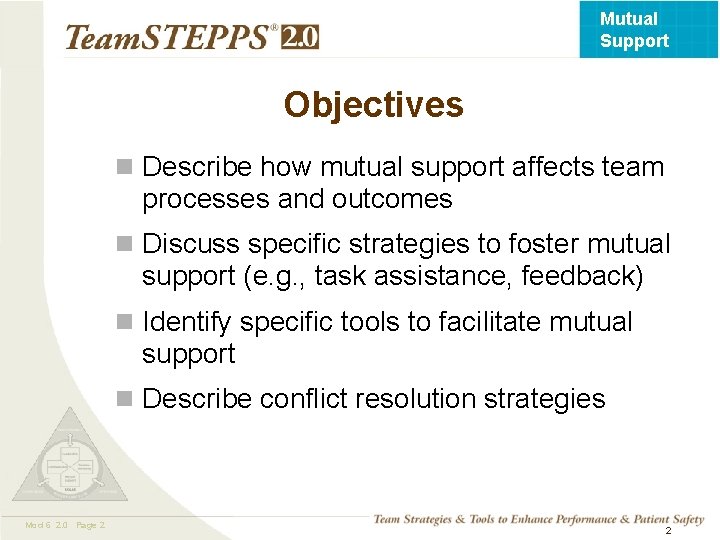
Mutual Support Objectives n Describe how mutual support affects team processes and outcomes n Discuss specific strategies to foster mutual support (e. g. , task assistance, feedback) n Identify specific tools to facilitate mutual support n Describe conflict resolution strategies Mod 6 2. 0 Page 2 TEAMSTEPPS 05. 2 2
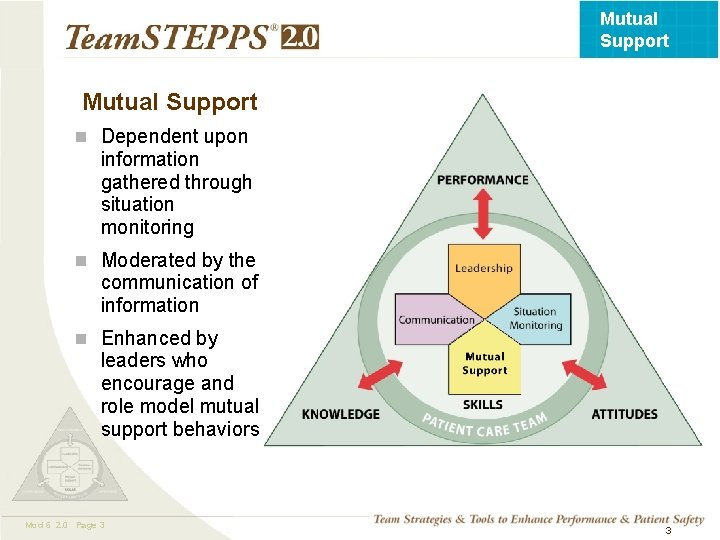
Mutual Support n Dependent upon information gathered through situation monitoring n Moderated by the communication of information n Enhanced by leaders who encourage and role model mutual support behaviors Mod 6 2. 0 Page 3 TEAMSTEPPS 05. 2 3
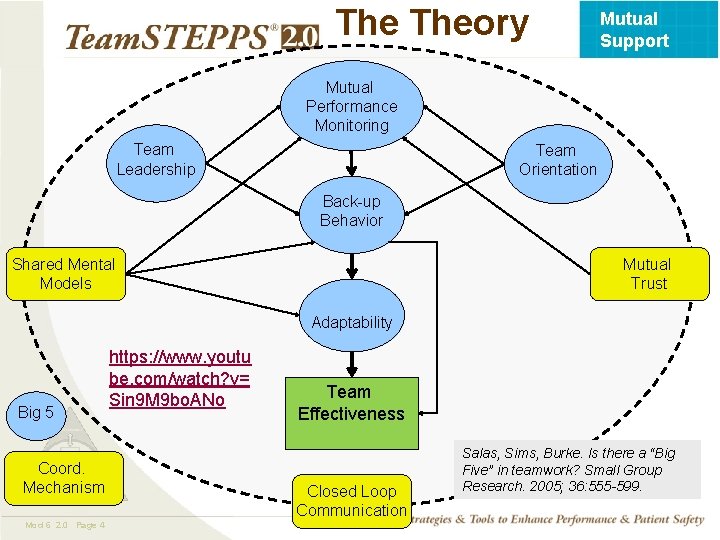
The Theory Mutual Support Mutual Performance Monitoring Team Leadership Team Orientation Back-up Behavior Shared Mental Models Mutual Trust Adaptability Big 5 Coord. Mechanism Mod 6 2. 0 Page 4 https: //www. youtu be. com/watch? v= Sin 9 M 9 bo. ANo Team Effectiveness Closed Loop Communication TEAMSTEPPS 05. 2 Salas, Sims, Burke. Is there a “Big Five” in teamwork? Small Group Research. 2005; 36: 555 -599.
Mutual Support The essence of teamwork… n Anticipate the needs of other team members because you are monitoring the situation and know their tasks and responsibilities n Provide a safety net for other team members when work overload situations may reduce effectiveness and increase the risk of error Mutual support involves members: 1. Assisting each other (providing task assistance) 2. Providing and receiving feedback 3. Exerting assertive and advocacy behaviors when patient safety is threatened Mod 6 2. 0 Page 5 TEAMSTEPPS 05. 2 5
Office-Based Care ® Task Assistance n Team members foster a climate in which it is expected that assistance will be actively sought and offered as a method for reducing the occurrence of error. n Why don’t we ask or offer help? In support of patient safety, task assistance is expected. Mod Page 1 605. 2 Page 6 TEAMSTEPPS 05. 2
Office-Based Care ® Task Assistance Think of two recent situations… 1. Task assistance was offered 2. Task assistance was not offered Think of the outcomes of these two situations…how do these outcomes compare in terms of staff burnout and patient outcomes? Discuss with the person next to you. Mod Page 1 705. 2 Page 7 TEAMSTEPPS 05. 2
Office-Based Care ® When was the last time you heard these words? “I’ve got 5 minutes…what can I do for you? ” When was the last time you said these words? “I’ve got 5 minutes…what can I do for you? ” Mod Page 1 805. 2 Page 8 TEAMSTEPPS 05. 2
Office-Based Care ® What Is Feedback? n Any team member can give feedback at any time n Feedback: n Fosters improvement in work performance n Meets the team’s and individual’s need for growth n Promotes better working relationships “Feedback is the giving, seeking, and receiving of performance-related information among the members of a team” (Dickinson and Mc. Intyre, 1997). Mod Page 1 905. 2 Page 9 TEAMSTEPPS 05. 2
Office-Based Care ® Types of Feedback n Can be formal (e. g. performance review) or informal n Constructive feedback n Is considerate and task specific and focuses attention on (performance) knowledge and practical skills not the individual’s personality (Baron, 1988) n Should be provided by all team members n Evaluative feedback Mod Page 1 10 05. 2 Page 10 n Helps the individual by comparing behavior to standards or to the individual’s own past performance (London, et al. , 1999) n Most often used by an individual in a coaching or mentoring role TEAMSTEPPS 05. 2
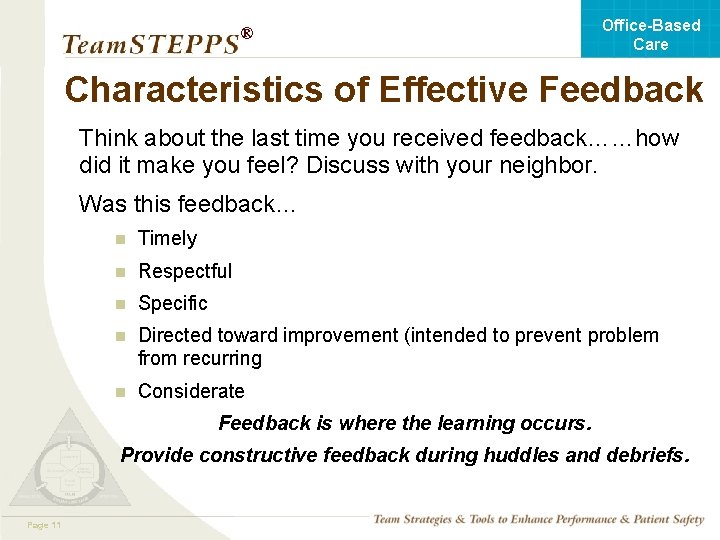
Office-Based Care ® Characteristics of Effective Feedback Think about the last time you received feedback……how did it make you feel? Discuss with your neighbor. Was this feedback… n Timely n Respectful n Specific n Directed toward improvement (intended to prevent problem from recurring n Considerate Feedback is where the learning occurs. Provide constructive feedback during huddles and debriefs. Mod Page 1 11 05. 2 Page 11 TEAMSTEPPS 05. 2
Office-Based Care ® Providing Effective Feedback Video Play the video available on the AHRQ website at https: //www. ahrq. gov/teamstepps/instructor/videos/ts_F eedback. Doc. To. Med. Tech/feedback. Doc. To. Medtech. html Mod Page 1 12 05. 2 Page 12 TEAMSTEPPS 05. 2 10
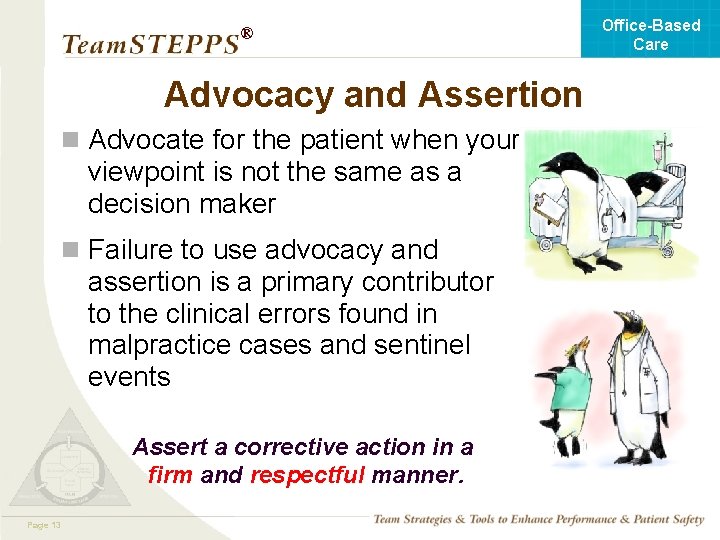
Office-Based Care ® Advocacy and Assertion n Advocate for the patient when your viewpoint is not the same as a decision maker n Failure to use advocacy and assertion is a primary contributor to the clinical errors found in malpractice cases and sentinel events Assert a corrective action in a firm and respectful manner. Mod Page 1 13 05. 2 Page 13 TEAMSTEPPS 05. 2
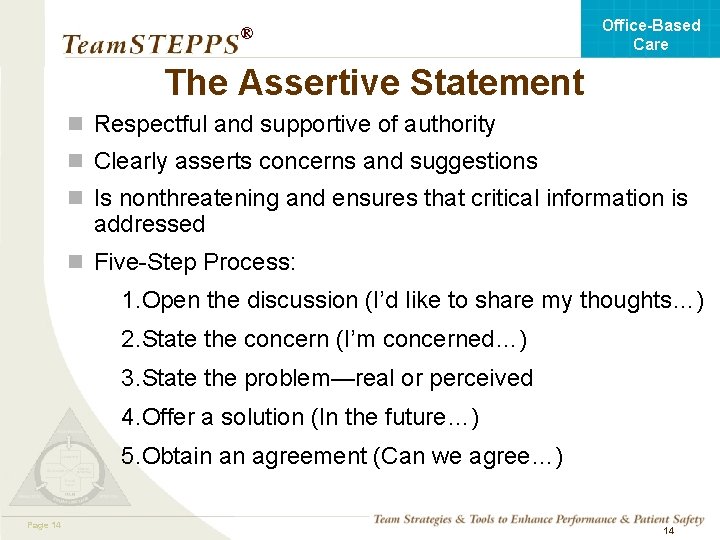
Office-Based Care ® The Assertive Statement n Respectful and supportive of authority n Clearly asserts concerns and suggestions n Is nonthreatening and ensures that critical information is addressed n Five-Step Process: 1. Open the discussion (I’d like to share my thoughts…) 2. State the concern (I’m concerned…) 3. State the problem—real or perceived 4. Offer a solution (In the future…) 5. Obtain an agreement (Can we agree…) Mod Page 1 14 05. 2 Page 14 TEAMSTEPPS 05. 2 14
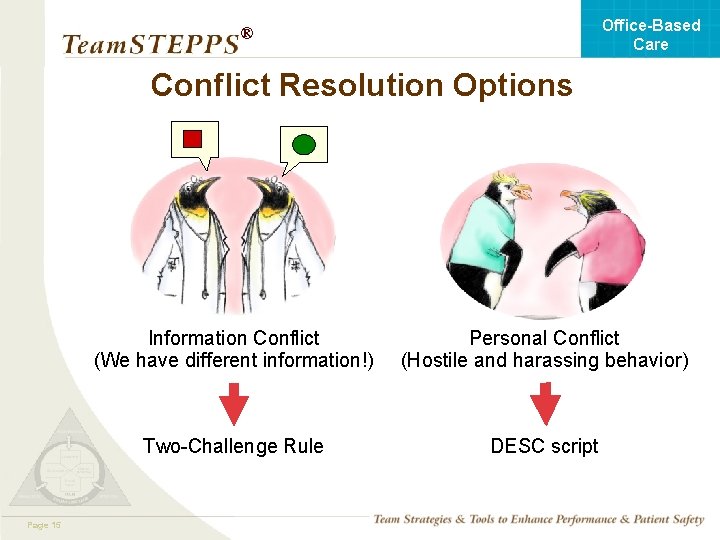
Office-Based Care ® Conflict Resolution Options Information Conflict (We have different information!) Personal Conflict (Hostile and harassing behavior) Two-Challenge Rule DESC script Mod Page 1 15 05. 2 Page 15 TEAMSTEPPS 05. 2
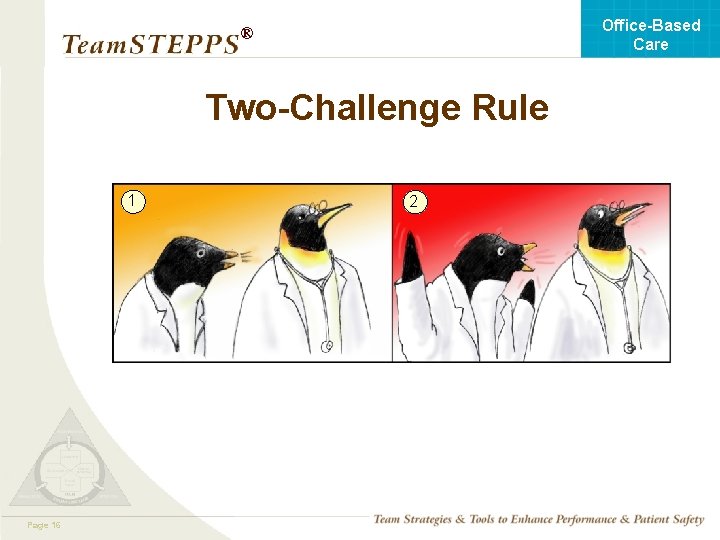
Office-Based Care ® Two-Challenge Rule 1 Mod Page 1 16 05. 2 Page 16 2 TEAMSTEPPS 05. 2
Office-Based Care ® Two-Challenge Rule Invoked when an initial assertion is ignored… n It is your responsibility to assertively voice your concern at least two times to ensure that it has been heard n The member being challenged must acknowledge n If the outcome is still not acceptable n n Take a stronger course of action Use supervisor or chain of command n How do team members stop the line now? n Can patients and families stop the line? Empower any team member to “stop the line” if patient safety is at stake Mod Page 1 17 05. 2 Page 17 TEAMSTEPPS 05. 2 17
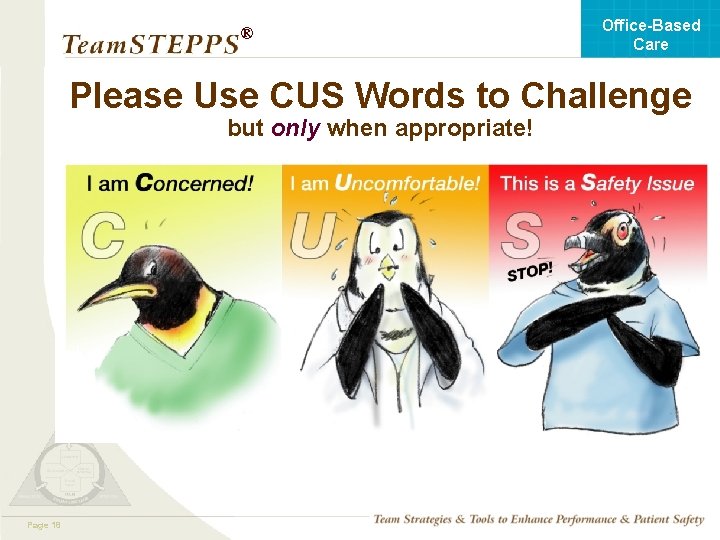
Office-Based Care ® Please Use CUS Words to Challenge but only when appropriate! Mod Page 1 18 05. 2 Page 18 TEAMSTEPPS 05. 2
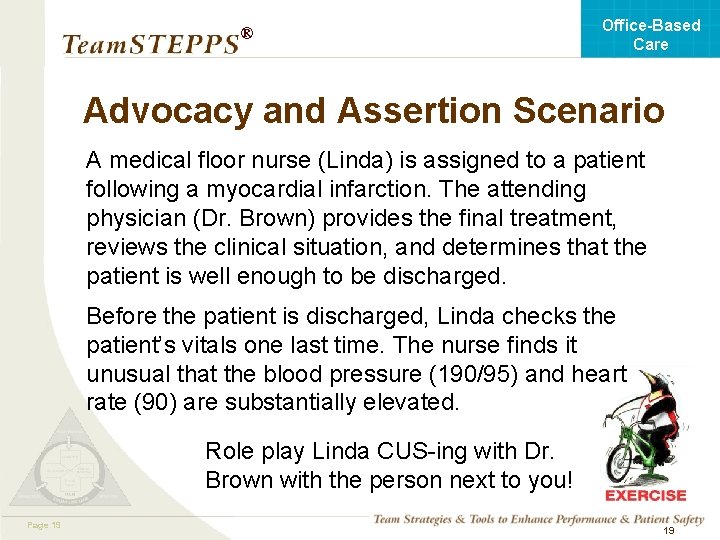
Office-Based Care ® Advocacy and Assertion Scenario A medical floor nurse (Linda) is assigned to a patient following a myocardial infarction. The attending physician (Dr. Brown) provides the final treatment, reviews the clinical situation, and determines that the patient is well enough to be discharged. Before the patient is discharged, Linda checks the patient’s vitals one last time. The nurse finds it unusual that the blood pressure (190/95) and heart rate (90) are substantially elevated. Role play Linda CUS-ing with Dr. Brown with the person next to you! Mod Page 1 19 05. 2 Page 19 TEAMSTEPPS 05. 2 19
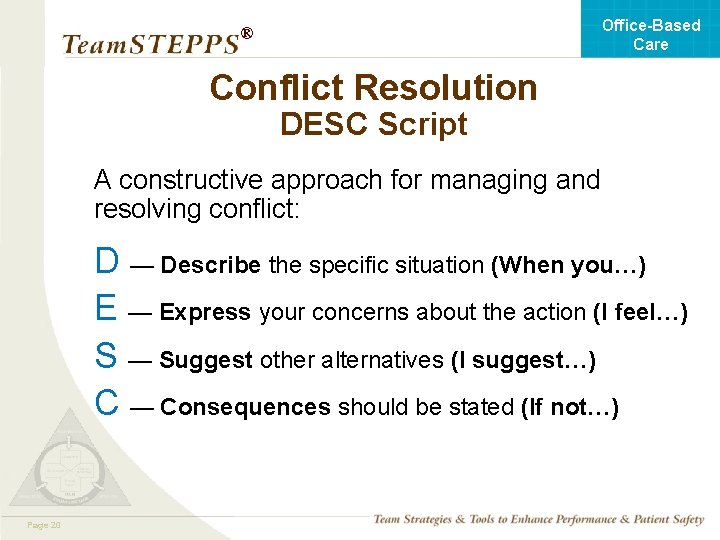
Office-Based Care ® Conflict Resolution DESC Script A constructive approach for managing and resolving conflict: D — Describe the specific situation (When you…) E — Express your concerns about the action (I feel…) S — Suggest other alternatives (I suggest…) C — Consequences should be stated (If not…) Mod Page 1 20 05. 2 Page 20 TEAMSTEPPS 05. 2
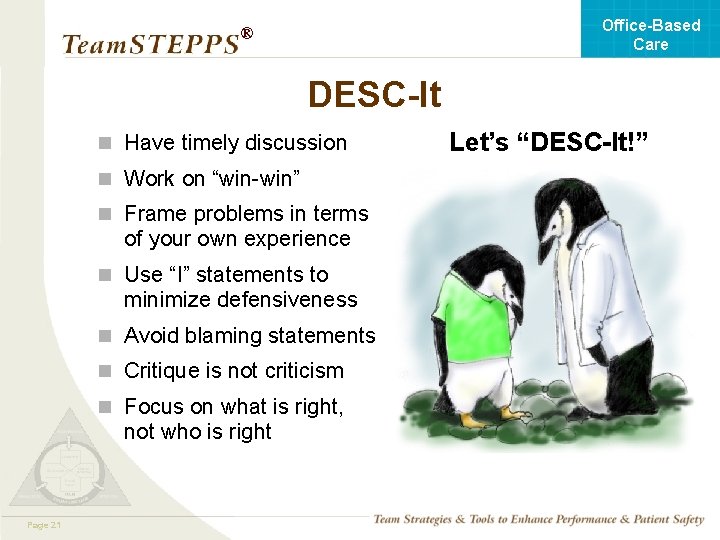
Office-Based Care ® DESC-It n Have timely discussion n Work on “win-win” n Frame problems in terms of your own experience n Use “I” statements to minimize defensiveness n Avoid blaming statements n Critique is not criticism n Focus on what is right, not who is right Mod Page 1 21 05. 2 Page 21 TEAMSTEPPS 05. 2 Let’s “DESC-It!”
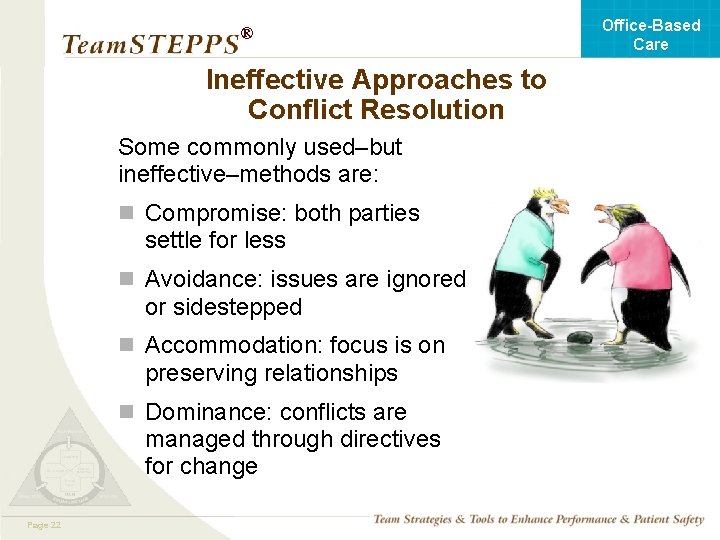
Office-Based Care ® Ineffective Approaches to Conflict Resolution Some commonly used–but ineffective–methods are: n Compromise: both parties settle for less n Avoidance: issues are ignored or sidestepped n Accommodation: focus is on preserving relationships n Dominance: conflicts are managed through directives for change Mod Page 1 22 05. 2 Page 22 TEAMSTEPPS 05. 2
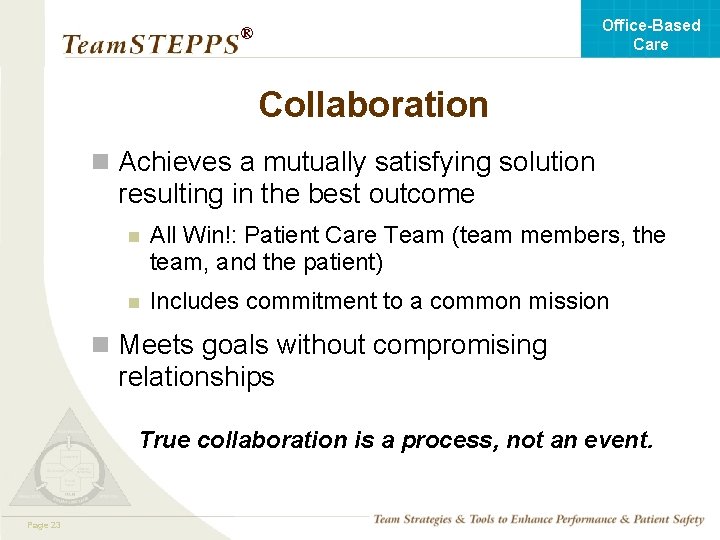
Office-Based Care ® Collaboration n Achieves a mutually satisfying solution resulting in the best outcome n All Win!: Patient Care Team (team members, the team, and the patient) n Includes commitment to a common mission n Meets goals without compromising relationships True collaboration is a process, not an event. Mod Page 1 23 05. 2 Page 23 TEAMSTEPPS 05. 2
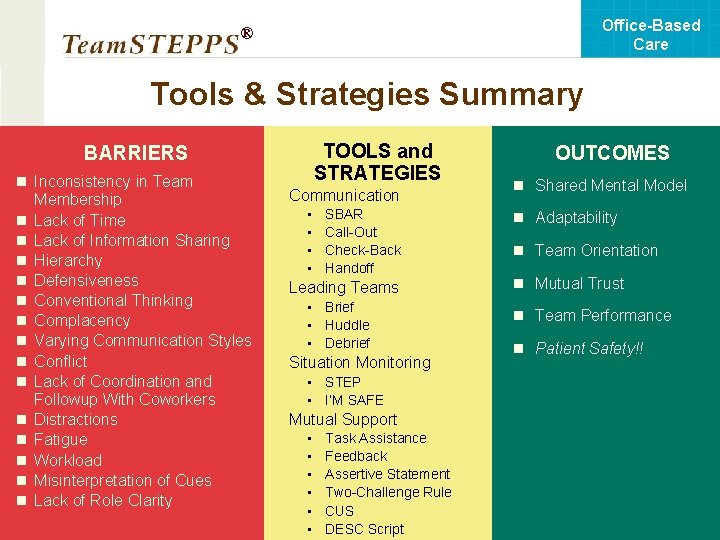
Office-Based Care ® Tools & Strategies Summary TOOLS and STRATEGIES BARRIERS n Inconsistency in Team n n n n Membership Lack of Time Lack of Information Sharing Hierarchy Defensiveness Conventional Thinking Complacency Varying Communication Styles Conflict Lack of Coordination and Followup With Coworkers Distractions Fatigue Workload Misinterpretation of Cues Lack of Role Clarity Mod Page 1 24 05. 2 Page 24 Communication • • SBAR Call-Out Check-Back Handoff Leading Teams • • • Brief Huddle Debrief Situation Monitoring • • OUTCOMES n Shared Mental Model n Adaptability n Team Orientation n Mutual Trust n Team Performance n Patient Safety!! STEP I’M SAFE Mutual Support • Task Assistance • Feedback • Assertive Statement • Two-Challenge Rule • CUS T • EAMDESC STEPPS Script 05. 2 24