Music and Mathematics Christina Lloyd Mathematics Specialization Introduction
- Slides: 10
Music and Mathematics Christina Lloyd Mathematics Specialization
Introduction Research Question: Will teaching a mathematics unit through music increase first graders’ understanding of that mathematical content over time?
Literature Review Music is mathematics o Music is comprised of mathematical relationships (Southgate and Roscigno, 2009) o Music naturally lends itself to incorporating and teaching mathematical concepts (Johnson & Edelson, 2003; Geist & Geist, 2008) Musical mnemonics o Help students memorize information (Scruggs & Mastropieri, 1990) o Works through rehearsal of material (Scruggs & Mastropieri, 1990)
Methodology Setting: o Kindergarten/First grade multi-aged classroom in a Stafford County public school Participants: o Only first graders were assessed during this study o 9 first graders from my K/1 classroom (experimental group) o 7 first graders from a different K/1 classroom (control group) Duration: o Two week measurement unit o Tested after the unit, and again two and four weeks after the unit o Coins were taught and practiced throughout my student teaching experience
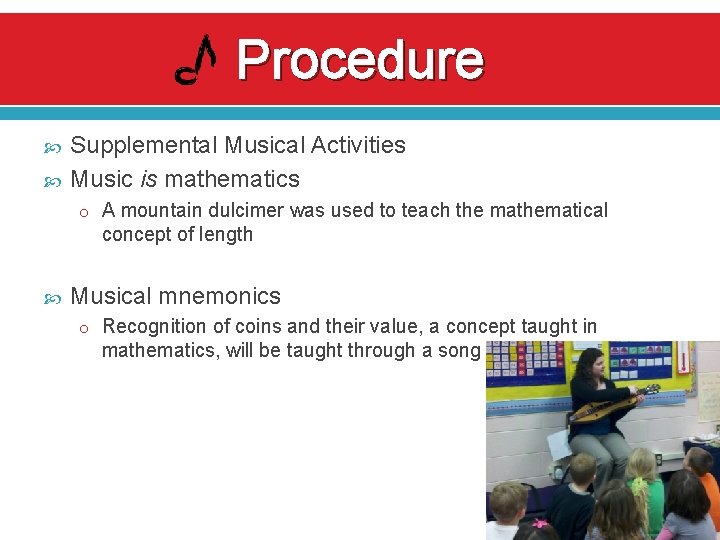
Procedure Supplemental Musical Activities Music is mathematics o A mountain dulcimer was used to teach the mathematical concept of length Musical mnemonics o Recognition of coins and their value, a concept taught in mathematics, will be taught through a song
Assessment Students were assessed one-on-one with the researcher Assessments took place after the measurement unit, and again two and four weeks after the unit ended Students were asked to: o List tools and strategies we can use to measure things o What measurement is (definition) o Identify coins o Identify values of coins o List how students learned about the coins
Results Music is Mathematics o Students in the experimental group had a broader definition of measurement than the control group o Students in the experimental group also had more measurement strategies, on average, than the control group
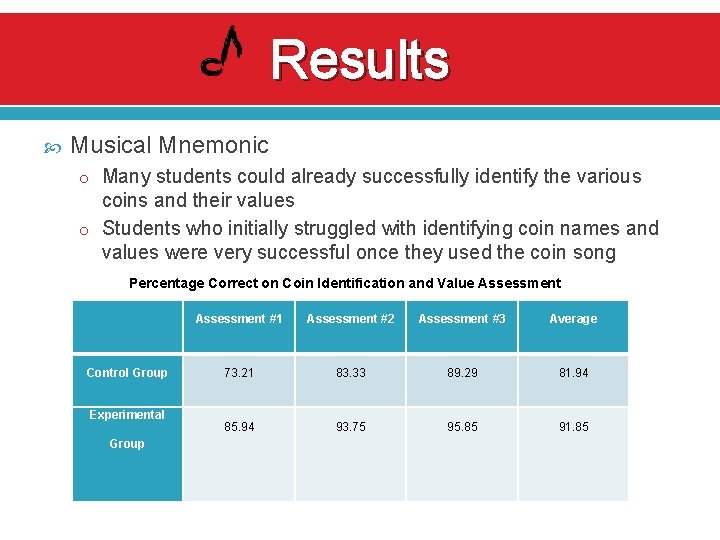
Results Musical Mnemonic o Many students could already successfully identify the various coins and their values o Students who initially struggled with identifying coin names and values were very successful once they used the coin song Percentage Correct on Coin Identification and Value Assessment #1 Assessment #2 Assessment #3 Average Control Group 73. 21 83. 33 89. 29 81. 94 Experimental Group 85. 94 93. 75 95. 85 91. 85
Implications Music is a tool which can be used to broader understanding of underlying mathematical content Music as a memory tool can help struggling students master mathematical concepts which must be memorized I would use this in my own classroom to enhance mathematics activities, and to engage students
References Armistead, M. (2007). Kaleidoscope: How a creative arts enrichment program prepares children for kindergarten. Young Children, 62, 86 -93. Geist, E. A. , Geist, K. (2008). Using music to support emergent mathematics. Young Children, 63, 20 -25. Johnson, G. L. , Edelson, R. J. (2003). Integrating music and mathematics in the elementary classroom. Teaching Children Mathematics, 9, 474 -479. Scruggs, T. E. , Mastropieri, M. A. (1990). The case for mnemonic instruction: From laboratory research to classroom applications. The Journal of Special Education, 24, 7 -29. Southgate, D. E. , & Roscigno, V. J. (2009). The impact of music on childhood and adolescent achievement. Social Science Quarterly (Blackwell Publishing Limited), 90, 4 -21. Questions?