Multiple Intelligences English Language Teaching and Technology A

- Slides: 48
Multiple Intelligences, English Language Teaching, and Technology A Winning Combination! Dr. In-Seok Kim Professor of ESL and Applied Linguistics Dongduk Women’s University President-elect of Asia Pacific Association of Multimedia Assisted Language Learning iskim@dongduk. ac. kr http: //www. eflcall. com
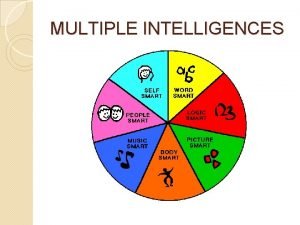
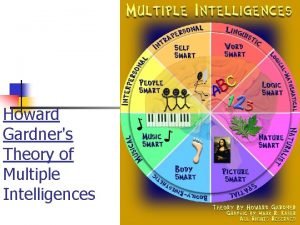
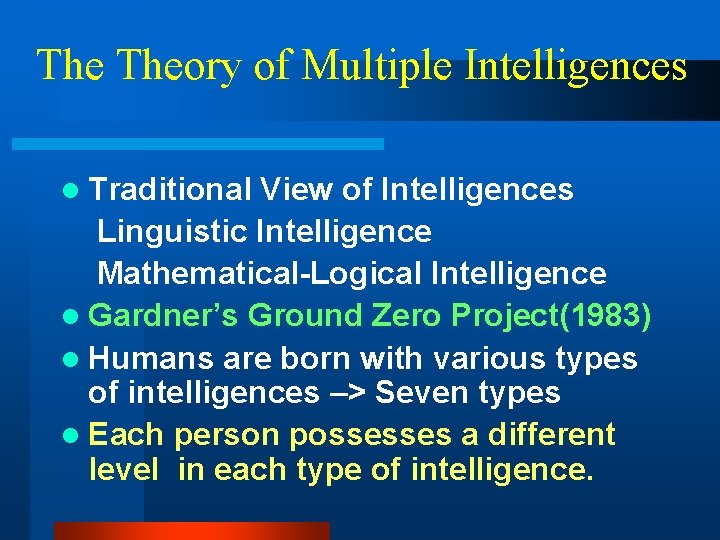
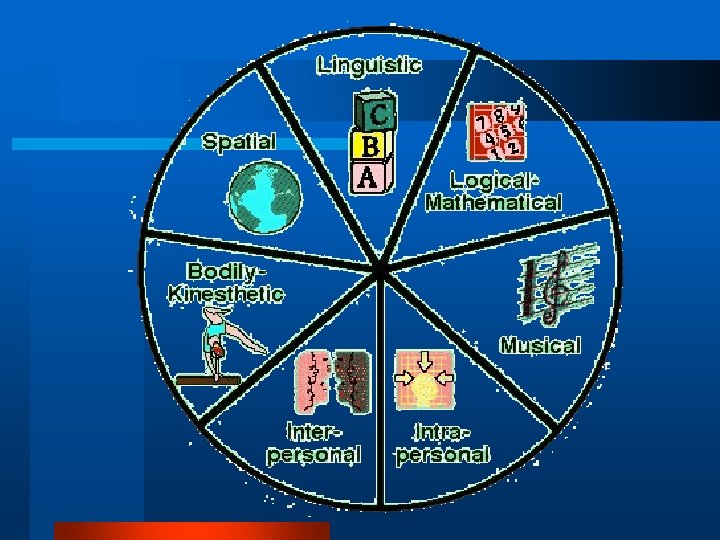
The Theory of Multiple Intelligences l Traditional View of Intelligences Linguistic Intelligence Mathematical-Logical Intelligence l Gardner’s Ground Zero Project(1983) l Humans are born with various types of intelligences –> Seven types l Each person possesses a different level in each type of intelligence.
Linguistic Intelligence l The intelligence of words Love to play around with the sounds of language through puns, word games, and tongue twisters l Trivia experts, Masters of literacy Talk persuasively, Read a lot, Write clearly l Journalist, storyteller, poet, lawyer, etc. l
Logical-Mathematical Intelligence l The intelligence of numbers and logic The ability to reason, sequence, think in terms of cause-and-effect, create hypotheses, look for numerical patterns l Enjoy a generally rational outlook on life l The intelligence of the scientists, accountant, and computer programmers, Newton, Einstein, etc.
Visual-Spatial Intelligence l Smart with pictures and images The ability to perceive, transform, and recreate different aspects of the visualspatial world l An acute sensitivity to visualize details l Can visualize vividly, draw, sketch their ideas graphically, and orient themselves in three-dimensional space with ease
Visual-Spatial Intelligence l Architects, photographers, artists, pilots, mechanical engineers l Designer of the Pyramids in Egypt, Thomas Edison, Pable Piccaso, etc.
Musical Intelligence l The capacity to perceive, appreciate, and produce rhythms and melodies l Has a good ear, can sing in tune, keep time to music l Can listen to different musical selections with some degree of discernment l Bach, Beethoven, Brahms, etc.
Bodily-kinesthetic Intelligence l l The intelligence of the physical self Talent in controlling one’s body movement and handling objects skillfully Athletes, craft people, mechanics, and surgeons, carpenter, model-building Enjoy physical pursuits like hiking, dancing, swimming, or boating Charlie Chaplin, Michael Jackson, etc
Interpersonal Intelligence l The ability to understand work with others l A capacity to perceive and be responsive to the moods, temperaments, intentions, and desires of others l A social director on a cruise ship, administrator of a large corporation
Interpersonal Intelligence l Very compassionate and socially responsible like Gandhi, Machiavelli l The ability to get inside the skin of another person and view the world from the individual perspective Networkers, negotiators, teachers
Intrapersonal Intelligence l The intelligence of the inner self Can access one’s own feelings and discriminate between many different kinds of inner emotional states Can use one’s self-understanding to enrich and guide her life l Very introspective, enjoy meditation, contemplation, deep soul searching l
Intrapersonal Intelligence l Independent, highly goal-oriented, and self-disciplined l Counselors, theologians, selfemployed business people l Prefer to work on their own rather than with others
The Position of Multiple Intelligences(1) l One can be strong in one or more of the above intelligences. But all possess all seven intelligences l Any normal person can develop every one of the seven kinds of intelligences to a reasonable level of mastery.
The Position of Multiple Intelligences(2) l Example: German thinker Rudolf Steiner was a philosopher, writer, scientist, sculptor, social theorist, architect. He also created a system of dance, a theory of color, and a system of gardening l There a few people who have developed only one intelligence to a high level, while the other intelligences lagged far behind
The Position of Multiple Intelligences(3) We have a few intelligences that stand out, some that seem average, and others that we have difficulty with in our lives. l There is room for everyone to shine in this new model of intelligence. l The farmer, the parent, the painter, the mechanic, and the merchant have as much right to the term intelligence as do the psychiatrist, the brain surgeon, and the law professor. l
Effective Learning through MI l Through new imaging techniques, scientists can now study the inner workings of the brain, thus opening a vast frontier of knowledge on human cognition. l Researchers agree that Intelligence and Learning are multi-dimensional. l Brain research supports theory that throughout our lives, we are capable of growing new connections between neurons, and these connections create learning and memory.
Effective Learning through MI l l Memory and intelligence are closely linked. Thinking and feeling are connected because our patterning is emotional. Our emotions open and close the doors to our ability to learn new information and perform specific tasks. We are most motivated to learn when we are involved in activities for which we possess some talent.
Effective Learning through MI Creating a State of “Flow” l We learn best when we are in a state of high, relaxed concentration where an individual is actively engaged in learning something new, but not to the point of frustration.
Effective Learning through MI Effective Learning Through M. I. Means “Triple Coding” Content Anytime three or more intelligences are used to introduce new material to students, the greater their chances of long term retention.
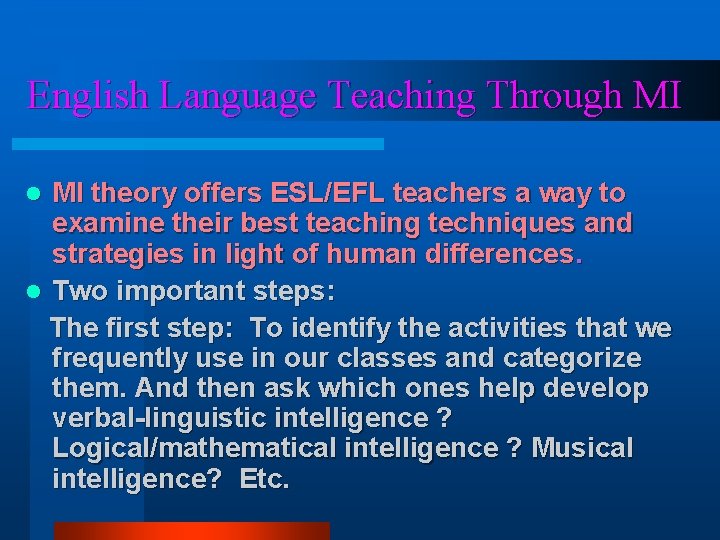
English Language Teaching Through MI MI theory offers ESL/EFL teachers a way to examine their best teaching techniques and strategies in light of human differences. l Two important steps: The first step: To identify the activities that we frequently use in our classes and categorize them. And then ask which ones help develop verbal-linguistic intelligence ? Logical/mathematical intelligence ? Musical intelligence? Etc. l
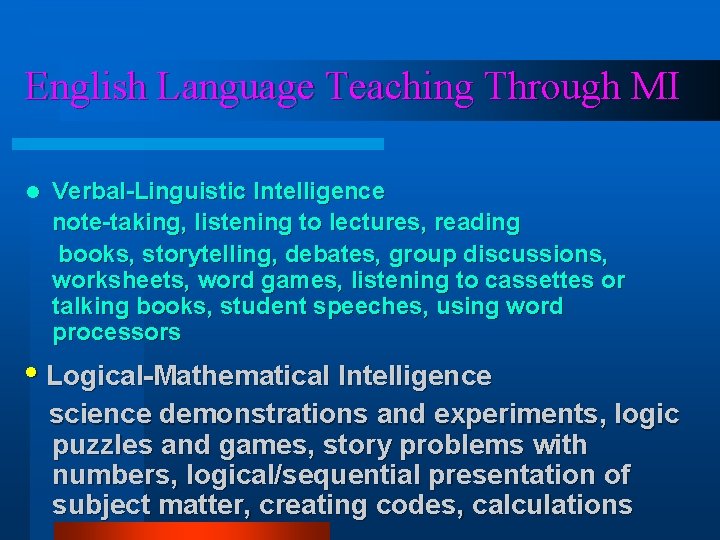
English Language Teaching Through MI l Verbal-Linguistic Intelligence note-taking, listening to lectures, reading books, storytelling, debates, group discussions, worksheets, word games, listening to cassettes or talking books, student speeches, using word processors • Logical-Mathematical Intelligence science demonstrations and experiments, logic puzzles and games, story problems with numbers, logical/sequential presentation of subject matter, creating codes, calculations
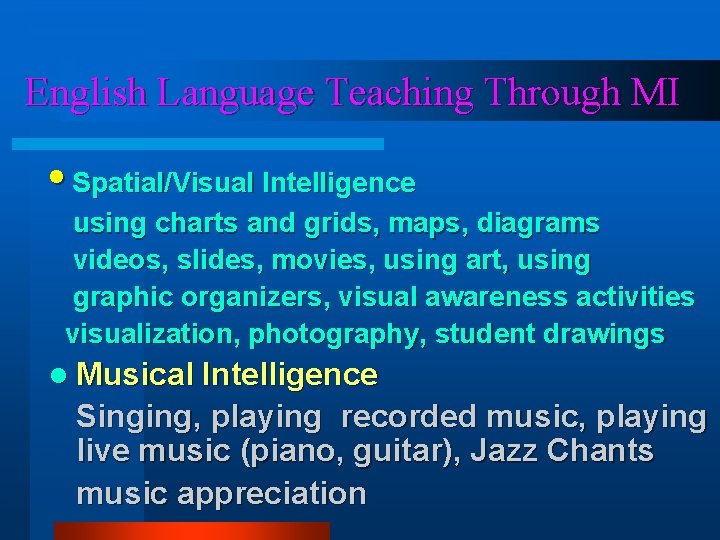
English Language Teaching Through MI • Spatial/Visual Intelligence using charts and grids, maps, diagrams videos, slides, movies, using art, using graphic organizers, visual awareness activities visualization, photography, student drawings l Musical Intelligence Singing, playing recorded music, playing live music (piano, guitar), Jazz Chants music appreciation
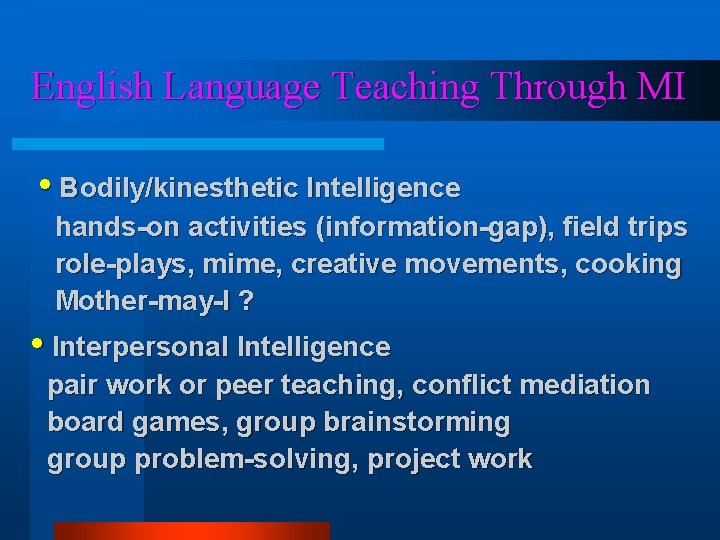
English Language Teaching Through MI • Bodily/kinesthetic Intelligence hands-on activities (information-gap), field trips role-plays, mime, creative movements, cooking Mother-may-I ? • Interpersonal Intelligence pair work or peer teaching, conflict mediation board games, group brainstorming group problem-solving, project work
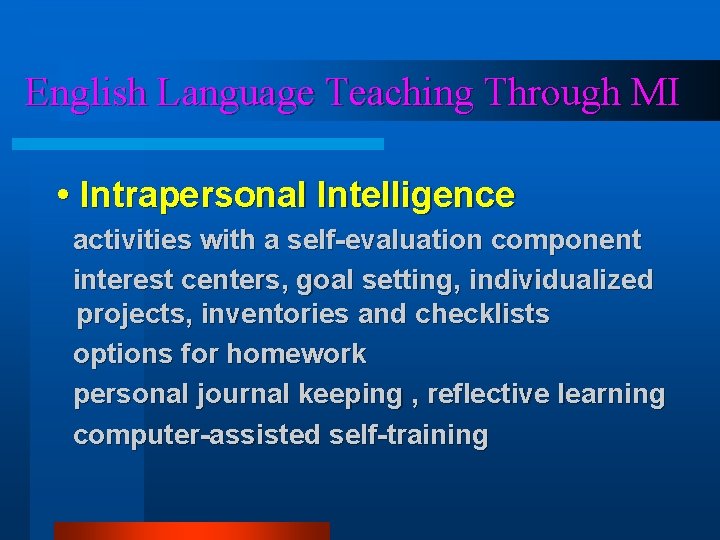
English Language Teaching Through MI • Intrapersonal Intelligence activities with a self-evaluation component interest centers, goal setting, individualized projects, inventories and checklists options for homework personal journal keeping , reflective learning computer-assisted self-training
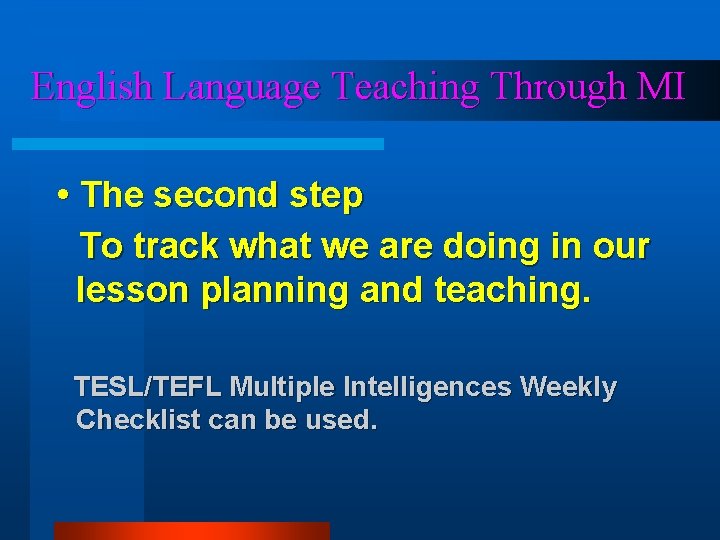
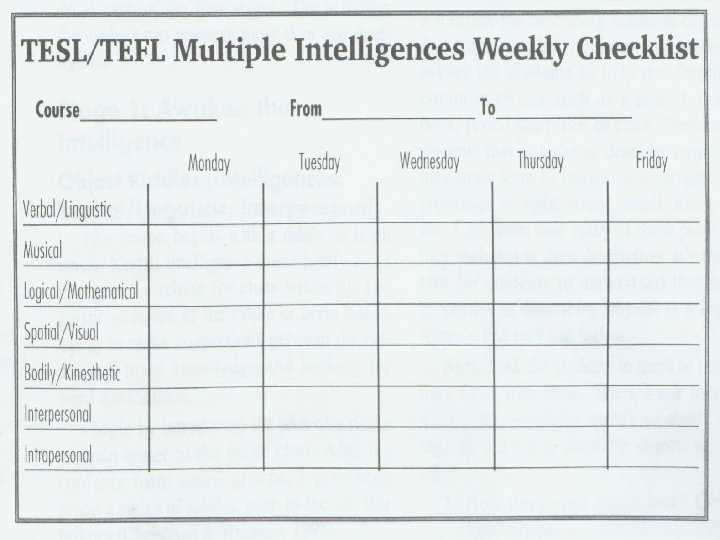
English Language Teaching Through MI • The second step To track what we are doing in our lesson planning and teaching. TESL/TEFL Multiple Intelligences Weekly Checklist can be used.
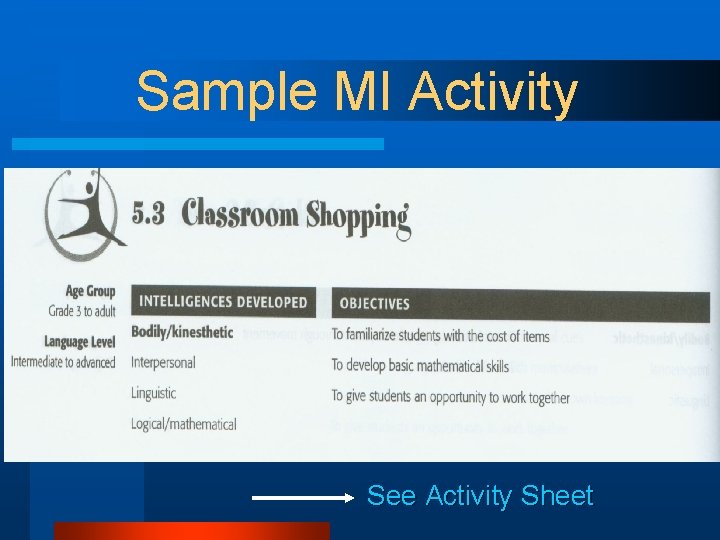
Sample MI Activity See Activity Sheet
Technology Enhances the Multiple Intelligences At least one-third of our students are u i v s al learners. Computers offer students a multi-sensory smorgasbord.
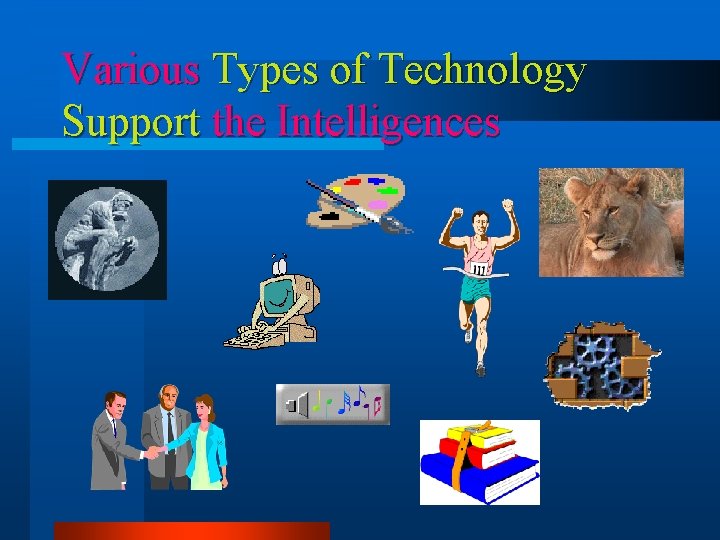
Various Types of Technology Support the Intelligences
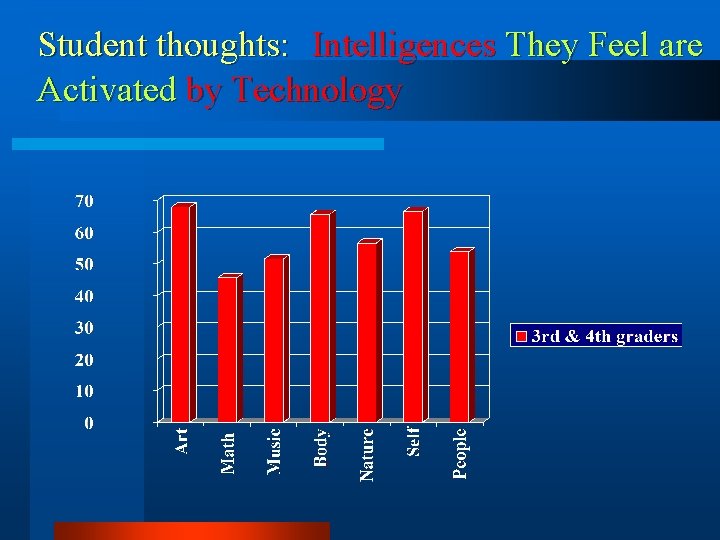
Student thoughts: Intelligences They Feel are Activated by Technology
The Integration of M. I. & Technology: The Positive Effects: l Students find topics more interesting when information is presented in a variety of ways. l Students feel more comfortable and motivated when they know that their learning styles will be addressed. l Students believe their learning has more meaning when the way in which they learn and present new information is acknowledged. l Students are more challenged, engaged, and independent.
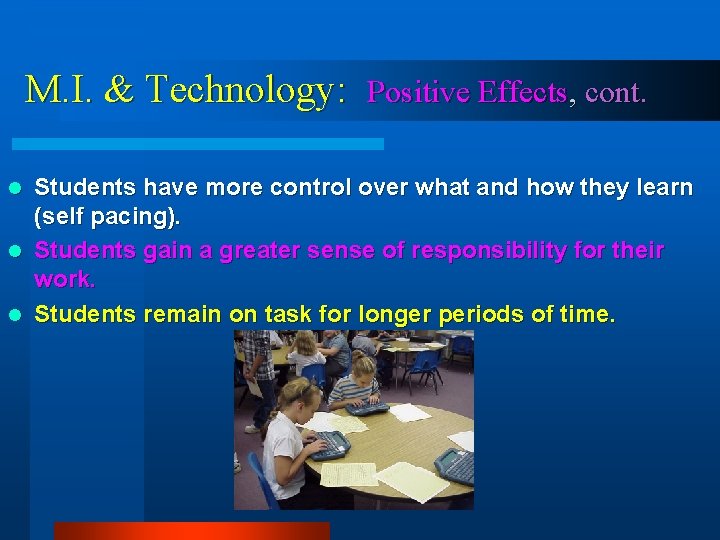
M. I. & Technology: Positive Effects, cont. Students have more control over what and how they learn (self pacing). l Students gain a greater sense of responsibility for their work. l Students remain on task for longer periods of time. l
Positive Effects, cont. Students produce higher quality work, that reflects the increased depth and breadth of their knowledge and talents. Students become better at critical thinking, organizing & evaluating information, and presenting their new knowledge in creative ways.
Verbal / Linguistic Intelligence · CD-ROM titles for English Learning (Tell me more Kids, Q-Steps, Let’s Go series, OUP Picture Dictionary) · keypal programs · videoconferencing program (Yahoo net meeting, MSN messenger
Verbal / Linguistic Intelligence · Word processing programs (Word) · Typing tutors (Mavis Beacon) · Desktop publishing (Micro. Soft Publisher) · Electronic libraries (World Library) · Word games (Missing Links) · Story Writing Programs (Imagination Express; The Amazing Writing Machine; Storybook Weaver) · Co: Writer (www. donjohnston. com/catalog/cow 4000 s. htm)
Verbal / Linguistic Intelligence Internet Resources for Teachers · www. riverdeep. com · www. nifl. gov/nifl/eliteracy · www. glef. org · www. learningspace. org · www. iearn. org · www. iste. org
Logical / Mathematical Intelligence · Millie’s Mathhouse (The Learning Company) · The Adventures of Jasper Woodbury (developed by Vanderbilt University) - Rescue at Boone’s Meadow (5 th Grade) http: //peabody. vanderbilt. edu/ltc/Research/ jasper. overview. html · Critical thinking programs (H. O. T. S. - Higher Order Thinking Skills; Visual Venture) http: //www. hots. org • Lost Mind of Dr. Brain (Sierra)
Logical / Mathematical Intelligence · Math skills tutorials (Math Blaster; Treasure Math Storm; Math Rock!; Cosmic Geometry; Astro Algebra) · Computer programming tutors (LOGO) · Logic games (King's Quest) · Strategy games (Strategy Series) · Science programs (Science Tool Kits; DK Multimedia; Gizmos & Gadgets) · Microworld (www. kidsandcomputers. com) · Math brain twister programs
Visual/Spatial Intelligence · Magic Books Software (HIT Lab) – virtual reality book · Virtual Explorer (UC/San Diego) –sciencebased reality adventure (http: //www. wilson. ucsd. edu/ve) · Drawing Tools Scholastic Hyper. Screen Software – built-in fonts, clip art, and drawing tools Cross. Pad; Apple Newton
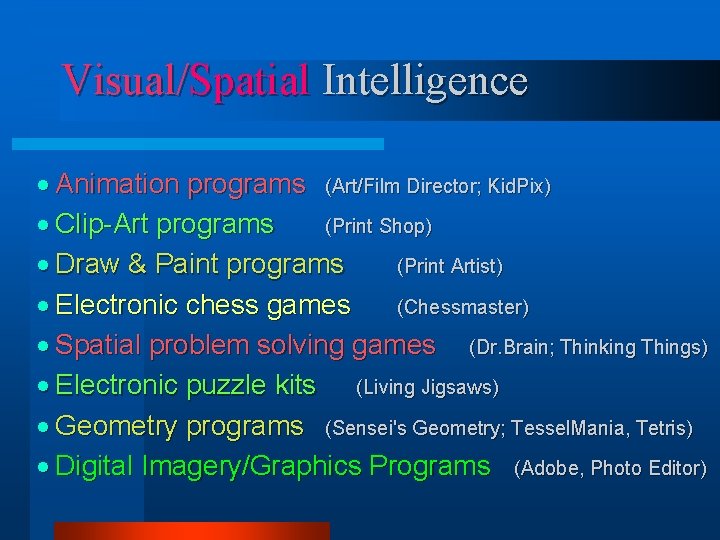
Visual/Spatial Intelligence · Animation programs (Art/Film Director; Kid. Pix) · Clip-Art programs (Print Shop) · Draw & Paint programs (Print Artist) · Electronic chess games (Chessmaster) · Spatial problem solving games (Dr. Brain; Thinking Things) · Electronic puzzle kits (Living Jigsaws) · Geometry programs (Sensei's Geometry; Tessel. Mania, Tetris) · Digital Imagery/Graphics Programs (Adobe, Photo Editor)
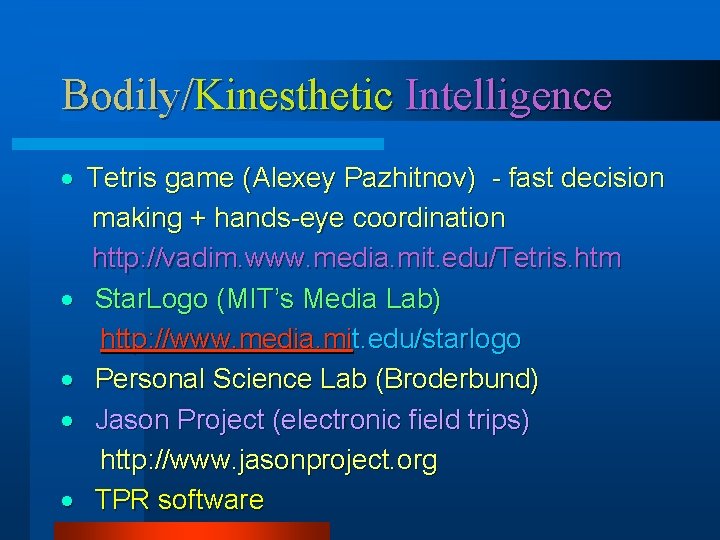
Bodily/Kinesthetic Intelligence · Tetris game (Alexey Pazhitnov) - fast decision making + hands-eye coordination http: //vadim. www. media. mit. edu/Tetris. htm · Star. Logo (MIT’s Media Lab) http: //www. media. mit. edu/starlogo · Personal Science Lab (Broderbund) · Jason Project (electronic field trips) http: //www. jasonproject. org · TPR software
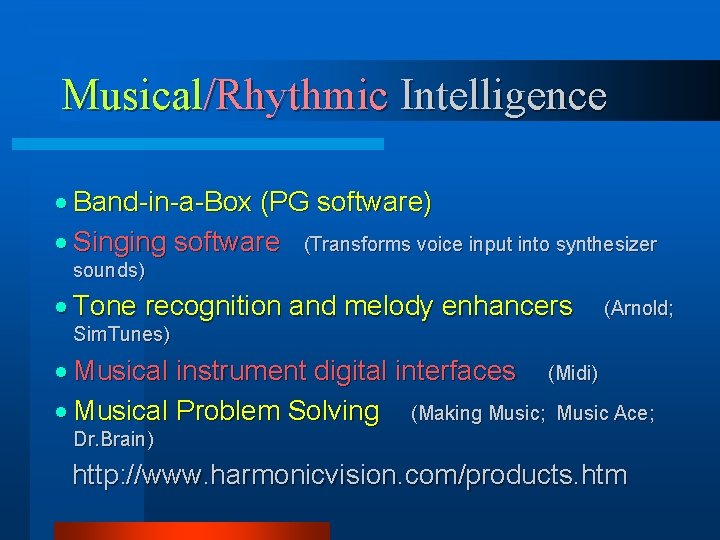
Musical/Rhythmic Intelligence · Band-in-a-Box (PG software) · Singing software (Transforms voice input into synthesizer sounds) · Tone recognition and melody enhancers (Arnold; Sim. Tunes) · Musical instrument digital interfaces (Midi) · Musical Problem Solving (Making Music; Music Ace; Dr. Brain) http: //www. harmonicvision. com/products. htm
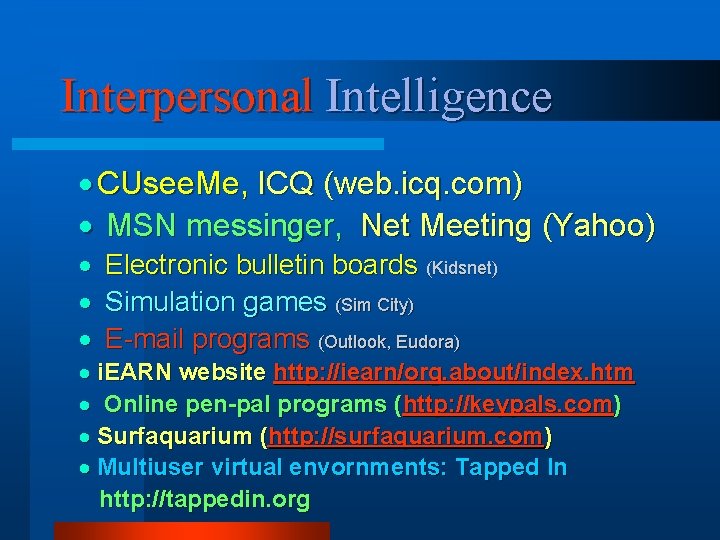
Interpersonal Intelligence · CUsee. Me, ICQ (web. icq. com) · MSN messinger, Net Meeting (Yahoo) · · · Electronic bulletin boards (Kidsnet) Simulation games (Sim City) E-mail programs (Outlook, Eudora) · i. EARN website http: //iearn/org. about/index. htm · Online pen-pal programs (http: //keypals. com) · Surfaquarium (http: //surfaquarium. com) · Multiuser virtual envornments: Tapped In http: //tappedin. org
Intrapersonal Intelligence · Personal choice software (Decisions, Decisions) · Career counseling software (The Perfect Career) · Inspiration or kidspiration (www. inspiration. com) · Any self-paced program (Foreign Languages; Personal finances) · Decisions, Decisions · Graphic Organizer Index (www. graphic. org) · Intelligent Tutoring Systems (Dave ESL by MIT)
Conclusion (1) · MI theory offers ESL/EFL teachers a way to examine their best teaching techniques and strategies in light of human differences. · Teachers’ language-learning materials affect the multiple intelligence profiles of their students. · We must identify the activities that we frequently use in our classes and categorize them to see which ones help develop which types of students’ intelligences
Conclusion (2) · The use of technology in English language teaching should be maximized since the technology and MI provides a winning combination. This means that English teaching with technology is believed to influence students’ learning more than any other medium. · The MI-based teaching of English with technology will help students develop seven kinds of their intelligences. This being the case, students can get smarter through learning English through technology.
Conclusion (3) · In the future multimedia software that will assist students in developing their intelligences through learning English is likely to be developed. · The caveat of MI-based language learning through technology is that such a combination will surely help teachers create activities that will be flexible, reflective, logical, and The End