MS Project Management Development of Complex Projects Course

- Slides: 28
MS Project Management & Development of Complex Projects Course Code - 706 Budgeting Process Lecture # 11
Summary of Previous Lecture In previous Lecture, we have discussed about Ø Ø Cost management Some definitions Estimates types Accuracies, uses and advantages of estimate types
Budget types Organizations use many different types of budgets Ø Short- run Budgets are used for compensation contracts Ø Long-run budgets are used for strategic planning Ø Line-item budgets are used to set spending limits. Ø Budget lapsing are used to prevent managers from carrying surpluses from one year to the next. üLeads to waste (“use it or lose it”) (bad). üManagers can’t coast on past performance (good).
Budget types Static budgets are based on planned or single level of activity. Flexible budgets are based on actual level of activity üIn flexible budget, Fixed Costs are the same as the static budget (by definition these costs do not vary with volume), but variable costs are re-scaled to reflect the actual volume produced. üStatic budgets do not adjust for volume changes whereas flexible budgets do. üIf manager does not control volume decisions, the flexible budget is more useful to evaluate managerial performance. üIf manager controls volume both flexible budget as well as shortfall/overproduction i. e. volume must be considered.
Budget types In incremental budgeting, only changes from the previous year’s budget are submitted for approval/discussion/review. • easy to forget why things were added in the first place. over time many assumptions are never questioned and organization may get inefficient. Zero Based Budgeting (ZBB) questions everything -- all budget items must be justified afresh each year. • hugely time consuming and wasteful in many cases.
Reserve Analysis Ø Cost estimates may include contingency reserves (sometimes called contingency allowances) to account for cost uncertainty. Ø Contingency reserves are the budget within the cost baseline that is allocated for identified risks, which are accepted and for which contingent or mitigating responses are developed. Ø Contingency reserves are often viewed as the part of the budget intended to address the “known-unknowns” that can affect a project.
Reserve Analysis Ø Estimates may also be produced for the amount of management reserve to be funded for the project. Ø Management reserves are an amount of the project budget withheld for management control purposes and are reserved for unforeseen work that is within scope of the project. Ø Management reserves are intended to address the “unknowns” that can affect a project
Cost Aggregation Ø Cost estimates are aggregated by work packages in accordance with the WBS. Ø The work package cost estimates are then aggregated for the higher component levels of the WBS (such as control accounts) and ultimately for the entire project
Funding Limit Reconciliation Ø The expenditure of funds should be reconciled with any funding limits on the commitment of funds for the project. Ø A variance between the funding limits and the planned expenditures will sometimes necessitate the rescheduling of work to level out the rate of expenditures. Ø This is accomplished by placing imposed date constraints for work into the project schedule
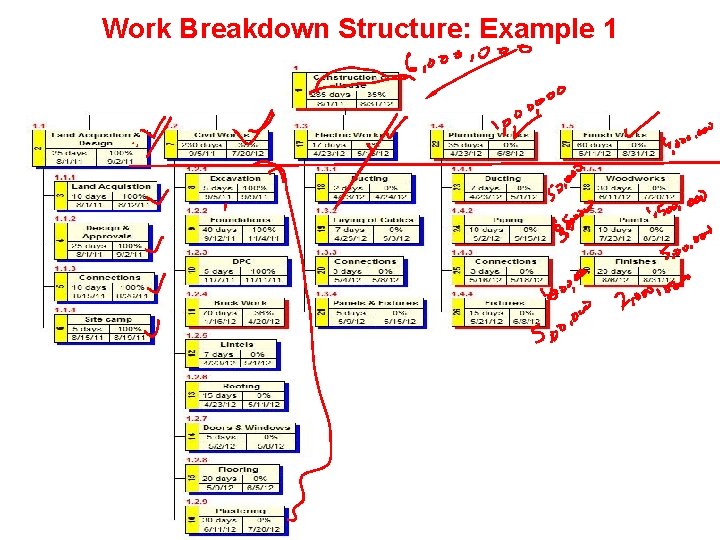
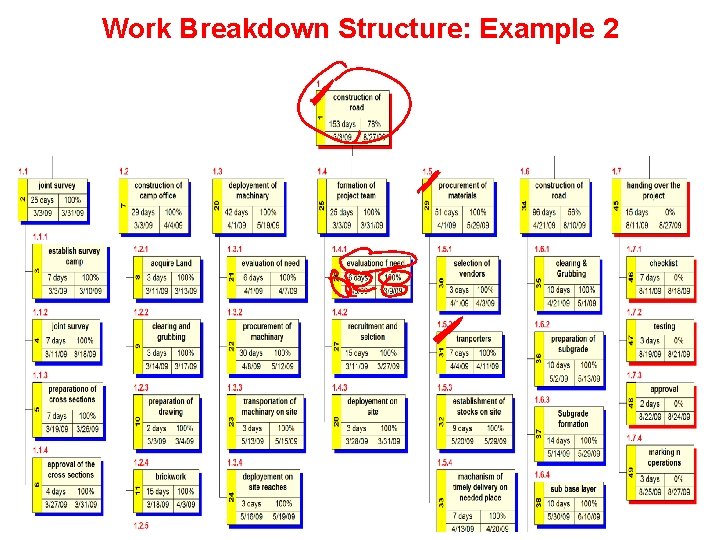
Work Breakdown Structure The Work Breakdown Structure is the process of decomposition of project in phases, then control accounts and then to work packages.
Work Breakdown Structure: Example 1
Work Breakdown Structure: Example 2
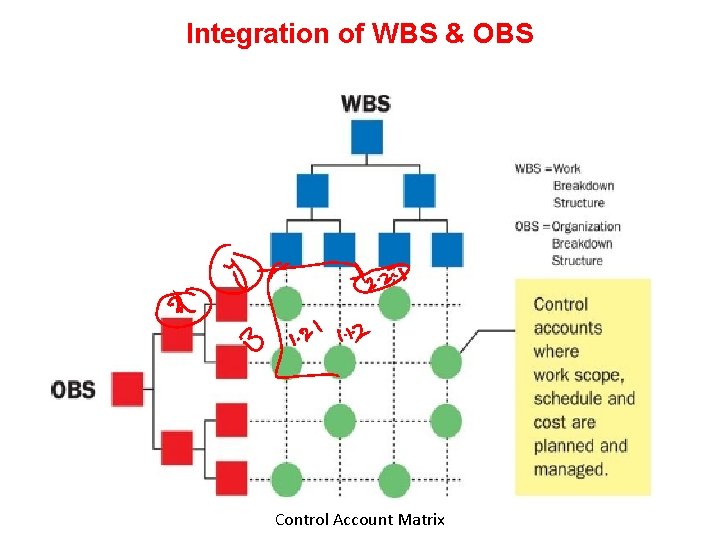
Integration of WBS & OBS Control Account Matrix
The Budgeting Process Planning is about making decisions with the following objectives: Ø Define what will be performed (Scope Statement) Ø Determine how the work will be structured and tracked (Work Breakdown Structure) Ø Assign Responsibility for elements of work (Organizational Breakdown Structure) Ø Schedule the authorized work in a manner which describes the sequence of work and identifies significant task interdependencies required to meet the requirements of the program Ø Now is Budgeting.
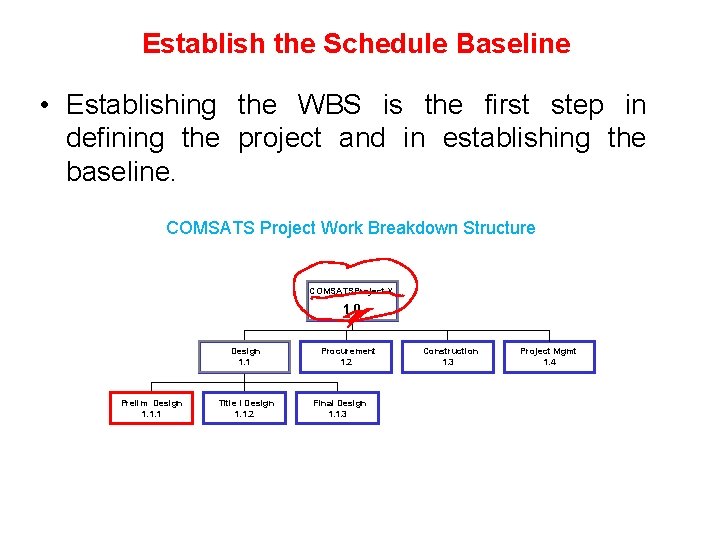
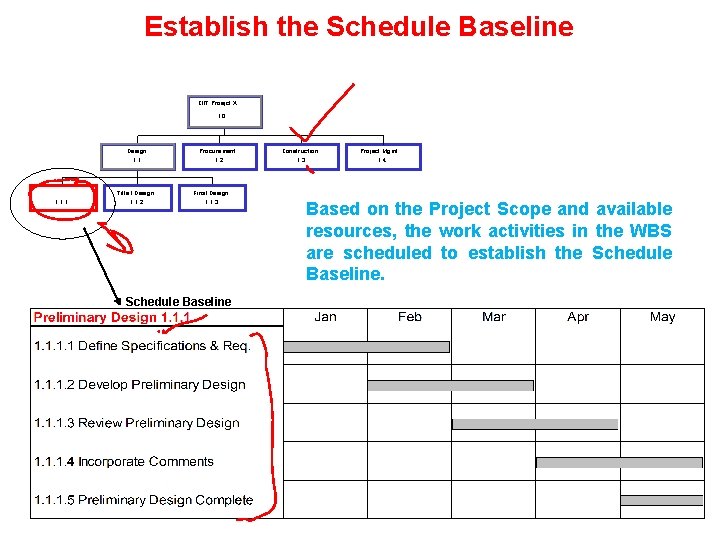
Establish the Schedule Baseline • Establishing the WBS is the first step in defining the project and in establishing the baseline. COMSATS Project Work Breakdown Structure COMSATSProject X 1. 0 Design 1. 1 Prelim Design 1. 1. 1 Title I Design 1. 1. 2 Procurement 1. 2 Final Design 1. 1. 3 Construction 1. 3 Project Mgmt 1. 4
Establish the Schedule Baseline CIIT Proejct X 1. 0 Prelim Design 1. 1. 1 Design Procurement Construction 1. 1 1. 2 1. 3 Title I Design Final Design 1. 1. 2 1. 1. 3 Schedule Baseline Project Mgmt 1. 4 Based on the Project Scope and available resources, the work activities in the WBS are scheduled to establish the Schedule Baseline.
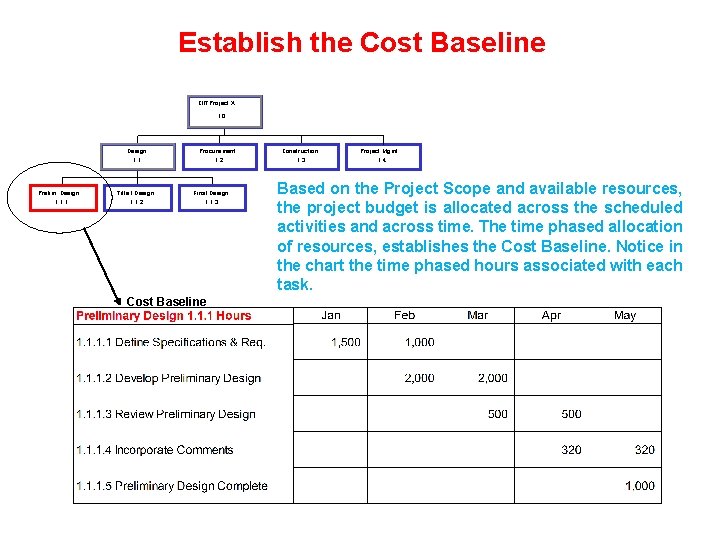
Establish the Cost Baseline CIITProject X 1. 0 Prelim Design 1. 1. 1 Design Procurement Construction 1. 1 1. 2 1. 3 Title I Design Final Design 1. 1. 2 1. 1. 3 Cost Baseline Project Mgmt 1. 4 Based on the Project Scope and available resources, the project budget is allocated across the scheduled activities and across time. The time phased allocation of resources, establishes the Cost Baseline. Notice in the chart the time phased hours associated with each task.
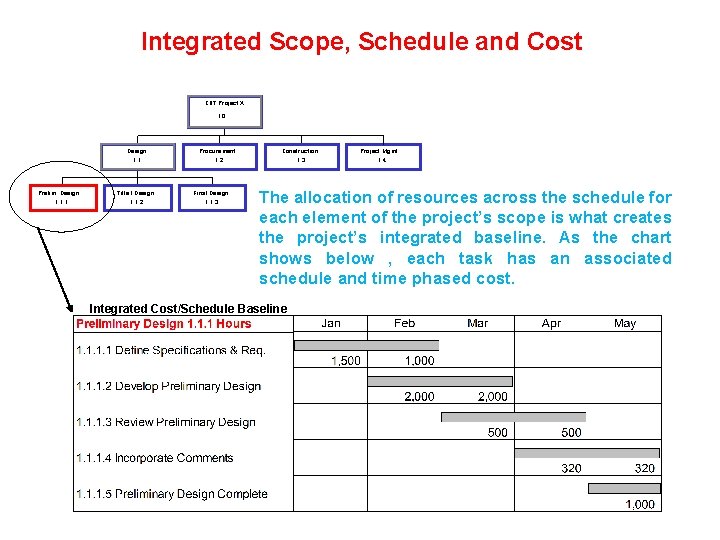
Integrated Scope, Schedule and Cost CIIT Project X 1. 0 Prelim Design 1. 1. 1 Design Procurement Construction 1. 1 1. 2 1. 3 Title I Design Final Design 1. 1. 2 1. 1. 3 Project Mgmt 1. 4 The allocation of resources across the schedule for each element of the project’s scope is what creates the project’s integrated baseline. As the chart shows below , each task has an associated schedule and time phased cost. Integrated Cost/Schedule Baseline
Work Breakdown Structure Reporting Levels The Work Breakdown Structure is the framework used to facilitate the requirement for integrating these major components. The Work Breakdown Structure is further broken down by Control Accounts, Work Packages, and Planning Packages.
Control Accounts • A Control Account is an assigned WBS Level used to monitor the cost and schedule performance of a significant element of the work. Control Accounts are also referred to as Cost Accounts. These terms are interchangeable, however, we will use the term Control Accounts. • A Control Account is a major management control point for: • • • Cost Summarization Variance Analysis and Reporting Responsibility Assignment Scope Description Corrective Action Planning • A Control Account Manager (CAM) is responsible for executing the Statement of Work associated with their assigned Control Account(s).
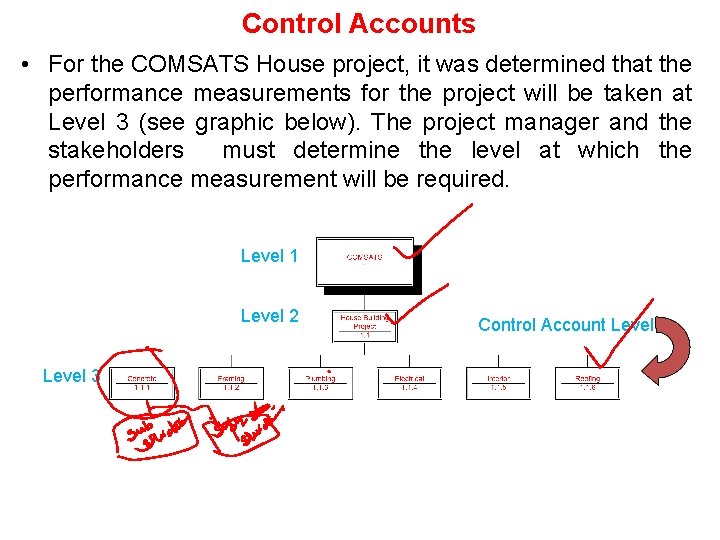
Control Accounts • For the COMSATS House project, it was determined that the performance measurements for the project will be taken at Level 3 (see graphic below). The project manager and the stakeholders must determine the level at which the performance measurement will be required. Level 1 Level 2 Level 3 Control Account Level
Work Packages • Work Packages (WP) contain a discrete segment of work below the Control Account level that is defined by – a description or brief work statement – starting and ending dates – completion milestone – work-in-process measure – time-phased budget expressed in direct labor (hours and/or Rupees), material, other direct costs and subcontract dollars • It is important that the duration of a Work Package be a relatively short span of time (normally, but not limited to, six months or less).
Planning Packages • Planning Packages reflect a future segment of work within a Control Account that is not yet broken down into detailed work packages. A planning package has a firm budget, estimated start and complete dates, and Statement of Work. • As work becomes more clearly defined, Planning Packages are converted into Work Packages, with the following constraints: – All planning packages are converted into work packages as requirements are defined – Conversion of planning packages to work packages is reviewed by the Project Manager & Sponsor – Any conversion involving a change to the schedule or budget of the control account must be accompanied by approval from senior management
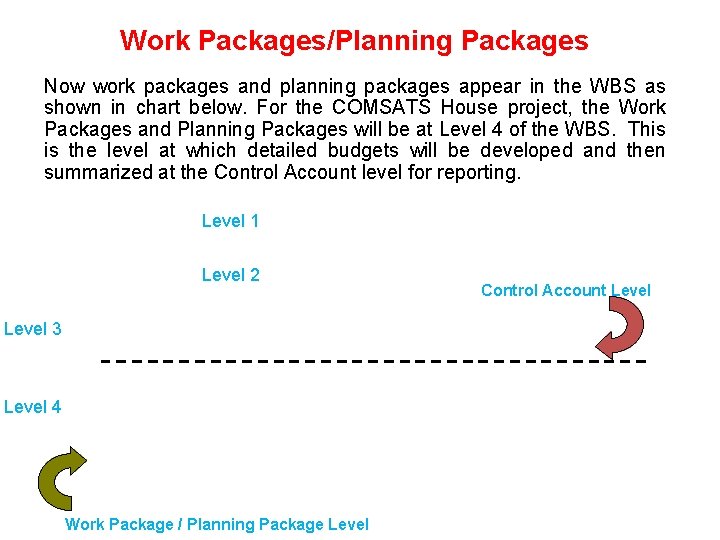
Work Packages/Planning Packages Now work packages and planning packages appear in the WBS as shown in chart below. For the COMSATS House project, the Work Packages and Planning Packages will be at Level 4 of the WBS. This is the level at which detailed budgets will be developed and then summarized at the Control Account level for reporting. Level 1 Level 2 Level 3 Level 4 Work Package / Planning Package Level Control Account Level
Review The budgeting process establishes a means for documenting and tracking the cost goals for all contractually authorized work. The baseline is what cost and schedule performance is measured against. A Control Account is an assigned WBS Level used to monitor the cost and schedule performance of a significant element of the work. Detail below the Control Account Level is contained in Work Packages and Planning Packages.
Summary of This Lecture In this Lecture, we have discussed about Ø Ø Ø Budget Types Reserve Analysis Cost Aggregation & Funding Limit reconciliation WBS, OBS Budgeting Process
End Note Don’t Break Promise, Renegotiate the Commitmen
THANK YOU!