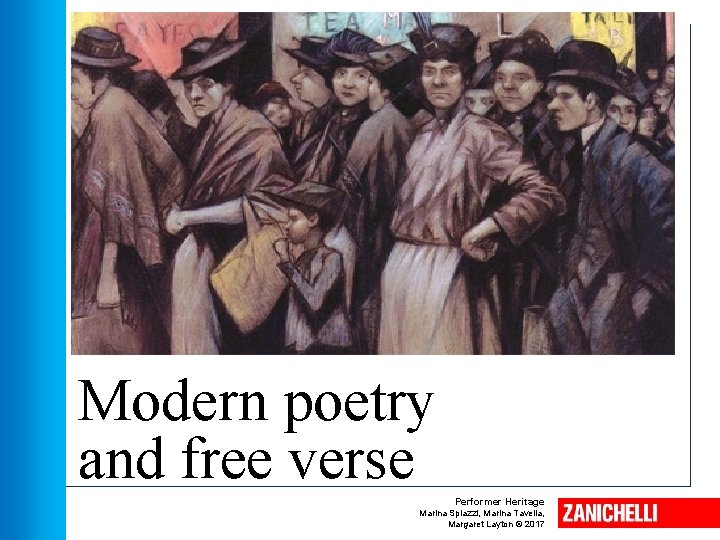
Modern poetry and free verse Performer Heritage Marina




- Slides: 14
Modern poetry and free verse Performer Heritage Marina Spiazzi, Marina Tavella, Margaret Layton © 2017
Modern poetry and free verse 1. Tradition and experimentation First decades of the 20 th century a period of extraordinary originality and vitality in poetry. A variety of trends and currents expressed the nature of modern experience: • the Georgian poets; • the War Poets; • imagist poets; • symbolist poets. Performer Heritage Karl Moll, ‘Twilight’, c. 1900, Osterreisches Gallery, Belvedere (Vienna).
Modern poetry and free verse 2. The Georgian poets influenced by the Victorian Romantic tradition. They were Rupert Brooke (1887 -1915), Walter De La Mare (1873 -1956), and Edward Thomas (1878 -1917). They: • felt sympathy for English elements, such as the countryside as an idyllic place; • employed the convention of diction; • remained indifferent or hostile to the revolution in sensibility and technique started by the Symbolists. Rupert Brooke. Performer Heritage Walter de la Mare. Edward Thomas.
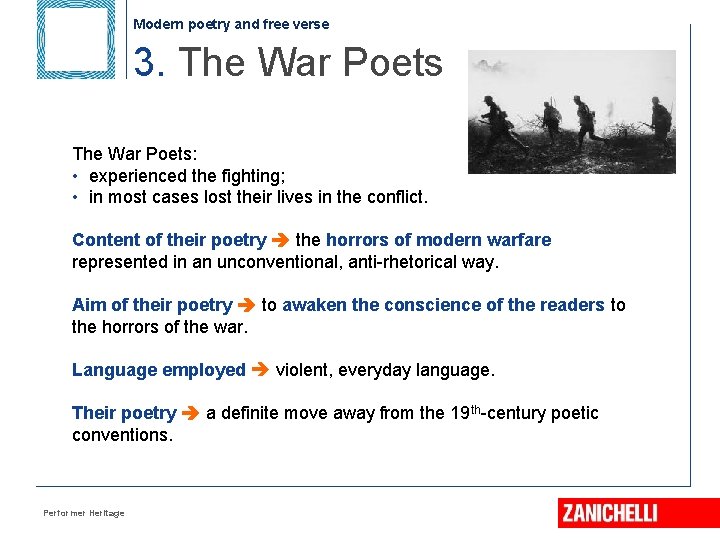
Modern poetry and free verse 3. The War Poets: • experienced the fighting; • in most cases lost their lives in the conflict. Content of their poetry the horrors of modern warfare represented in an unconventional, anti-rhetorical way. Aim of their poetry to awaken the conscience of the readers to the horrors of the war. Language employed violent, everyday language. Their poetry a definite move away from the 19 th-century poetic conventions. Performer Heritage
Modern poetry and free verse 4. Imagist poets Modern poetry officially began with Imagism, a movement which flourished between 1912 and 1917. The name ‘Imagiste’ invented by the American poet Ezra Pound (1885 -1972). Performer Heritage
Modern poetry and free verse 4. Imagist poets The main aesthetic principles of Imagist poets were • free choice of any subject matter; • poems, usually short, were the poet’s response to a scene or object and contained no moral comment; • use of hard, clear and precise images; • use of a rhythm freed from the artificial demands of metrical regularity; • the aim of poetry: to achieve precision, discipline, dry hardness. Performer Heritage
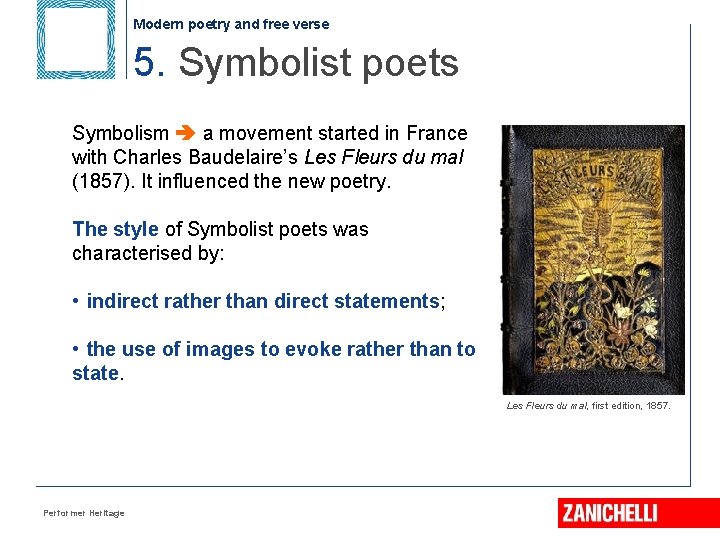
Modern poetry and free verse 5. Symbolist poets Symbolism a movement started in France with Charles Baudelaire’s Les Fleurs du mal (1857). It influenced the new poetry. The style of Symbolist poets was characterised by: • indirect rather than direct statements; • the use of images to evoke rather than to state. Les Fleurs du mal, first edition, 1857. Performer Heritage
Modern poetry and free verse 5. Symbolist poets • the importance given to the ‘sound’ of words; • the use of quotations from other literatures, revealing cosmopolitan interests; • the use of free verse; • the possibility for the reader to bring meaning to the poem. Performer Heritage
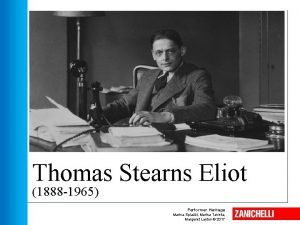
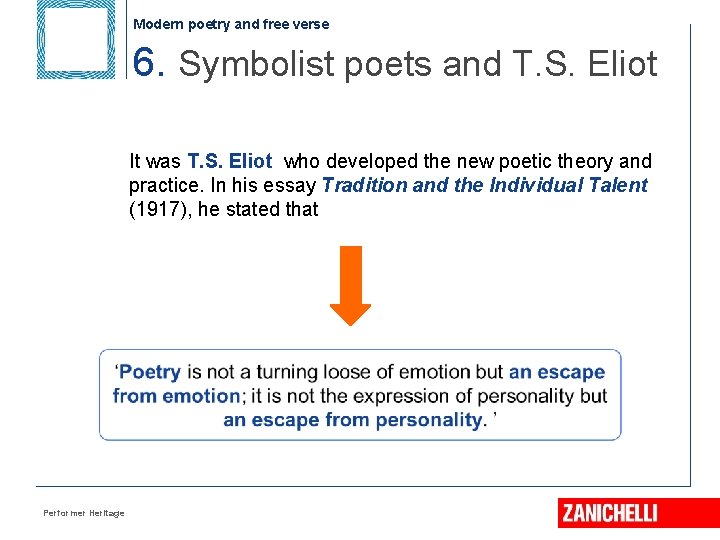
Modern poetry and free verse 6. Symbolist poets and T. S. Eliot It was T. S. Eliot who developed the new poetic theory and practice. In his essay Tradition and the Individual Talent (1917), he stated that Performer Heritage
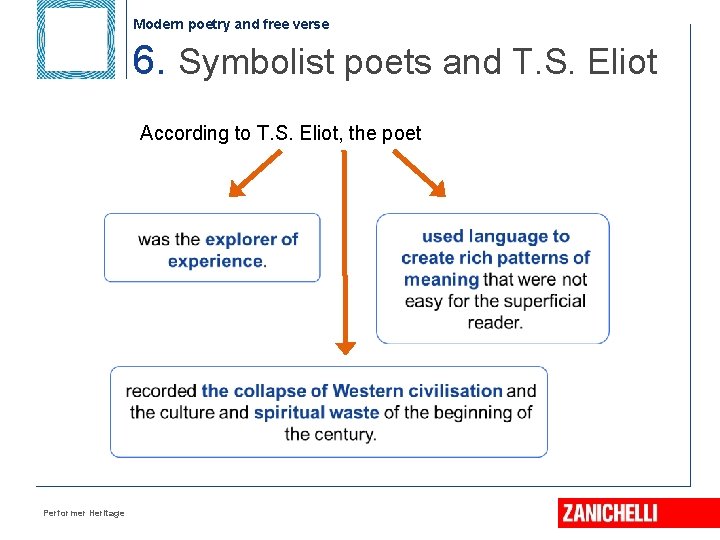
Modern poetry and free verse 6. Symbolist poets and T. S. Eliot According to T. S. Eliot, the poet Performer Heritage
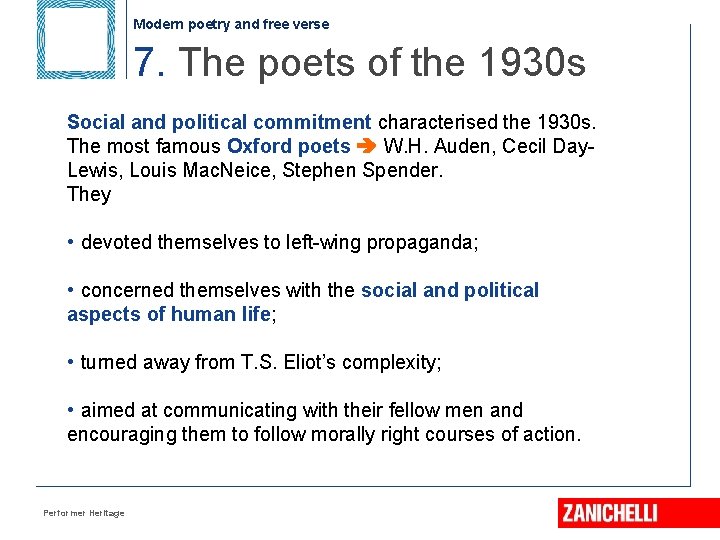
Modern poetry and free verse 7. The poets of the 1930 s Social and political commitment characterised the 1930 s. The most famous Oxford poets W. H. Auden, Cecil Day. Lewis, Louis Mac. Neice, Stephen Spender. They • devoted themselves to left-wing propaganda; • concerned themselves with the social and political aspects of human life; • turned away from T. S. Eliot’s complexity; • aimed at communicating with their fellow men and encouraging them to follow morally right courses of action. Performer Heritage
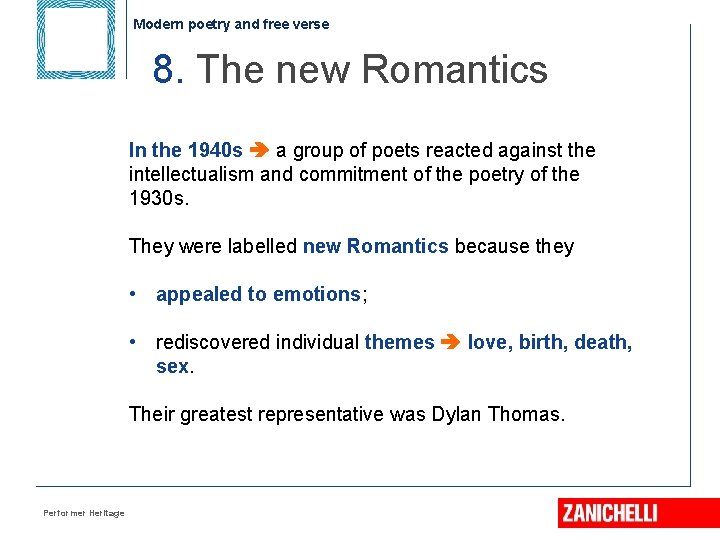
Modern poetry and free verse 8. The new Romantics In the 1940 s a group of poets reacted against the intellectualism and commitment of the poetry of the 1930 s. They were labelled new Romantics because they • appealed to emotions; • rediscovered individual themes love, birth, death, sex. Their greatest representative was Dylan Thomas. Performer Heritage
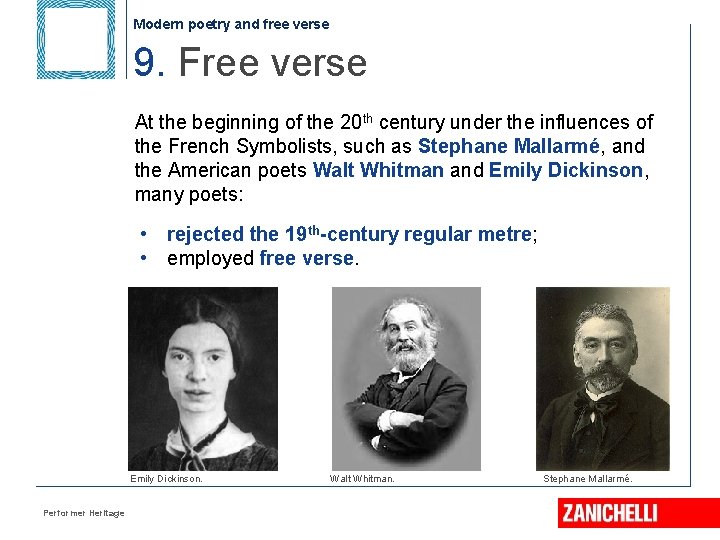
Modern poetry and free verse 9. Free verse At the beginning of the 20 th century under the influences of the French Symbolists, such as Stephane Mallarmé, and the American poets Walt Whitman and Emily Dickinson, many poets: • rejected the 19 th-century regular metre; • employed free verse. Emily Dickinson. Performer Heritage Walt Whitman. Stephane Mallarmé.
Modern poetry and free verse 9. Free verse Features of free verse: • Absence of the traditional metre. • Lack of regular rhyme scheme. • Use of alliteration and assonance. • Metre and sound determined by a correspondence between feeling, impression and poetic form and not by the conventional rules of poetic diction. • The unifying element is the use of the poetic line. • Flexibility of verse line length. Performer Heritage