Modeling MEMS Sensors SUGAR A Computer Aided Design






- Slides: 15
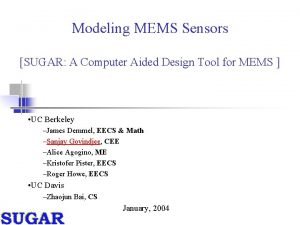
Modeling MEMS Sensors [SUGAR: A Computer Aided Design Tool for MEMS ] • UC Berkeley –James Demmel, EECS & Math –Sanjay Govindjee, CEE –Alice Agogino, ME –Kristofer Pister, EECS –Roger Howe, EECS • UC Davis –Zhaojun Bai, CS January, 2004
Sugar Project Objective • “Be SPICE to the MEMS world” – open source and more Design Fast, Simple, Capable Measurement Simulation
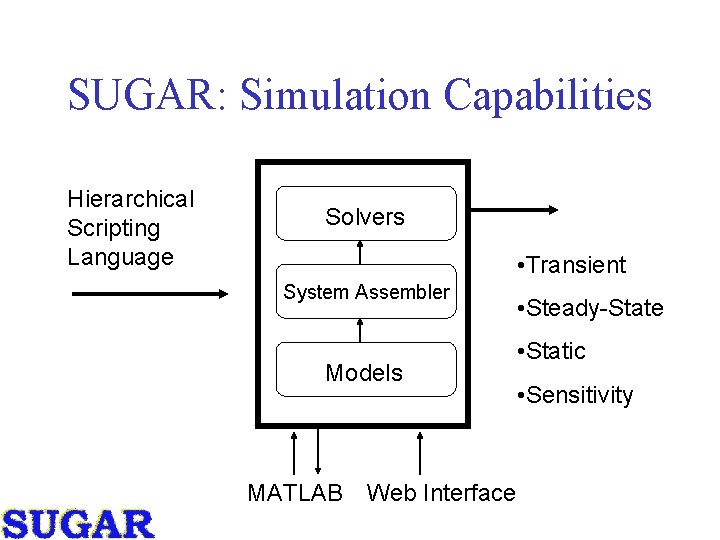
SUGAR: Simulation Capabilities Hierarchical Scripting Language Solvers • Transient System Assembler Models MATLAB Web Interface • Steady-State • Static • Sensitivity
Resonant MEMS Systems • Essential element in RF MEMS signal processing • Specific signal amplification in physical and chemical sensors • Bulk Acoustic Waves for 1 - 100 GHz • Traditional analytic design methods frustratingly inadequate; Abdelmoneum, Demirci, and Nguyen 2003
Checkerboard Resonator
Bode Plot Sun Ultra 10: Exact 1474 sec Reduced 28 sec
Challenges in Simulation of Resonator Based MEMS Sensors • Coupled energy domains with differing temporal and spatial scales; boundary layer effects • Accurate material models: thermoelastic damping, Akhieser mechanism, uncertainty • Radiation boundaries for semi-infinite half-spaces: anchor losses • Large sparse systems for which parallelism needs to be exploited (cluster computing) • Automated generation of reduced order models to accelerate large simulations
Design Synthesis and Optimization • Beyond a quick design tool we are looking to design development and constrained optimization – Multi-objective genetic algorithms (combinatorial type problems) – Specialized gradient methods (continuous type problems)
Simulation is not enough Design synthesis is needed v Unconstrained case v Symmetric Leg Constraint case v Manhattan Angle and Symmetric Leg Constraints case
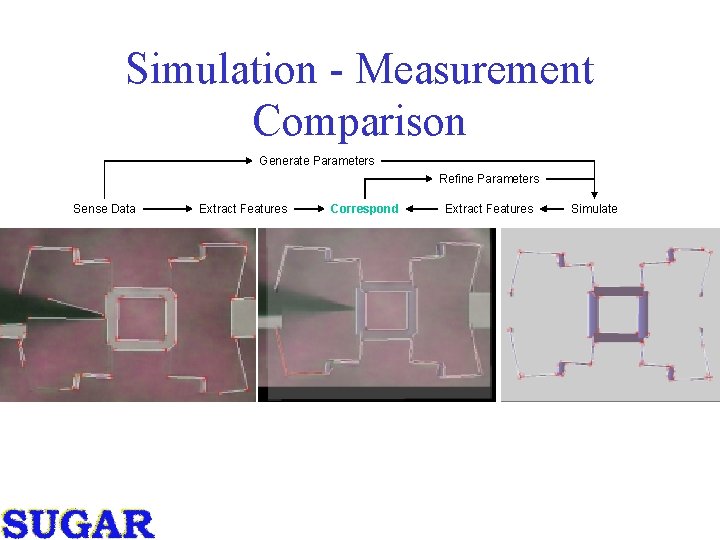
Experimental Measurements • Modeling is not enough; verification is needed – Integrated modeling and testing is the ideal – Tight coupling of simulation and testing with automatic model extraction and comparison (using SMIS)
Synthesized Structures
Simulation - Measurement Comparison Generate Parameters Refine Parameters Sense Data Extract Features Correspond Extract Features Simulate
Other current and future activities • Bounding sets for expected performance variation • Material parameter extraction • Single crystal Silicon models; CMOS processes; Si-Ge etc • Other reduced order models; e. g. electrostatic gap models directly from EM-field equations • Real-time dynamic experiment-simulation coupling • Advanced design synthesis and optimization technologies
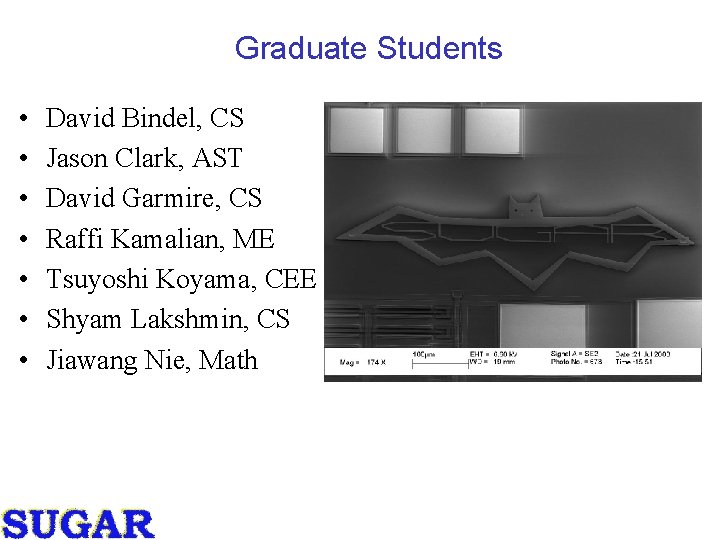
Graduate Students • • David Bindel, CS Jason Clark, AST David Garmire, CS Raffi Kamalian, ME Tsuyoshi Koyama, CEE Shyam Lakshmin, CS Jiawang Nie, Math
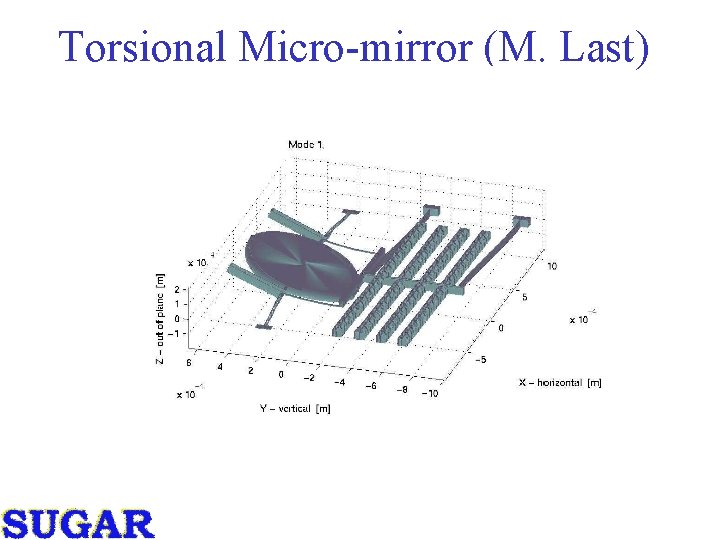
Torsional Micro-mirror (M. Last)