MKTG Principles Of Marketing Twelfth Edition Chapter 2

- Slides: 48
MKTG Principles Of Marketing Twelfth Edition Chapter 2 Strategic Planning for Competitive Advantage © 2019 Cengage. All rights reserved.
Learning Outcomes (slide 1 of 2) 2 -1 2 -2 2 -3 2 -4 2 -5 2 -6 Understand the importance of strategic planning Define strategic business units (SBUs) Identify strategic alternatives and know a basic outline for a marketing plan Develop an appropriate business mission statement Describe the components of a situation analysis Identify sources of competitive advantage © 2019 Cengage. All rights reserved.
Learning Outcomes (slide 2 of 2) 2 -7 Explain the criteria for stating good marketing objectives 2 -8 Discuss target market strategies 2 -9 Describe the elements of the marketing mix 2 -10 Explain why implementation, evaluation, and control of the marketing plan are necessary 2 -11 Identify several techniques that help make strategic planning effective © 2019 Cengage. All rights reserved.
Strategic Planning • Strategic planning: is the managerial process of creating and maintaining a fit between the organization’s objectives and resources and the evolving market opportunities • Strategic marketing management addresses two questions: – What is the organization’s main activity at a particular time? – How will it reach its goals? © 2019 Cengage. All rights reserved.
Strategic Business Units (SBUs) • Strategic Business Units (SBUs): a subgroup of a single business or collection of related businesses within the larger organization • SBUs have the following characteristics: – – – Distinct mission and specific target market Control over its resources Its own competitors A single business or a collection of related businesses Plans independent of other SBUs in the total organization © 2019 Cengage. All rights reserved.
Strategic Alternatives • A company, or an SBU, can use several tools to manage the strategic direction of its portfolio of businesses – Ansoff’s strategic opportunity matrix – Boston Consulting Group model – General Electric model © 2019 Cengage. All rights reserved.
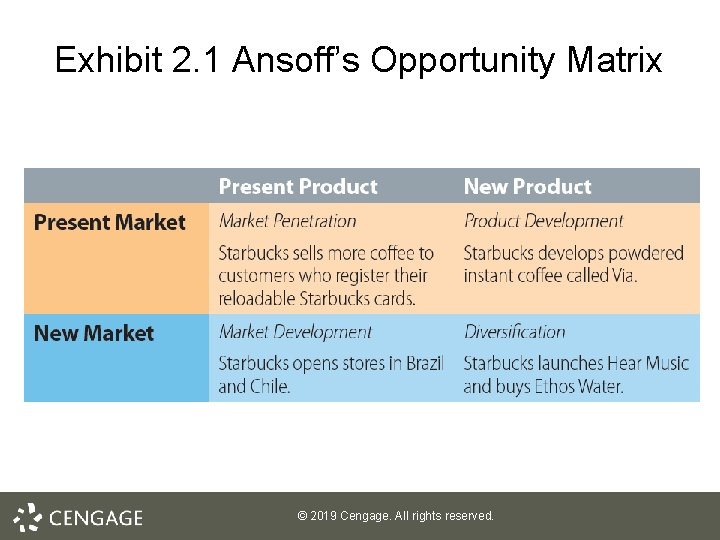
Ansoff’s Strategic Opportunity Matrix • A method for developing alternatives is Ansoff’s strategic opportunity matrix, which matches products with markets – Market penetration: a marketing strategy that tries to increase market share among existing customers – Market development: a marketing strategy that entails attracting new customers to existing products – Product development: a marketing strategy that entails the creation of new products for present markets – Diversification: a strategy of increasing sales by introducing new products into new markets © 2019 Cengage. All rights reserved.
Exhibit 2. 1 Ansoff’s Opportunity Matrix © 2019 Cengage. All rights reserved.
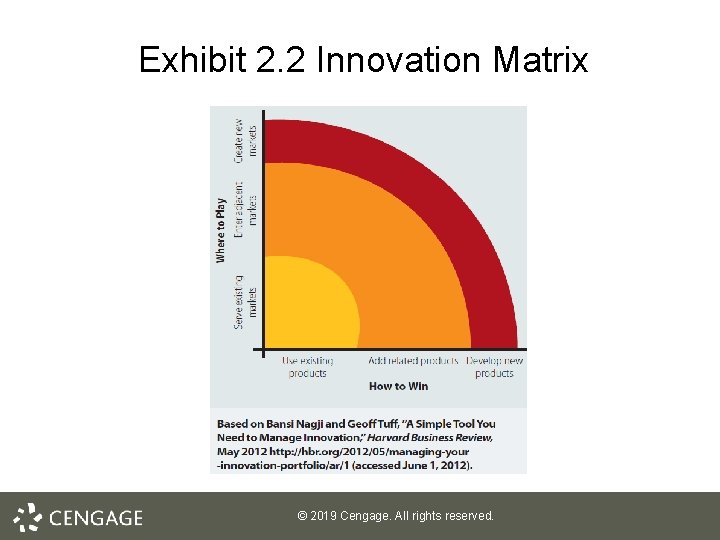
The Innovation Matrix (slide 1 of 2) • The Innovation Matrix allows a company to see exactly what types of assets need to be developed and what types of markets are possible to grow into based on the company’s core capabilities • As a company moves away from its core capabilities it crosses a range of change and innovation • These ranges are broken down into three levels: – Core Innovation: These decisions implement changes that use existing assets to provide added convenience to existing customers and potentially entice customers from other brands. © 2019 Cengage. All rights reserved.
The Innovation Matrix (2 of 2) • Three levels, cont. – Adjacent Innovation: These decisions are designed to take company strengths into new markets. This space uses existing abilities in new ways. – Transformational Innovation: These decisions result in brand -new markets, products, and often new businesses. The company must rely on new, unfamiliar assets to develop the type of breakthrough decisions that fall in this category. © 2019 Cengage. All rights reserved.
Exhibit 2. 2 Innovation Matrix © 2019 Cengage. All rights reserved.
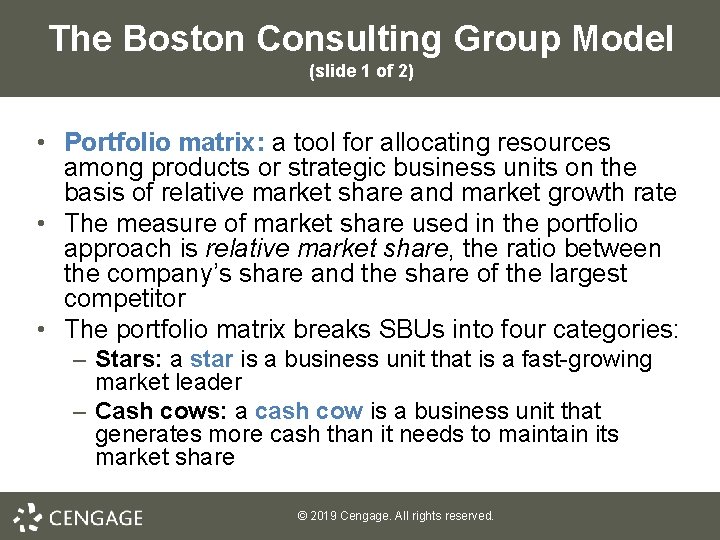
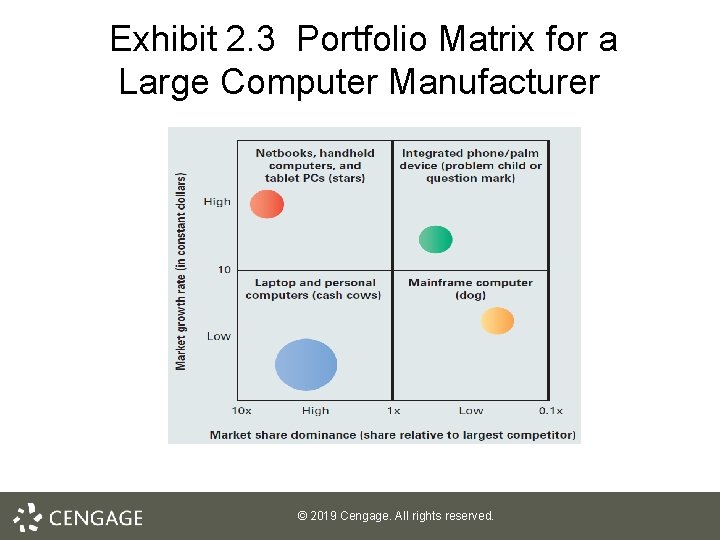
The Boston Consulting Group Model (slide 1 of 2) • Portfolio matrix: a tool for allocating resources among products or strategic business units on the basis of relative market share and market growth rate • The measure of market share used in the portfolio approach is relative market share, the ratio between the company’s share and the share of the largest competitor • The portfolio matrix breaks SBUs into four categories: – Stars: a star is a business unit that is a fast-growing market leader – Cash cows: a cash cow is a business unit that generates more cash than it needs to maintain its market share © 2019 Cengage. All rights reserved.
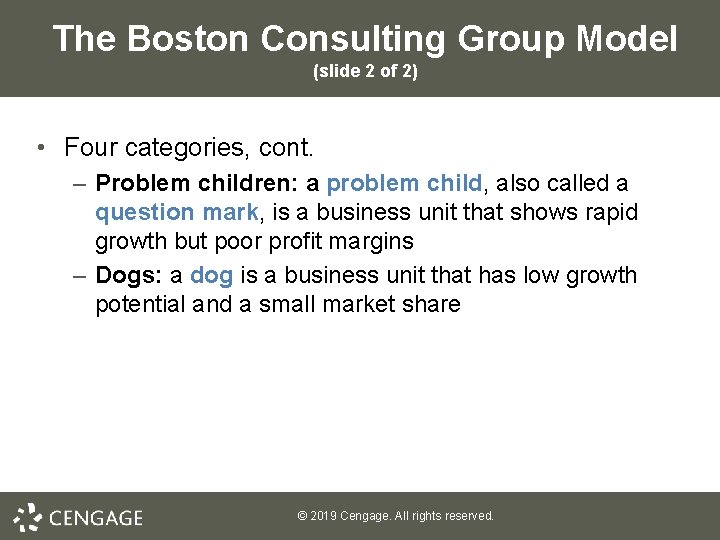
The Boston Consulting Group Model (slide 2 of 2) • Four categories, cont. – Problem children: a problem child, also called a question mark, is a business unit that shows rapid growth but poor profit margins – Dogs: a dog is a business unit that has low growth potential and a small market share © 2019 Cengage. All rights reserved.
Exhibit 2. 3 Portfolio Matrix for a Large Computer Manufacturer © 2019 Cengage. All rights reserved.
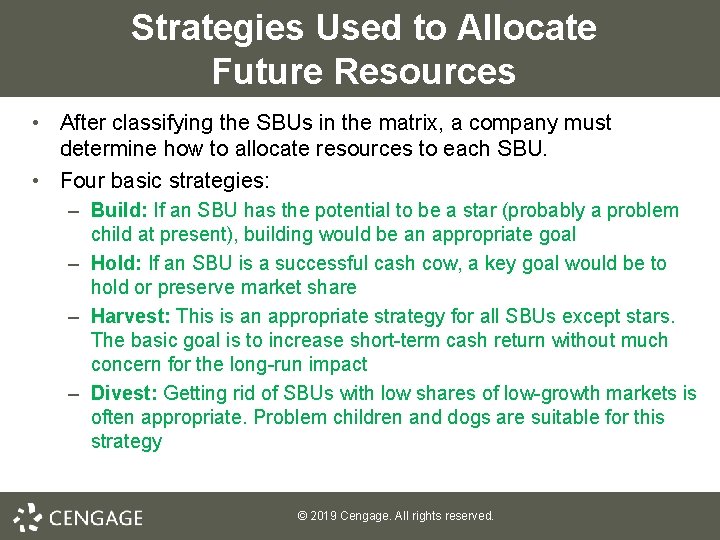
Strategies Used to Allocate Future Resources • After classifying the SBUs in the matrix, a company must determine how to allocate resources to each SBU. • Four basic strategies: – Build: If an SBU has the potential to be a star (probably a problem child at present), building would be an appropriate goal – Hold: If an SBU is a successful cash cow, a key goal would be to hold or preserve market share – Harvest: This is an appropriate strategy for all SBUs except stars. The basic goal is to increase short-term cash return without much concern for the long-run impact – Divest: Getting rid of SBUs with low shares of low-growth markets is often appropriate. Problem children and dogs are suitable for this strategy © 2019 Cengage. All rights reserved.
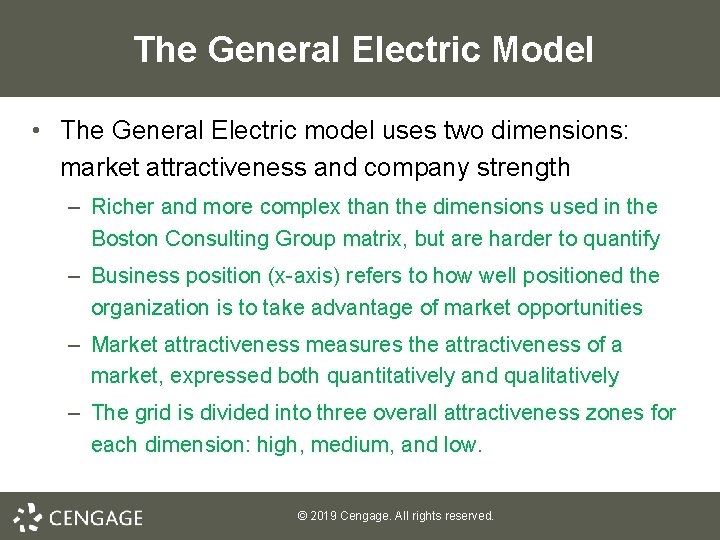
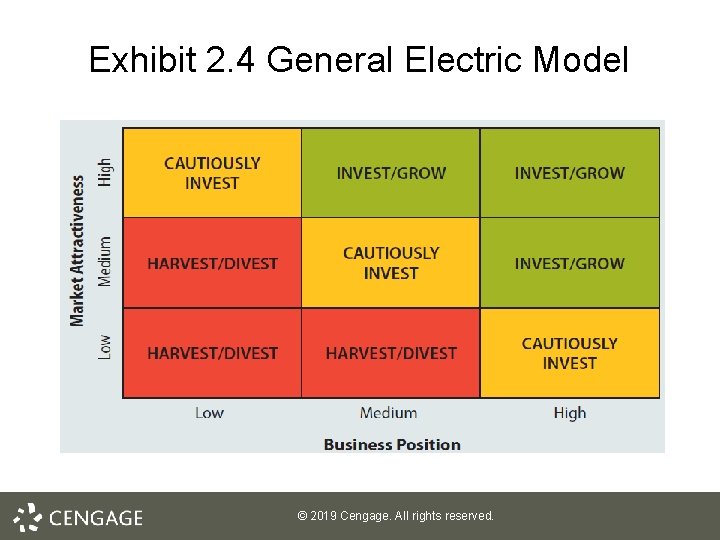
The General Electric Model • The General Electric model uses two dimensions: market attractiveness and company strength – Richer and more complex than the dimensions used in the Boston Consulting Group matrix, but are harder to quantify – Business position (x-axis) refers to how well positioned the organization is to take advantage of market opportunities – Market attractiveness measures the attractiveness of a market, expressed both quantitatively and qualitatively – The grid is divided into three overall attractiveness zones for each dimension: high, medium, and low. © 2019 Cengage. All rights reserved.
Exhibit 2. 4 General Electric Model © 2019 Cengage. All rights reserved.
The Marketing Plan • Planning: the process of anticipating future events and determining strategies to achieve organizational objectives in the future • Marketing planning: designing activities relating to marketing objectives and the changing marketing environment • Marketing plan: a written document that acts as a guidebook of marketing activities for the marketing manager © 2019 Cengage. All rights reserved.
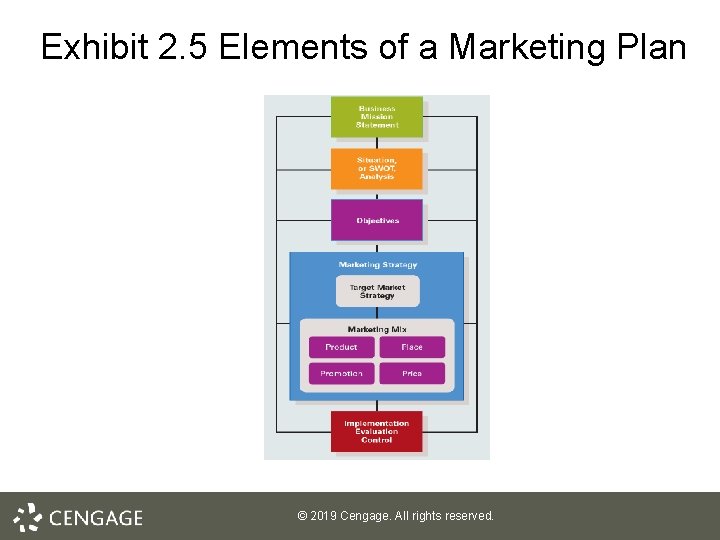
Exhibit 2. 5 Elements of a Marketing Plan © 2019 Cengage. All rights reserved.
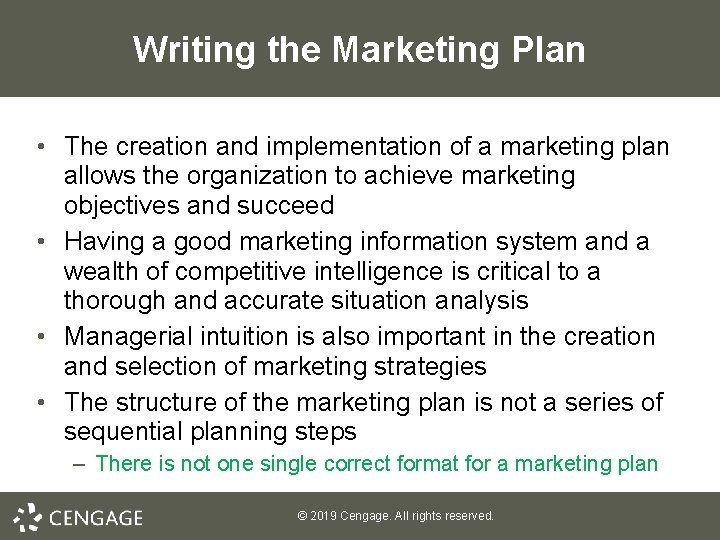
Writing the Marketing Plan • The creation and implementation of a marketing plan allows the organization to achieve marketing objectives and succeed • Having a good marketing information system and a wealth of competitive intelligence is critical to a thorough and accurate situation analysis • Managerial intuition is also important in the creation and selection of marketing strategies • The structure of the marketing plan is not a series of sequential planning steps – There is not one single correct format for a marketing plan © 2019 Cengage. All rights reserved.
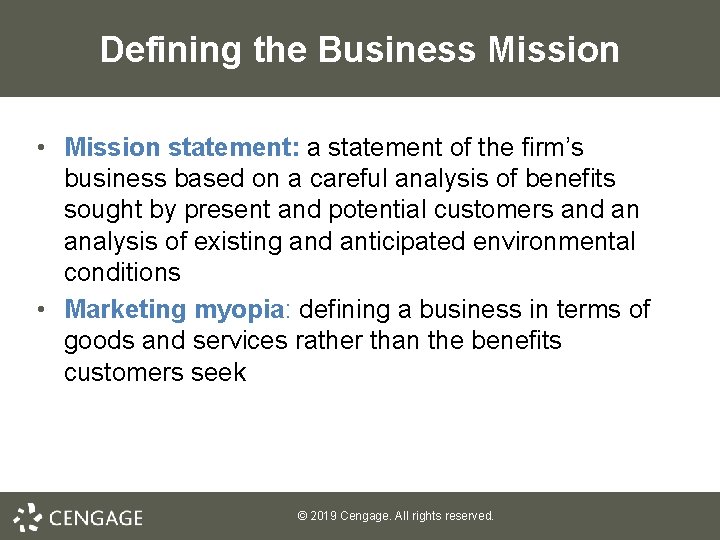
Defining the Business Mission • Mission statement: a statement of the firm’s business based on a careful analysis of benefits sought by present and potential customers and an analysis of existing and anticipated environmental conditions • Marketing myopia: defining a business in terms of goods and services rather than the benefits customers seek © 2019 Cengage. All rights reserved.
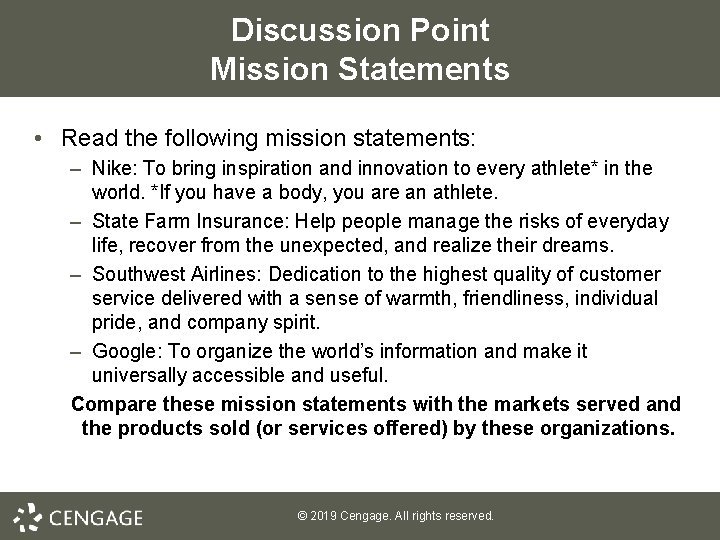
Discussion Point Mission Statements • Read the following mission statements: – Nike: To bring inspiration and innovation to every athlete* in the world. *If you have a body, you are an athlete. – State Farm Insurance: Help people manage the risks of everyday life, recover from the unexpected, and realize their dreams. – Southwest Airlines: Dedication to the highest quality of customer service delivered with a sense of warmth, friendliness, individual pride, and company spirit. – Google: To organize the world’s information and make it universally accessible and useful. Compare these mission statements with the markets served and the products sold (or services offered) by these organizations. © 2019 Cengage. All rights reserved.
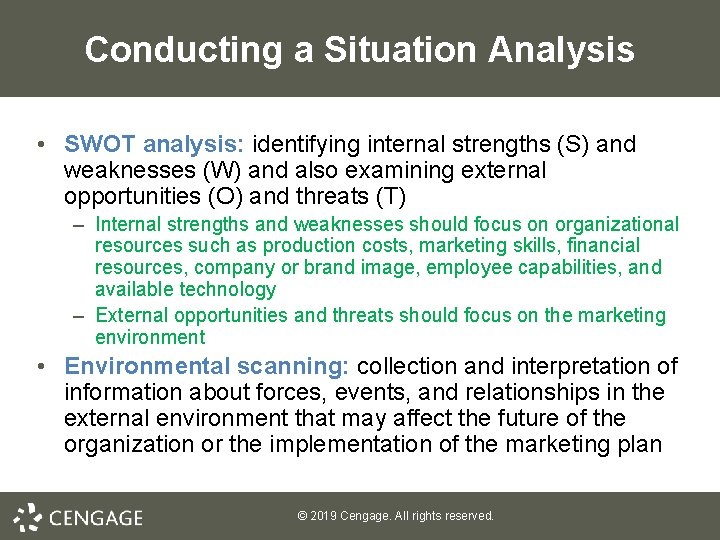
Conducting a Situation Analysis • SWOT analysis: identifying internal strengths (S) and weaknesses (W) and also examining external opportunities (O) and threats (T) – Internal strengths and weaknesses should focus on organizational resources such as production costs, marketing skills, financial resources, company or brand image, employee capabilities, and available technology – External opportunities and threats should focus on the marketing environment • Environmental scanning: collection and interpretation of information about forces, events, and relationships in the external environment that may affect the future of the organization or the implementation of the marketing plan © 2019 Cengage. All rights reserved.
Discussion Point SWOT Analysis • Conduct a SWOT analysis for a company of your choosing. Be sure to include at least two strengths, two weaknesses, two opportunities, and two threats. © 2019 Cengage. All rights reserved.
Competitive Advantage • Competitive advantage: a set of unique features of a company and its products that are perceived by the target market as significant and superior to those of the competition • Three types of competitive advantage: – Cost – Product/service differentiation – Niche © 2019 Cengage. All rights reserved.
Cost Competitive Advantage (slide 1 of 2) • Cost competitive advantage: being the low-cost competitor in an industry while maintaining satisfactory profit margins • Costs can be reduced in a variety of ways: – Experience curves: curves that show costs declining at a predictable rate as experience with a product increases – Efficient labor: labor costs can be an important component of total costs in low-skill, labor-intensive industries – No-frills products and services: removing frills and options from a product or service can reduce costs – Government subsidies: governments may provide grants and interest-free loans to target industries © 2019 Cengage. All rights reserved.
Cost Competitive Advantage (slide 2 of 2) – Product design: cutting-edge design and reverse engineering can offset costs – Reengineering: fundamental rethinking and redesign of business processes help achieve dramatic improvements in critical measures of performance – Product innovations: new technology and simplified production techniques can reduce the average production costs – New methods of service delivery: medical expenses have been lowered by the use of outpatient surgery and walk-in clinics. Online-only magazines can help save on material and shipping costs © 2019 Cengage. All rights reserved.
Product/Service Differentiation Competitive Advantage • Product/service differentiation competitive advantage: the provision of something unique and valuable to buyers beyond simply offering a lower price than that of the competition – – – Brand names Strong dealer network Product reliability Image Service © 2019 Cengage. All rights reserved.
Niche Competitive Advantage • Niche competitive advantage: the advantage achieved when a firm seeks to target and effectively serve a single segment of the market – Used by small companies with limited resources – May be used in a limited geographic market – Effective for market segments with good growth potential but is not crucial to success of competitors © 2019 Cengage. All rights reserved.
Discussion Point Competitive Advantage • Look at the list firms: – Ritz Carlton hotels – Southwest Airlines – Lefty’s, a retail store in San Francisco that sells school supplies, kitchen tools, and more for left-handed people – General Electric – Coca Cola What type of competitive advantage is each company using: cost, product/service differentiation, or niche? © 2019 Cengage. All rights reserved.
Building Sustainable Competitive Advantage • Sustainable competitive advantage: an advantage that cannot be copied by the competition • Notion is that a successful firm will stake out a position unique in some manner from its rivals • Sources: Skills and assets of an organization – Patents, copyrights, locations, equipment, technology, customer service, and promotion © 2019 Cengage. All rights reserved.
Setting Marketing Plan Objectives (slide 1 of 2) • Marketing objective: a statement of what is to be accomplished through marketing activities • Should be: – Realistic: Managers should develop objectives that have a chance of being met. – Measurable: Managers need to be able to quantitatively measure whether or not an objective has been met. – Time specific: By what time should the objective be met? – Compared to a benchmark: The objective is to increase sales by 15 percent; it is important to know the baseline against which the objective will be measured. © 2019 Cengage. All rights reserved.
Setting Marketing Plan Objectives (slide 2 of 2) • Communicate marketing management philosophy • Provide directions for lower-level marketing managers to integrate and point marketing efforts in a consistent direction • Motivate employees • Force executives to clarify their thinking • Form a basis for control © 2019 Cengage. All rights reserved.
Describing the Target Market (slide 1 of 2) • Marketing strategy: the activities of selecting and describing one or more target markets and developing and maintaining a marketing mix that will produce mutually satisfying exchanges with target markets • The target market strategy identifies the market segment or segments to focus on • Market opportunity analysis (MOA): the description and estimation of the size and sales potential of market segments that are of interest to the firm and the assessment of key competitors in these market segments © 2019 Cengage. All rights reserved.
Describing the Target Market (slide 2 of 2) • Strategies for selecting target markets: – Appeal to the entire market with one marketing mix – Concentrate on one marketing segment – Appeal to multiple market segments with multiple marketing mixes © 2019 Cengage. All rights reserved.
The Marketing Mix • Marketing mix (four Ps): a unique blend of product, place (distribution), promotion, and pricing strategies designed to produce mutually satisfying exchanges with a target market – Any marketing mix is only as good as its weakest component • Marketing mixes are carefully designed to satisfy target markets © 2019 Cengage. All rights reserved.
Product Strategies • Product: – The product is the starting point of the marketing mix. It is difficult to decide on a promotion campaign, determine a price, or design a distribution strategy until the product offering and product strategy are defined – The product is not only the physical unit but also its package, warranty, after-sale service, brand name, company image, value, and other factors – Product involves tangible goods, ideas, or services © 2019 Cengage. All rights reserved.
Place (Distribution) Strategies • Place, or distribution, involves: – Physical distribution that includes storage and transportation – Making product available where and when customers want them – Ensuring that products arrive in usable condition at designated places when needed © 2019 Cengage. All rights reserved.
Promotion Strategies • Promotion: – Includes advertising, public relations, sales promotion, and personal selling – Brings about mutually satisfying exchanges by informing, educating, persuading, and reminding buyers about the product – Each element of the promotion mix is coordinated with the others to create a promotional blend – A good promotion strategy can increase sales © 2019 Cengage. All rights reserved.
Pricing Strategies • Price: – What a buyer must give up to obtain a product – Most flexible of the “four Ps” – Price is an important competitive weapon. Of the four Ps, it can be changed most quickly – Price multiplied by the number of units sold equals total revenue for the firm © 2019 Cengage. All rights reserved.
Following up on the Marketing Plan (slide 1 of 3) • Implementation: the process that turns a marketing plan into action assignments and ensures these assignments are executed in a way that accomplishes the plan's objectives – Requires delegating authority and responsibility – Determining a time frame for completing tasks – Allocating resources • Evaluation: gauging the extent to which the marketing objectives have been achieved during the specified time period © 2019 Cengage. All rights reserved.
Following up on the Marketing Plan (slide 2 of 3) • Control: provides the mechanisms for evaluating marketing results in light of the plan’s objectives and for correcting actions that do not help the organization reach those objectives within budget guidelines • Marketing audit: a thorough, systematic, periodic evaluation of the objectives, strategies, structure, and performance of the marketing organization – Broadest control device available to marketing managers – Main purpose is to develop a full profile of the organization’s marketing effort and to provide a basis for developing and revising the marketing plan – Can also improve communication © 2019 Cengage. All rights reserved.
Following up on the Marketing Plan (slide 3 of 3) • Post-Audit Tasks: – To profile and make recommendations about weaknesses and inhibiting factors as well as strengths and new opportunities – To ensure that the role of the audit has been clearly communicated – To make someone accountable for implementing recommendations © 2019 Cengage. All rights reserved.
Effective Strategic Planning • Effective strategic planning requires continual attention, creativity, and management commitment – Strategic planning should not be an annual exercise in which managers go through the motions and forget about strategic planning until the next year – Sound strategic planning is based on creativity. Managers should challenge assumptions about the firm and the environment and establish new strategies – Perhaps the most critical element in successful strategic planning is top management’s support and participation © 2019 Cengage. All rights reserved.
Key Terms (slide 1 of 4) • • • Strategic planning Strategic business unit (SBU) Market penetration Market development Product development Diversification Portfolio matrix Star Cash cow Problem child (question mark) © 2019 Cengage. All rights reserved.
Key Terms (slide 2 of 4) • • • Dog Planning Marketing plan Mission statement Marketing myopia SWOT analysis Environmental scanning Competitive advantage Cost competitive advantage © 2019 Cengage. All rights reserved.
Key Terms (slide 3 of 4) • • Experience curves Product/service differentiation competitive advantage Niche competitive advantage Sustainable competitive advantage Marketing objective Marketing strategy Market opportunity analysis (MOA) Marketing mix (four Ps) © 2019 Cengage. All rights reserved.
Key Terms (slide 4 of 4) • • Implementation Evaluation Control Marketing audit © 2019 Cengage. All rights reserved.