Mediation and legislative prospects of its development in
- Slides: 15
Mediation and legislative prospects of its development in accordance with best European practices Kari Kiesiläinen 18 December
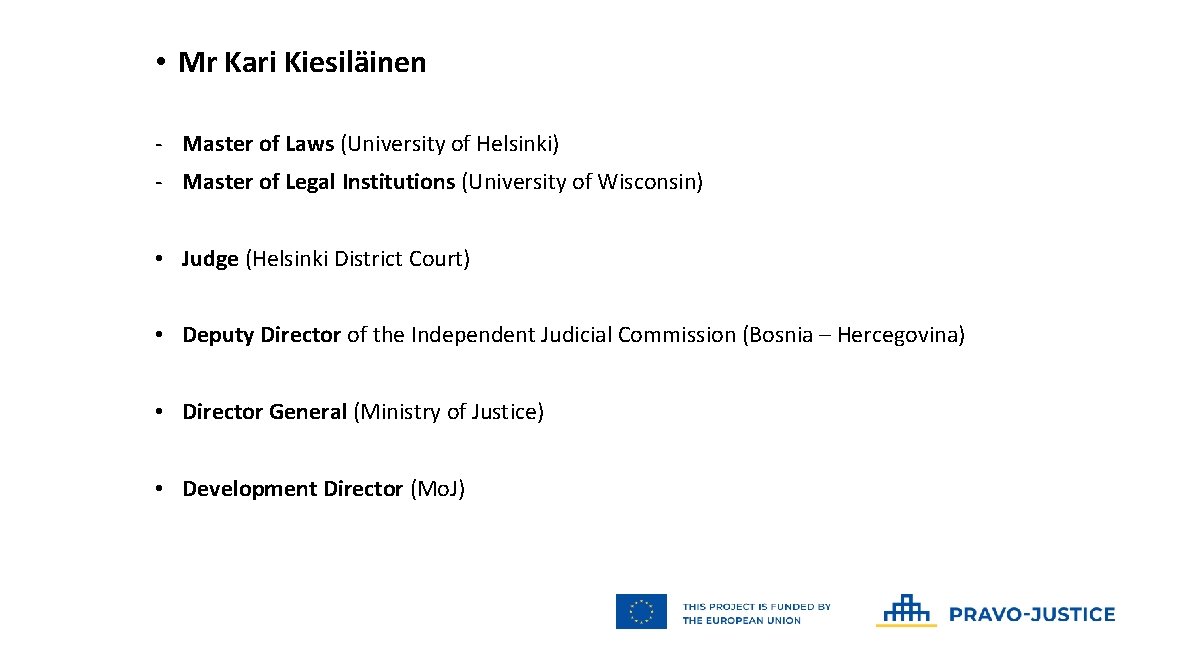
• Mr Kari Kiesiläinen - Master of Laws (University of Helsinki) - Master of Legal Institutions (University of Wisconsin) • Judge (Helsinki District Court) • Deputy Director of the Independent Judicial Commission (Bosnia – Hercegovina) • Director General (Ministry of Justice) • Development Director (Mo. J)
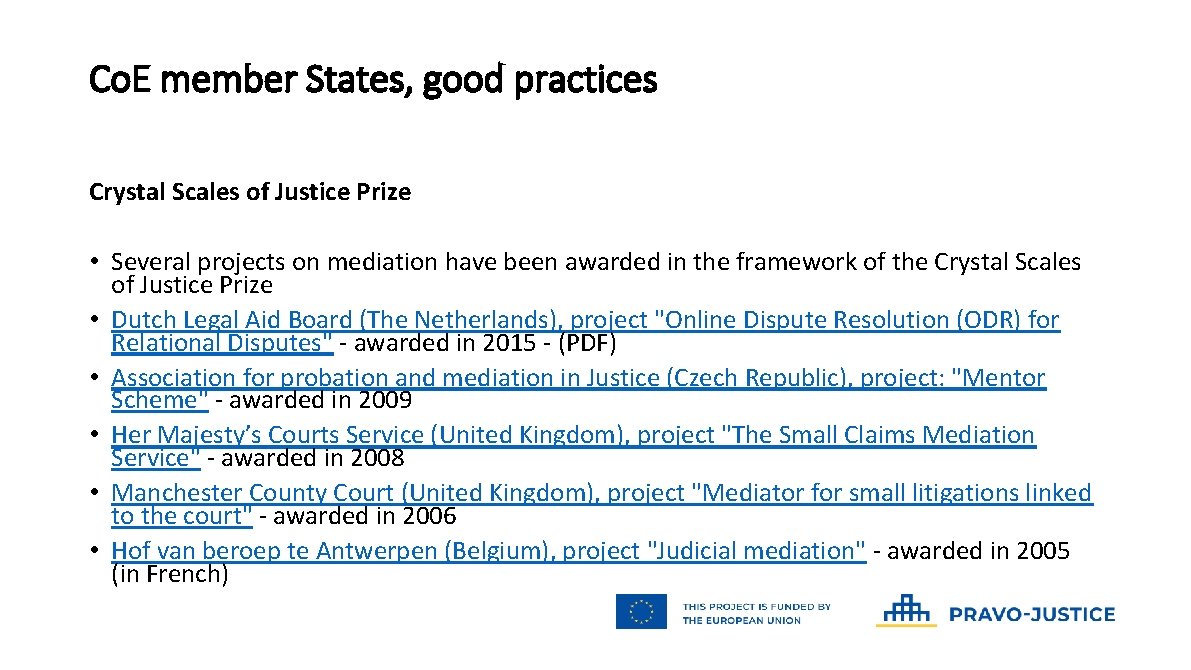
Co. E member States, good practices Crystal Scales of Justice Prize • Several projects on mediation have been awarded in the framework of the Crystal Scales of Justice Prize • Dutch Legal Aid Board (The Netherlands), project "Online Dispute Resolution (ODR) for Relational Disputes" - awarded in 2015 - (PDF) • Association for probation and mediation in Justice (Czech Republic), project: "Mentor Scheme" - awarded in 2009 • Her Majesty’s Courts Service (United Kingdom), project "The Small Claims Mediation Service" - awarded in 2008 • Manchester County Court (United Kingdom), project "Mediator for small litigations linked to the court" - awarded in 2006 • Hof van beroep te Antwerpen (Belgium), project "Judicial mediation" - awarded in 2005 (in French)
Recommendation Rec (2002)10 of the Co. E Committee of Ministers to member States on mediation in civil matters Guiding Principles concerning mediation in civil matters I. Definition of mediation II. Scope of application III. Organization of mediation IV. Mediation process V. Training and responsibility of mediators VI. Agreements reached in mediation VII. Information on mediation VIII. International aspects
International standards • Council of Europe: Recommendation No R(99) 19 of the Committee of Ministers to Member States concerning mediation in penal matters => update 2018 • United Nations Economic and Social Council resolution 2002/12: Basic principles on use of restorative justice programmes in criminal matters
European Union Victims´ Directive • DIRECTIVE 2012/29/EU OF THE EUROPEAN PARLIAMENT AND OF THE COUNCIL of 25 October 2012 • Establishes minimum standards on the rights, support and protection of victims of crime, and replacing Council Framework Decision 2001/220/JHA • Emphasizes the benefit of restorative justice interventions such as victimoffender mediation or family group conferencing to the victim (Preamble 46). • The European Code of Conduct for Mediators in 2004, • A non-binding soft law instrument setting model principles to guide the European mediators in their work.
Court Mediation • The Act on Mediation in Civil Matters and Confirmation of Settlements in General Courts • The mediator is a judge • The advantages include speed, low costs and the right that the parties themselves have to manage and control the conciliation agreement. • To ensure the needed expertise, the mediator is free to bring in an assistant. • The mediation is confidential; if the case is not settled and moves on to a court trial, • The mediating judge may not hear the case in an eventual trial. • Mediation in the civil procedure • The Code of Judicial Procedure enacted in 1991 introduced a mandatory tool for the judges to encourage the parties into a settlement in cases amenable to settlemen • Child custody mediation • Plea bargain
Court procedure related mediation • The Ministry of Social Affairs and Health leads, steers and monitors the mediation services in criminal and civil cases at national level. • A free-of-charge public service • Volunteer mediators mediate between the parties to a crime or a dispute and assist them in the negotiations. • The purpose of mediation is to discuss the mental and material harm suffered by the victim and agree on measures to redress the harm. • Mediation is a procedure either parallel or supplementary to the criminal process. • A key objective is to prevent recidivism.
Provisions on mediation in criminal and civil cases laid down by law The Advisory Board on Mediation in Criminal Cases, - appointed by the Government, - monitors, outlines and promotes the mediation activities and development. The Finnish Institute for Health and Welfare (THL) • responsible for organizing mediation across the country. • concludes service provision contracts with municipalities and third-sector operators; • guides and supervises the mediation offices; • organizes training for the personnel; • allocates the state reimbursement for organizing mediation services to the mediation offices; • compiles statistics on mediation in criminal and civil cases, monitors and studies mediation, and coordinates its development at national level.
In criminal and civil cases mediation can be requested • by a party involved in a criminal or civil case • by a guardian or a legal representative of a child or a young person • by the police, prosecuting authority or other authority. • A mediation request is submitted to the nearest mediation office. • However, in domestic violence cases, only the police or prosecutor can initiate mediation. • The officials at the mediation office assess whether the case is suitable for mediation and give parties advice on all details.
Consent is required • Mediation can be undertaken only between parties who have personally and voluntarily expressed their consent to mediation and who can understand the significance of mediation and of any mediation settlements. Before giving their consent to mediation, the parties will be informed of their rights and status in the mediation process. The parties have the right to withdraw their consent at any point during the mediation. Mediation is subject to consent from all parties involved. Consent is required even from minors and their guardians or, if necessary, their legal representative.
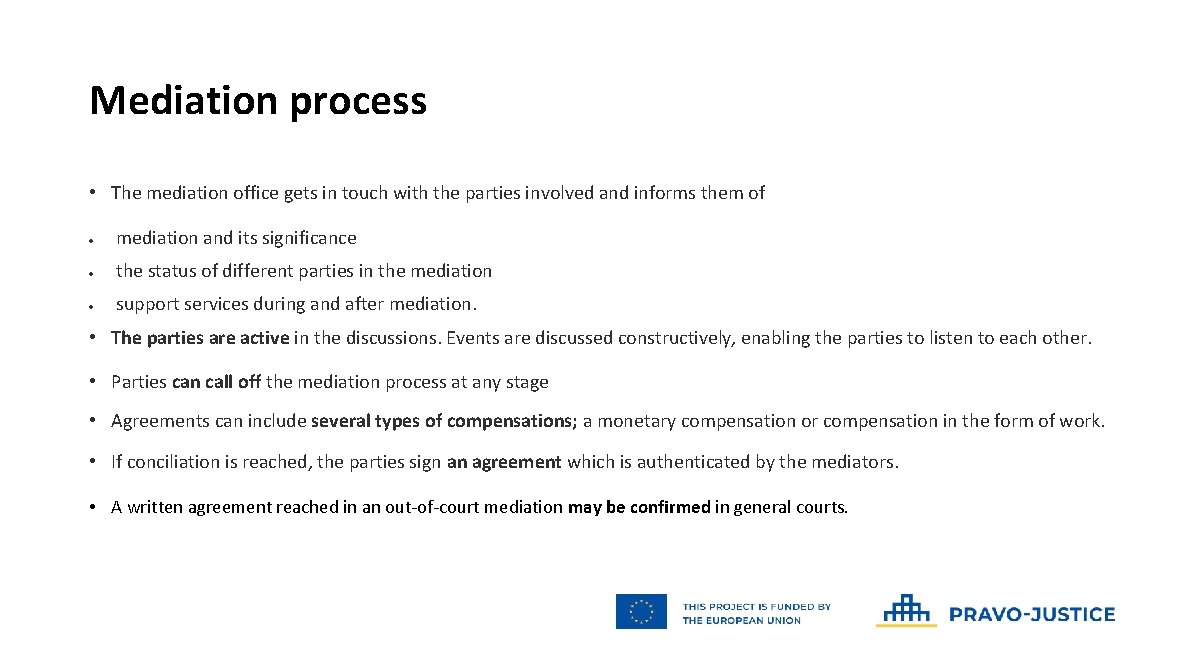
Mediation process • The mediation office gets in touch with the parties involved and informs them of mediation and its significance the status of different parties in the mediation support services during and after mediation. • The parties are active in the discussions. Events are discussed constructively, enabling the parties to listen to each other. • Parties can call off the mediation process at any stage • Agreements can include several types of compensations; a monetary compensation or compensation in the form of work. • If conciliation is reached, the parties sign an agreement which is authenticated by the mediators. • A written agreement reached in an out-of-court mediation may be confirmed in general courts.
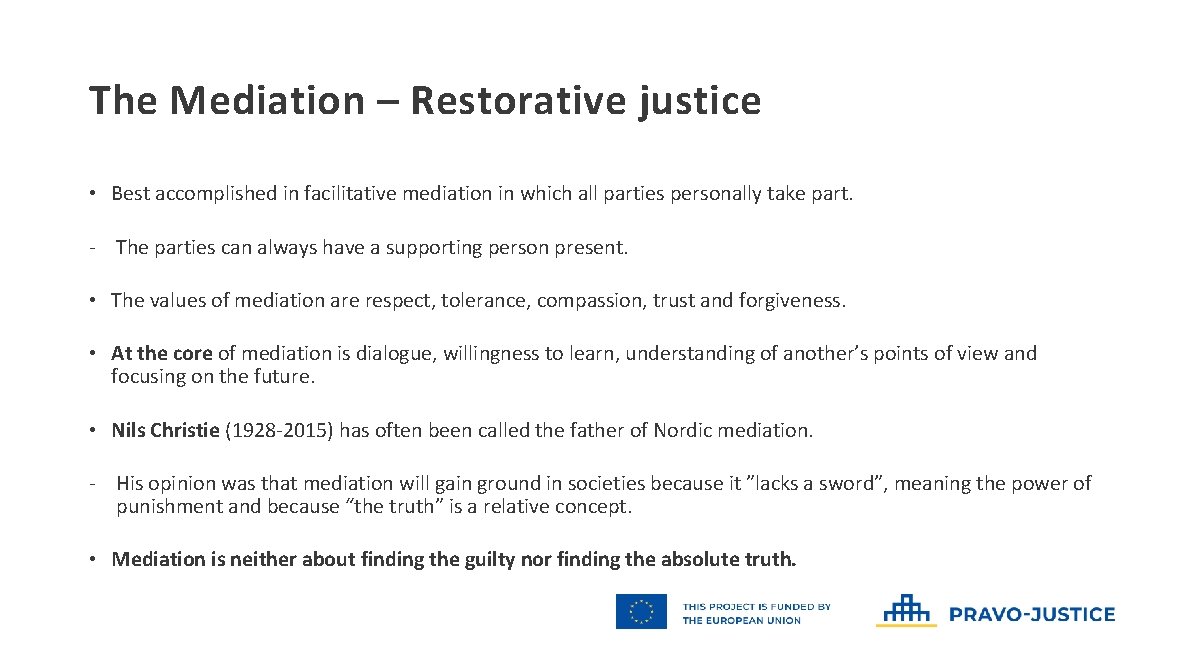
The Mediation – Restorative justice • Best accomplished in facilitative mediation in which all parties personally take part. - The parties can always have a supporting person present. • The values of mediation are respect, tolerance, compassion, trust and forgiveness. • At the core of mediation is dialogue, willingness to learn, understanding of another’s points of view and focusing on the future. • Nils Christie (1928 -2015) has often been called the father of Nordic mediation. - His opinion was that mediation will gain ground in societies because it ”lacks a sword”, meaning the power of punishment and because “the truth” is a relative concept. • Mediation is neither about finding the guilty nor finding the absolute truth.
Other arenas of mediation • • • The Finnish Bar Association – attorneys as mediator Mediation in the field of day care and education – VERSO -programme Mediation in work communities Mediation in family conflicts Environmental mediation Private mediation for example Ms PIRITA VIRTANEN Mediator, Founder & CEO International or Peace Mediation Finnish Forum for Mediation in Labour Disputes – National Conciliator Mediation in commercial disputes
Thank you! This presentation was produced with the financial support of the European Union. Its contents are the sole responsibility of PRAVO-JUSTICE and do not necessarily reflect the views of the European Union.