
Agriculture in Bangladesh Present position Problems Prospects and

Agriculture in Bangladesh: Present position, Problems, Prospects and Policy 1
Outline Bangladesh agriculture at a glance p Characteristics p Importance of agriculture p Some challenges of agriculture p Prospects p Climate change and agriculture p Factors related to climate change impact p Consequences of climate change on agriculture p Adapting to climate change p Comprehensive approach to deal with the issues p Policy Supports p Conclusion p 2
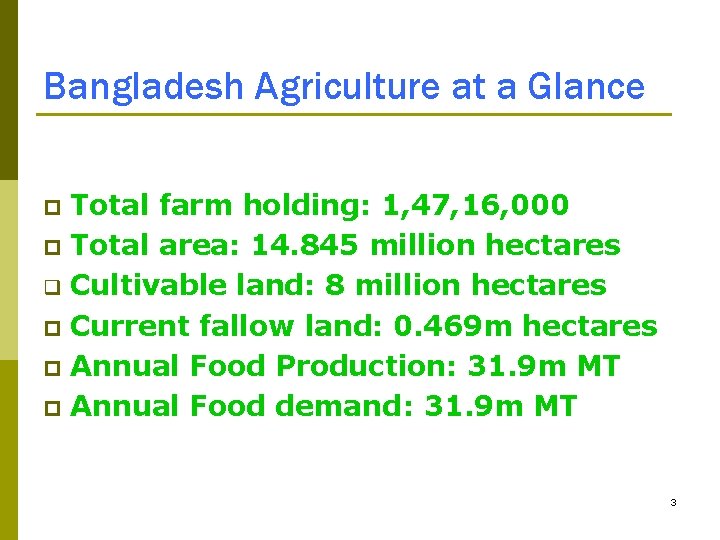
Bangladesh Agriculture at a Glance Total farm holding: 1, 47, 16, 000 p Total area: 14. 845 million hectares q Cultivable land: 8 million hectares p Current fallow land: 0. 469 m hectares p Annual Food Production: 31. 9 m MT p Annual Food demand: 31. 9 m MT p 3
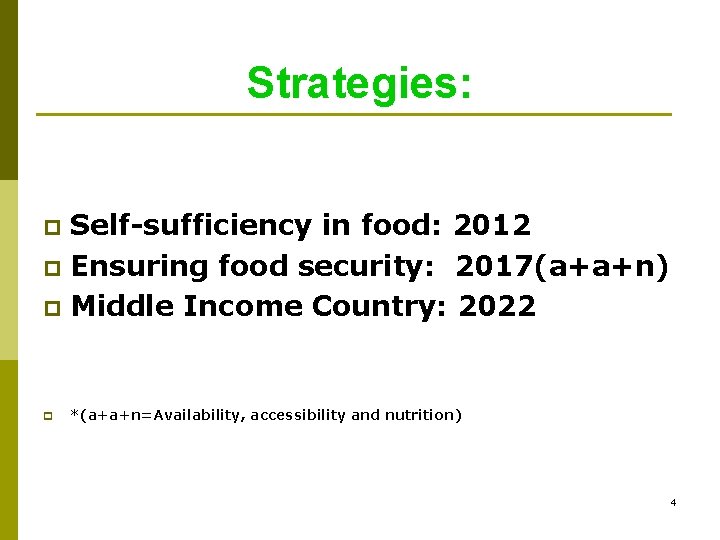
Strategies: Self-sufficiency in food: 2012 p Ensuring food security: 2017(a+a+n) p Middle Income Country: 2022 p p *(a+a+n=Availability, accessibility and nutrition) 4
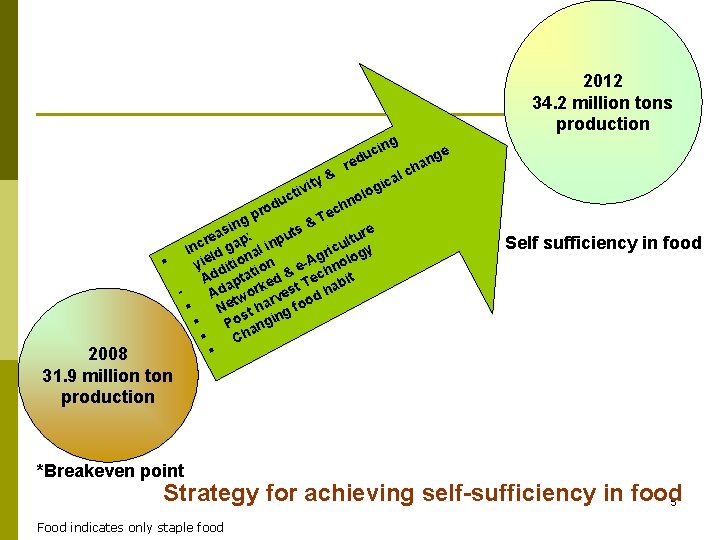
2012 34. 2 million tons production in uc y& du vit cti red g ge n ha c l ica log o hn ec pro T g & sin : ts a u ure e t p p r l Inc ld ga al in icu gy r g n § -A nolo yie ditio ion e h t Ad apta ed & Tec bit a t k Ad twor rves od h § Ne st ha g fo n § Po angi § Ch § Self sufficiency in food 2008 31. 9 million ton production *Breakeven point Strategy for achieving self-sufficiency in food 5 Food indicates only staple food
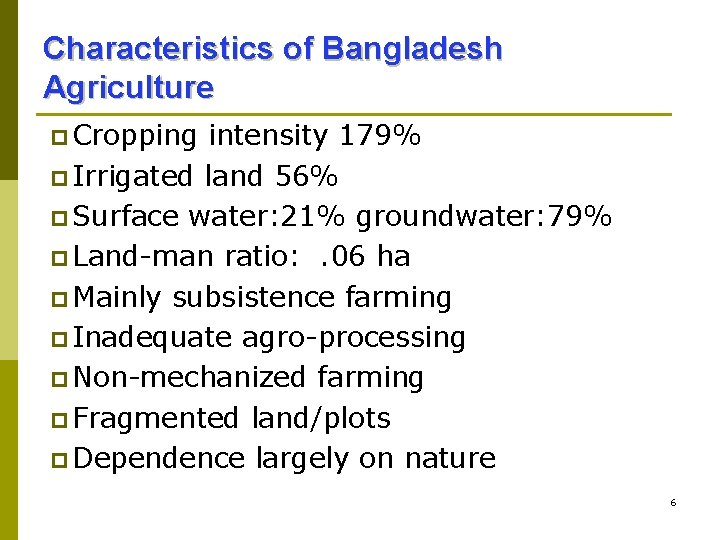
Characteristics of Bangladesh Agriculture p Cropping intensity 179% p Irrigated land 56% p Surface water: 21% groundwater: 79% p Land-man ratio: . 06 ha p Mainly subsistence farming p Inadequate agro-processing p Non-mechanized farming p Fragmented land/plots p Dependence largely on nature 6
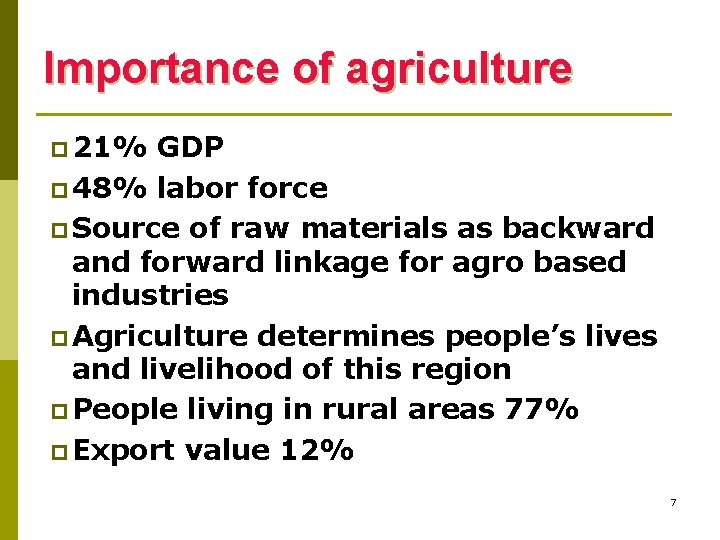
Importance of agriculture p 21% GDP p 48% labor force p Source of raw materials as backward and forward linkage for agro based industries p Agriculture determines people’s lives and livelihood of this region p People living in rural areas 77% p Export value 12% 7
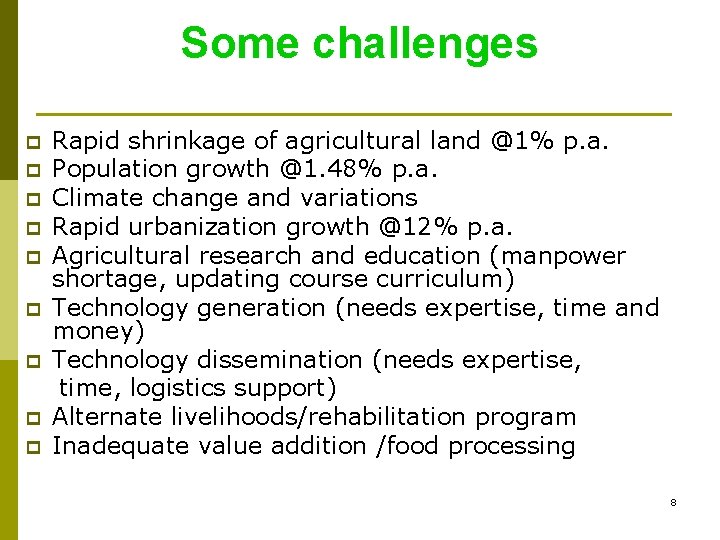
Some challenges p p p p p Rapid shrinkage of agricultural land @1% p. a. Population growth @1. 48% p. a. Climate change and variations Rapid urbanization growth @12% p. a. Agricultural research and education (manpower shortage, updating course curriculum) Technology generation (needs expertise, time and money) Technology dissemination (needs expertise, time, logistics support) Alternate livelihoods/rehabilitation program Inadequate value addition /food processing 8
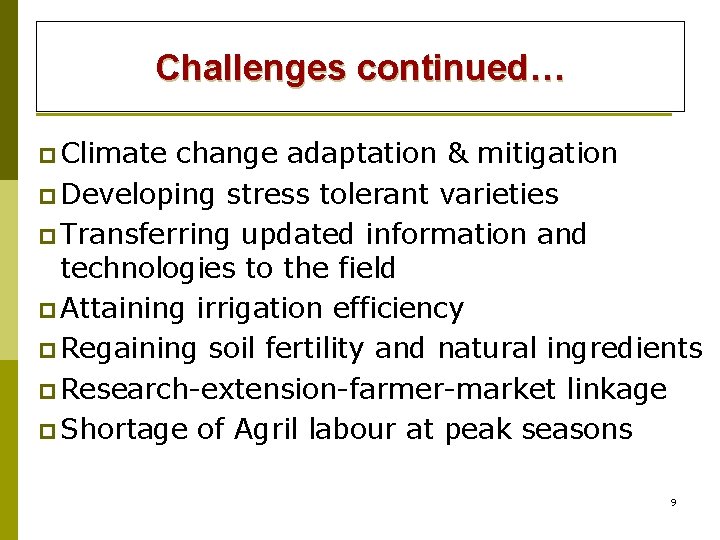
Challenges continued… p Climate change adaptation & mitigation p Developing stress tolerant varieties p Transferring updated information and technologies to the field p Attaining irrigation efficiency p Regaining soil fertility and natural ingredients p Research-extension-farmer-market linkage p Shortage of Agril labour at peak seasons 9
Prospects of Agriculture: p p p p Modern technological know-how is available for dissemination Scope for expanding hybrid technology exists(10%) Prospects for adoption of advanced technology in agriculture are bright Potentials for proper utilization of hilly/coastal areas including agro-ecologically disadvantaged regions exist Export potentials exist for high-value crops Scope for crop diversification, intensification and value addition to agricultural produces Agriculture sector has capacity to absorb labor force and to generate income Scope for reducing yield gaps exists 10
Why Climate Change matters for agriculture? p Heavily depends on natural rainfall, weather & temperature, water level, soil condition etc. p Uncontrolled farming environment p Rice based agriculture greatly depends availability of fresh surface and ground water p Seasonal farming p Lack of stress tolerant varieties p Changed cropping pattern 11
Types of climate change problems p p p p Sea Level Rise (SLR) Floods Riverbank erosion Drought Salinity intrusion Loss of homestead and livelihoods Pest infestation Land scarcity 12
Factors related to climate change p Indiscriminate use of natural resources p Excessive and unplanned urbanization p Unplanned industrial growth p Imbalanced use of agricultural inputs and extreme farming p Population pressure p Effect of industrial pollution by developed countries 13
Combating Climate Change Impact Adaptation: §Stress (flood, drought, submergence, salinity, heat, cold. . ) tolerant varieties §Short duration crops §Innovative farming practices §Floating cultivation method §Crop diversification §Changing/shifting cropping pattern §Alternate wetting and drying irrigation methods 14
Continued… Mitigation p. Coastal green belt p. Embankment/Dam p. Tidal River Management p. Early warning and weather forecasting p. Cyclone shelters p. Crop insurance 15
Collective efforts needed p Political commitment p Educational Institutions p Civil society p NGOs p Media p Research organizations p Department of Agricultural Extension/Extension service providers p Global cooperation 16
Recurrent natural calamities p p p p Cyclones 1970, 1991, 2007(Sidr), 2009(Ayla) Floods 1988, 2000, 2004, 2007 Erratic rainfall (e. g. late rainfall Aug/’ 09) Severe drought Heat and cold waves Northwestern storm Pest infestation Draw down/Declining Water Table 17
Last two decades agricultural growth § § § Inputs based growth (intensive use of HYV/Hybrid seeds, irrigation, fertilizer, pesticides, etc. ) Less mechanized farming Insignificant methodological change of farming Crop diversification Combination of vertical & horizontal growth Presently less scope of horizontal growth 18
Policy support National Agriculture Policy[1999; 2009(draft)] p New Agricultural Extension Policy p National Food Policy p National Seed Policy p National IPM policy p Fertilizer Management (Amendment) Act, 2009 p The Pesticide Act, 2009 p Rural Credit Policy (Farmers friendly) p Land Policy & National Land use policy p 19
PRSP- Agriculture and Rural Development PRSP places agriculture and rural development as key driver of pro-poor growth strategy. q Government’s policy is to create enabling environment and support transformation of subsistence agriculture to a more diversified agribusiness with increased participation of private sector. p 20
Continued… p Poverty Reduction Strategy Paper (PRSP), entitled “Unlocking the Potential –National Strategy for Accelerated Poverty Reduction” (2005), highlights the need for - higher growth in rural areas, development of agriculture and rural non-farm economic activities as one of the four priority areas to accelerating pro-poor economic growth. 21
Continued… q PRSP puts emphasis on achieving productivity and profitability gains, broadbased support to agriculture, diversification and commercialization of agricultural enterprises. q PRSP also stressed on agricultural research and technology generation, farmers’ demand -led extension services, energizing agricultural marketing and agro-processing, land use and women in agriculture. 22
Continued… The most important feature of PRSP is the formulation of precise and workable policy matrix, which identifies 22 crucially important strategic goals, fixes up targets against these goals, charts actions already taken, sets future policy agenda and priorities and delineates responsibilities for the concerned ministries. 23
Government’s recent interventions Farmers database and Farmers Inputs Support Card to 1 Crore 82 Lakh farmers. p Increased subsidy on Agricultural Inputs (Fertilizer, diesel, electricity, seeds) p Farmer friendly agricultural credit policy p 1 Crore 82 Lakh farmers’ new bank accounts being opened p 100 Hr. free supplementary irrigation p Enhanced Agricultural rehab grants to victims of natural calamities p Support for accelerated mechanization of agriculture p Surface water irrigation p 24
Conclusion: Agriculture is the determining factor food security as well as pro-poor development of Bangladesh economy. The Problems of agriculture are multifaceted. So the ways of addressing the challenges should be comprehensive, global and participatory for sustainable agricultural development. 25

26
- Slides: 26