Measuring e commerce the Eurostat and OECD approach
- Slides: 17
Measuring e commerce the Eurostat and OECD approach and the Statistics Finland experience Aarno Airaksinen 10. 2. 2017 Regional Workshop, Strengthening EAEU Member States Statistical Capacity in E Commerce Statistics
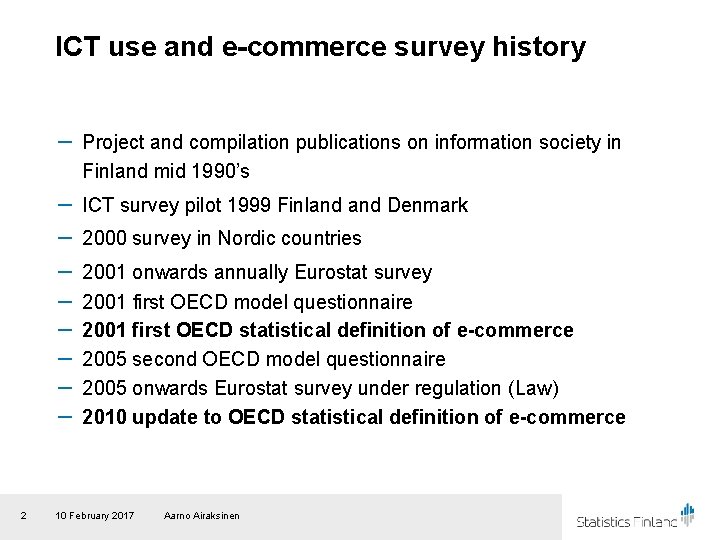
ICT use and e-commerce survey history - Project and compilation publications on information society in Finland mid 1990’s - ICT survey pilot 1999 Finland Denmark - 2000 survey in Nordic countries - - - 2 2001 onwards annually Eurostat survey 2001 first OECD model questionnaire 2001 first OECD statistical definition of e-commerce 2005 second OECD model questionnaire 2005 onwards Eurostat survey under regulation (Law) 2010 update to OECD statistical definition of e-commerce 10 February 2017 Aarno Airaksinen
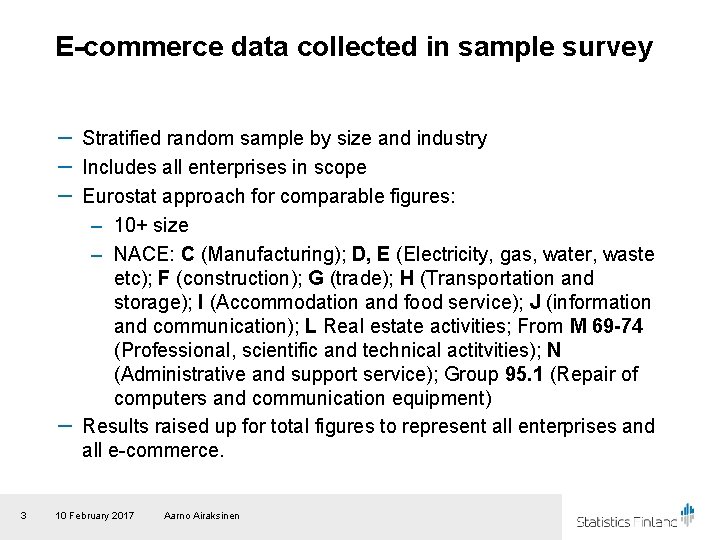
E-commerce data collected in sample survey - Stratified random sample by size and industry - Includes all enterprises in scope - Eurostat approach for comparable figures: – 10+ size – NACE: C (Manufacturing); D, E (Electricity, gas, water, waste etc); F (construction); G (trade); H (Transportation and storage); I (Accommodation and food service); J (information and communication); L Real estate activities; From M 69 -74 (Professional, scientific and technical actitvities); N (Administrative and support service); Group 95. 1 (Repair of computers and communication equipment) - Results raised up for total figures to represent all enterprises and all e commerce. 3 10 February 2017 Aarno Airaksinen
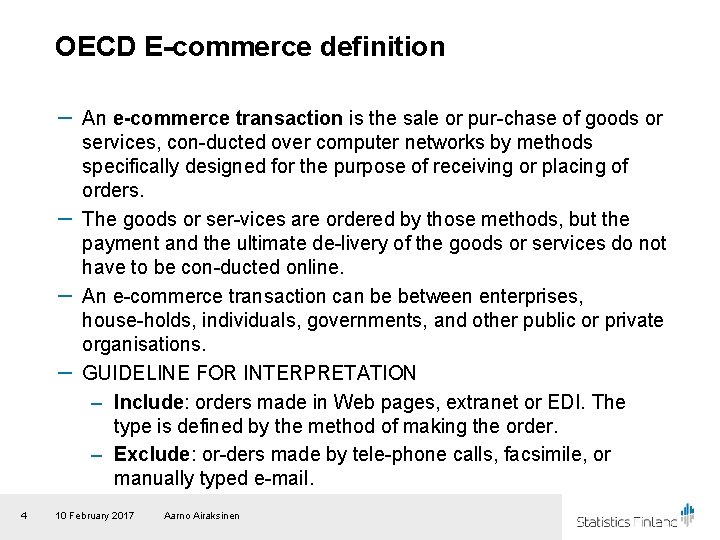
OECD E-commerce definition - An e-commerce transaction is the sale or pur chase of goods or services, con ducted over computer networks by methods specifically designed for the purpose of receiving or placing of orders. - The goods or ser vices are ordered by those methods, but the payment and the ultimate de livery of the goods or services do not have to be con ducted online. - An e commerce transaction can be between enterprises, house holds, individuals, governments, and other public or private organisations. - GUIDELINE FOR INTERPRETATION – Include: orders made in Web pages, extranet or EDI. The type is defined by the method of making the order. – Exclude: or ders made by tele phone calls, facsimile, or manually typed e mail. 4 10 February 2017 Aarno Airaksinen
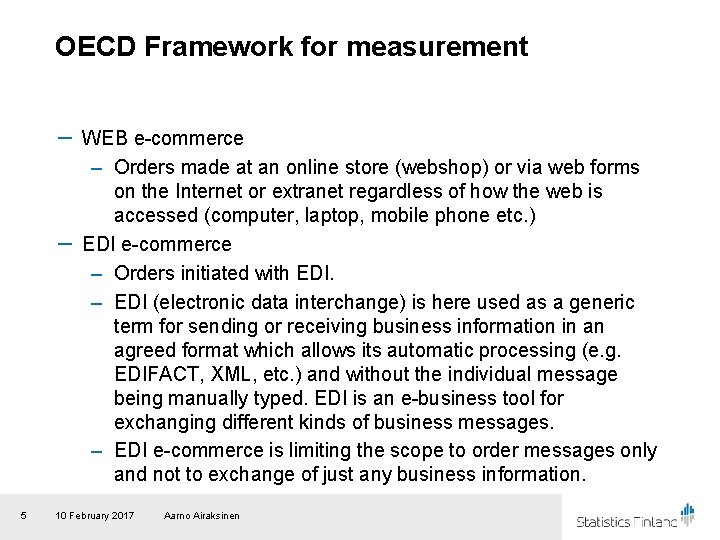
OECD Framework for measurement - WEB e commerce – Orders made at an online store (webshop) or via web forms on the Internet or extranet regardless of how the web is accessed (computer, laptop, mobile phone etc. ) - EDI e commerce – Orders initiated with EDI. – EDI (electronic data interchange) is here used as a generic term for sending or receiving business information in an agreed format which allows its automatic processing (e. g. EDIFACT, XML, etc. ) and without the individual message being manually typed. EDI is an e business tool for exchanging different kinds of business messages. – EDI e commerce is limiting the scope to order messages only and not to exchange of just any business information. 5 10 February 2017 Aarno Airaksinen
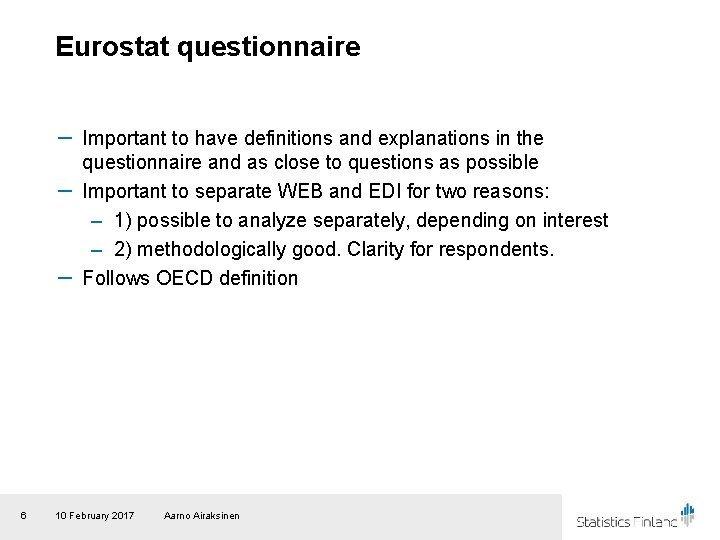
Eurostat questionnaire - Important to have definitions and explanations in the questionnaire and as close to questions as possible - Important to separate WEB and EDI for two reasons: – 1) possible to analyze separately, depending on interest – 2) methodologically good. Clarity for respondents. - Follows OECD definition 6 10 February 2017 Aarno Airaksinen
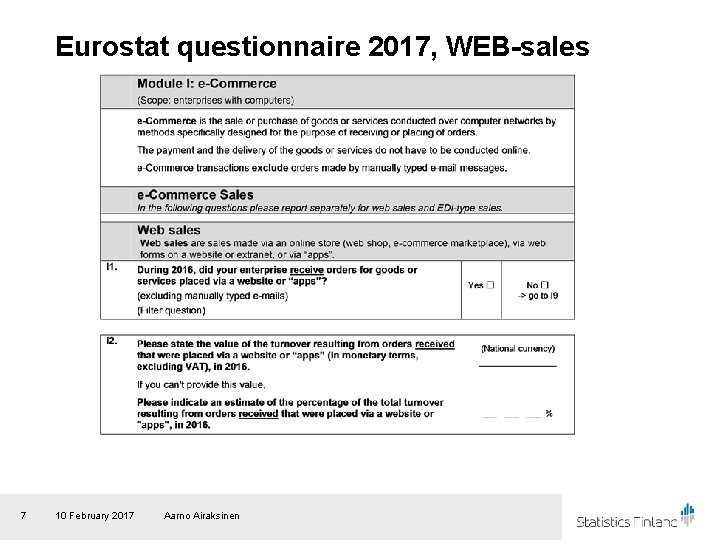
Eurostat questionnaire 2017, WEB-sales 7 10 February 2017 Aarno Airaksinen
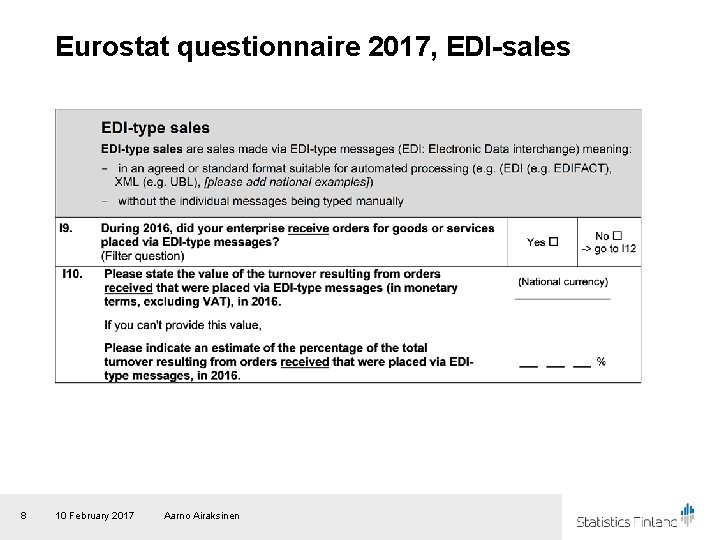
Eurostat questionnaire 2017, EDI-sales 8 10 February 2017 Aarno Airaksinen
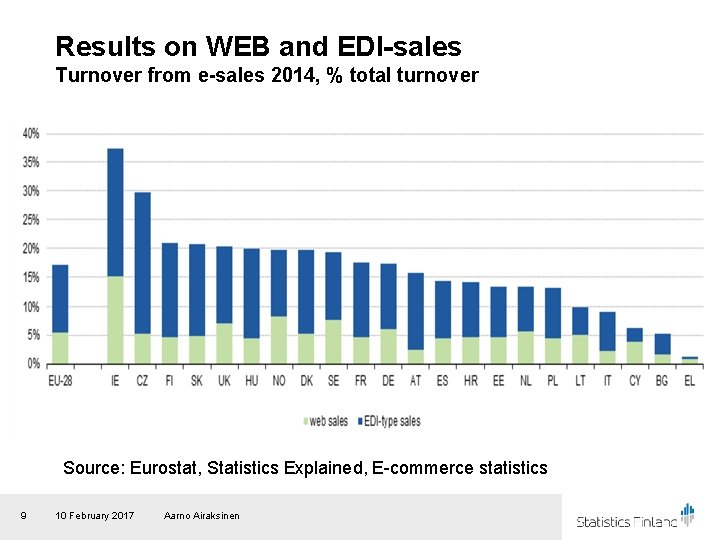
Results on WEB and EDI-sales Turnover from e-sales 2014, % total turnover Source: Eurostat, Statistics Explained, E commerce statistics 9 10 February 2017 Aarno Airaksinen
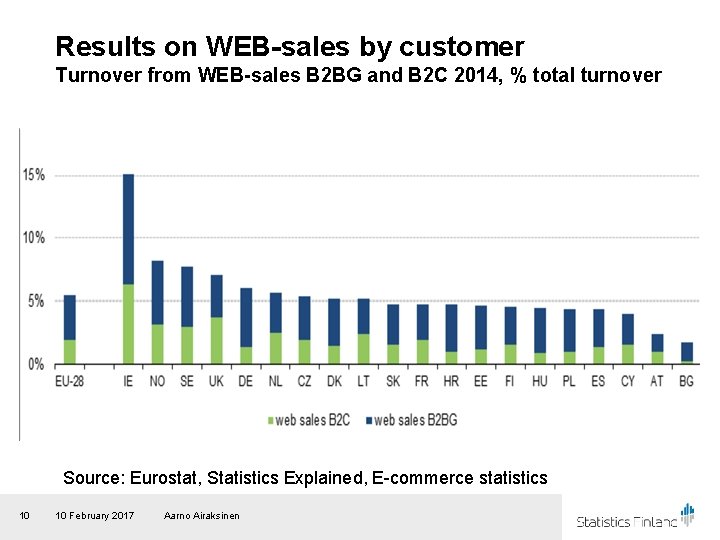
Results on WEB-sales by customer Turnover from WEB-sales B 2 BG and B 2 C 2014, % total turnover Source: Eurostat, Statistics Explained, E commerce statistics 10 10 February 2017 Aarno Airaksinen
Eurostat questionnaire 2017, Cross border web-sales 11 10 February 2017 Aarno Airaksinen
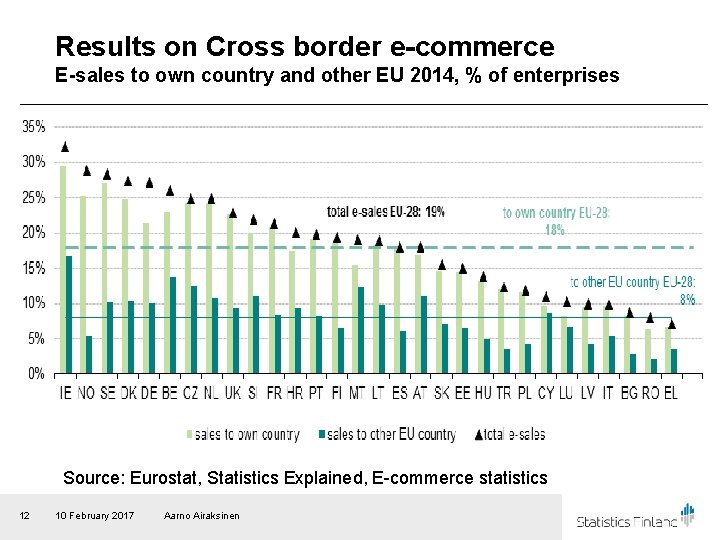
Results on Cross border e-commerce E-sales to own country and other EU 2014, % of enterprises Source: Eurostat, Statistics Explained, E commerce statistics 12 10 February 2017 Aarno Airaksinen
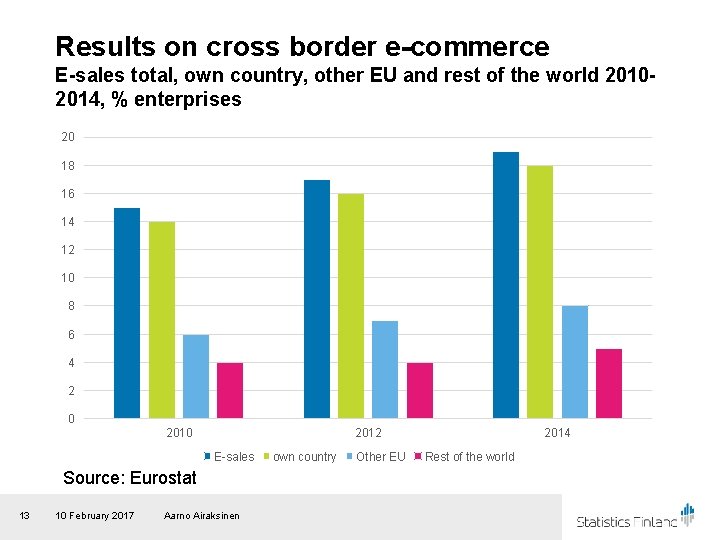
Results on cross border e-commerce E-sales total, own country, other EU and rest of the world 20102014, % enterprises 20 18 16 14 12 10 8 6 4 2 0 2012 E sales Source: Eurostat 13 10 February 2017 Aarno Airaksinen own country Other EU 2014 Rest of the world
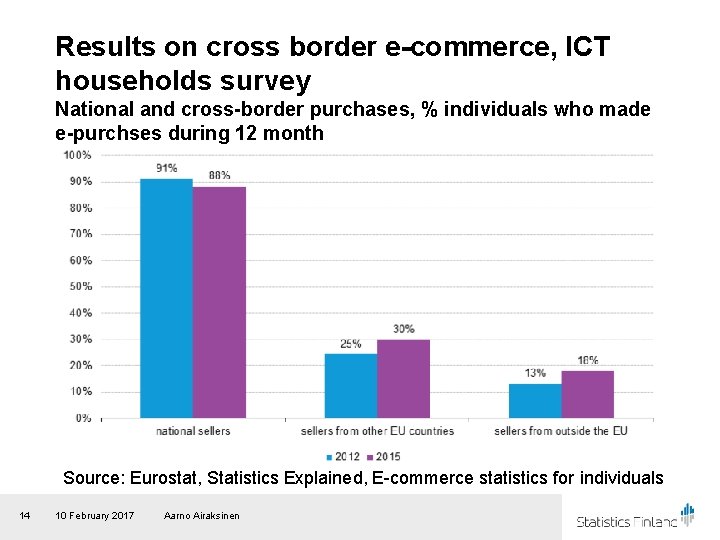
Results on cross border e-commerce, ICT households survey National and cross-border purchases, % individuals who made e-purchses during 12 month Source: Eurostat, Statistics Explained, E commerce statistics for individuals 14 10 February 2017 Aarno Airaksinen
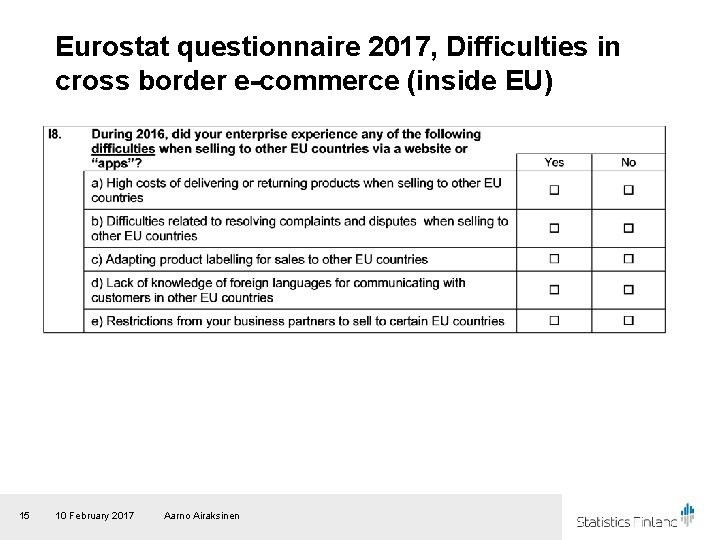
Eurostat questionnaire 2017, Difficulties in cross border e-commerce (inside EU) 15 10 February 2017 Aarno Airaksinen
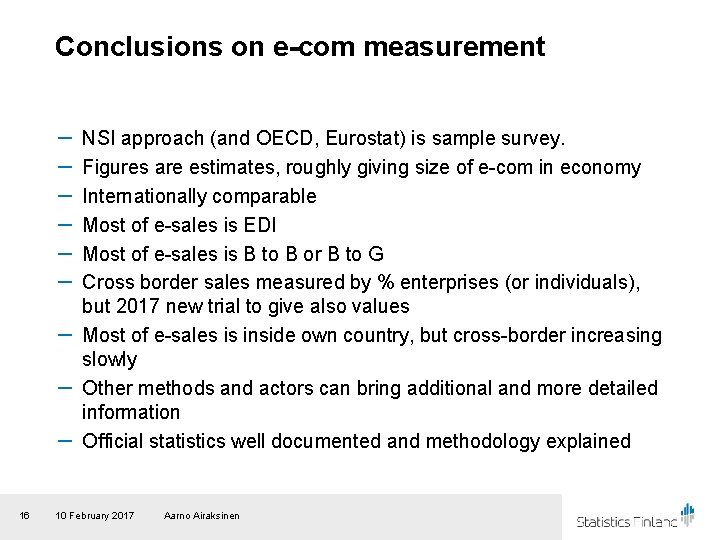
Conclusions on e-com measurement NSI approach (and OECD, Eurostat) is sample survey. Figures are estimates, roughly giving size of e com in economy Internationally comparable Most of e sales is EDI Most of e sales is B to B or B to G Cross border sales measured by % enterprises (or individuals), but 2017 new trial to give also values - Most of e sales is inside own country, but cross border increasing slowly - Other methods and actors can bring additional and more detailed information - Official statistics well documented and methodology explained - - - 16 10 February 2017 Aarno Airaksinen
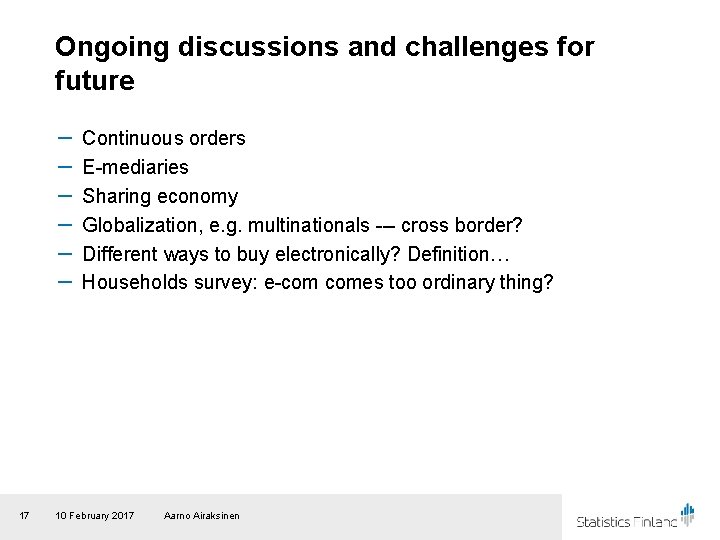
Ongoing discussions and challenges for future - - - 17 Continuous orders E mediaries Sharing economy Globalization, e. g. multinationals cross border? Different ways to buy electronically? Definition… Households survey: e comes too ordinary thing? 10 February 2017 Aarno Airaksinen