Meanings Mete give order Dole give money Hoard
- Slides: 9
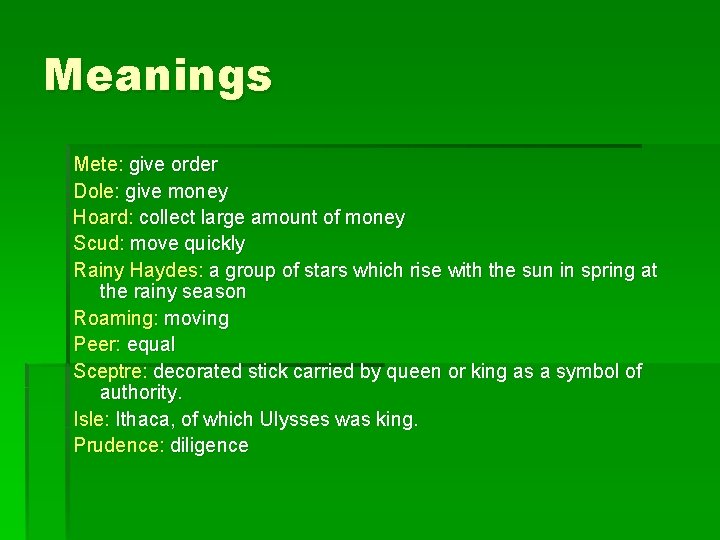
Meanings Mete: give order Dole: give money Hoard: collect large amount of money Scud: move quickly Rainy Haydes: a group of stars which rise with the sun in spring at the rainy season Roaming: moving Peer: equal Sceptre: decorated stick carried by queen or king as a symbol of authority. Isle: Ithaca, of which Ulysses was king. Prudence: diligence
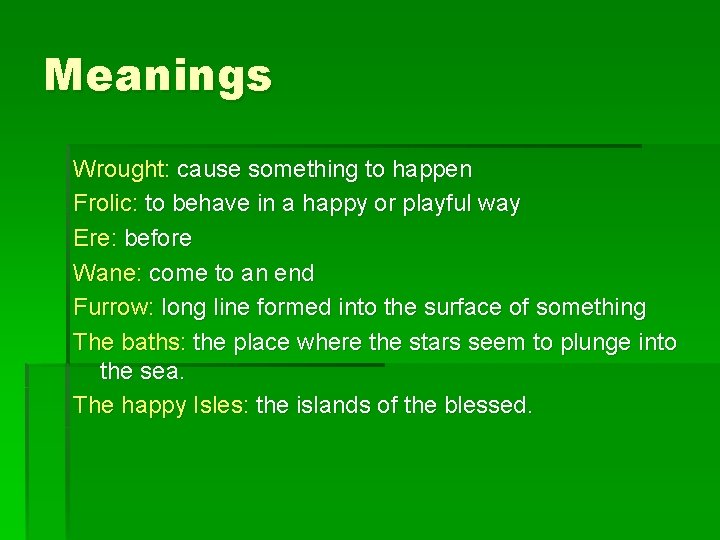
Meanings Wrought: cause something to happen Frolic: to behave in a happy or playful way Ere: before Wane: come to an end Furrow: long line formed into the surface of something The baths: the place where the stars seem to plunge into the sea. The happy Isles: the islands of the blessed.
Summary "Ulysses" details Ulysses' intense dissatisfaction and boredom on his island home of Ithaca. The poem is a monologue spoken by him, where he not only expresses his discontent, but also describes his desire to keep sailing. He's getting older and doesn't have a lot of time left, so he wants to get busy living rather than busy dying. The poem concludes with his resolution to "strive, to seek, to find, and not to yield. "
Themes Dissatisfaction Restlessness Steadfastness Mortality Old Age Exploration
Form “Ulysses” is a dramatic monologue {a poem written spoken by a single person to an audience; that audience could be one person or a group of people referred to in the poem (at line 49 Ulysses says “you and I are old”) or any other implied audience. } It is made of 70 lines of blank verse.
Setting The poem takes place in several places in Ithaca: • Near hearth in Ulysses’ palace or castle. • Then points to port. • And then somehow ends up there. • In the end it is felt that Ulysses is standing next to his mariners by the ship.
Speaker Ulysses is the speaker of the poem; he is a semi-retired warrior who is now king.
Techniques 1. 2. 3. Personification: “vexing the sea. ” vex means to upset (Ll. 9 -11). The ship can’t “puff” its own sail: the wind is probably doing it (Ll. 44 -45) 2. Simile: 1. “like a sinking star” (l. 31) 3. Synecdoche (using a part to stand for the whole): 1. In line 46 Ulysses refers to his “mariners” as “souls”. The “soul” is a part to stand for the whole (the mariners). 4. Metaphor: 1. In line 12 Ulysses compares himself to a lion or tiger, "roaming" the seas with a "hungry heart. "
Techniques • In line 16 Ulysses refers to his enjoyment of battle as a kind of consumption, a "drinking" of "delight. " Enjoying the delight of battle is compared to the drinking of some kind of beverage. • In lines 6 -7 Ulysses says he will "drink / Life to the lees, " an old version of "live life to the fullest. " Living life is here compared to drinking a bottle of something.