Math 205 Calculus III Andy Rosen www rosenmath
- Slides: 22
Math 205 – Calculus III Andy Rosen www. rosenmath. com [If you are trying to crash the course, that will be the first thing we talk about. ]
Student Learning Outcomes Students will be able to • perform calculus on vector valued functions. • perform vector operations using geometry in space. • perform calculus on multivariable functions.
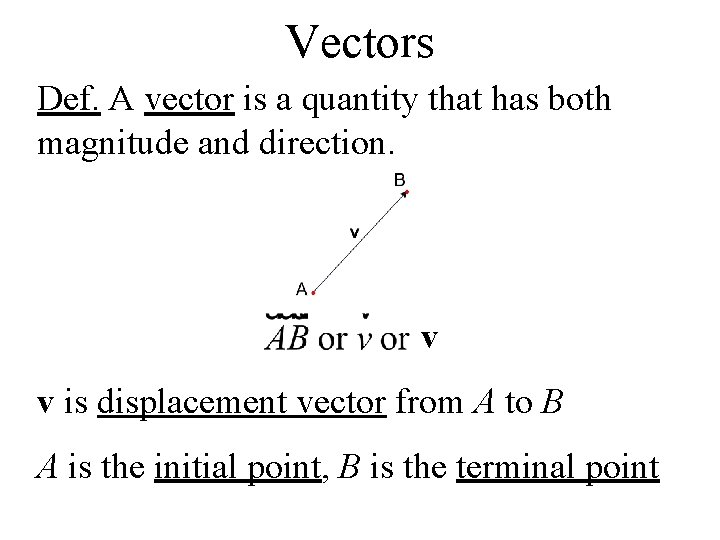
Vectors Def. A vector is a quantity that has both magnitude and direction. v v is displacement vector from A to B A is the initial point, B is the terminal point
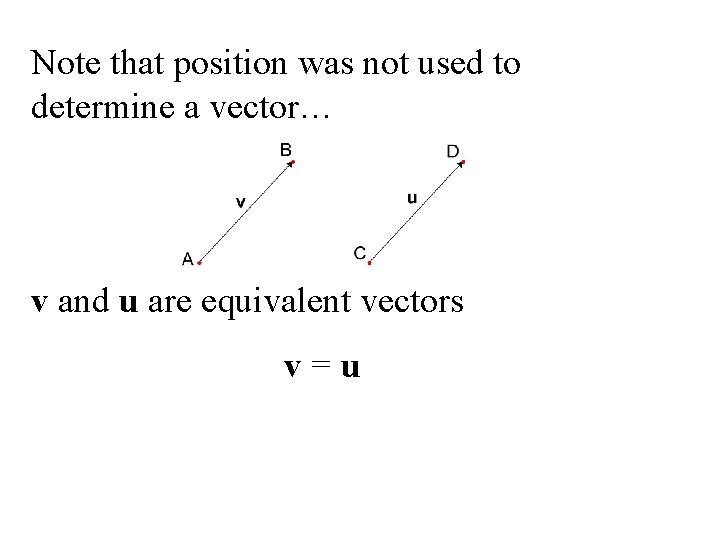
Note that position was not used to determine a vector… v and u are equivalent vectors v=u
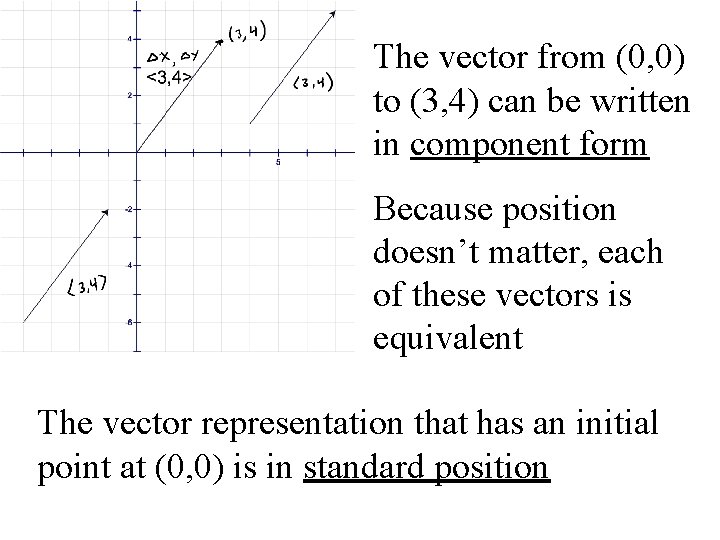
The vector from (0, 0) to (3, 4) can be written in component form Because position doesn’t matter, each of these vectors is equivalent The vector representation that has an initial point at (0, 0) is in standard position
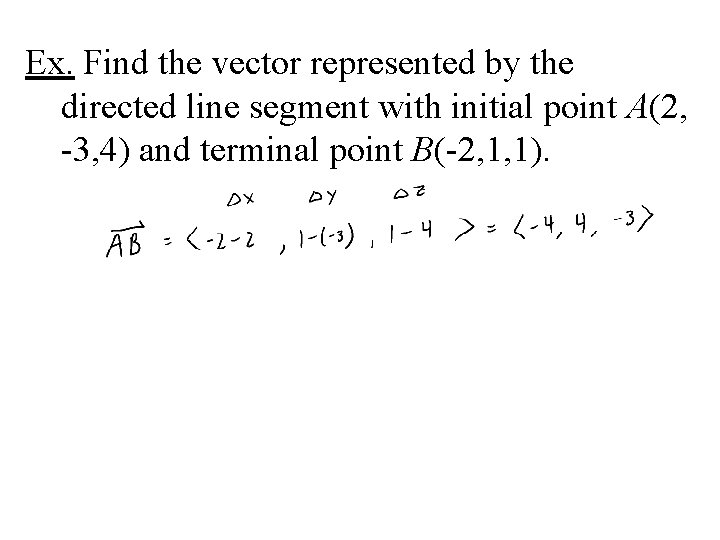
Ex. Find the vector represented by the directed line segment with initial point A(2, -3, 4) and terminal point B(-2, 1, 1).
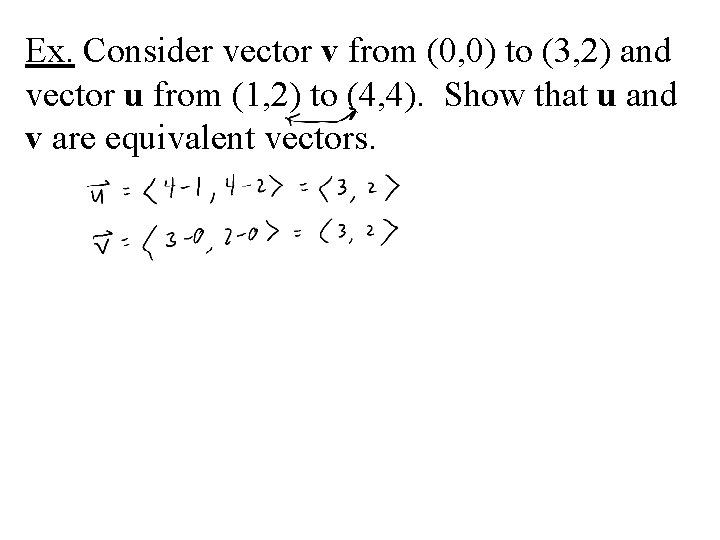
Ex. Consider vector v from (0, 0) to (3, 2) and vector u from (1, 2) to (4, 4). Show that u and v are equivalent vectors.
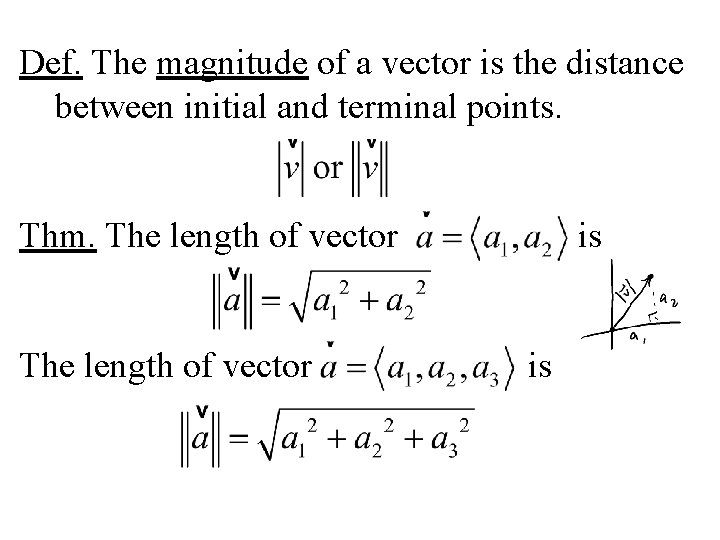
Def. The magnitude of a vector is the distance between initial and terminal points. Thm. The length of vector is is
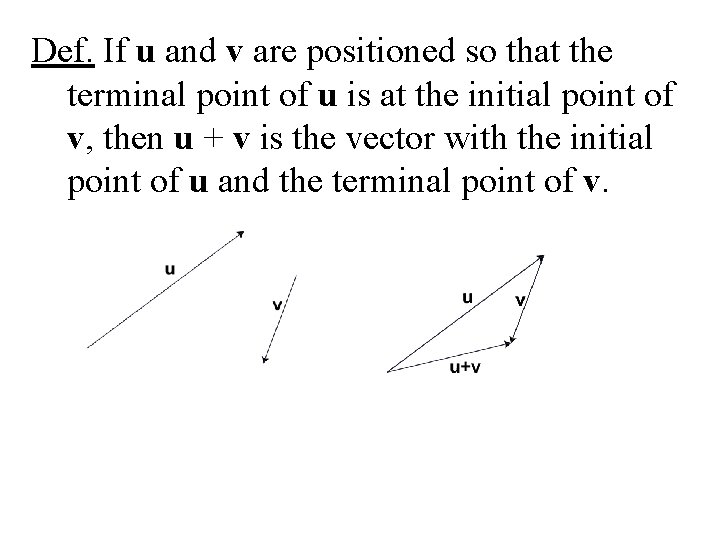
Def. If u and v are positioned so that the terminal point of u is at the initial point of v, then u + v is the vector with the initial point of u and the terminal point of v.
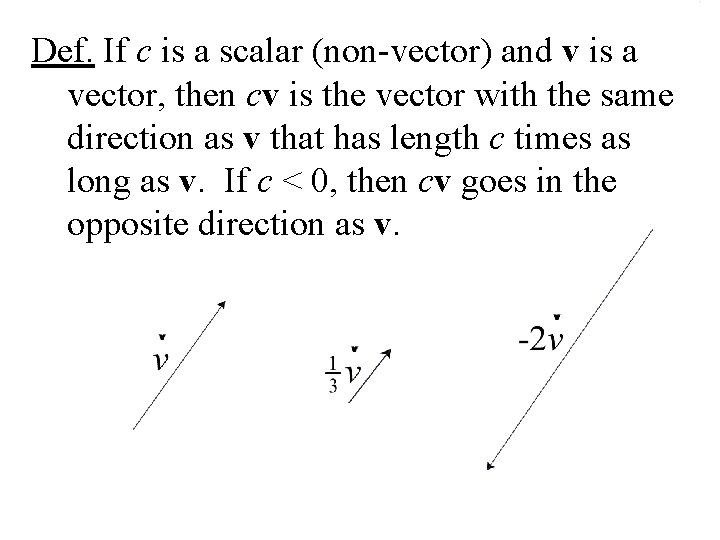
Def. If c is a scalar (non-vector) and v is a vector, then cv is the vector with the same direction as v that has length c times as long as v. If c < 0, then cv goes in the opposite direction as v.
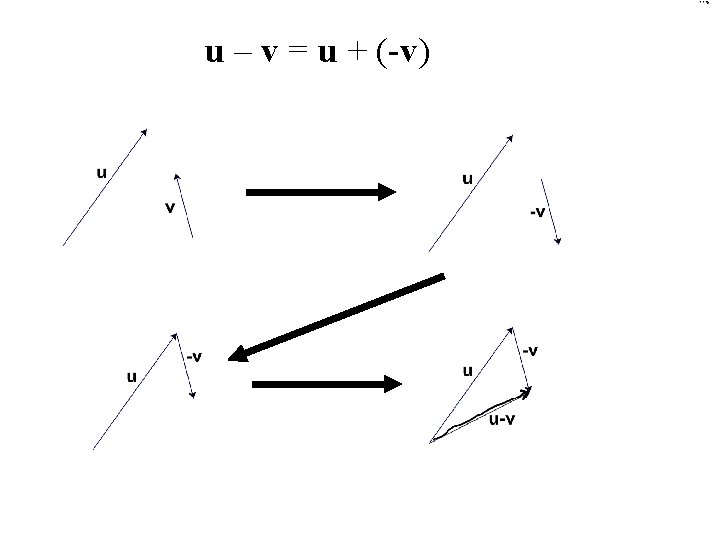
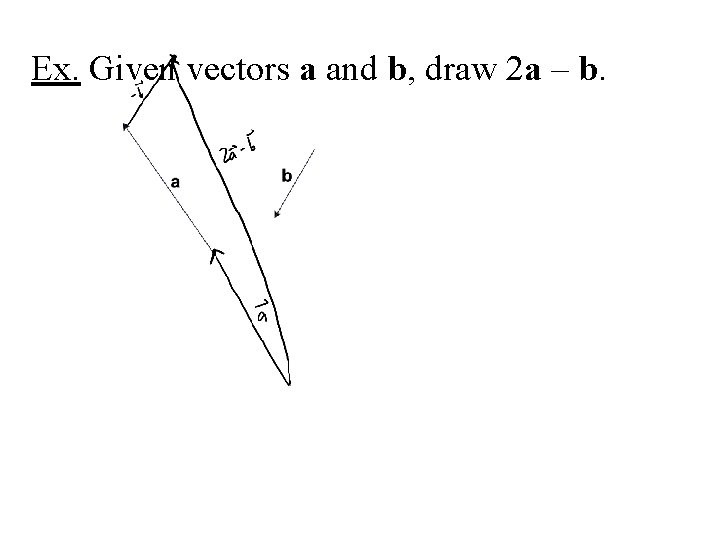
Ex. Given vectors a and b, draw 2 a – b.
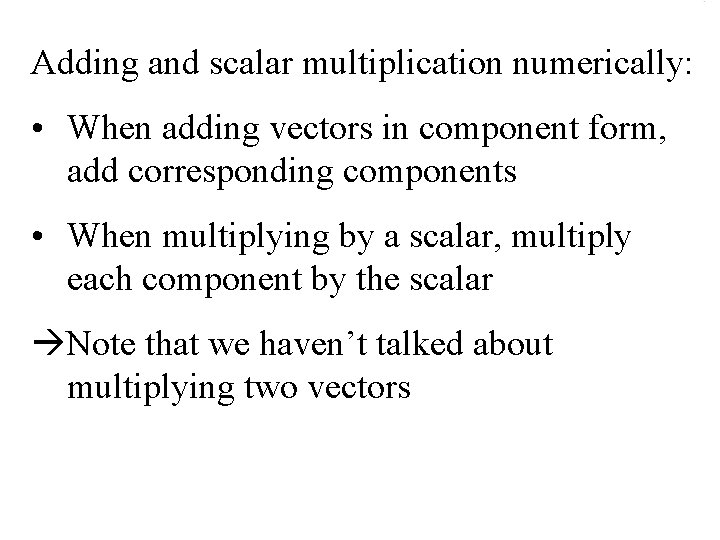
Adding and scalar multiplication numerically: • When adding vectors in component form, add corresponding components • When multiplying by a scalar, multiply each component by the scalar Note that we haven’t talked about multiplying two vectors
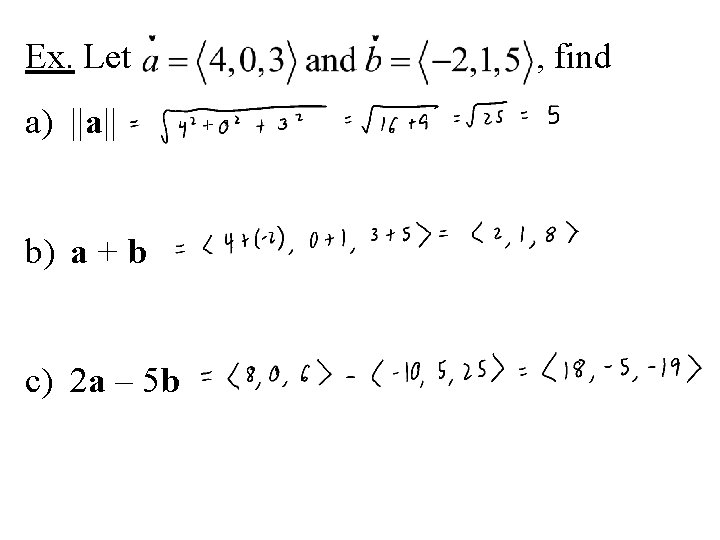
Ex. Let a) ||a|| b) a + b c) 2 a – 5 b , find
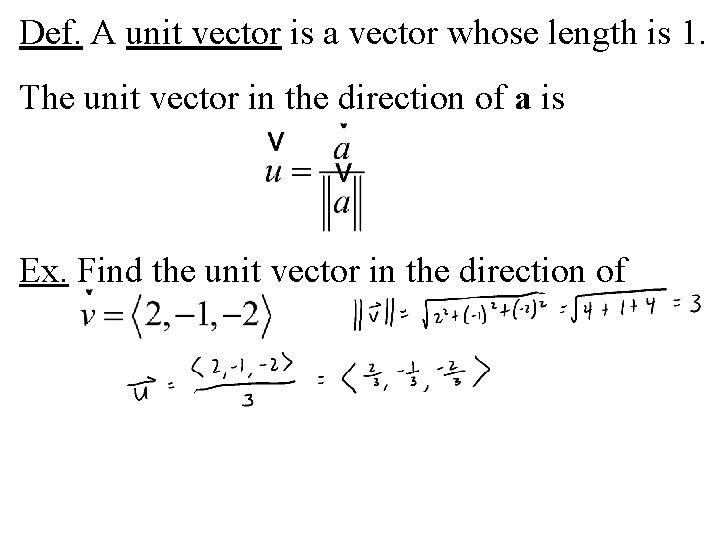
Def. A unit vector is a vector whose length is 1. The unit vector in the direction of a is Ex. Find the unit vector in the direction of
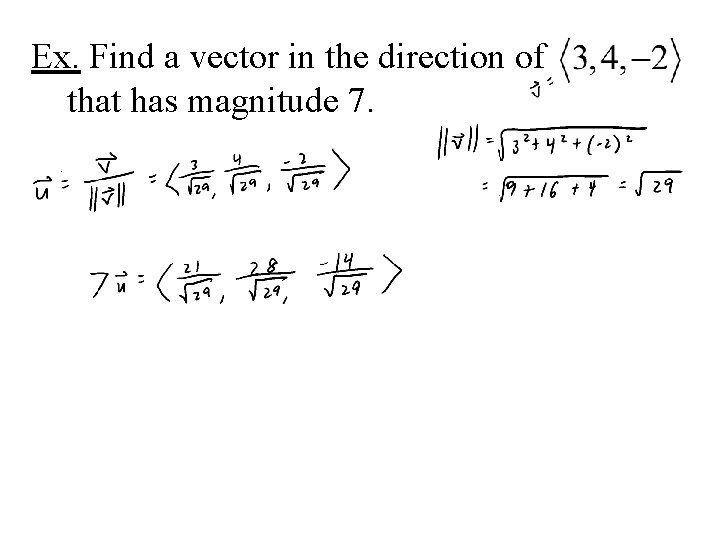
Ex. Find a vector in the direction of that has magnitude 7.
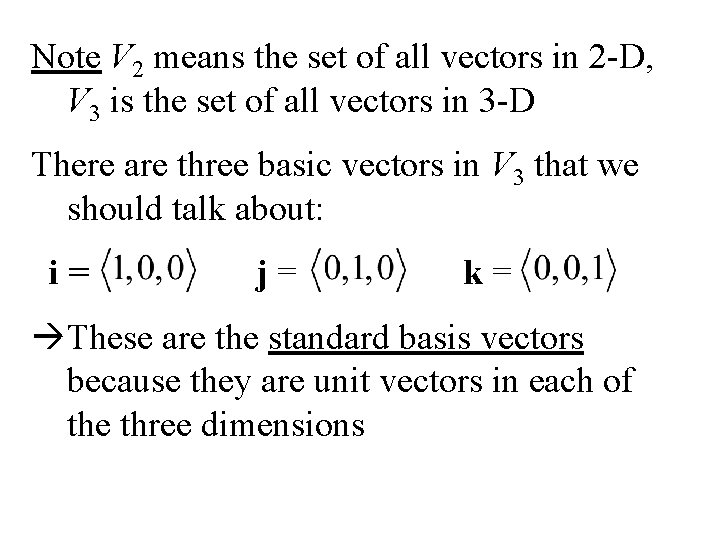
Note V 2 means the set of all vectors in 2 -D, V 3 is the set of all vectors in 3 -D There are three basic vectors in V 3 that we should talk about: i= j= k= These are the standard basis vectors because they are unit vectors in each of the three dimensions
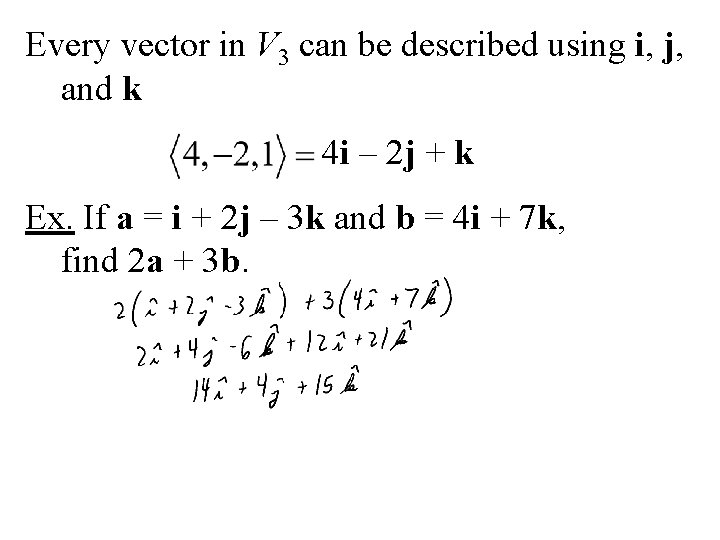
Every vector in V 3 can be described using i, j, and k 4 i – 2 j + k Ex. If a = i + 2 j – 3 k and b = 4 i + 7 k, find 2 a + 3 b.
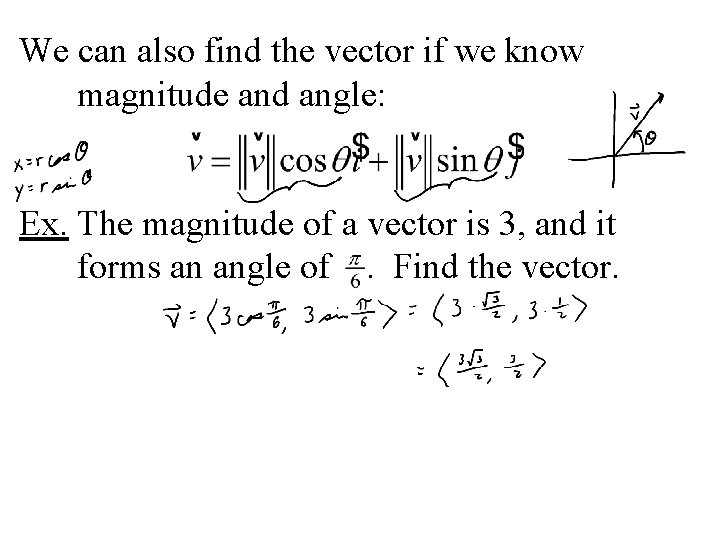
We can also find the vector if we know magnitude and angle: Ex. The magnitude of a vector is 3, and it forms an angle of. Find the vector.
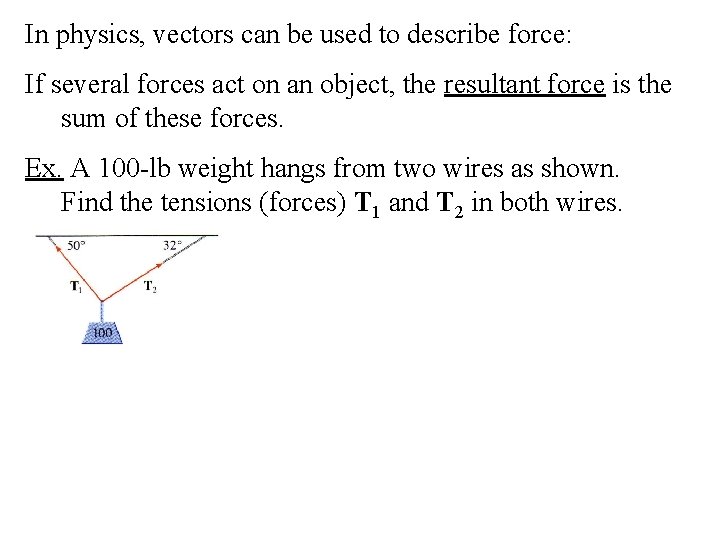
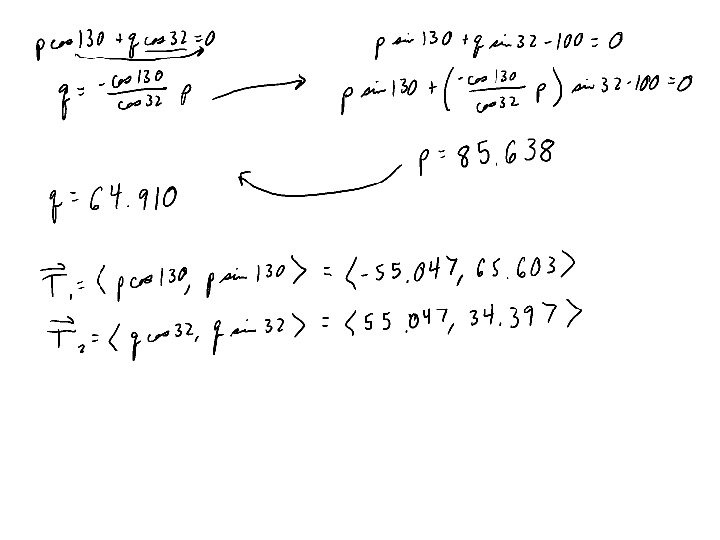
In physics, vectors can be used to describe force: If several forces act on an object, the resultant force is the sum of these forces. Ex. A 100 -lb weight hangs from two wires as shown. Find the tensions (forces) T 1 and T 2 in both wires.