MATH 1330 Section 4 3 Unit Circle Trigonometry


- Slides: 27
MATH 1330 Section 4. 3
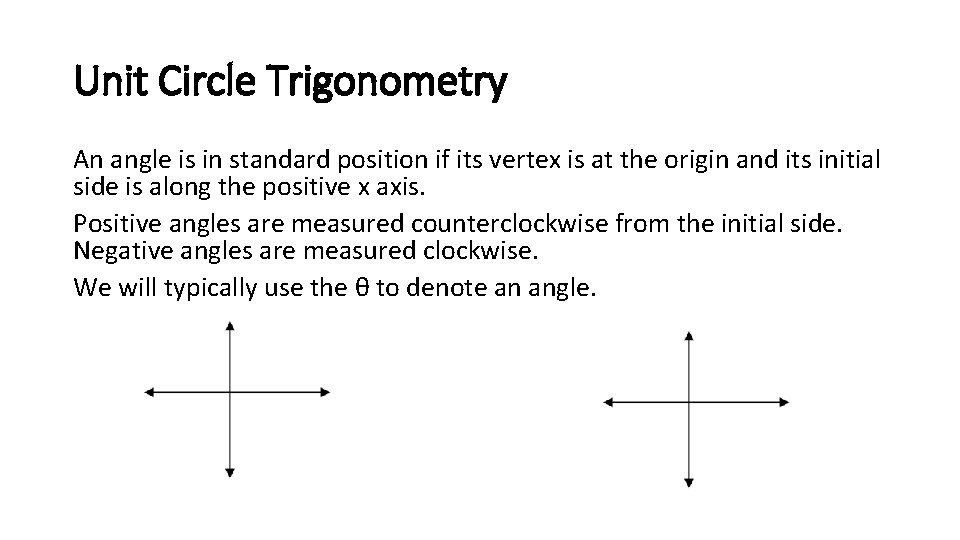
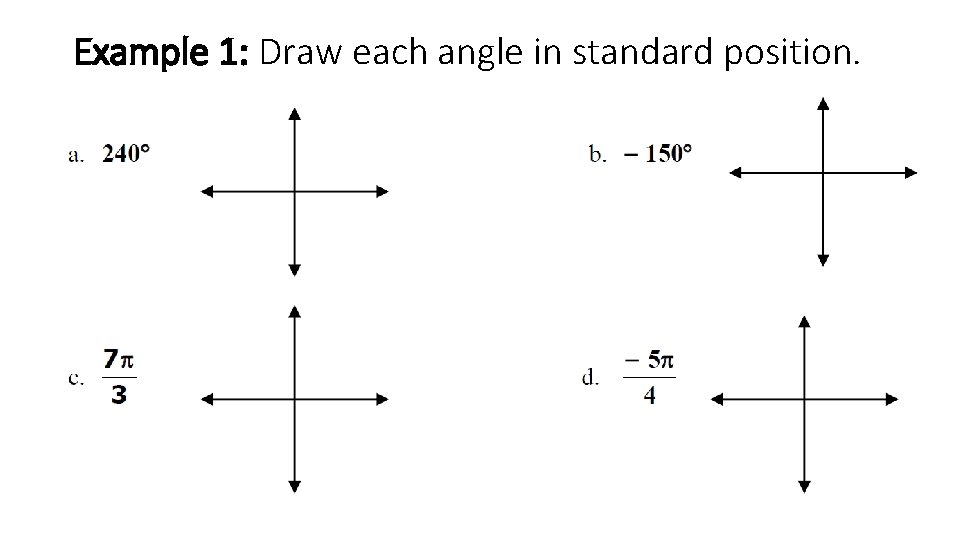
Unit Circle Trigonometry An angle is in standard position if its vertex is at the origin and its initial side is along the positive x axis. Positive angles are measured counterclockwise from the initial side. Negative angles are measured clockwise. We will typically use the θ to denote an angle.
Example 1: Draw each angle in standard position.
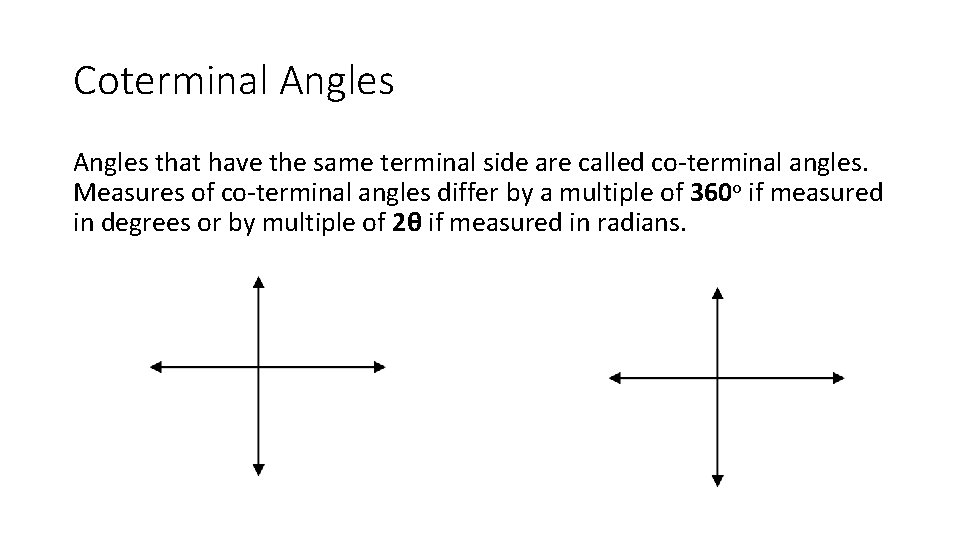
Coterminal Angles that have the same terminal side are called co-terminal angles. Measures of co-terminal angles differ by a multiple of 360 o if measured in degrees or by multiple of 2θ if measured in radians.
Calculating Coterminal Angles in standard position with the same terminal side are called coterminal angles. The measures of two coterminal angles differ by a factor corresponding to an integer number of complete revolutions. The degree measure of coterminal angles differ by an integer multiple of 360 o. For any angle θ measured in degrees, an angle coterminal with θ can be found by the formula θ + n(360 o).
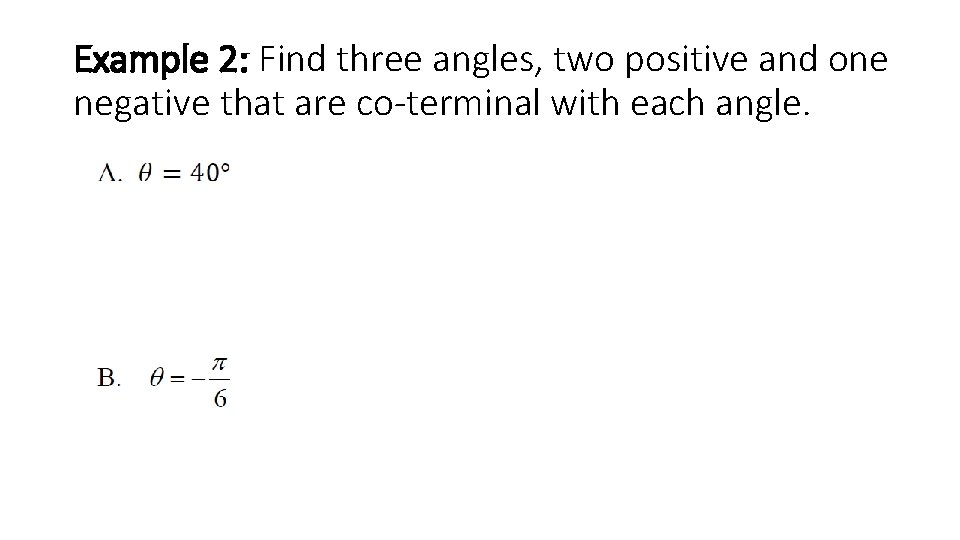
Example 2: Find three angles, two positive and one negative that are co-terminal with each angle.
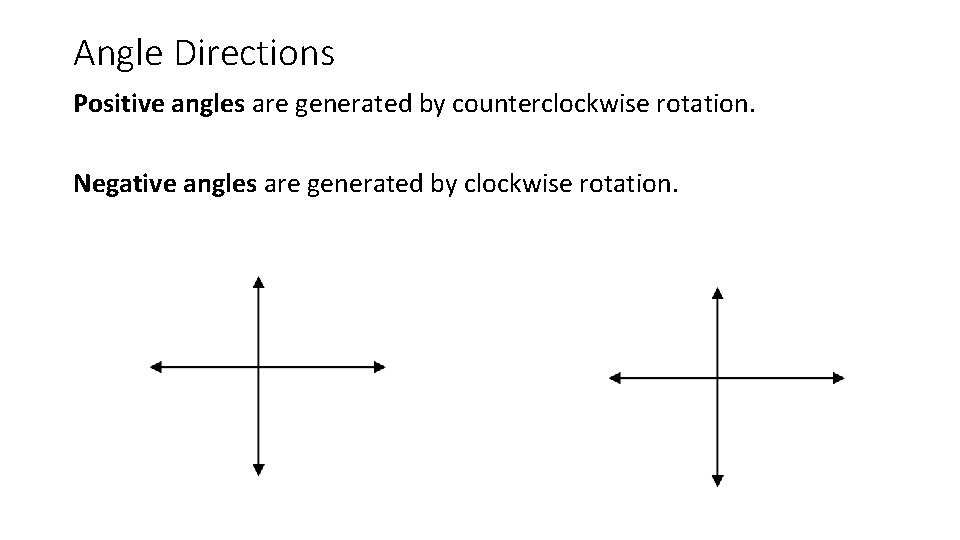
Angle Directions Positive angles are generated by counterclockwise rotation. Negative angles are generated by clockwise rotation.
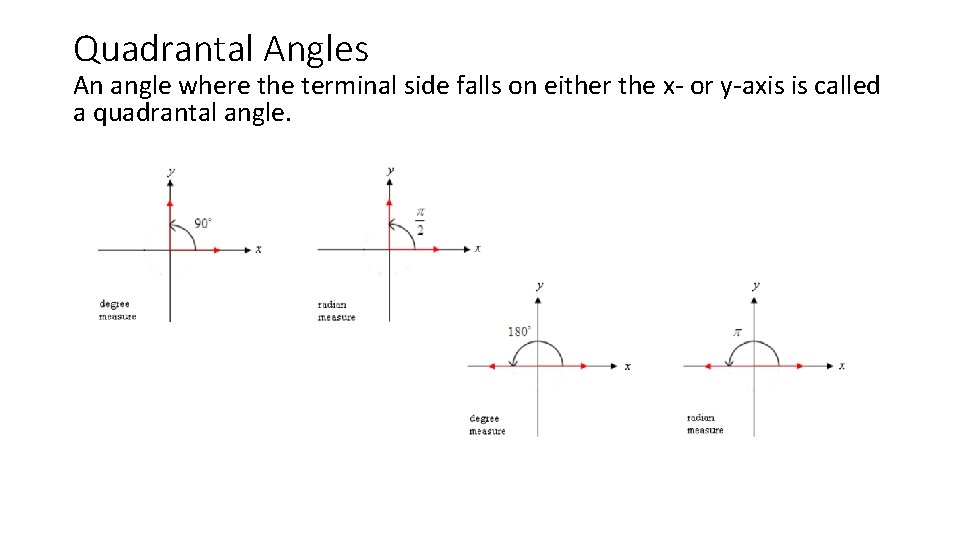
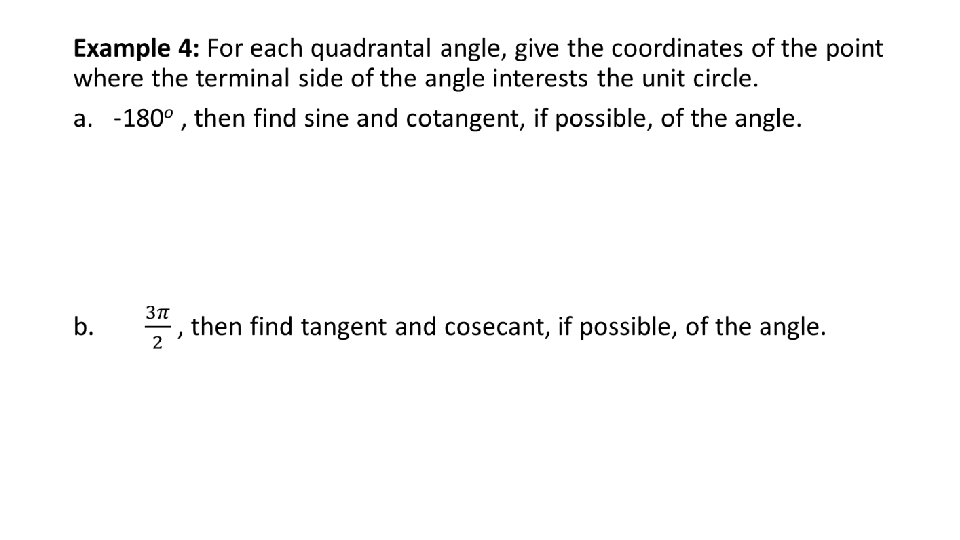
Quadrantal Angles An angle where the terminal side falls on either the x- or y-axis is called a quadrantal angle.
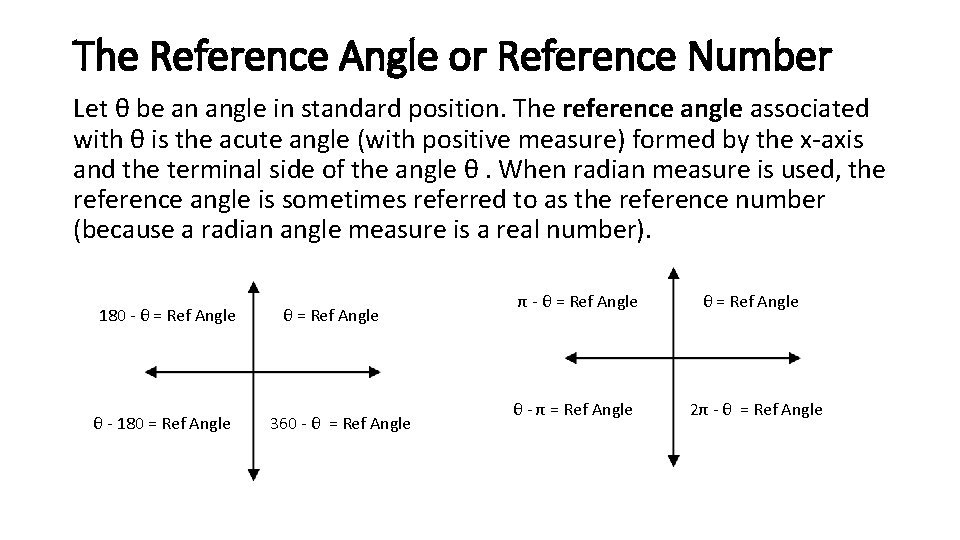
The Reference Angle or Reference Number Let θ be an angle in standard position. The reference angle associated with θ is the acute angle (with positive measure) formed by the x-axis and the terminal side of the angle θ. When radian measure is used, the reference angle is sometimes referred to as the reference number (because a radian angle measure is a real number). 180 - θ = Ref Angle θ - 180 = Ref Angle θ = Ref Angle 360 - θ = Ref Angle π - θ = Ref Angle θ - π = Ref Angle θ = Ref Angle 2π - θ = Ref Angle
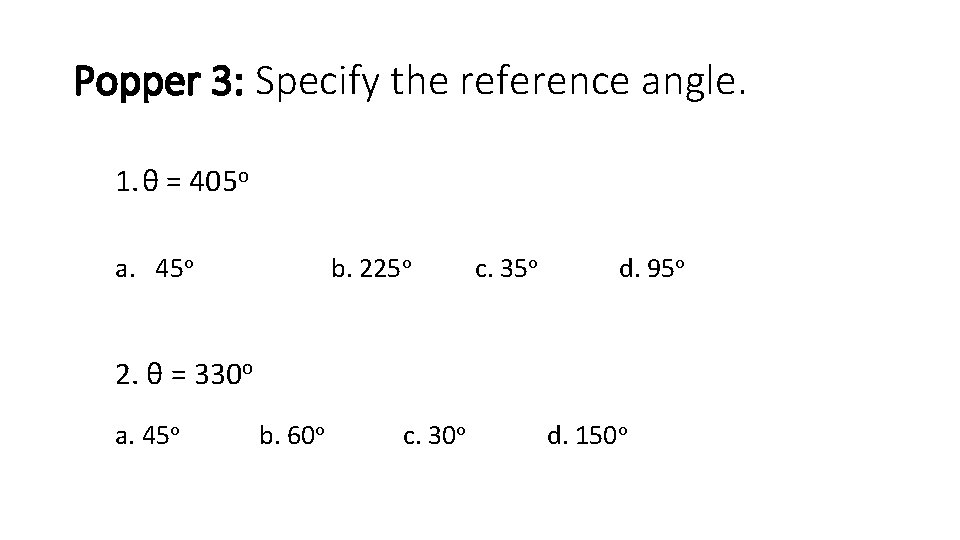
Popper 3: Specify the reference angle. 1. θ = 405 o a. 45 o b. 225 o c. 35 o d. 95 o 2. θ = 330 o a. 45 o b. 60 o c. 30 o d. 150 o
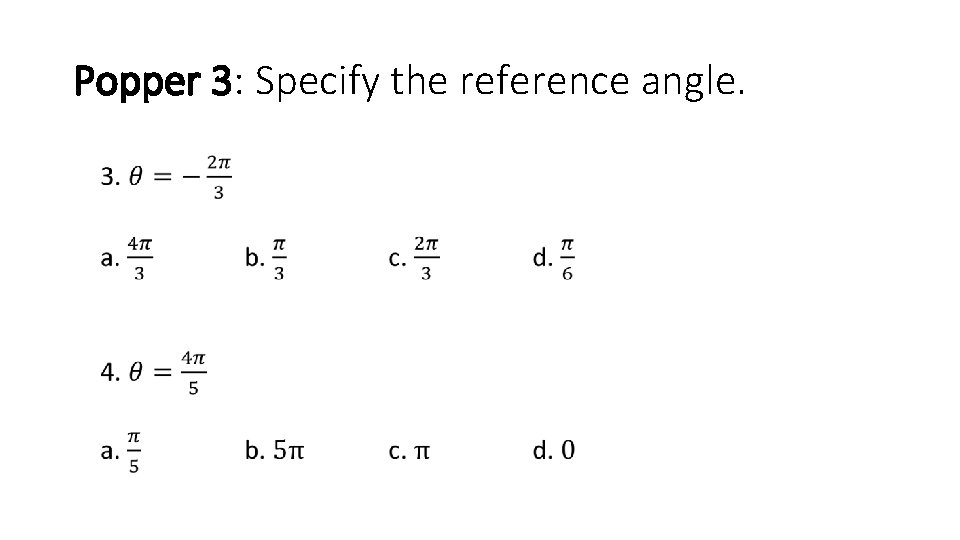
Popper 3: Specify the reference angle.
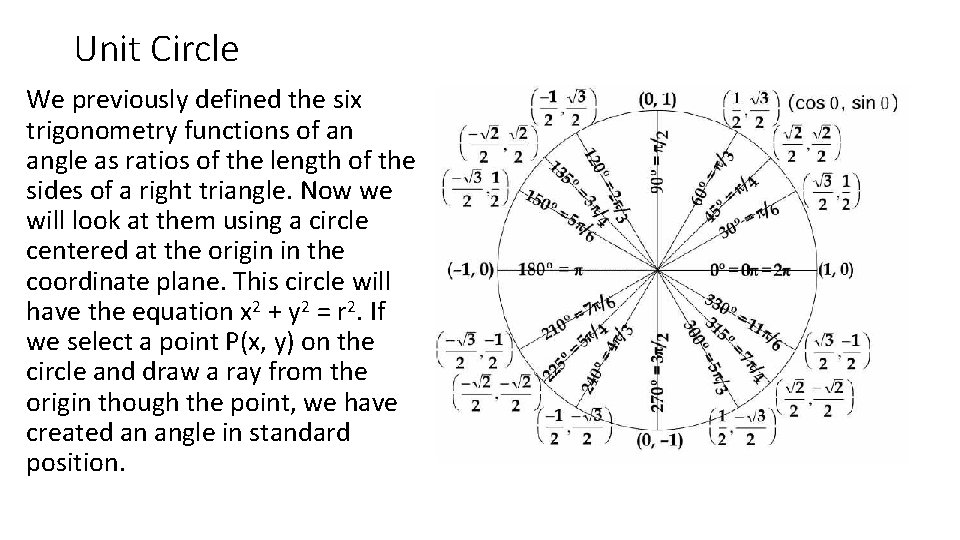
Unit Circle We previously defined the six trigonometry functions of an angle as ratios of the length of the sides of a right triangle. Now we will look at them using a circle centered at the origin in the coordinate plane. This circle will have the equation x 2 + y 2 = r 2. If we select a point P(x, y) on the circle and draw a ray from the origin though the point, we have created an angle in standard position.
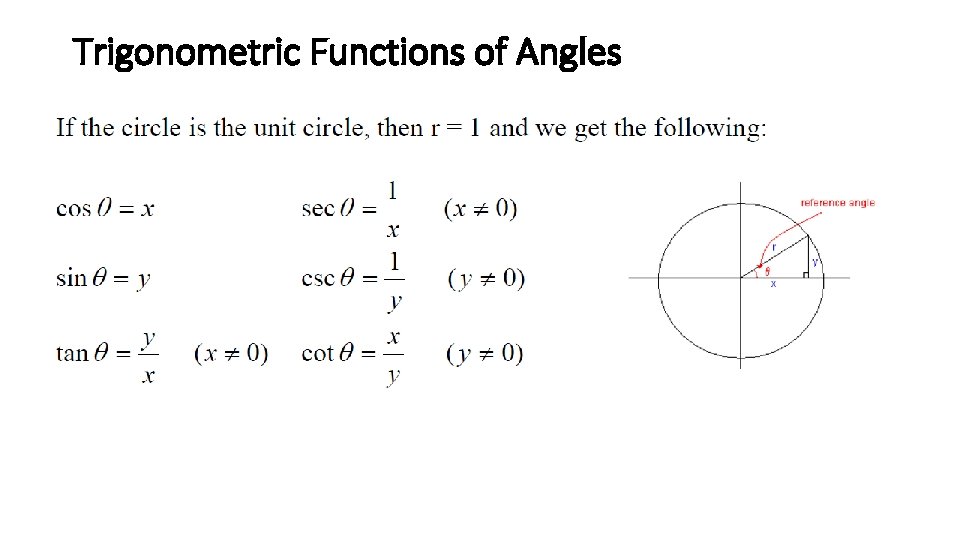
Trigonometric Functions of Angles
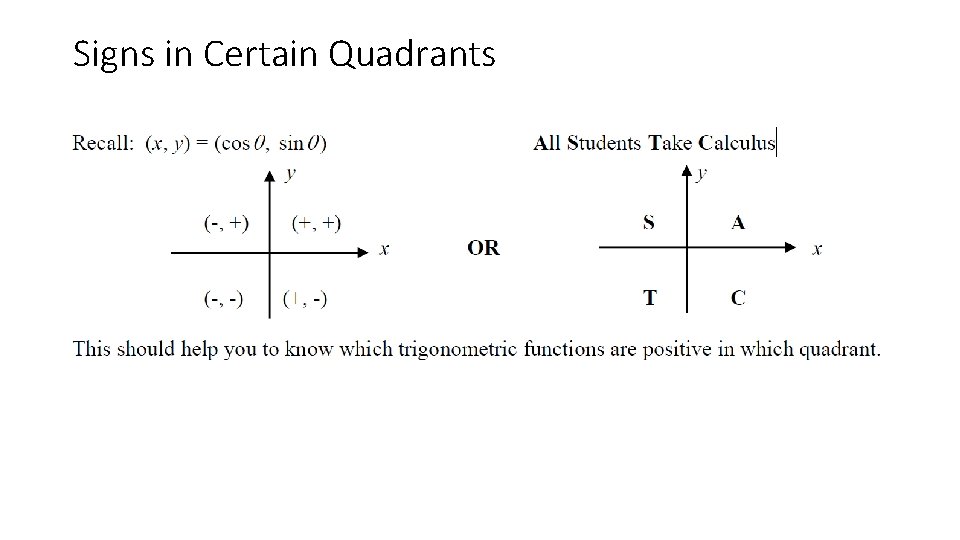
Signs in Certain Quadrants
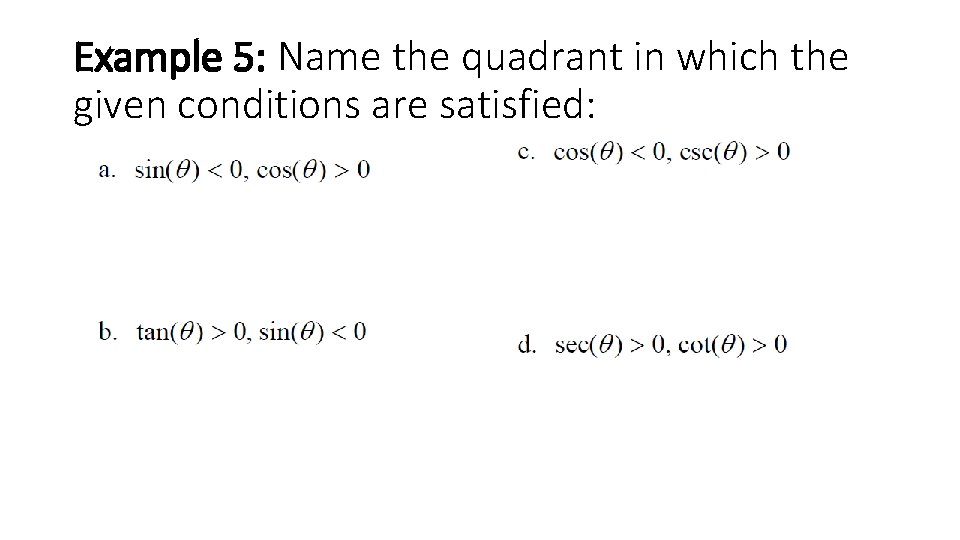
Example 5: Name the quadrant in which the given conditions are satisfied:
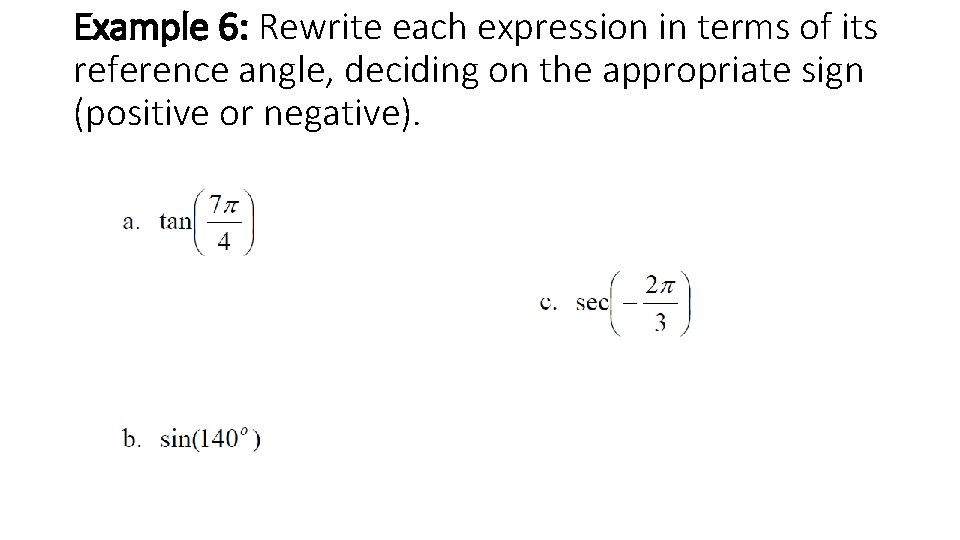
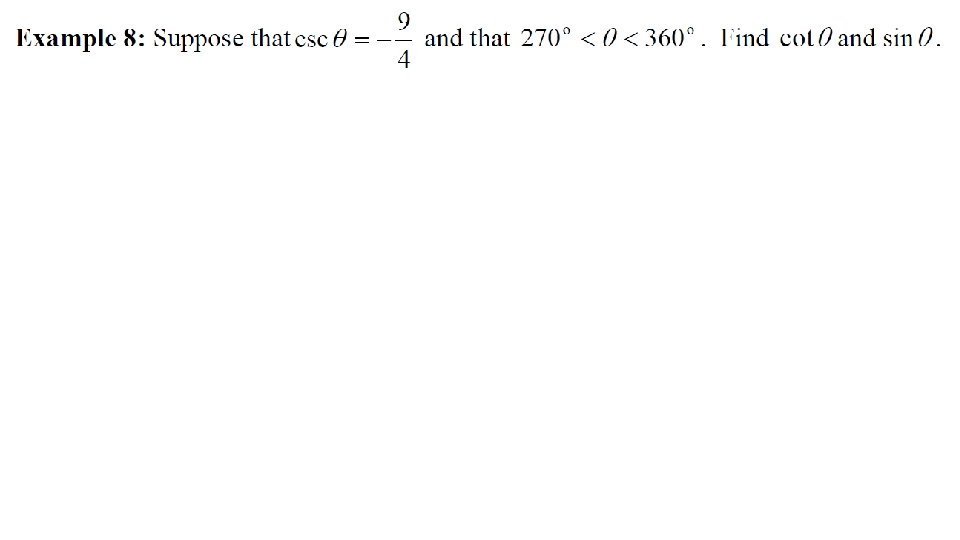
Example 6: Rewrite each expression in terms of its reference angle, deciding on the appropriate sign (positive or negative).
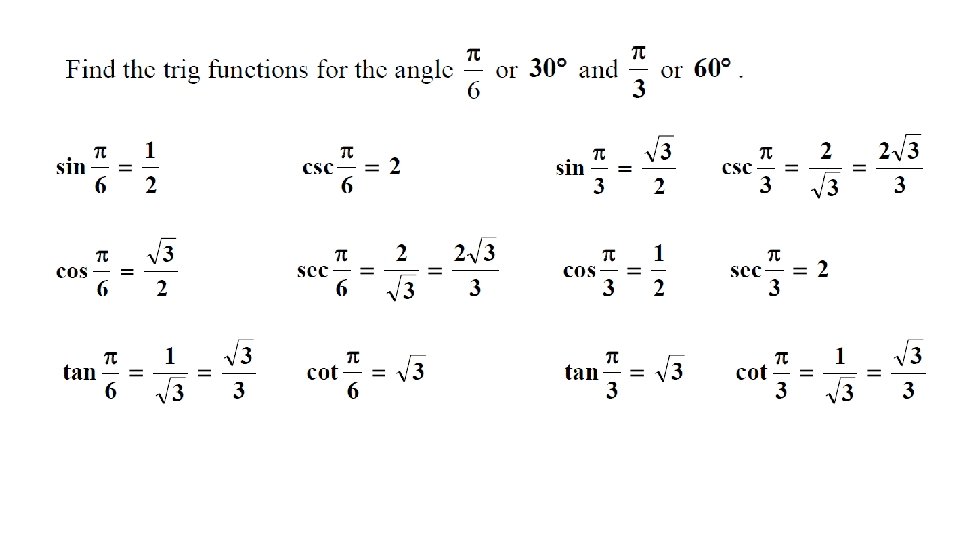
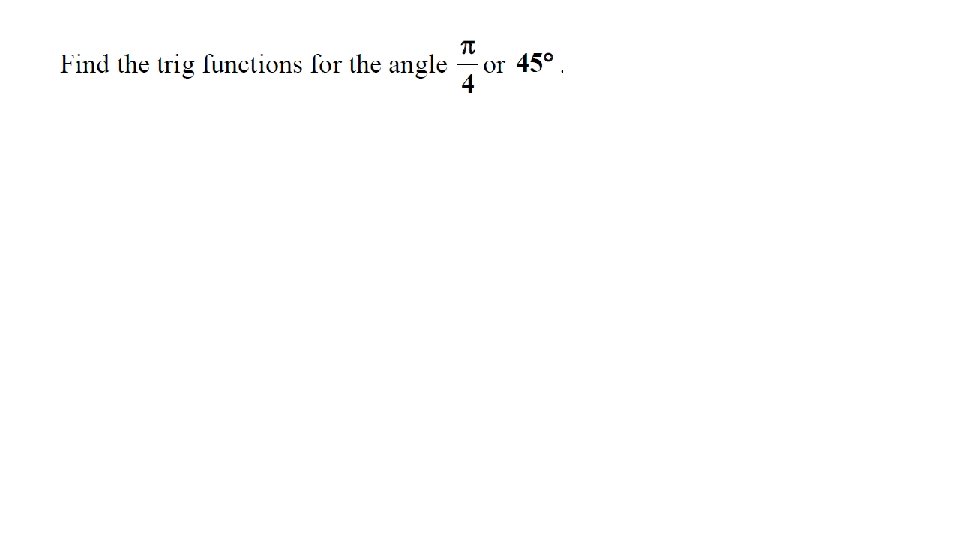
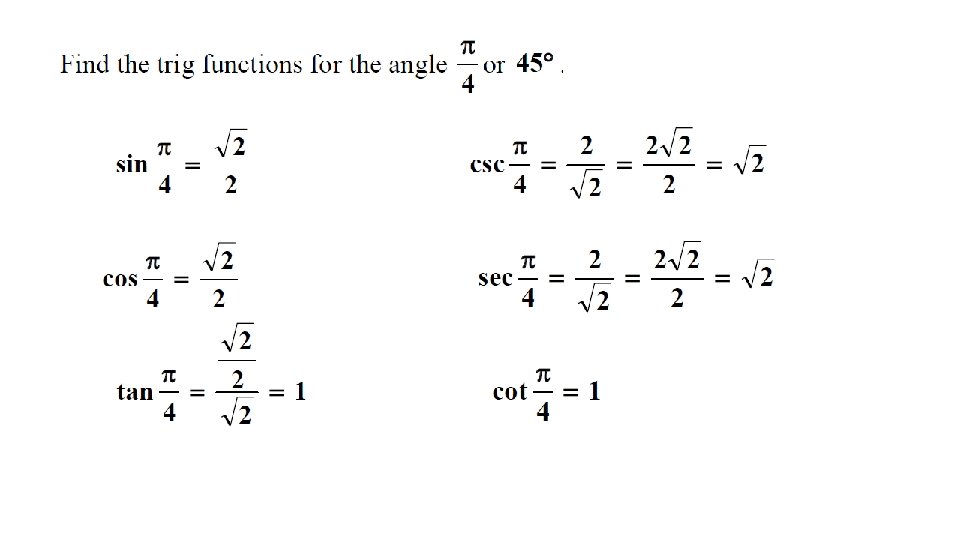
Trig Value Chart:
Evaluating Using Reference Angles 1. Determine the reference angle associated with the given angle. 2. Evaluate the given trigonometric function of the reference angle. 3. Affix the appropriate sign determined by the quadrant of the terminal side of the angle in standard position
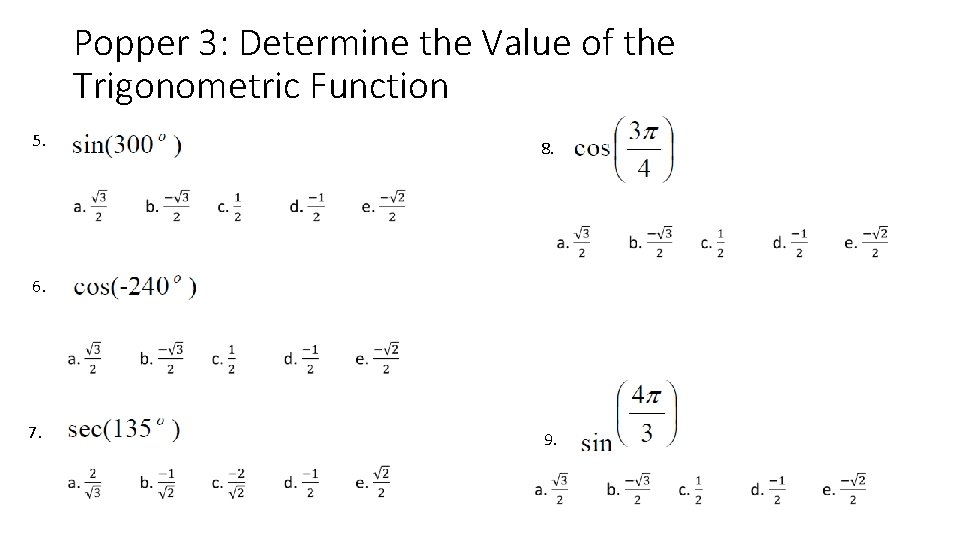
Popper 3: Determine the Value of the Trigonometric Function 5. 8. 6. 7. 9.