Marketing Real People Real Decisions The World of
- Slides: 20
Marketing: Real People, Real Decisions The World of Marketing Chapter 1 Lecture Slides Solomon, Stuart, Carson, & Smith Your name here Course title/number Date ©Copyright 2003 Pearson Education Canada Inc.
Marketing: Real People, Real Decisions Chapter Learning Objectives When you have completed your study of this chapter, you should be able to: • Define the marketing concept. • Define the objective of marketing. • Understand the basics of marketing planning. • Describe the evolution of the marketing concept. • Explain how marketing is important to both individual and business customers in the market place, in our daily lives, and in society. • Explain marketing’s role within an organization. ©Copyright 2003 Pearson Education Canada Inc. 2
Marketing: Real People, Real Decisions Introduction to the Topic • What is marketing? • Is is advertising? Sales? Going to the grocery store? • It is a functional area within a business, but what does it do? • A useful definition from the American Marketing Association: • Marketing: the process of planning and executing the conception, pricing, promotion, and distribution of ideas, goods, and services to create exchanges that satisfy individual and organizational objectives. • Note the many component parts (including the 4 P’s) to this definition, which will all be discussed in good time. ©Copyright 2003 Pearson Education Canada Inc. 3
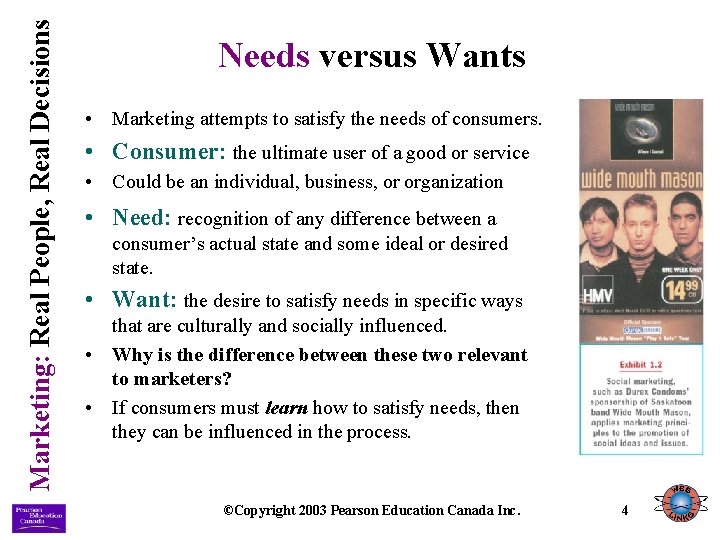
Marketing: Real People, Real Decisions Needs versus Wants • Marketing attempts to satisfy the needs of consumers. • Consumer: the ultimate user of a good or service • Could be an individual, business, or organization • Need: recognition of any difference between a consumer’s actual state and some ideal or desired state. • Want: the desire to satisfy needs in specific ways that are culturally and socially influenced. • Why is the difference between these two relevant to marketers? • If consumers must learn how to satisfy needs, then they can be influenced in the process. ©Copyright 2003 Pearson Education Canada Inc. 4
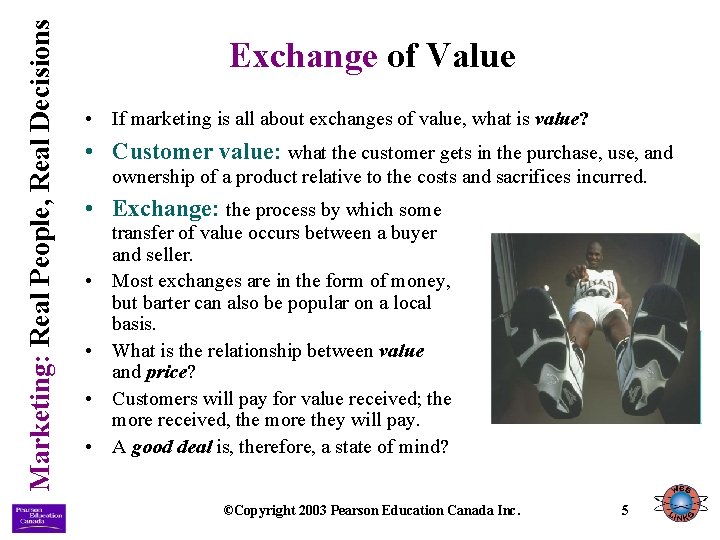
Marketing: Real People, Real Decisions Exchange of Value • If marketing is all about exchanges of value, what is value? • Customer value: what the customer gets in the purchase, use, and ownership of a product relative to the costs and sacrifices incurred. • Exchange: the process by which some • • transfer of value occurs between a buyer and seller. Most exchanges are in the form of money, but barter can also be popular on a local basis. What is the relationship between value and price? Customers will pay for value received; the more received, the more they will pay. A good deal is, therefore, a state of mind? ©Copyright 2003 Pearson Education Canada Inc. 5
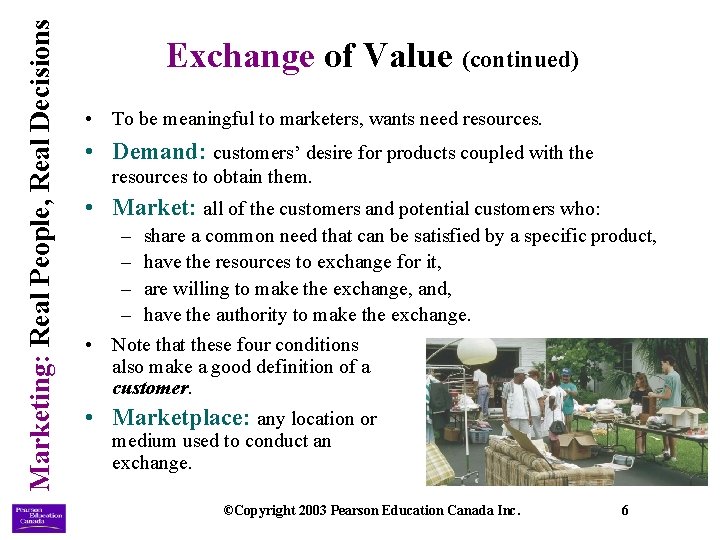
Marketing: Real People, Real Decisions Exchange of Value (continued) • To be meaningful to marketers, wants need resources. • Demand: customers’ desire for products coupled with the resources to obtain them. • Market: all of the customers and potential customers who: – share a common need that can be satisfied by a specific product, – have the resources to exchange for it, – are willing to make the exchange, and, – have the authority to make the exchange. • Note that these four conditions also make a good definition of a customer. • Marketplace: any location or medium used to conduct an exchange. ©Copyright 2003 Pearson Education Canada Inc. 6
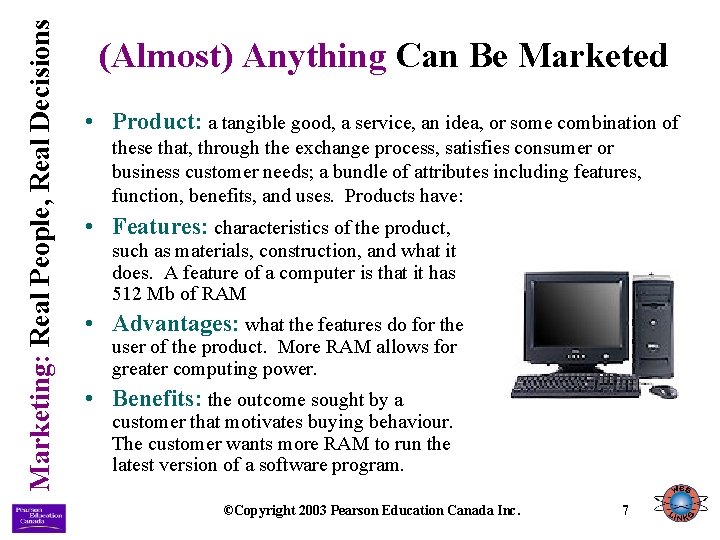
Marketing: Real People, Real Decisions (Almost) Anything Can Be Marketed • Product: a tangible good, a service, an idea, or some combination of these that, through the exchange process, satisfies consumer or business customer needs; a bundle of attributes including features, function, benefits, and uses. Products have: • Features: characteristics of the product, such as materials, construction, and what it does. A feature of a computer is that it has 512 Mb of RAM • Advantages: what the features do for the user of the product. More RAM allows for greater computing power. • Benefits: the outcome sought by a customer that motivates buying behaviour. The customer wants more RAM to run the latest version of a software program. ©Copyright 2003 Pearson Education Canada Inc. 7
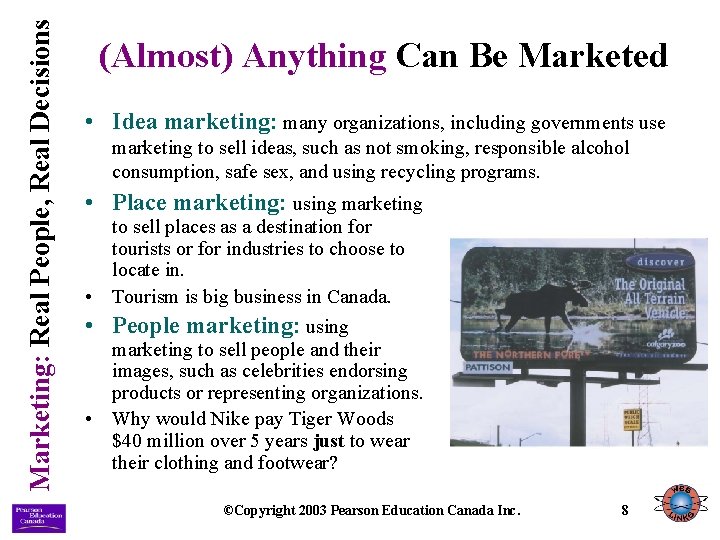
Marketing: Real People, Real Decisions (Almost) Anything Can Be Marketed • Idea marketing: many organizations, including governments use marketing to sell ideas, such as not smoking, responsible alcohol consumption, safe sex, and using recycling programs. • Place marketing: using marketing to sell places as a destination for tourists or for industries to choose to locate in. • Tourism is big business in Canada. • People marketing: using marketing to sell people and their images, such as celebrities endorsing products or representing organizations. • Why would Nike pay Tiger Woods $40 million over 5 years just to wear their clothing and footwear? ©Copyright 2003 Pearson Education Canada Inc. 8
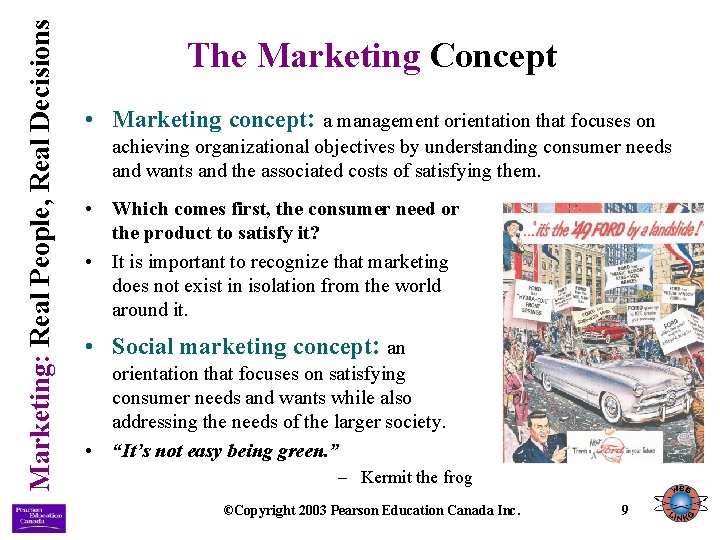
Marketing: Real People, Real Decisions The Marketing Concept • Marketing concept: a management orientation that focuses on achieving organizational objectives by understanding consumer needs and wants and the associated costs of satisfying them. • Which comes first, the consumer need or the product to satisfy it? • It is important to recognize that marketing does not exist in isolation from the world around it. • Social marketing concept: an orientation that focuses on satisfying consumer needs and wants while also addressing the needs of the larger society. • “It’s not easy being green. ” – Kermit the frog ©Copyright 2003 Pearson Education Canada Inc. 9
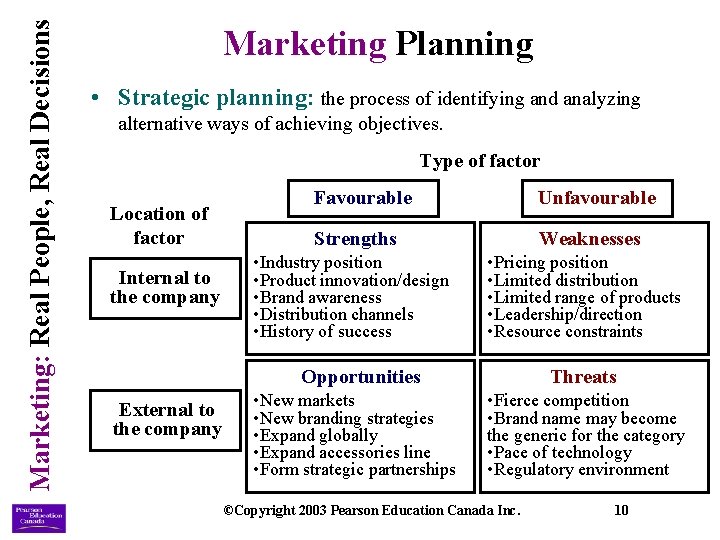
Marketing: Real People, Real Decisions Marketing Planning • Strategic planning: the process of identifying and analyzing alternative ways of achieving objectives. Type of factor Location of factor Internal to the company Favourable Unfavourable Strengths Weaknesses • Industry position • Product innovation/design • Brand awareness • Distribution channels • History of success • Pricing position • Limited distribution • Limited range of products • Leadership/direction • Resource constraints Opportunities External to the company • New markets • New branding strategies • Expand globally • Expand accessories line • Form strategic partnerships Threats • Fierce competition • Brand name may become the generic for the category • Pace of technology • Regulatory environment ©Copyright 2003 Pearson Education Canada Inc. 10
Marketing: Real People, Real Decisions Marketing Planning (continued) • Market segment: a distinct group of customer within a larger market, who are similar to one another in some way and whose needs differ from other customers in the larger market. • Target market: the market segment on which and organization focuses its marketing plan and toward which it directs its marketing efforts. • Market position: the way in which the target market perceives the product in comparison to competitors’ brands. • To be effective, organizations will do all three steps, one after the other, as each one builds on the step previous. • How do marketers achieve positioning? ©Copyright 2003 Pearson Education Canada Inc. 11
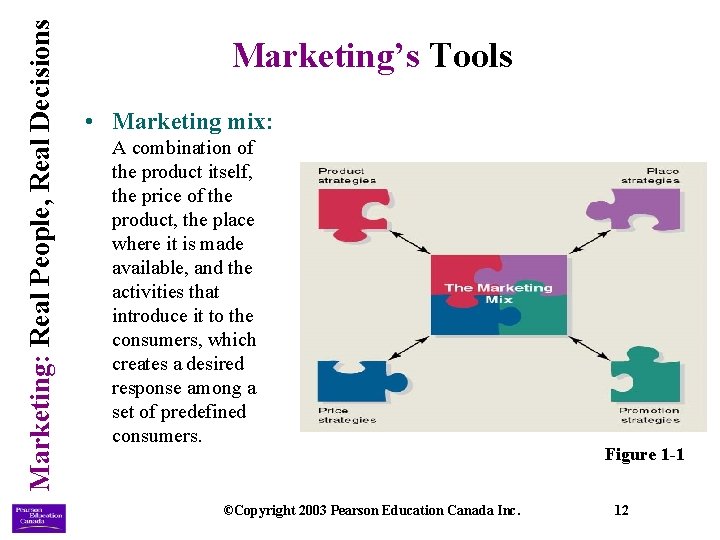
Marketing: Real People, Real Decisions Marketing’s Tools • Marketing mix: A combination of the product itself, the price of the product, the place where it is made available, and the activities that introduce it to the consumers, which creates a desired response among a set of predefined consumers. ©Copyright 2003 Pearson Education Canada Inc. Figure 1 -1 12
Marketing: Real People, Real Decisions Marketing Planning (continued) • Relationship marketing: a marketing philosophy that focuses on building long-term relationships with customers, suppliers, distributors, and other key stakeholders to satisfy mutual needs. • This philosophy recognizes that it is more efficient to keep existing customers happy and buying, than to be constantly trying to find new ones to replace those who have left. • It also recognizes the value of teamwork, when it comes to the supply chain. • Stakeholders: individuals or organizations who affect, or are affected by, the activities of a firm. • Society as a whole have a stake in what organizations do. ©Copyright 2003 Pearson Education Canada Inc. 13
Marketing: Real People, Real Decisions The Evolution of a Concept • Product orientation: a management philosophy that emphasizes the most efficient ways to produce and distribute products. • This philosophy focuses on developing products through research and development activities. • This approach works best in a seller’s market, where demand is greater than supply. • Selling orientation: a managerial view of marketing as a sales function, or a way to move products out of warehouses to reduce inventory. • Also known as the hard sell, this approach is necessary in times of a buyer’s market, where product availability exceeds demand. • Think aluminum siding in the early 60’s, home security systems today, and other unsought goods. ©Copyright 2003 Pearson Education Canada Inc. 14
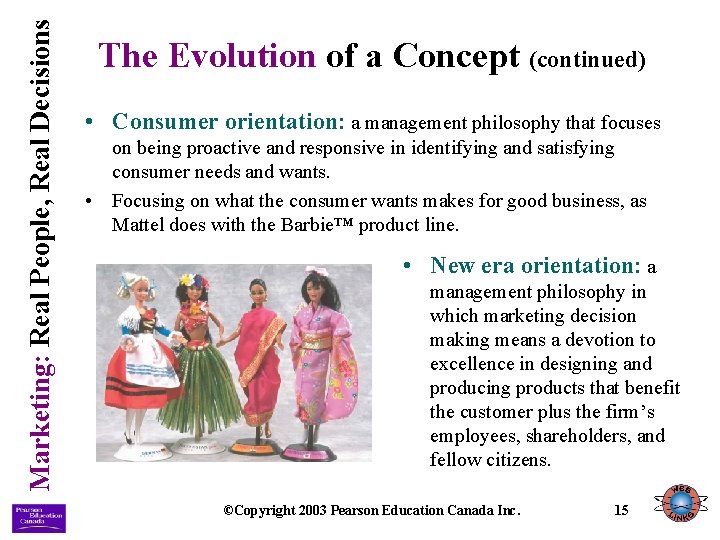
Marketing: Real People, Real Decisions The Evolution of a Concept (continued) • Consumer orientation: a management philosophy that focuses on being proactive and responsive in identifying and satisfying consumer needs and wants. • Focusing on what the consumer wants makes for good business, as Mattel does with the Barbie™ product line. • New era orientation: a management philosophy in which marketing decision making means a devotion to excellence in designing and producing products that benefit the customer plus the firm’s employees, shareholders, and fellow citizens. ©Copyright 2003 Pearson Education Canada Inc. 15
Marketing: Real People, Real Decisions Marketing Creates Value • Functional value: consumer benefits relating to product features, characteristics, utility, performance, and outcomes. • What will the product do for me? • Utility: the usefulness or benefit received by consumers from a product. Utility can based on form, place, time, and possession. • Buying snow tires after the first snowfall in winter qualifies for all four! • Experiential value: consumer benefits relating to sensory, emotional, relational, and epistemic experiences. • Live theatre and sports are experiences enjoyed for many different reasons. ©Copyright 2003 Pearson Education Canada Inc. 16
Marketing: Real People, Real Decisions Marketing Creates Value • Symbolic (expressive) value: consumer benefits relating to self -concept or self-identity, self-expression, social meaning, personal meaning, or conditional meaning. • Some products or services we consume for what we believe they say about us to others. Luxury products are a good example. • Cost (sacrifice) value: consumer benefits relating to economic costs, psychological costs, personal investment, and risk. • Warehouse retailers and e-tailers appeal to those consumers who appreciate value created by low prices, selection, and convenience of shopping. ©Copyright 2003 Pearson Education Canada Inc. 17
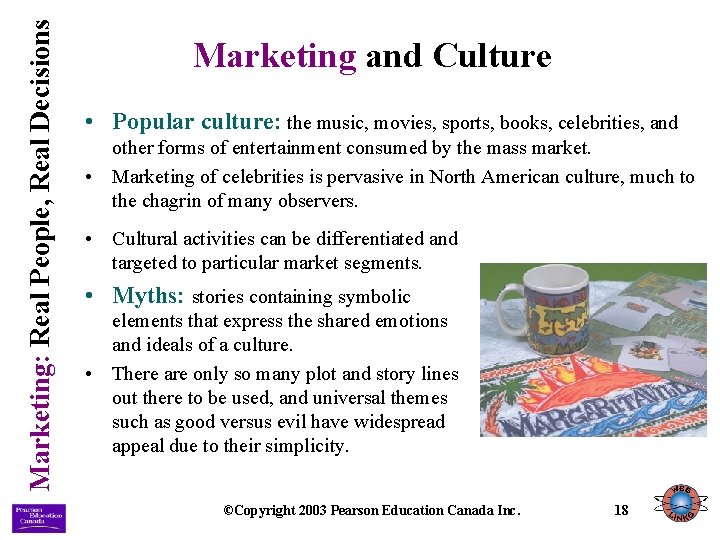
Marketing: Real People, Real Decisions Marketing and Culture • Popular culture: the music, movies, sports, books, celebrities, and other forms of entertainment consumed by the mass market. • Marketing of celebrities is pervasive in North American culture, much to the chagrin of many observers. • Cultural activities can be differentiated and targeted to particular market segments. • Myths: stories containing symbolic elements that express the shared emotions and ideals of a culture. • There are only so many plot and story lines out there to be used, and universal themes such as good versus evil have widespread appeal due to their simplicity. ©Copyright 2003 Pearson Education Canada Inc. 18
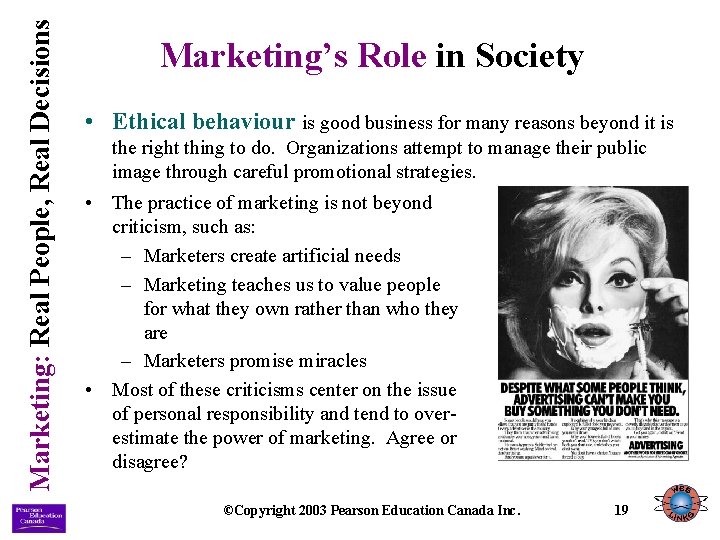
Marketing: Real People, Real Decisions Marketing’s Role in Society • Ethical behaviour is good business for many reasons beyond it is the right thing to do. Organizations attempt to manage their public image through careful promotional strategies. • The practice of marketing is not beyond criticism, such as: – Marketers create artificial needs – Marketing teaches us to value people for what they own rather than who they are – Marketers promise miracles • Most of these criticisms center on the issue of personal responsibility and tend to overestimate the power of marketing. Agree or disagree? ©Copyright 2003 Pearson Education Canada Inc. 19
Marketing: Real People, Real Decisions Famous Last Words… • For good or bad, marketing is everywhere. • Our challenge for the remainder of this course will be to try to understand what it can do for organizations attempting to achieve their objectives. ©Copyright 2003 Pearson Education Canada Inc. 20