Main Idea The Sui and Tang dynasties reunited






- Slides: 25
Main Idea: The Sui and Tang dynasties reunited and rebuilt China after years of war.
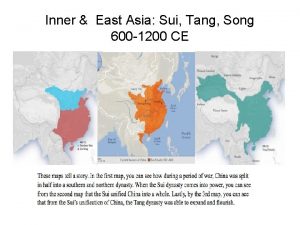
After the Han empire ended, 1. China broke into 17 kingdoms and war and poverty were everywhere. 2. Warlords, or military leaders who run a government, fought with each other 3. Nomads invaded and conquered parts of northern China. 4. The people of the Korean peninsula ended Chinese rule by breaking away and built their own separate civilization. ►China was finally united by a Chinese general named Wendi, who founded the a new dynasty called the Sui.
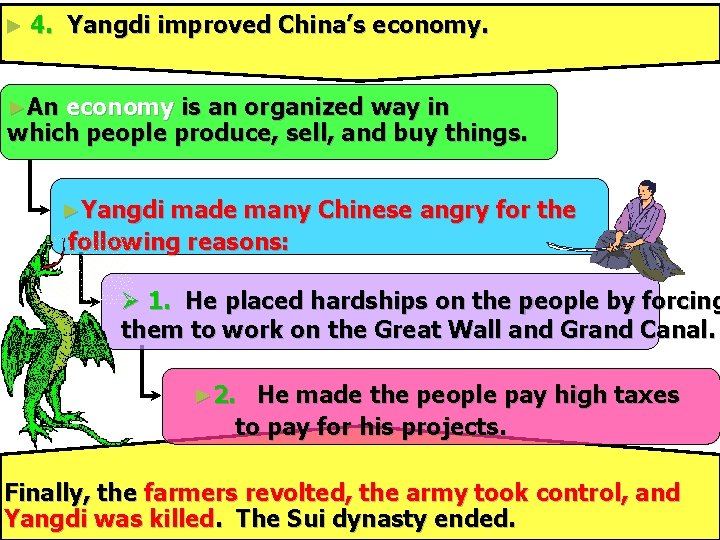
►After Wendi died, his son Yangdi became emperor. ►Yangdi tried to expand improve China’s territory in the following ways: 1. He sent an army to fight the Koreans but was defeated. 2. He had the Great Wall rebuilt. 3. He built the Grand Canal linking the Chan Jiang and Huang He Rivers which became an important route for shipping products between north and south.
► 4. Y a ng d i i m p r o v e d C hi na ’ s e c o no m y. ►An economy is an organized way in which people produce, sell, and buy things. ►Yangdi made many Chinese angry for the following reasons: Ø 1. He placed hardships on the people by forcing them to work on the Great Wall and Grand Canal. ► 2. He made the people pay high taxes to pay for his projects. Fi n a l l y , t h e f a r m e r s r e v o l t e d , t h e a r m y t o o k c o n t r o l , a n d Y a ng d i w a s k i l l e d. T he S ui d y na s t y e nd e d.
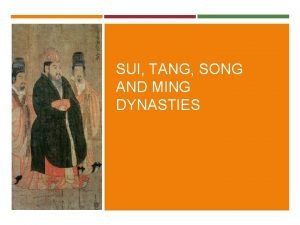
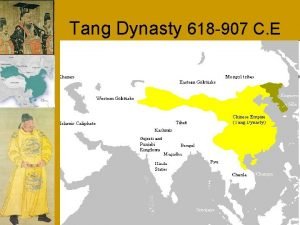
► In A. D. 618, one of Yangdi’s generals took over China and set up the Tang dynasty. ► It’s capital, Changan, became a magnificent city with one million people. ► The most powerful Tang emperor was named Taizong.
In the late A. D. 600 s, a woman named Wu Zetian ruled China. ► She was the only woman in history to rule China on her own. ► She added more officials to the government and strengthened the military forces. ►
Taizong and other Tang rulers worked to strengthen China and make reforms. ► Reforms are changes that bring about improvements. ► Reforms made by the Tang included: ► 1. 2. 3. 4. 5. Restored the civil service exam system making government officials positions based on how well they did on exams rather than family connections. Gave land to farmers and brought order to the countryside. Strengthened the military forces. Expanded China’s territory in the west and took control of the Silk Road Marched into Korea and forced the Korean kingdoms to pay tribute.
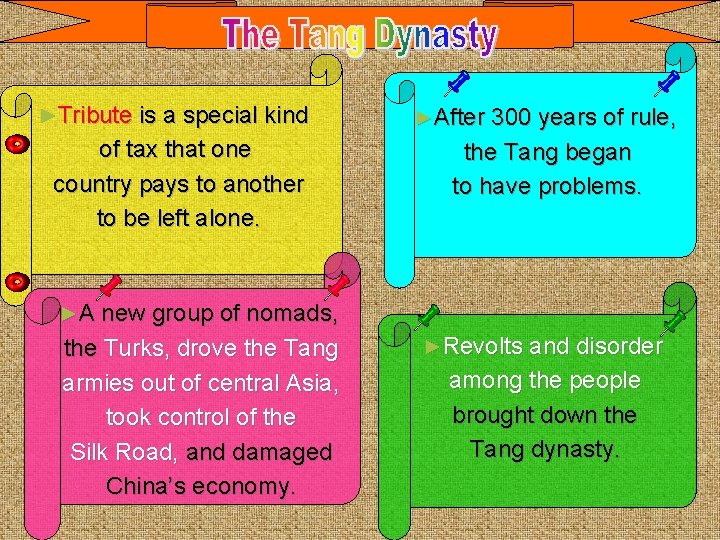
►Tribute is a special kind ►After 300 years of rule, of tax that one country pays to another to be left alone. the Tang began to have problems. ►A new group of nomads, the Turks, drove the Tang armies out of central Asia, took control of the Silk Road, and damaged China’s economy. ►Revolts and disorder among the people brought down the Tang dynasty.
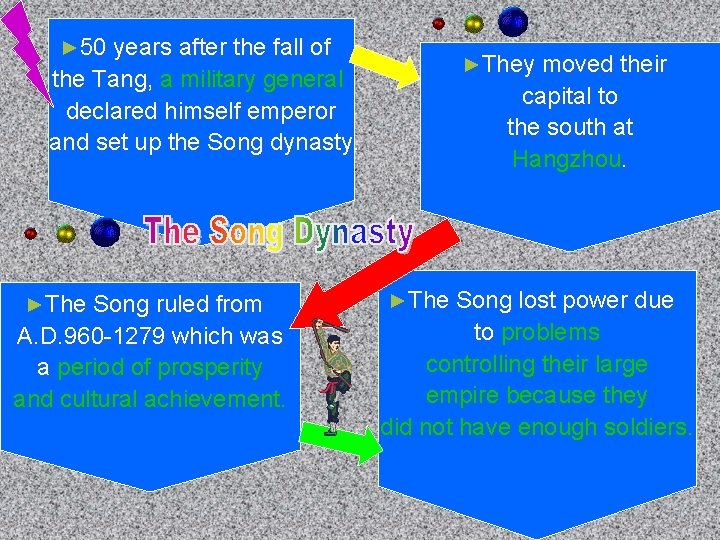
► 50 years after the fall of the Tang, a military general declared himself emperor and set up the Song dynasty. ►They moved their capital to the south at Hangzhou. ►The Song ruled from ►The Song lost power due A. D. 960 -1279 which was a period of prosperity and cultural achievement. to problems controlling their large empire because they did not have enough soldiers.
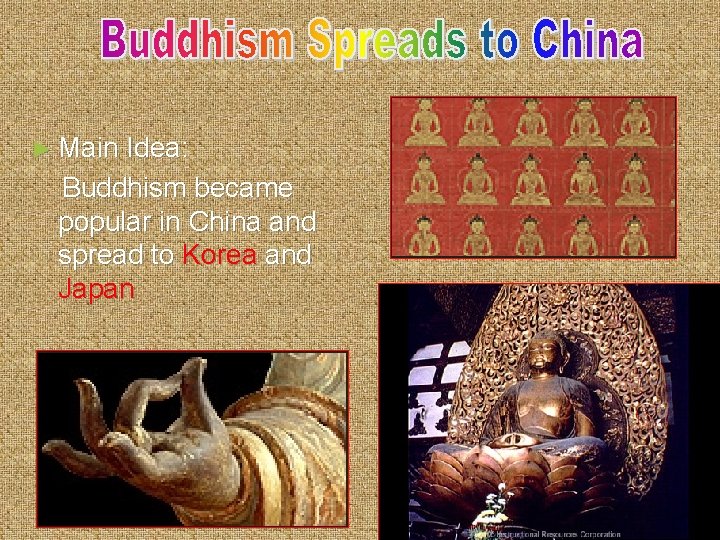
► Main Idea: Buddhism became popular in China and spread to Korea and Japan
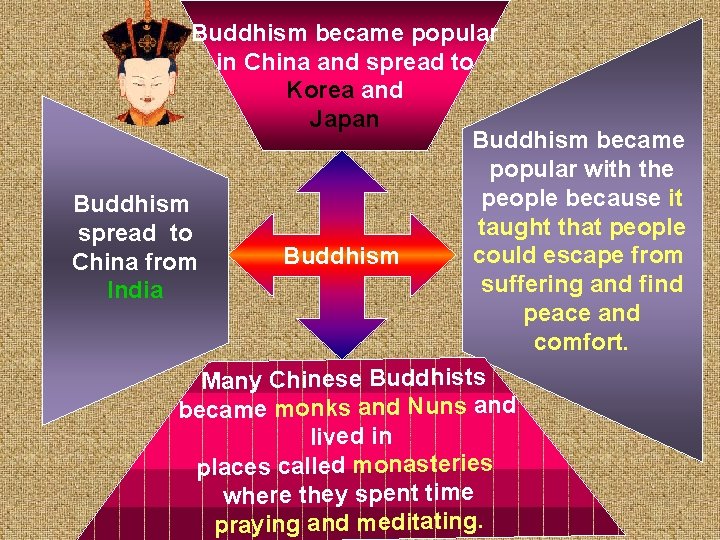
Buddhism became popular in China and spread to Korea and Japan Buddhism became popular with the people because it Buddhism taught that people spread to could escape from Buddhism China from suffering and find India peace and comfort. Many Chinese Buddhists became monks and Nuns and lived in places called monasteries where they spent time praying and meditating.
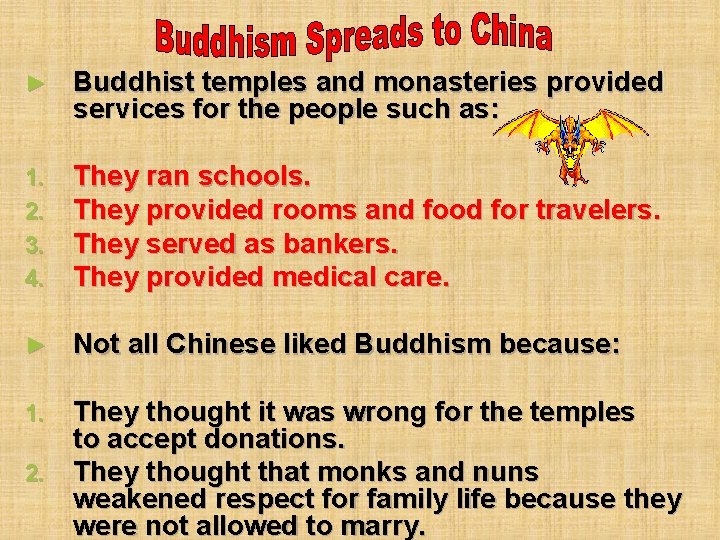
► Buddhist temples and monasteries provided services for the people such as: 1. 2. 3. 4. They ran schools. They provided rooms and food for travelers. They served as bankers. They provided medical care. ► Not all Chinese liked Buddhism because: They thought it was wrong for the temples to accept donations. 2. They thought that monks and nuns weakened respect for family life because they were not allowed to marry. 1.
In the early A. D. 800’s Tang officials feared Buddhism’s growing power and saw it as an enemy of China’s traditions. They believed it weakened respect for family life because monks and nuns were not allowed to marry. Many Buddhist monasteries and temples were destroyed by the Tang. Korea had broken free from China and was divided into three independent kingdoms. In the A. D. 300’s many Chinese Buddhists brought their religion to Korea. In A. D. 660, the Koreans united to form one country and Buddhism grew stronger in Korea. Buddhism later spread to Japan from Korea.
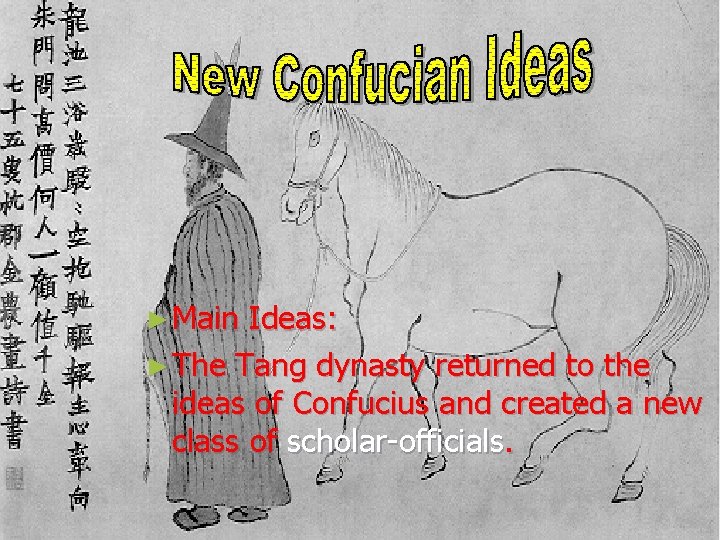
► Main Ideas: ► The Tang dynasty returned to the ideas of Confucius and created a new class of scholar-officials.
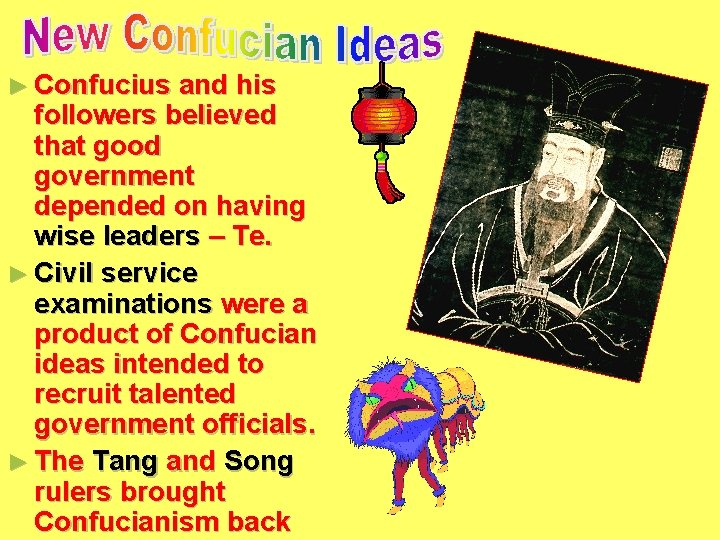
► Confucius and his followers believed that good government depended on having wise leaders – Te. ► Civil service examinations were a product of Confucian ideas intended to recruit talented government officials. ► The Tang and Song rulers brought Confucianism back
► The Tang and Song dynasties both gave support to a new kind of Confucianism called neo-Confucianism. ► It was created to reduce Buddhism’s popularity which taught that life in this world was just as important as the afterlife. ► It combined aspects of both Buddhism and Daoism. ► Expected followers to take part in their present life and help others.
Confucianism became more than a system of rules for being good, but rather a religion with beliefs about the spiritual world. ► Neo-Confucianism taught that if people followed Confucius’s teachings they would find peace of mind and live in harmony with nature. ► Neo-Confucianism became a way to strengthen the Chinese government because: ► 1. Civil service examinations were used to hire officials. ► 2. The bureaucracy was based on a merit system where people are accepted for what they can do and not on their riches or personal contacts. ►
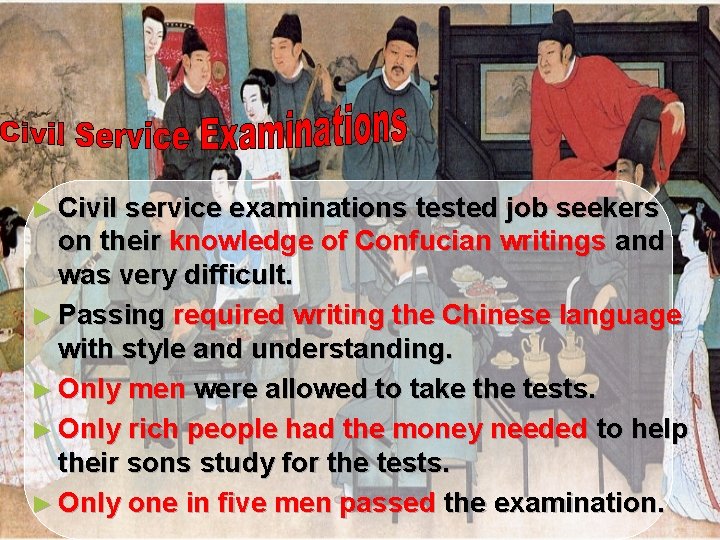
► Civil service examinations tested job seekers on their knowledge of Confucian writings and was very difficult. ► Passing required writing the Chinese language with style and understanding. ► Only men were allowed to take the tests. ► Only rich people had the money needed to help their sons study for the tests. ► Only one in five men passed the examination.
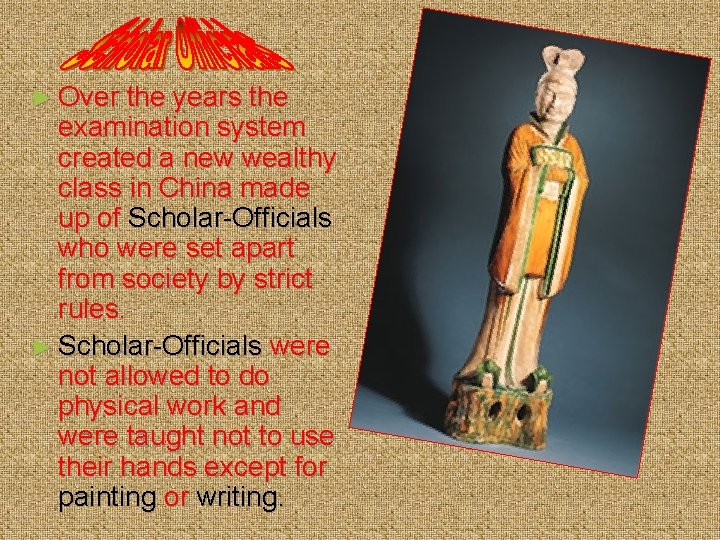
► Over the years the examination system created a new wealthy class in China made up of Scholar-Officials who were set apart from society by strict rules. ► Scholar-Officials were not allowed to do physical work and were taught not to use their hands except for painting or writing.