MA 201 CMR 17 00 John Hally January
- Slides: 5
MA 201 CMR 17. 00 John Hally January 2012 GIAC GSEC, GCIA, GCIH, GCFA, GCWN, GPEN 1 1
17. 01 - Purpose and Scope • Effective Date: March 2010 • Purpose • Implementation of provisions set forth in Massachusetts General Law (MGL) 93 H • Establish minimum standard to safeguard personal information contained in paper and electronic records • Ensure security and confidentiality of information consistent with industry standards • Scope • Applies to any and all persons that own or license personal information of a Massachusettes resident 2
17. 02 - Key Definitions • Personal Information: Resident’s first name/initial and last name in combination with: • Social Security Number. • Driver’s License/State Identification Number. • Financial account/Credit card number with or without PIN/Security/Access Code. • Record: Any material upon which written, drawn, spoken, visual, or electromagnetic information or images are recorded or preserved, regardless of physical form or characteristics. • Owner/licenser: Receives, maintains, processes, or otherwise has access to personal information in connection with the provision of goods or services or in connection with employment. 3
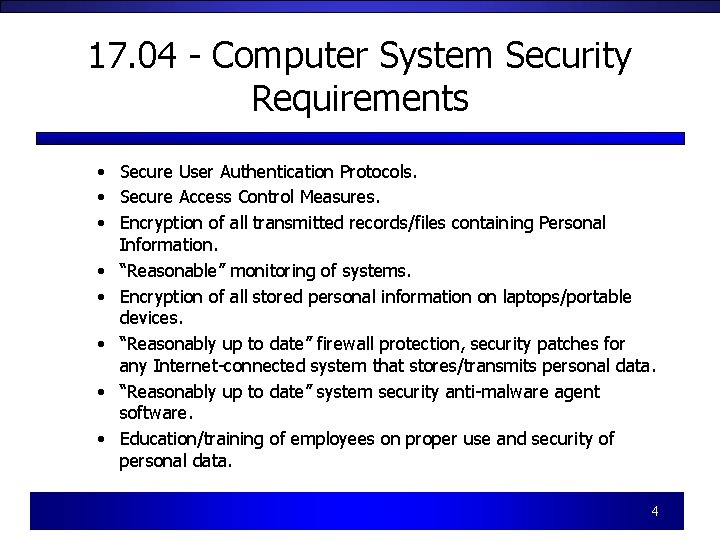
17. 04 - Computer System Security Requirements • Secure User Authentication Protocols. • Secure Access Control Measures. • Encryption of all transmitted records/files containing Personal Information. • “Reasonable” monitoring of systems. • Encryption of all stored personal information on laptops/portable devices. • “Reasonably up to date” firewall protection, security patches for any Internet-connected system that stores/transmits personal data. • “Reasonably up to date” system security anti-malware agent software. • Education/training of employees on proper use and security of personal data. 4
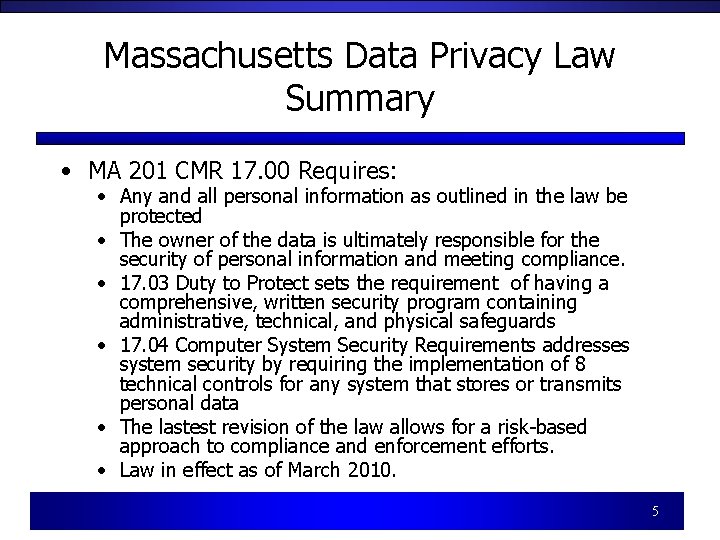
Massachusetts Data Privacy Law Summary • MA 201 CMR 17. 00 Requires: • Any and all personal information as outlined in the law be protected • The owner of the data is ultimately responsible for the security of personal information and meeting compliance. • 17. 03 Duty to Protect sets the requirement of having a comprehensive, written security program containing administrative, technical, and physical safeguards • 17. 04 Computer System Security Requirements addresses system security by requiring the implementation of 8 technical controls for any system that stores or transmits personal data • The lastest revision of the law allows for a risk-based approach to compliance and enforcement efforts. • Law in effect as of March 2010. 5