LUCID DREAMING Ngan Diep Kim Fleck Stephen Johnson

- Slides: 11
LUCID DREAMING Ngan Diep Kim Fleck Stephen Johnson David Yoshida
Outline • • Discussion Questions Introduction History Characteristics of Lucid Dreaming Physiological Aspects Usefulness of Lucidity Methods of Induction Conclusion
Discussion Questions • Could there be consciousness during sleep? • Do we have deliberate control over our actions in dreams? • What is the nature of imaginary worlds? • Is lucid dreaming an altered state of consciousness?
Introduction • What is lucid dreaming? • Dreams in which you know that you are dreaming. • Levels of lucid dreaming and awareness • High-level lucidity • Low-level lucidity • How common are lucid dreams? • "About 58% of the population have experienced a lucid dream at least once in their lifetime, while about 21% report it with some frequency (one or more a month). – Jayne Gackenbach
History • 415 AD written in a letter by St. Augustine. • Practiced by Tibetan Buddhists for a thousand years through a form of dream yoga • 1913 Term coined by Frederick Van Eeden • Modern research- Stephen La. Berge and Lynn Nagel of Stanford University
CHARACTERISITICS • The beginning of lucidity is marked by distinct eye movements • Occurs late during the REM sleep cycle • Induced by some sort of “cue” • Recognition of this “cue” is made possible by higher cortical arousal • Waking up from a lucid dream feels more real than waking from a normal dream • This is due to the higher cortical arousal experienced during lucid dreaming
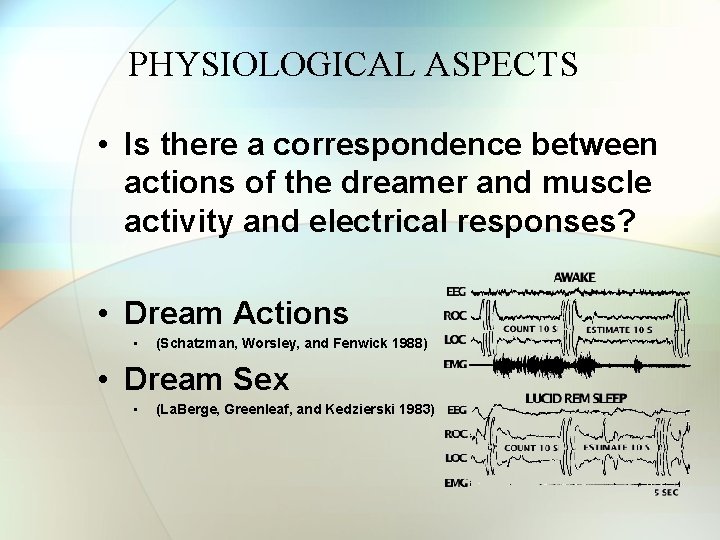
PHYSIOLOGICAL ASPECTS • Is there a correspondence between actions of the dreamer and muscle activity and electrical responses? • Dream Actions • (Schatzman, Worsley, and Fenwick 1988) • Dream Sex • (La. Berge, Greenleaf, and Kedzierski 1983)
Usefulness of Lucidity • Adventure and Excitement • Practice/Rehearsal • Creative Problem Solving • Therapeutic What is the nature of the dream world?
Methods of Induction • Mnemonic Induction of Lucid Dreaming (MILD) • Mindfulness • External Signals • Electric Shock to the wrist • Dream Light (La. Berge 1985) How long do dreams last?
Conclusion • Is lucid dreaming an ASC? YES • How long do dreams take? About 13 sec • Is there a correspondence between actions of the dreamer and muscle activity and electrical responses? YES • What is the nature of the dream world? We don’t know.
References • Blackmore, Susan. Lucid Dreaming: Awake in Your Sleep? Skeptical Inquirer, 1991. 362 -370. • Conscious Mind, Sleeping Brain: Perspectives on Lucid Dreaming. Ed. Gackenbach, Jayne and Stephen La. Berge. New York: Plenum Press, 1988. • Holt, Doug. LUCID DREAMING. Philadelphia. 1998. http: //serendip. brynmawr. edu/bb/neuro 98/202 s 98 -paper 1/Holt. html • La. Berge, S. , Greenleaf, W. , & Kedzierski, B. (1983). Physiological responses to dreamed sexual activity during lucid REM sleep. Psychophysiology, 20, 454 -455. • La. Berge, Stephen and H. Rheingold. EXPLORING THE WORLD OF LUCID DREAMING. New York: Ballantine. 1990. http: //www. lucidity. com/EWLD 6. txt • La. Berge, Stephen. Lucid Dreaming. New York: Ballantine. 1985. http: //www. lucidity. com/LD 8 DFM. html • Schatzman, M. , A. Worsley, and P. Fenwick. 1988. Correspondence during lucid dreams between dreamed and actual events. In Conscious Mind, Sleeping Brain, 155 -179, ed. J. Gackenbach and S. La. Berge. New York: Plenum. • Sparrow, G. S. LUCID DREAMING, DAWNING OF THE CLEAR LIGHT Virginia Beach: A. R. E. Press, 1976. • Wallace, Benjamin, and Leslie Fisher. Consciousness and Behavior. Waveland press. 2003.