
The Future of Stroke James D Fleck M


- Slides: 31
The Future of Stroke James D. Fleck, M. D. Medical Director IU Health Methodist Hospital Comprehensive Stroke Center
Disclosures None
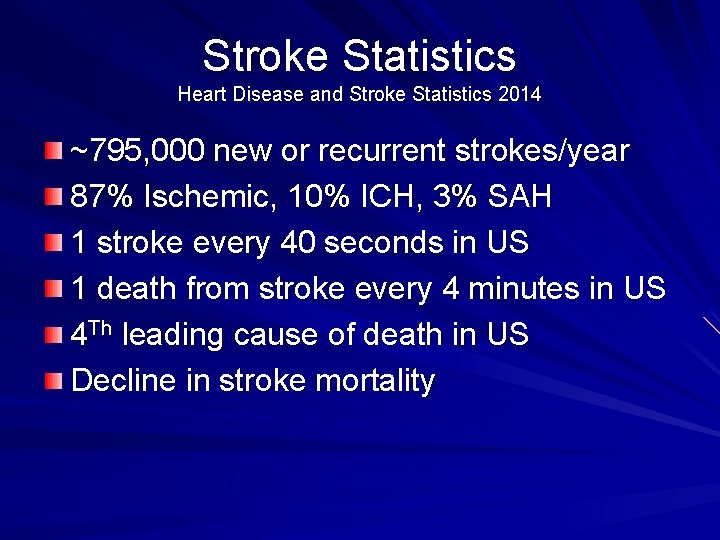
Stroke Statistics Heart Disease and Stroke Statistics 2014 ~795, 000 new or recurrent strokes/year 87% Ischemic, 10% ICH, 3% SAH 1 stroke every 40 seconds in US 1 death from stroke every 4 minutes in US 4 Th leading cause of death in US Decline in stroke mortality
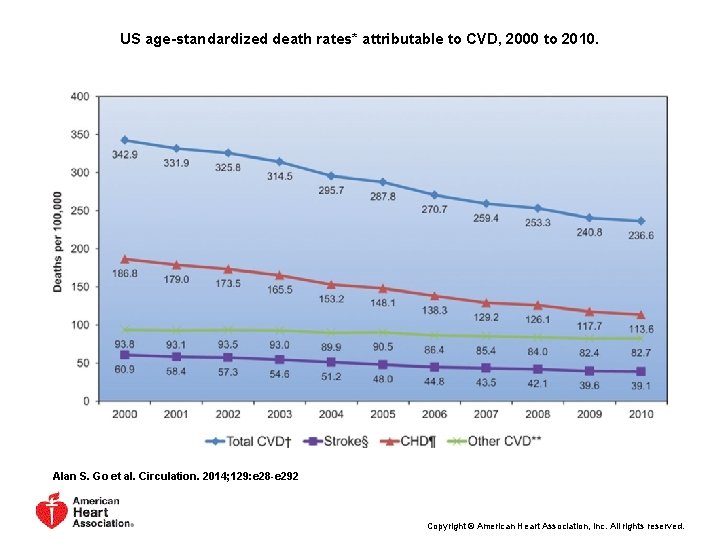
US age-standardized death rates* attributable to CVD, 2000 to 2010. Alan S. Go et al. Circulation. 2014; 129: e 28 -e 292 Copyright © American Heart Association, Inc. All rights reserved.
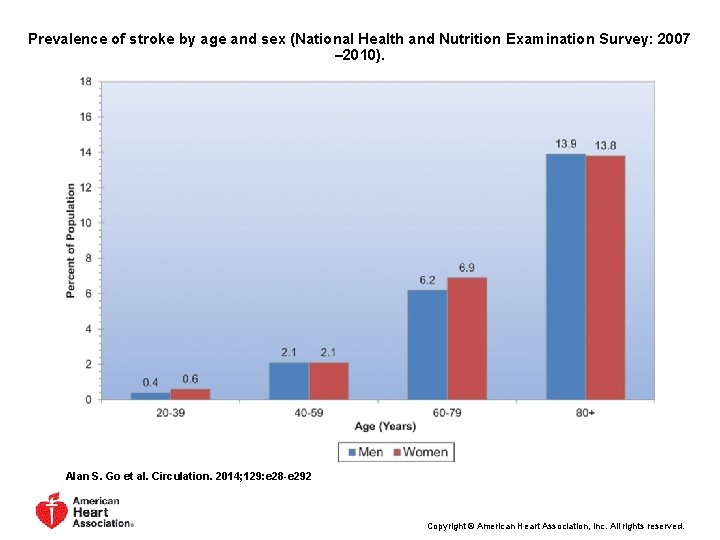
Prevalence of stroke by age and sex (National Health and Nutrition Examination Survey: 2007 – 2010). Alan S. Go et al. Circulation. 2014; 129: e 28 -e 292 Copyright © American Heart Association, Inc. All rights reserved.
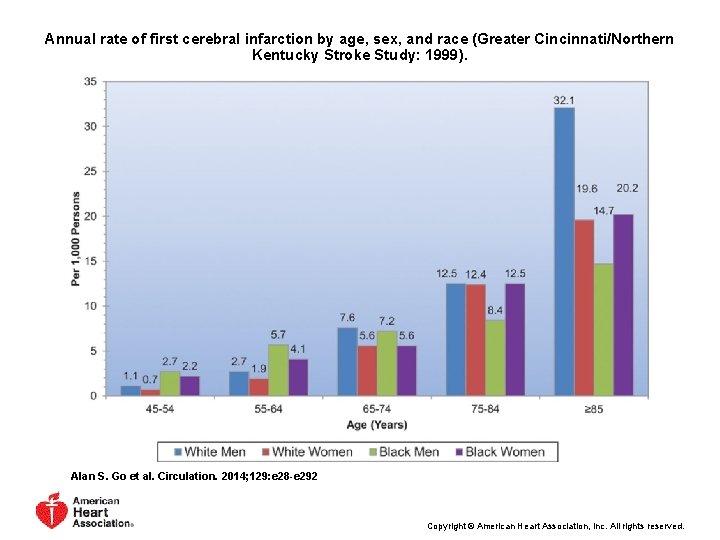
Annual rate of first cerebral infarction by age, sex, and race (Greater Cincinnati/Northern Kentucky Stroke Study: 1999). Alan S. Go et al. Circulation. 2014; 129: e 28 -e 292 Copyright © American Heart Association, Inc. All rights reserved.
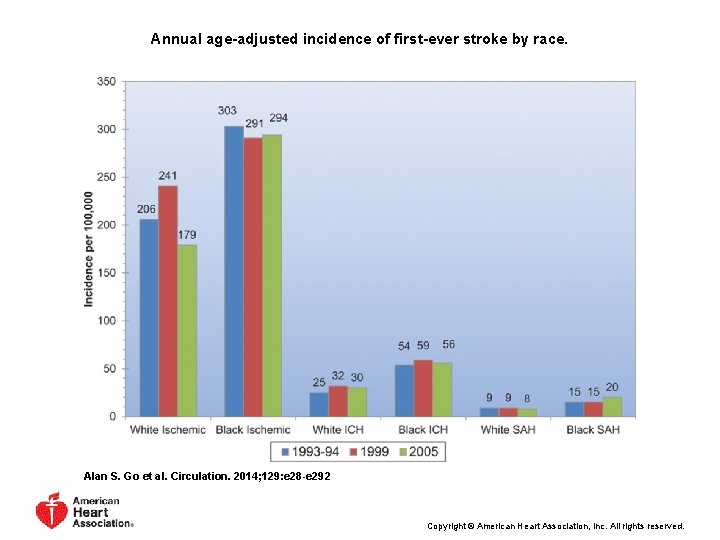
Annual age-adjusted incidence of first-ever stroke by race. Alan S. Go et al. Circulation. 2014; 129: e 28 -e 292 Copyright © American Heart Association, Inc. All rights reserved.
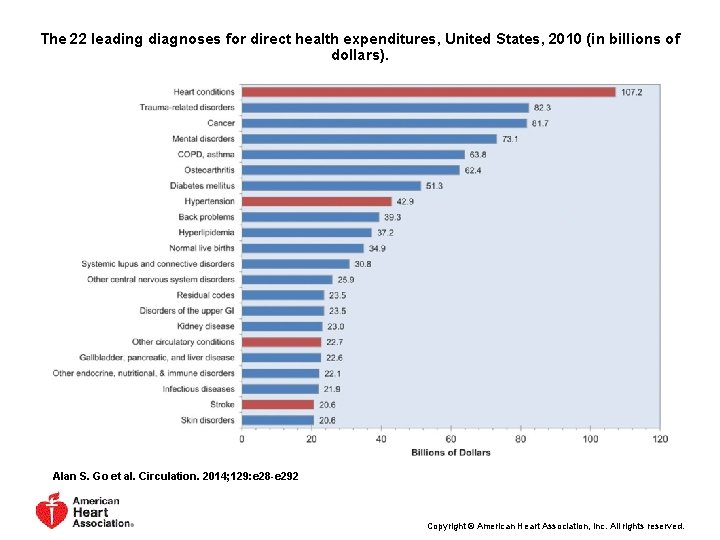
The 22 leading diagnoses for direct health expenditures, United States, 2010 (in billions of dollars). Alan S. Go et al. Circulation. 2014; 129: e 28 -e 292 Copyright © American Heart Association, Inc. All rights reserved.
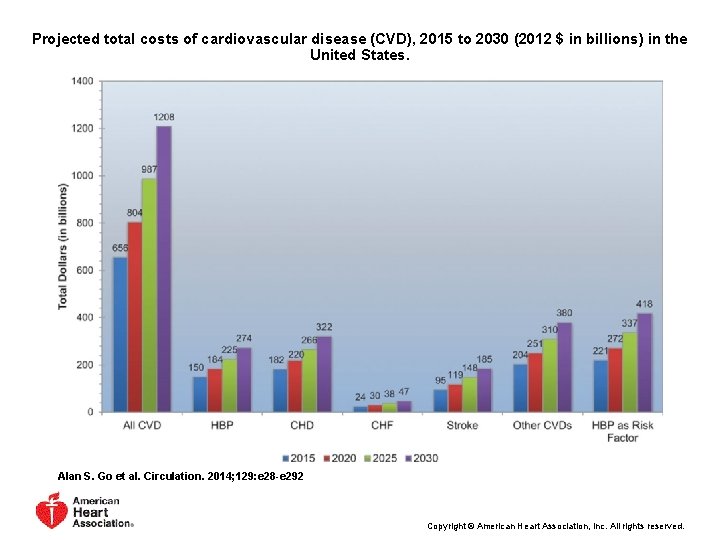
Projected total costs of cardiovascular disease (CVD), 2015 to 2030 (2012 $ in billions) in the United States. Alan S. Go et al. Circulation. 2014; 129: e 28 -e 292 Copyright © American Heart Association, Inc. All rights reserved.
Treatment of Acute Ischemic Stroke Neuroprotection Reperfusion
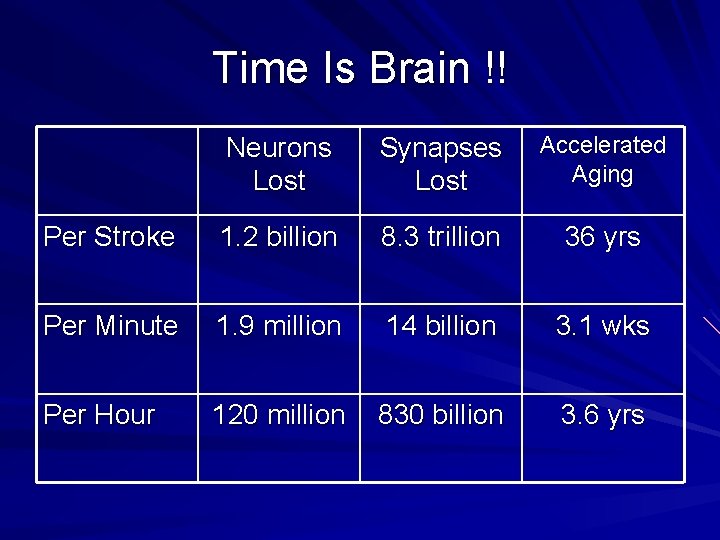
Time Is Brain !! Neurons Lost Synapses Lost Accelerated Aging Per Stroke 1. 2 billion 8. 3 trillion 36 yrs Per Minute 1. 9 million 14 billion 3. 1 wks Per Hour 120 million 830 billion 3. 6 yrs
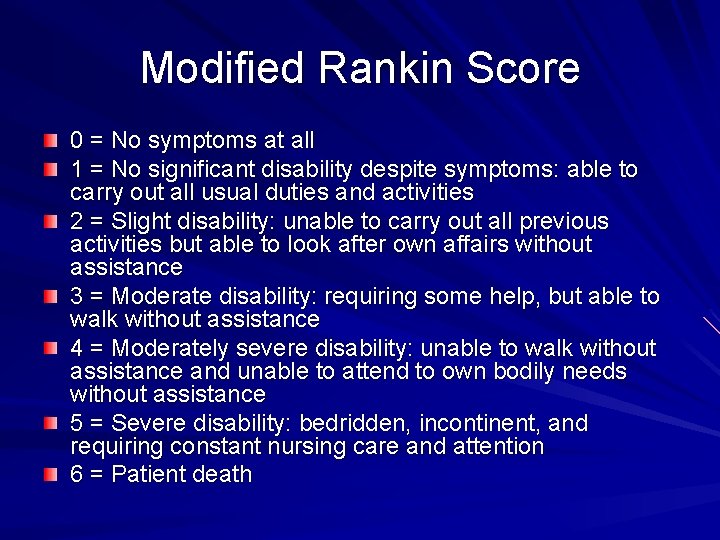
Modified Rankin Score 0 = No symptoms at all 1 = No significant disability despite symptoms: able to carry out all usual duties and activities 2 = Slight disability: unable to carry out all previous activities but able to look after own affairs without assistance 3 = Moderate disability: requiring some help, but able to walk without assistance 4 = Moderately severe disability: unable to walk without assistance and unable to attend to own bodily needs without assistance 5 = Severe disability: bedridden, incontinent, and requiring constant nursing care and attention 6 = Patient death
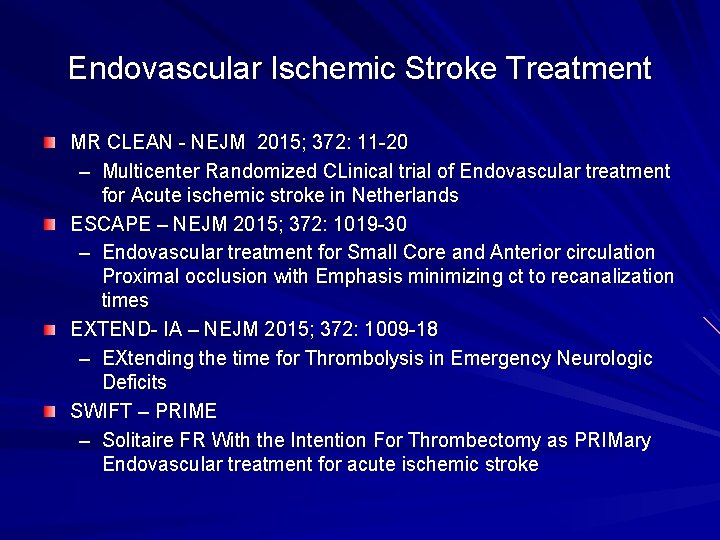
Endovascular Ischemic Stroke Treatment MR CLEAN - NEJM 2015; 372: 11 -20 – Multicenter Randomized CLinical trial of Endovascular treatment for Acute ischemic stroke in Netherlands ESCAPE – NEJM 2015; 372: 1019 -30 – Endovascular treatment for Small Core and Anterior circulation Proximal occlusion with Emphasis minimizing ct to recanalization times EXTEND- IA – NEJM 2015; 372: 1009 -18 – EXtending the time for Thrombolysis in Emergency Neurologic Deficits SWIFT – PRIME – Solitaire FR With the Intention For Thrombectomy as PRIMary Endovascular treatment for acute ischemic stroke
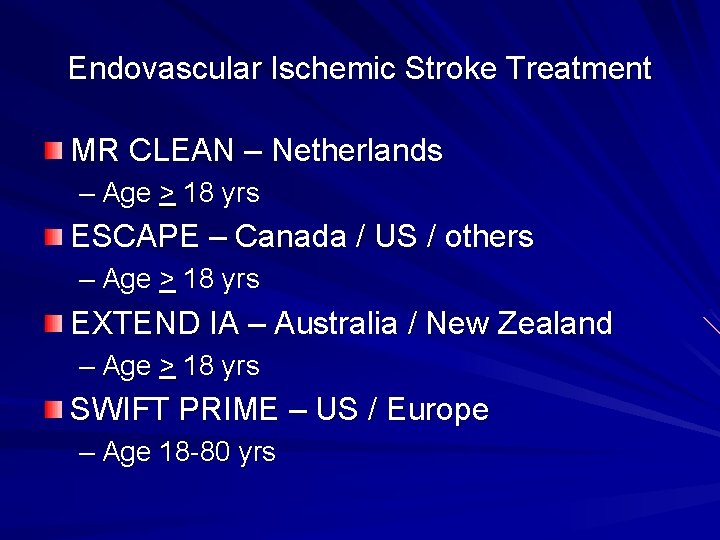
Endovascular Ischemic Stroke Treatment MR CLEAN – Netherlands – Age > 18 yrs ESCAPE – Canada / US / others – Age > 18 yrs EXTEND IA – Australia / New Zealand – Age > 18 yrs SWIFT PRIME – US / Europe – Age 18 -80 yrs
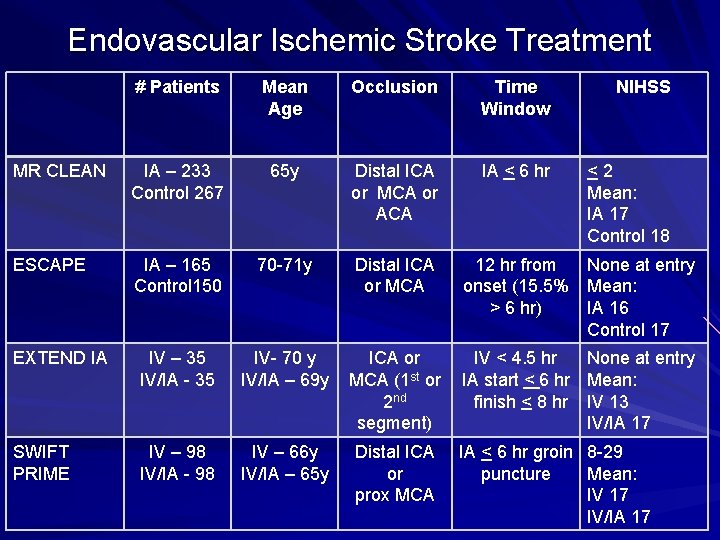
Endovascular Ischemic Stroke Treatment # Patients Mean Age Occlusion Time Window NIHSS MR CLEAN IA – 233 Control 267 65 y Distal ICA or MCA or ACA IA < 6 hr <2 Mean: IA 17 Control 18 ESCAPE IA – 165 Control 150 70 -71 y Distal ICA or MCA 12 hr from onset (15. 5% > 6 hr) EXTEND IA IV – 35 IV/IA - 35 IV- 70 y IV/IA – 69 y ICA or MCA (1 st or 2 nd segment) SWIFT PRIME IV – 98 IV/IA - 98 IV – 66 y IV/IA – 65 y Distal ICA or prox MCA None at entry Mean: IA 16 Control 17 IV < 4. 5 hr None at entry IA start < 6 hr Mean: finish < 8 hr IV 13 IV/IA 17 IA < 6 hr groin 8 -29 puncture Mean: IV 17 IV/IA 17
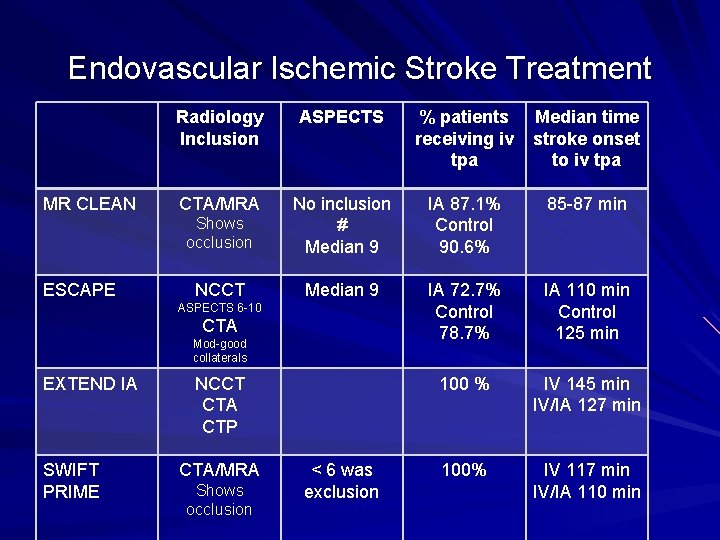
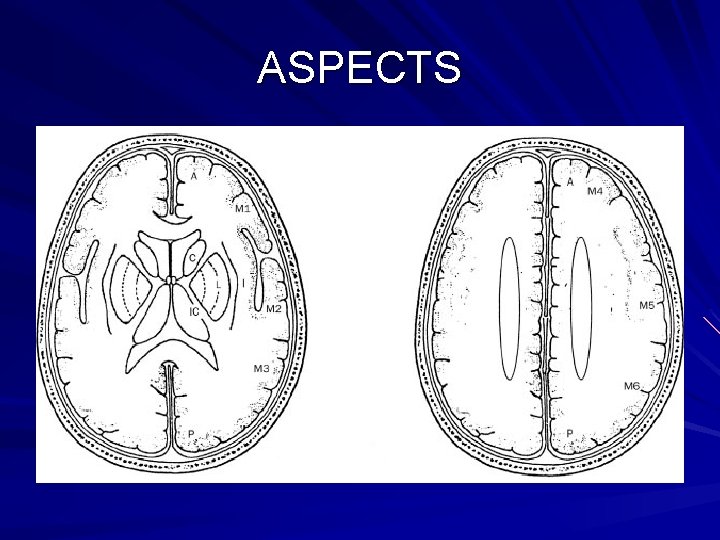
Endovascular Ischemic Stroke Treatment MR CLEAN ESCAPE Radiology Inclusion ASPECTS % patients receiving iv tpa Median time stroke onset to iv tpa CTA/MRA IA 87. 1% Control 90. 6% 85 -87 min Shows occlusion No inclusion # Median 9 NCCT Median 9 IA 72. 7% Control 78. 7% IA 110 min Control 125 min 100 % IV 145 min IV/IA 127 min 100% IV 117 min IV/IA 110 min ASPECTS 6 -10 CTA Mod-good collaterals EXTEND IA SWIFT PRIME NCCT CTA CTP CTA/MRA Shows occlusion < 6 was exclusion
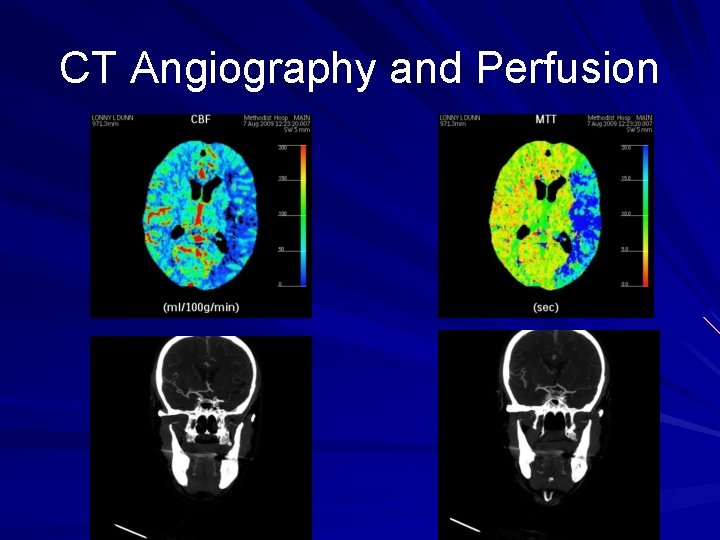
CT Angiography and Perfusion
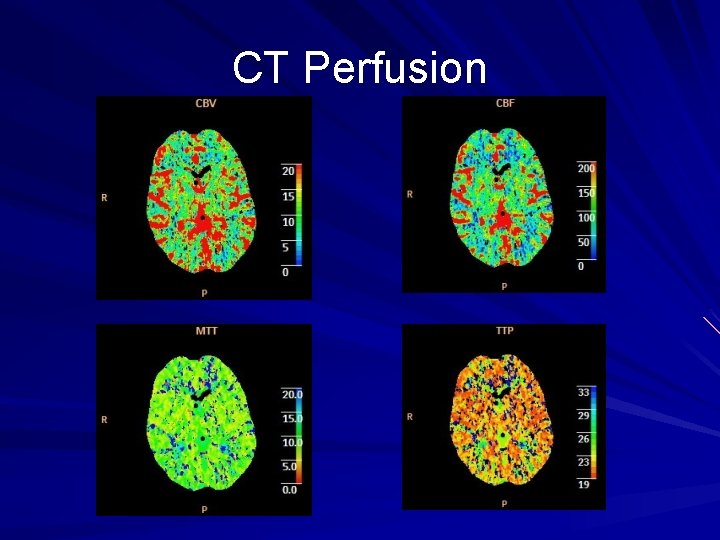
CT Perfusion
ASPECTS
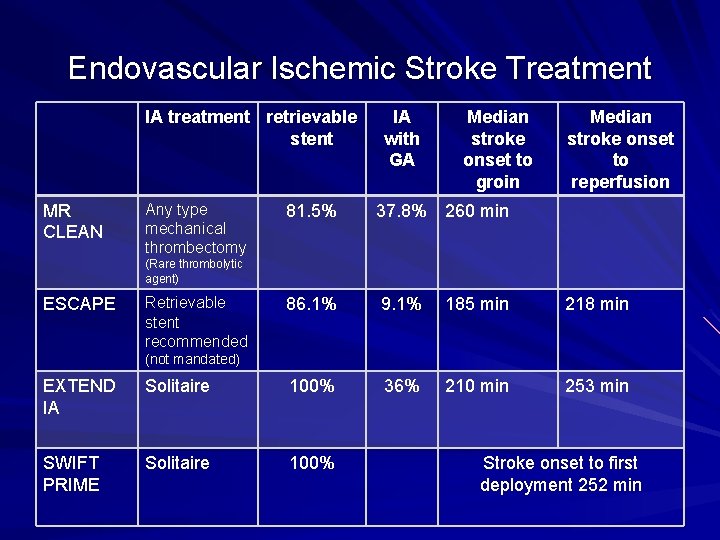
Endovascular Ischemic Stroke Treatment IA treatment retrievable stent MR CLEAN Any type mechanical thrombectomy IA with GA Median stroke onset to groin Median stroke onset to reperfusion 81. 5% 37. 8% 260 min 86. 1% 9. 1% 185 min 218 min 36% 210 min 253 min (Rare thrombolytic agent) ESCAPE Retrievable stent recommended (not mandated) EXTEND IA Solitaire 100% SWIFT PRIME Solitaire 100% Stroke onset to first deployment 252 min
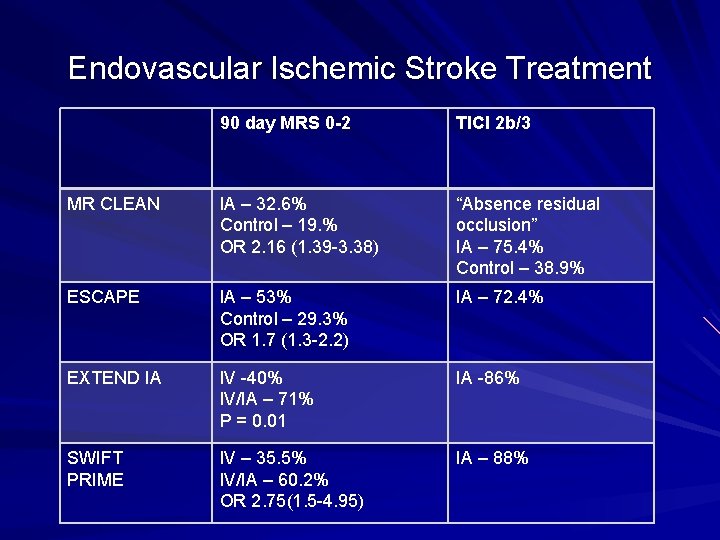
Endovascular Ischemic Stroke Treatment 90 day MRS 0 -2 TICI 2 b/3 MR CLEAN IA – 32. 6% Control – 19. % OR 2. 16 (1. 39 -3. 38) “Absence residual occlusion” IA – 75. 4% Control – 38. 9% ESCAPE IA – 53% Control – 29. 3% OR 1. 7 (1. 3 -2. 2) IA – 72. 4% EXTEND IA IV -40% IV/IA – 71% P = 0. 01 IA -86% SWIFT PRIME IV – 35. 5% IV/IA – 60. 2% OR 2. 75(1. 5 -4. 95) IA – 88%
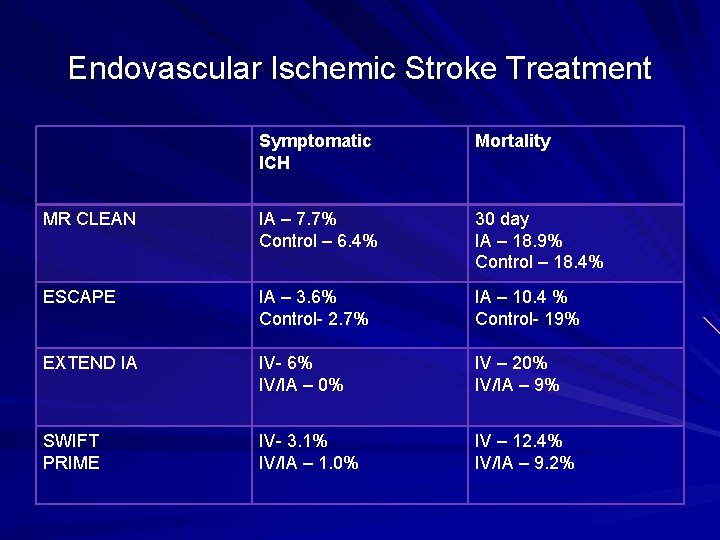
Endovascular Ischemic Stroke Treatment Symptomatic ICH Mortality MR CLEAN IA – 7. 7% Control – 6. 4% 30 day IA – 18. 9% Control – 18. 4% ESCAPE IA – 3. 6% Control- 2. 7% IA – 10. 4 % Control- 19% EXTEND IA IV- 6% IV/IA – 0% IV – 20% IV/IA – 9% SWIFT PRIME IV- 3. 1% IV/IA – 1. 0% IV – 12. 4% IV/IA – 9. 2%
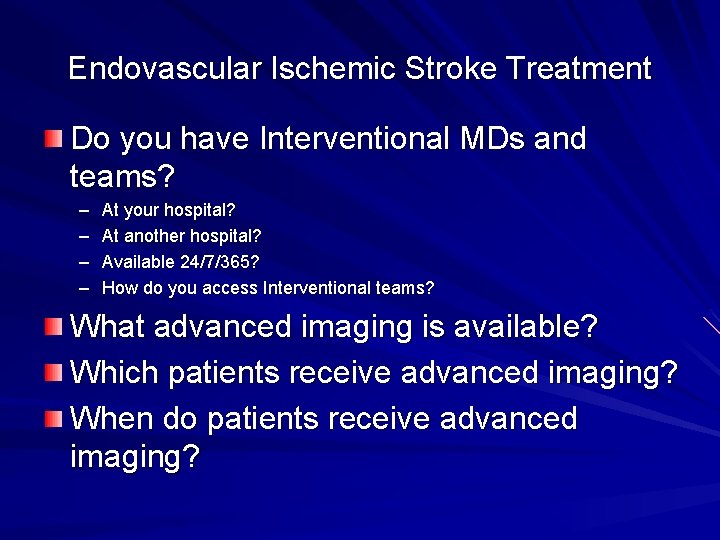
Endovascular Ischemic Stroke Treatment Do you have Interventional MDs and teams? – – At your hospital? At another hospital? Available 24/7/365? How do you access Interventional teams? What advanced imaging is available? Which patients receive advanced imaging? When do patients receive advanced imaging?
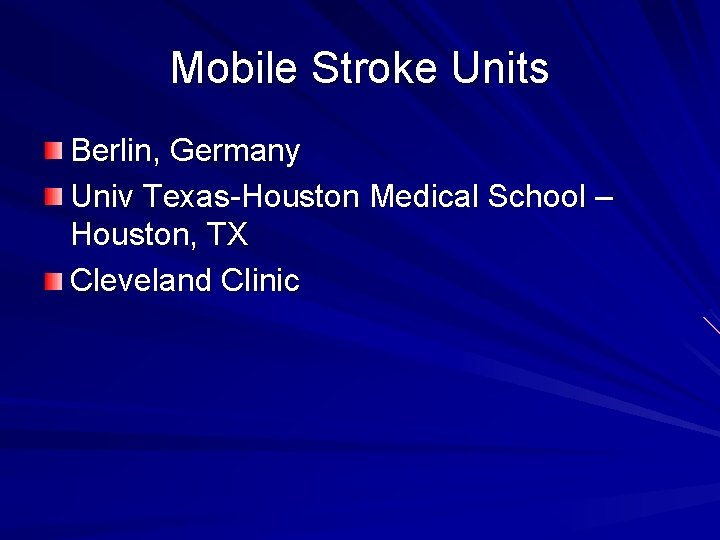
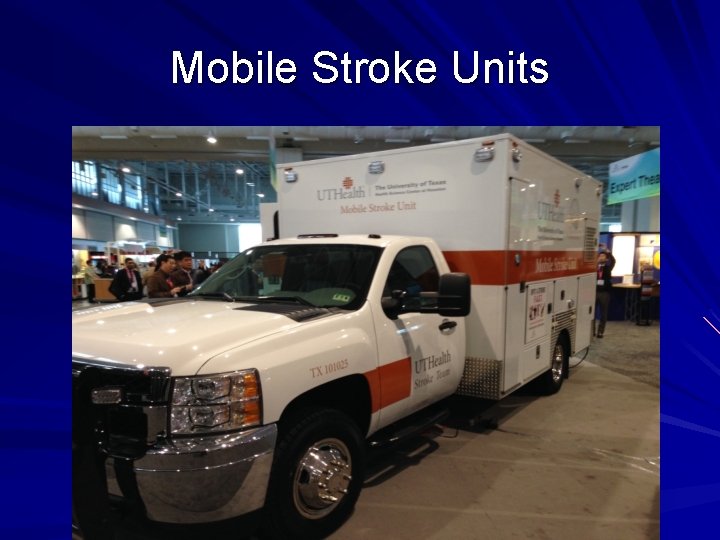
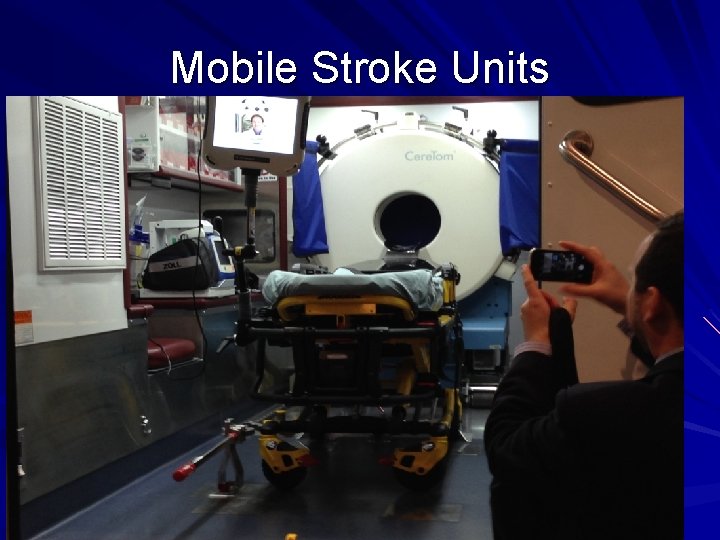
Mobile Stroke Units Berlin, Germany Univ Texas-Houston Medical School – Houston, TX Cleveland Clinic
Mobile Stroke Units
Mobile Stroke Units
Mobile Stroke Units PHANTOM –S – Prehospital Acute Neurological Treatment and Optimization of Medical Care in Stroke Study – Berlin Germany – STEMO – Stroke Emergency Mobile – JAMA 2014; 311: 1622 -1631
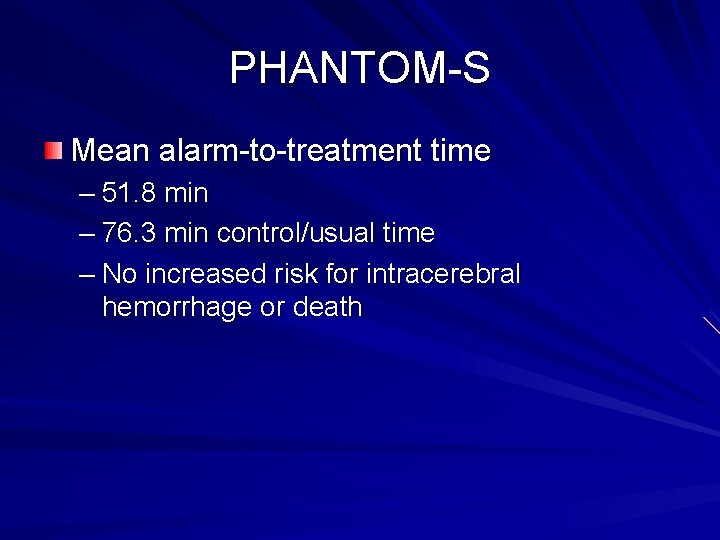
PHANTOM-S Mean alarm-to-treatment time – 51. 8 min – 76. 3 min control/usual time – No increased risk for intracerebral hemorrhage or death
Mobile Stroke Units Ambulance with CT scanner Ambulance personnel EMS organization Point-of-care labs Telemedicine connection Cost
Future of Stroke Care Organization – PSC and CSC – State laws requiring where patients receive care Neuroprotection – EMS deployment of meds Enhancing recovery and rehabilitation
Questions?