Louis Vuitton Market Entry Strategy RTW in South






- Slides: 15
Louis Vuitton Market Entry Strategy RTW in South Korea Group B-1, RSM MBA FT 2005 Mark Amritanand, Edo Avraham, Are Hofstad, Weiming Li, Kelly Pender, Stefan Salzer Strategy Management Rotterdam, 16. 04. 2004
Agenda Objective Global Luxury Goods Market Louis Vuitton Moët Hennessy (LVMH) The South Korean Opportunity Market Segmentation Competition South Korean Luxury Goods Market Louis Vuitton Analysis Conclusion Recommendations Group B 1 – Final Strategy Project MBA FT 2005, Semester II, 16. 04. 2004
Objective Whether or not Louis Vuitton should launch its women’s ready-to-wear (RTW) clothing line in South Korea. Currently, Louis Vuitton has eighteen retail locations in South Korea, carrying only its luggage, handbags, accessories, and shoes. Group B 1 – Final Strategy Project MBA FT 2005, Semester II, 16. 04. 2004
Global Luxury Goods Market Total market $66 bn in 2000; expected $75 bn in 2004 Gross margins for clothing approx. 70% Dominated by large luxury goods conglomerates Group B 1 – Final Strategy Project MBA FT 2005, Semester II, 16. 04. 2004
Luxury Goods Industry Trends Horizontal consolidation Reliance on one star brand Professional management Move away from licensing Investing in multi-million $ stores Recruiting international designers Democratization of fashion Group B 1 – Final Strategy Project MBA FT 2005, Semester II, 16. 04. 2004
Louis Vuitton Moët Hennessy Fashion & Leather Goods (14) – – – Louis Vuitton Fendi Kenzo – – – Moët & Chandon Dom Pérignon Hennessy Wines & Spirits (13) Perfumes & Cosmetics (10) – Guerlain – Parfums Christian Dior Watches & Jewelry (5) – Tag Heuer – Chaumet 33% of Revenue 66% of Profit! Selective Retailing (6) – DFS Duty-Free Stores – Le Bon Marché – e. LUXURY. com Other (2) – Media & publishing Group B 1 – Final Strategy Project MBA FT 2005, Semester II, 16. 04. 2004
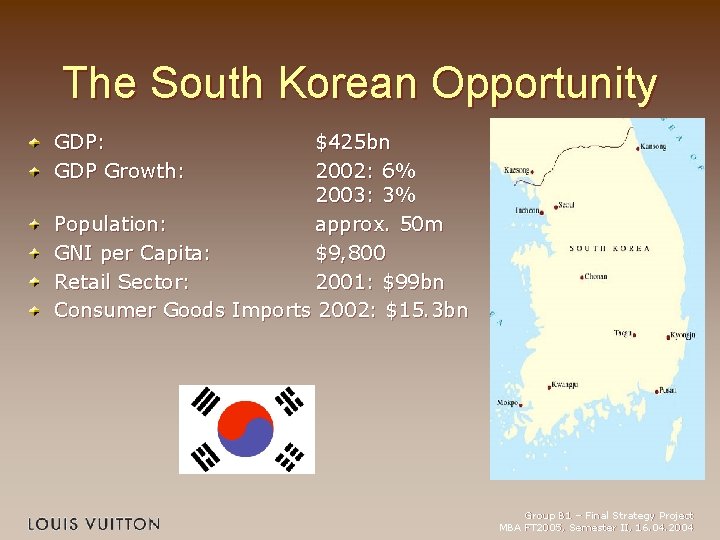
The South Korean Opportunity GDP: GDP Growth: $425 bn 2002: 6% 2003: 3% Population: approx. 50 m GNI per Capita: $9, 800 Retail Sector: 2001: $99 bn Consumer Goods Imports 2002: $15. 3 bn Group B 1 – Final Strategy Project MBA FT 2005, Semester II, 16. 04. 2004
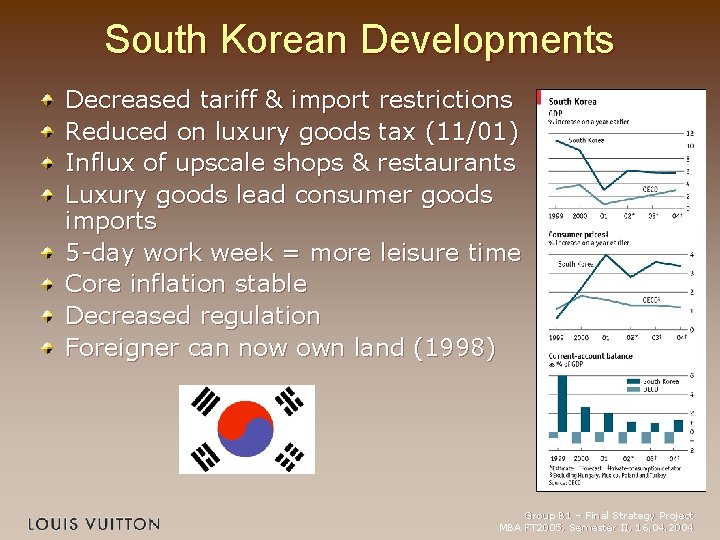
South Korean Developments Decreased tariff & import restrictions Reduced on luxury goods tax (11/01) Influx of upscale shops & restaurants Luxury goods lead consumer goods imports 5 -day work week = more leisure time Core inflation stable Decreased regulation Foreigner can now own land (1998) Group B 1 – Final Strategy Project MBA FT 2005, Semester II, 16. 04. 2004
Target Market Segment Women 25+ Early-adopter Urban Medium/High disposable income “LV sect” Grow along product lines In South Korea: Bohemian Bourgeois High-spending, brand conscious (Bo. Bos) Group B 1 – Final Strategy Project MBA FT 2005, Semester II, 16. 04. 2004
Competition Stores in SK FENDI Pricing 24 + 18 === 14 Main Strength Main Weakness Cross-Selling Allegra Beck Versace =/- Product Variety Giorgio Armani 12 + Privately Owned Couture Collection 11 + Jean Paul Gaultier Older Target Market 8 + PPR Ownership Tom Ford’s departure 8 + Holds 42% of LVMH Couture Collection 5 + LVMH Brand Higher Prices Group B 1 – Final Strategy Project MBA FT 2005, Semester II, 16. 04. 2004
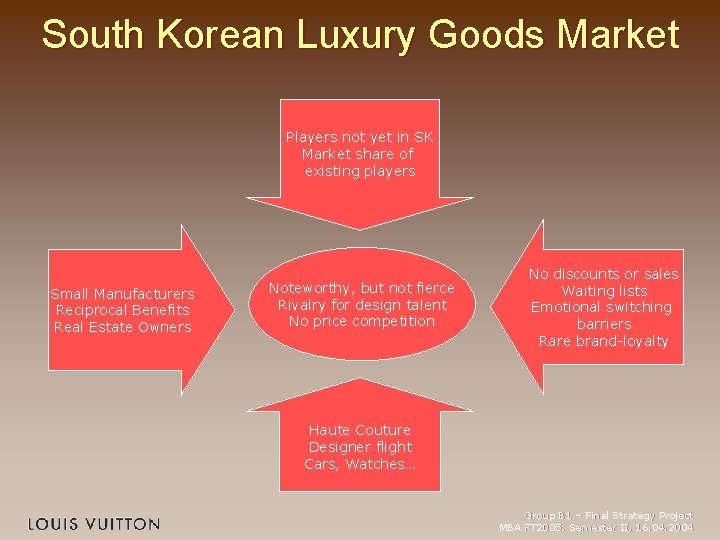
South Korean Luxury Goods Market Players not yet in SK Market share of existing players Small Manufacturers Reciprocal Benefits Real Estate Owners Noteworthy, but not fierce Rivalry for design talent No price competition No discounts or sales Waiting lists Emotional switching barriers Rare brand-loyalty Haute Couture Designer flight Cars, Watches… Group B 1 – Final Strategy Project MBA FT 2005, Semester II, 16. 04. 2004
Louis Vuitton SWOT Analysis EXTERNAL INTERNAL • Strong financials • 150 years of excellence • Existing presence in SK • Clothing not as wellknown as handbags • Risk of brand dilution • Marc Jacobs (designer) • Cross-sell from accessories SW OT • Most competitors don’t sell • Currency fluctuations in their own stores • Political instability • Strong SK economy • Democratization of fashion • LV brand already popular • Counterfeiting & grey • Young Bo. Bos target market • Marc Jacobs could leave Group B 1 – Final Strategy Project MBA FT 2005, Semester II, 16. 04. 2004
Conclusion Launch RTW Line in South Korea Expand into new market to fight mature markets in Eur. & N. Am. Complete distribution control in own stores Leverage existing store investments Grab mindshare before competitors Group B 1 – Final Strategy Project MBA FT 2005, Semester II, 16. 04. 2004
Recommendations Pilot Program 1. 2. 3. 4. 5. 6. 7. Launch in Seoul flagship store Market to Bo. Bos Cross-sell to existing customers Use competitive intelligence from DFS stores Evaluate results & roll-out nationwide Maintain brand exclusivity Knowledge transfer within LVMH to introduce conglomerate’s other brands Group B 1 – Final Strategy Project MBA FT 2005, Semester II, 16. 04. 2004
Any Questions ?